How to increase online presence: a UK business guide

TL;DR:
- Building a strong online presence involves optimizing your website, SEO, social media, and paid advertising as an interconnected system.
- Most UK businesses focus prematurely on social media without securing their website or Google Business Profile, risking loss of visibility.
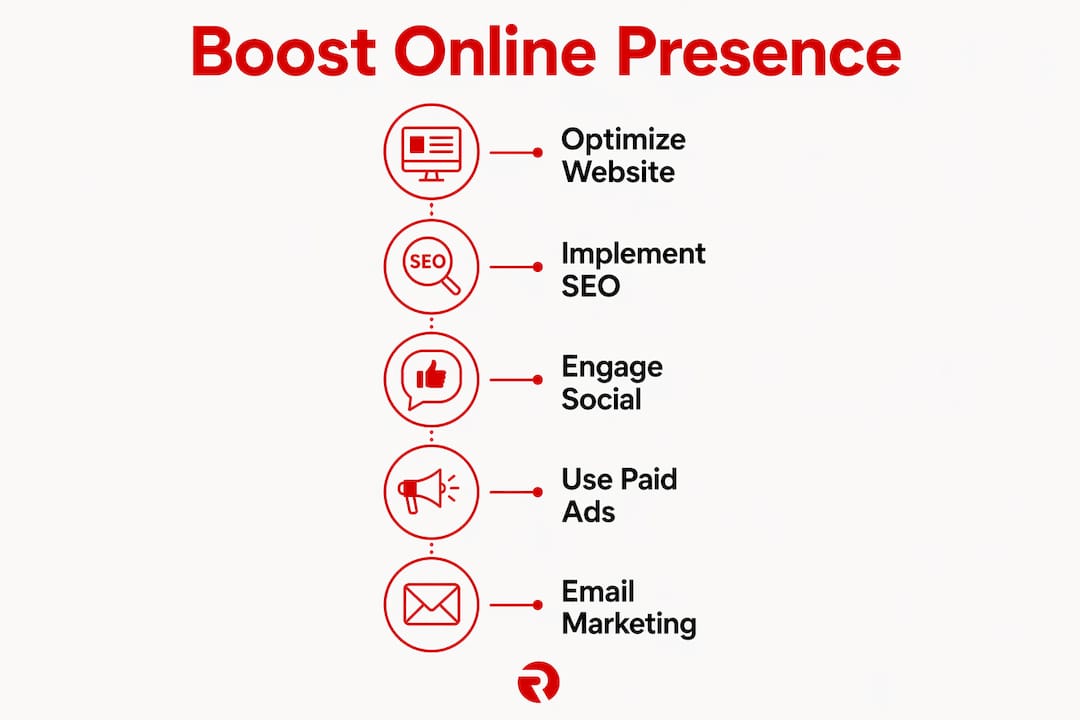
Online presence is the collective visibility, credibility, and engagement a business commands across digital platforms, and knowing how to increase online presence is one of the most direct levers UK entrepreneurs have for sustainable growth. The FSB calls SEO the “cornerstone” of a discoverable online presence, recommending a multi-channel approach that combines your website, search optimisation, social media, and paid advertising. This guide covers each of those channels in practical detail, with UK-specific compliance considerations included, so you can build a digital footprint that actually converts.
How to increase online presence through a strong website

Your website is the single asset you own outright in the digital world, and every other channel ultimately points back to it. WordStream highlights that a modern, mobile-friendly site with fast loading times and schema markup forms the technical bedrock of search visibility. Without it, every other effort you make, from social posts to paid campaigns, loses much of its impact.
Start with the fundamentals before worrying about content:
- Mobile-first design. Google indexes the mobile version of your site first. If your pages break on a phone screen, your rankings suffer regardless of how good your copy is.
- HTTPS security. An SSL certificate is a confirmed ranking signal and a trust indicator for visitors. Any site still running on HTTP in 2026 is leaving both rankings and conversions on the table.
- Core Web Vitals. Google measures Largest Contentful Paint, Interaction to Next Paint, and Cumulative Layout Shift. Failing these metrics pushes you down the results page even if your content is excellent.
- Schema markup. Structured data tells search engines exactly what your page contains, enabling rich results such as star ratings, FAQs, and event listings that increase click-through rates significantly.
- Clear site architecture. A logical menu structure with a submitted XML sitemap helps Google crawl every page. Orphaned pages, those with no internal links pointing to them, are effectively invisible to search engines.
Pro Tip: Register and fully complete your Google Business Profile. For UK businesses with a physical location or service area, this is often the fastest route to appearing in local search results and Google Maps, which FSB recommends as a priority alongside your main website.
How does SEO and content marketing expand your reach?
Search engine optimisation and content marketing work as a connected system. WordStream’s research confirms that website, SEO, blog content, and social channels reinforce each other, meaning a weakness in one area limits the performance of all the others. The practical implication is that you cannot treat blogging as optional if you want to grow organic search traffic.
Here is a structured approach to building SEO-driven content:
- Target long-tail and question keywords. Phrases like “accountant for freelancers in Manchester” or “how to register a limited company UK” have lower competition than broad terms and match the specific intent of buyers who are close to a decision.
- Optimise every on-page element. Each page needs a unique title tag, a compelling meta description, a single H1, and naturally placed keywords in subheadings and body copy.
- Publish a business blog consistently. Targeted blogging improves visibility by capturing “People also ask” results and long-tail queries that your homepage will never rank for.
- Build backlinks through guest posting. A single link from a respected UK trade publication or industry blog carries more authority than dozens of low-quality directory listings.
- Use internal linking deliberately. Link related posts and service pages to each other so that Google can understand the topical depth of your site and pass authority between pages.
Beyond the blog, repurpose your best-performing content. Similarweb advises transforming high-performing posts into videos, infographics, and email newsletters to reach audiences who consume content differently. A single well-researched article can become a LinkedIn carousel, a short-form video script, and a newsletter feature, tripling its reach without tripling your workload.
For a deeper look at how search optimisation connects to brand growth, the guide on SEO and brand awareness is worth reading alongside this one. You can also explore proven SEO strategies for UK businesses that Radkaadvertising has documented from working with clients across multiple sectors.
How to use social media to build genuine engagement
Social media is not a broadcast channel. It is a conversation, and the businesses that treat it as one consistently outperform those that simply push promotional content. Selecting the right platforms matters more than being everywhere at once. LinkedIn suits B2B services and professional consultancies. Instagram and TikTok work well for consumer brands, food businesses, and anything visually led. Facebook remains the dominant platform for local service businesses targeting adults over 35 in the UK.
Once you have chosen your platforms, the following practices separate accounts that grow from those that stagnate:
- Maintain a content calendar. Consistency signals credibility to both algorithms and audiences. Posting three times a week reliably beats posting ten times one week and going silent the next.
- Respond to every comment. Engagement rate, not follower count, determines how widely your content is distributed. A reply takes thirty seconds and tells the algorithm your post is worth showing to more people.
- Use keyword-rich profiles. Social media SEO involves embedding relevant keywords and niche or location-specific hashtags in your bio and posts to increase discoverability beyond your existing followers.
- Encourage user-generated content. A customer photo or testimonial shared on their own account reaches an entirely new audience at zero cost to you.
- Analyse platform analytics monthly. Most platforms show you which post formats, topics, and publishing times generate the most reach and saves. Use that data to refine your approach rather than guessing.
Pro Tip: Emotional and value-driven posts, those that teach something, make someone laugh, or tell a genuine story, consistently outperform purely promotional content in organic reach. Save the sales messaging for paid campaigns where you control the distribution.
What paid advertising strategies accelerate online visibility?
Paid advertising gives you immediate, targeted exposure in search results and social feeds while your organic SEO builds momentum. FSB and WordStream both identify paid search, retargeting, and social ads as key tactics for businesses that need traffic quickly rather than in six to twelve months.
The core paid channels worth understanding are:
- Google Ads (Search). Your ads appear when someone searches for your keywords. This is high-intent traffic because the person is actively looking for what you offer.
- Google Local Services Ads. Particularly effective for UK tradespeople, solicitors, and accountants. These appear above standard search results with a Google-verified badge.
- Facebook and Instagram Ads. Audience targeting by age, location, interests, and behaviour makes these platforms powerful for consumer brands and local businesses.
- LinkedIn Ads. More expensive per click than other platforms, but the ability to target by job title, company size, and industry makes it the most precise tool for B2B lead generation.
- Retargeting campaigns. These serve ads to people who have already visited your website, dramatically improving conversion rates because you are reaching a warm audience rather than cold prospects.
FSB details tracking click-through rates, cost per click, and conversions as the minimum performance metrics to monitor. Without this data, you are spending money without knowing what is working. Set up Google Analytics 4 and platform-specific conversion tracking before you spend a single pound on ads.
For UK businesses exploring how AI is reshaping paid and organic search together, the Radkaadvertising article on AI SEO strategies for 2026 covers the intersection in practical terms.
Email marketing, data privacy, and sustainable engagement
Email marketing is the most underused channel for UK small businesses, and it is the one channel where you own the relationship entirely. Unlike social media, where an algorithm change can halve your reach overnight, building an email list gives you direct access to your audience regardless of what any platform decides to do next.
However, email marketing in the UK operates under specific legal requirements that you cannot ignore:
- UK GDPR and PECR compliance. You must have a lawful basis for sending marketing emails. For most businesses, this means explicit consent. Pre-ticked boxes and implied consent do not meet the standard.
- ICO’s Direct Marketing Advice Generator. The ICO launched this free tool to help organisations understand their obligations quickly. Use it before you send a single campaign.
- Clear unsubscribe options. Every email must include a functioning unsubscribe link. Removing someone from your list within ten business days of their request is a legal requirement, not a courtesy.
- Data minimisation. Only collect the information you actually need. Asking for a date of birth when you only send a monthly newsletter creates unnecessary compliance risk.
Compliance with UK direct marketing regulations is non-negotiable for sustainable email marketing success and reputation protection.
Segment your list from the start. A subscriber who downloaded a guide on VAT returns has different needs from one who enquired about your bookkeeping services. Sending the same email to both reduces engagement and increases unsubscribe rates. Platforms such as Mailchimp and Klaviyo make basic segmentation straightforward even for small lists.
Key takeaways
A strong online presence requires your website, SEO, social media, paid advertising, and email marketing to work as a single connected system rather than isolated tactics.
| Point | Details |
|---|---|
| Website is the foundation | Mobile-first design, HTTPS, Core Web Vitals, and schema markup are non-negotiable starting points. |
| SEO and content compound over time | Consistent blogging targeting long-tail keywords builds authority that paid ads cannot replicate. |
| Social media rewards consistency | A regular posting schedule and genuine engagement outperform sporadic high-volume activity. |
| Paid ads accelerate, not replace, organic growth | Use Google Ads and social advertising to generate immediate traffic while SEO builds momentum. |
| Email marketing is your most resilient channel | A consent-based, segmented email list gives you direct audience access that no algorithm can remove. |
Why I think most UK businesses are building their online presence back to front
Most businesses I work with arrive having spent months on social media before they have sorted their website or claimed their Google Business Profile. That is the wrong order entirely. Social media is borrowed land. You build an audience on someone else’s platform, subject to their rules, their algorithm, and their monetisation decisions. I have seen businesses lose half their organic reach overnight because a platform updated how it ranks content. The ones who weathered it had email lists and strong organic search rankings to fall back on.
The other mistake I see constantly is treating paid advertising as a substitute for SEO rather than a complement to it. Ads stop the moment your budget runs out. A well-optimised page can generate enquiries for years. The businesses that grow most reliably are the ones that invest in SEO and content first, use paid ads to accelerate specific campaigns, and build an email list from day one. That combination, documented in the UK entrepreneur’s digital strategy guide, is what creates a presence that compounds rather than one that requires constant spending to maintain.
Patience is genuinely required for organic growth. Three months of consistent blogging and on-page SEO work rarely produces dramatic results. Six to twelve months of it, done properly, usually does. Set realistic milestones, measure the right metrics, and resist the temptation to abandon a strategy because it has not produced results in six weeks.
— Bart
How Radkaadvertising helps UK businesses grow their digital presence
Radkaadvertising is a London-based full-service agency that works with UK entrepreneurs and established brands on the exact challenges covered in this guide. From technical SEO audits and content strategy to Google Ads management and social media campaigns, the agency brings a data-driven approach to every channel. If you are unsure where your current digital presence is losing ground, a website and marketing audit is the clearest starting point. It identifies the gaps before you spend budget in the wrong places. For businesses ready to move forward with professional support, the client onboarding process at Radkaadvertising is designed to get campaigns live quickly and measure results from the outset.
FAQ
What does online presence actually mean for a business?
Online presence is the sum of all the places your business can be found and engaged with digitally, including your website, search rankings, social media profiles, and directory listings. The stronger and more consistent that presence is, the more credible and discoverable you appear to potential customers.
How long does it take to improve digital presence through SEO?
SEO typically produces measurable improvements in rankings and organic traffic within three to six months of consistent effort, with more significant results appearing at the six to twelve month mark. Paid advertising can generate traffic immediately while organic results build.
Which social media platform is best for UK businesses?
The right platform depends on your audience. LinkedIn suits B2B and professional services, Instagram and TikTok work for visually led consumer brands, and Facebook remains effective for local service businesses targeting adults. Focus on one or two platforms well rather than spreading effort thinly across all of them.
Is email marketing still effective for growing an online presence?
Email marketing remains one of the highest-return channels available, and it is the only one where you own the audience relationship outright. Building a consent-based, segmented list protects your business from social media algorithm changes and gives you a direct line to your most engaged customers.
What are the UK legal requirements for email marketing?
UK businesses must comply with both UK GDPR and PECR when sending marketing emails, which means obtaining explicit consent before contacting individuals. The ICO’s free Direct Marketing Advice Generator helps businesses understand their specific obligations and avoid fines.