Boost brand recognition: strategies for 2026

TL;DR:
- Brand recognition in 2026 depends on a coordinated, evidence-backed system that adapts to AI-driven discovery and fragmented channels.
- Building a strong foundation involves maintaining consistent messaging, active platform presence, and tracking metrics from the outset.
- Ongoing, strategic efforts across digital, PR, and AI-era visibility are essential for lasting brand recognition and competitive advantage.
Brand managers today face a brutal paradox: a stronger product than ever, yet a shrinking share of attention. Audiences are fragmented across more channels than any single campaign can cover, and AI-driven discovery is quietly reshaping which brands get seen and which get skipped entirely. The old playbook of a well-placed advert and a catchy tagline no longer guarantees recall. What does work is a coordinated, evidence-backed system that builds recognition consistently, measures it honestly, and adapts to the shifting landscape of how people find brands in 2026.
Table of Contents
- Setting the foundation for brand recognition success
- Executing coordinated branding initiatives across channels
- Measuring and verifying brand recognition
- Expanding visibility: brand recognition in the age of AI
- Our perspective: the layered reality of brand recognition in 2026
- Next steps: connect your brand with expert support
- Frequently asked questions
Key Takeaways
| Point | Details |
|---|---|
| Always-on system | Treat brand recognition as a continuous, cross-channel effort for lasting results. |
| Measure what matters | Track a portfolio of recognition metrics to get a true sense of brand impact. |
| Optimise for AI | Brand visibility in 2026 expands to AI-generated answers beyond just search and social platforms. |
| Consistent messaging | Uniform messaging across platforms boosts both aided and unaided brand recall. |
| Expert support available | Specialist agencies can help coordinate branding initiatives and accelerate visibility. |
Setting the foundation for brand recognition success
Before you launch your next campaign, you need to be honest about what is already in place. Brand recognition does not begin with a social media post or a press release. It begins with a foundation: documented guidelines, a clear messaging toolkit, and an active presence on the platforms your audience actually uses.
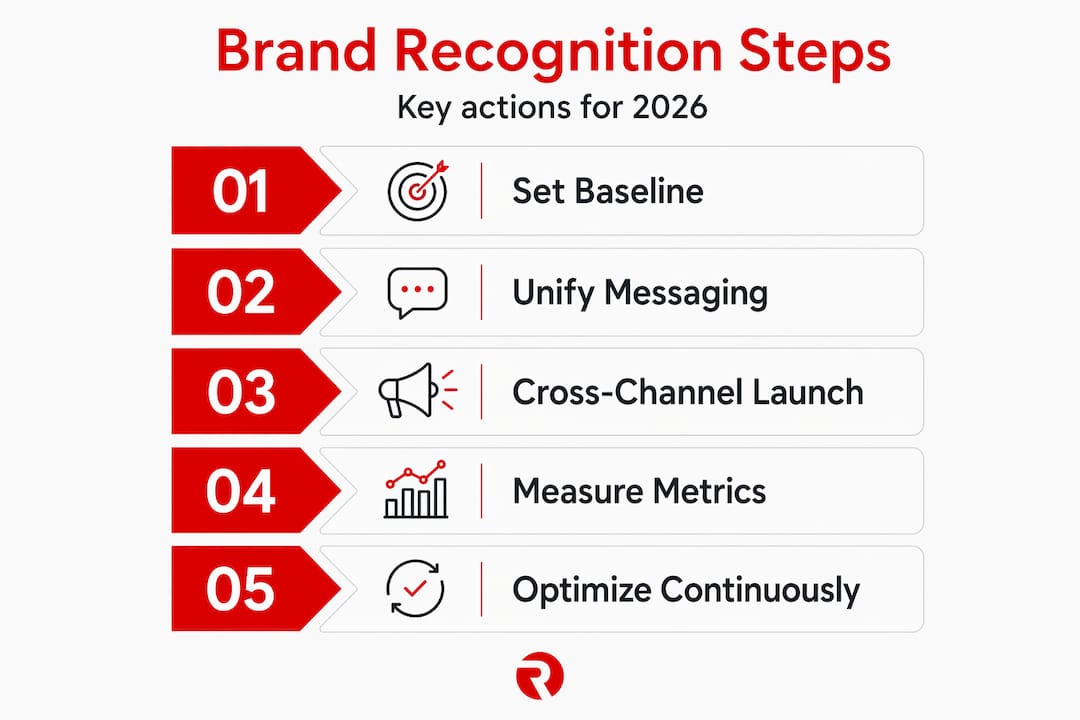
The most common mistake brands make is treating recognition as a project with a start and end date. It is not. Brand awareness strategy works best when you treat it as an always-on, cross-channel system with consistent messaging and coordinated execution. That means your tone of voice in a LinkedIn post should feel like the same brand a prospect encounters on your website, in an email newsletter, or during an in-person event.
Key foundational elements every brand needs:
- A living brand guidelines document covering logo usage, typography, colour palette, and tone of voice
- A messaging toolkit with pre-approved copy for headlines, taglines, and value propositions
- Platform presence audit: active and optimised profiles on the channels your target audience frequents
- A content calendar that coordinates activity across channels rather than siloing them
The table below compares how brands of different sizes can approach cross-channel readiness:
| Brand size | Priority channels | Minimum content cadence | Core asset needed |
|---|---|---|---|
| Early-stage startup | LinkedIn, website, email | Weekly | Brand guidelines |
| Growth-stage brand | LinkedIn, Instagram, PR, paid | 3 times per week | Messaging toolkit |
| Established brand | All digital, PR, OOH, events | Daily | Integrated campaign calendar |
| Enterprise | Full omnichannel | Real-time | Centralised brand governance |
The cross-channel marketing impact of coordinated activity compounds over time. A brand that shows up consistently across touchpoints builds what marketers call “processing fluency”: the ease with which an audience recognises and trusts a brand on contact.

One often underestimated element is tracking brand metrics from the outset. Without baseline data on awareness and recall, you cannot know whether your foundation-building efforts are working. Equally, media coverage strategies should be built into your planning from day one, not bolted on after a campaign launches.
Pro Tip: Create a messaging “playbook” — a short internal reference document (no more than two pages) that any team member or agency partner can use to ensure every piece of content stays on-brand. Include approved phrases, banned words, and examples of good and poor usage.
Executing coordinated branding initiatives across channels
With your foundation in place, the next challenge is execution. A common failure point is treating digital, PR, and creative as separate workstreams that happen to share a brand logo. Coordinated branding means these functions inform and amplify each other deliberately.
Here is a practical step-by-step process for launching a coordinated brand recognition campaign:
- Define a central campaign idea. Every asset, from a paid social ad to a press release, should connect back to a single, clear narrative. This is your campaign’s “north star” messaging.
- Map your channels and their roles. Decide which channels drive awareness (paid social, PR, display), which drive consideration (content marketing, email, SEO), and which drive conversion (landing pages, retargeting).
- Brief all creators from the same document. Whether you use in-house designers, external copywriters, or a specialist agency, everyone should work from the same creative brief and messaging toolkit.
- Stagger your launch for maximum reach. A simultaneous blast can burn out quickly. Instead, sequence your activity: build anticipation, launch with impact, then sustain with follow-up content.
- Monitor in real time and iterate. Use a shared dashboard so your team can see performance across channels and adjust messaging or spend without waiting for a monthly report.
Strategic media coverage plays a particularly powerful role in coordinated campaigns. A well-placed feature in a trade publication not only reaches its direct readership — it generates social shares, SEO backlinks, and a credibility signal that paid advertising simply cannot replicate. Research on channel integration tips confirms that multi-channel integration consistently outperforms single-channel pushes in building both aided and unaided recall.
Critical coordination warning: Campaigns that run without a shared calendar and central brief frequently result in contradictory messaging. One team pushing a “premium quality” narrative while another runs a discount promotion can permanently damage the brand positioning you have worked hard to build.
Pro Tip: Use a campaign calendar tool that is visible to all stakeholders, including your agency partners. Colour-code by channel so any scheduling conflict or content gap is immediately obvious, weeks before it becomes a problem.
Measuring and verifying brand recognition
Execution without measurement is expensive guesswork. Brand recognition is one of the most misunderstood metrics in marketing, partly because many teams default to vanity metrics — follower counts, impressions, raw reach — that feel meaningful but tell you very little about actual recognition.
The right approach is to measure brand awareness using a portfolio of metrics, including aided and unaided recall, branded search volume, share of voice, and direct traffic, rather than relying on any single number.
Recommended metrics for a brand recognition portfolio:
- Unaided recall: Surveyed customers name your brand unprompted when asked about a product category
- Aided recall: Surveyed customers confirm they recognise your brand when shown your name or logo
- Branded search volume: The number of times users search specifically for your brand name in a given period
- Share of voice: Your brand’s proportion of total online conversation or advertising within your category
- Direct traffic: Website visitors who type your URL directly, indicating strong brand memory
- Social mentions: Unprompted brand mentions across social platforms, indicating organic recognition
The table below compares commonly used measurement tools against key criteria:
| Tool | Measures | Best for | Cost indication |
|---|---|---|---|
| Google Search Console | Branded search volume | All brand sizes | Free |
| Brandwatch | Share of voice, social mentions | Mid to enterprise | Paid |
| SurveyMonkey/Pollfish | Aided and unaided recall | Quarterly surveys | Low to mid |
| SEMrush | Branded keyword trends, share of voice | Growth to enterprise | Paid |
| Google Analytics 4 | Direct traffic, branded referrals | All brand sizes | Free |
Interpreting these metrics together is where skill comes in. A brand might see strong aided recall but low unaided recall, suggesting the brand is familiar but not truly “top of mind.” That gap points to a frequency problem: the brand needs more touchpoints. Conversely, high branded search with low direct traffic may indicate that people remember the name but feel less motivated to return without a specific prompt.
Connecting your measurement data to your broader brand analysis tools creates a feedback loop: each campaign improves because it is informed by the last one.
Expanding visibility: brand recognition in the age of AI
Something genuinely new has entered the brand recognition equation in 2026. AI-driven platforms — from conversational search tools to recommendation engines embedded in apps — are now shaping which brands people encounter before they have even formed a search query.
Brand visibility now includes AI-generated discovery, meaning your brand needs presence not only in search results and social feeds but also in the answers generated by AI tools when a user asks a relevant question. If your brand is consistently absent from these generated responses, you are invisible to a growing segment of your audience.
This changes the nature of visibility work. Traditional SEO was built around keywords, backlinks, and page authority. AI systems may use a different signal set entirely: entity recognition, structured data, citation patterns across authoritative sources, and brand mentions within trusted content.
Actions to boost brand visibility in the AI era:
- Build entity authority: Ensure your brand is accurately and consistently represented across Wikipedia, Wikidata, LinkedIn, and other structured data sources that AI systems draw upon
- Generate authoritative third-party mentions: Earn coverage in publications that AI systems recognise as credible; this includes trade press, well-regarded digital media, and professional directories
- Use structured data markup: Implement schema markup on your website so AI crawlers can accurately interpret your brand, products, and services
- Create content that directly answers questions: AI-generated answers often draw from content that clearly and concisely addresses specific user questions — format your content accordingly
- Monitor AI outputs for your brand: Regularly query AI tools with category questions to see whether and how your brand appears in generated responses
Estimates suggest that AI-driven brand discovery is already influencing a significant proportion of initial brand discovery moments across B2B and B2C categories. Brands that wait to adapt risk ceding ground to competitors who are building AI-era visibility right now.
Our perspective: the layered reality of brand recognition in 2026
Most articles about brand recognition will tell you to be consistent, show up often, and measure your results. That advice is correct. But it is also incomplete in a way that can genuinely hurt ambitious brands if they follow it too literally.
The uncomfortable truth we have observed working with brands across multiple sectors is this: brand recognition is not a static achievement you reach and then maintain. It is a dynamic, layered process that requires constant recalibration as the environment around you shifts. A brand that was highly visible three years ago on the basis of strong SEO and a solid Instagram presence may find itself surprisingly invisible today, because the signals that drive discovery have quietly moved on.
“Visibility is now a dynamic algorithmic asset — not a fixed position on a leaderboard.”
Traditional SEO improvements may no longer be sufficient if AI systems decide recommendations using a different signal set than classic search engines. We have seen brands with excellent domain authority and high organic rankings find themselves absent from AI-generated answers in their category. The reason is not that their SEO is poor — it is that AI systems are drawing on entity graphs, citation networks, and structured data in ways that bypass traditional ranking factors entirely.
The practical lesson is to treat brand visibility as broader than search rankings. Your brand’s presence in authoritative third-party sources, your entity accuracy across data repositories, and your representation within AI-generated responses are all now legitimate brand recognition channels. Brand visibility case examples from our own client work confirm that brands which invest in earned media and structured brand authority alongside conventional SEO significantly outperform those that focus exclusively on search rankings.
Pro Tip: Set a quarterly reminder to query three or four key category questions in at least two major AI tools. Record whether your brand appears, in what context, and how accurately it is described. Use this as an early warning system for recognition gaps in AI-generated discovery.
Ultimately, the brands that will lead in 2026 and beyond are those who treat recognition as a strategic, ongoing programme rather than a campaign outcome. That shift in mindset is the most important thing we can offer you.
Next steps: connect your brand with expert support
Building durable brand recognition across channels, creative execution, and AI-era visibility is a significant undertaking. If you are ready to accelerate this work, Radka Advertising provides specialist support designed for brands that need results, not just reports. Explore our media coverage packages to build authoritative third-party presence, or begin with our structured support for onboarding process to align your brand strategy before any creative work begins. You can also browse our case studies to see how we have driven recognition for brands across multiple industries. The gap between a recognised brand and an overlooked one is often smaller than you think — it simply requires the right strategy and the right partner.
Frequently asked questions
How do I measure brand recognition accurately?
To measure brand recognition accurately, use a portfolio of metrics including aided and unaided recall, branded search volume, share of voice, and direct traffic to your website, rather than relying on a single number.
What is the difference between aided and unaided recall for brand recognition?
Aided recall measures whether people recognise your brand when they are prompted with your name or logo, whereas unaided recall shows whether your brand comes to mind spontaneously when a category is mentioned. Both are measured through surveys and give different strategic insights.
Why is cross-channel consistency important for brand recognition?
Consistent messaging across channels compounds visibility and makes your brand more memorable. Research confirms that always-on, cross-channel execution with coordinated messaging significantly outperforms fragmented, single-channel approaches in building lasting brand recall.
How does AI-generated discovery affect brand recognition in 2026?
AI-driven platforms now shape initial discovery moments, so brands must optimise not just for search engines but also for presence in AI-generated answers — through entity authority, structured data, and earned coverage in credible third-party sources.
Can promotional products improve brand recognition?
Yes, branded physical items are proven to increase aided and unaided recall across multiple marketing channels, making them a cost-effective complement to digital brand recognition strategies.