Boost your UK business with proven SEO strategies

TL;DR:
- Most UK business owners expect quick SEO results like paid ads, but SEO requires months to develop genuine visibility.
- Focusing on technical, on-page, and off-page SEO pillars consistently builds lasting authority and better search rankings over time.
Most UK business owners expect SEO to behave like paid advertising: spend today, see results tomorrow. That expectation sets them up for frustration. SEO typically takes months to show meaningful results, and the businesses that treat it as a long-term investment are the ones that eventually dominate their market. This article breaks down exactly how SEO works, gives you a practical roadmap anchored in the UK market, and shows you the steps to build genuine, lasting visibility for your brand.
Table of Contents
- Understanding SEO fundamentals for UK businesses
- Laying a solid technical SEO foundation
- On-page optimisation: Content, keywords and user value
- Authority-building and off-page SEO
- Tracking, measuring, and iterating your SEO strategy
- What most UK business owners get wrong about SEO
- Partner with experts for lasting SEO results
- Frequently asked questions
Key Takeaways
| Point | Details |
|---|---|
| SEO is a long-term investment | Expect to see real results over months, not days, as search engines gradually respond to changes. |
| Start with technical basics | Ensuring your site is indexable, fast, and error-free lays the groundwork for SEO success. |
| Prioritise UK user needs | Target keywords and create content that matches British search intent and local interest. |
| Authority and trust drive rankings | Genuine backlinks, reviews, and third-party signals improve your business’s standing in search. |
| Measure and refine continually | Tracking your performance and updating your strategy regularly leads to ongoing gains. |
Understanding SEO fundamentals for UK businesses
Search engine optimisation is not one thing. It is a collection of disciplines that, when applied together, signal to Google and other search engines that your website deserves to rank prominently for relevant queries. For UK businesses, SEO and UK brand growth are tightly linked because British consumers increasingly begin their buying journey with an organic search rather than a branded one.
The three core pillars are:
- Technical SEO: Ensures your website can be crawled, indexed, and understood by search engines. This includes site speed, mobile responsiveness, structured data, and canonical tags.
- On-page SEO: Covers the content and HTML elements on each page. Think metadata, headings, keyword placement, internal linking, and the overall relevance of your copy to a user’s query.
- Off-page or authority-building SEO: Relates to signals generated outside your website, such as backlinks from reputable sources, local citations, and online reviews.
A practical approach for UK SMEs is to combine all three pillars rather than obsessing over one at the expense of the others. Consider a small independent bookshop in Bristol. They might invest in great on-page content about rare first editions, but if their website takes seven seconds to load on mobile, Google will deprioritise them regardless. The pillars reinforce one another.
“SEO is not a sprint. It is infrastructure. The brands that build it properly benefit from compounding visibility that paid media can never replicate.”
Pro Tip: If you are starting from scratch and have limited time, begin with technical SEO. No amount of great content will rank well on a broken or slow website.
Laying a solid technical SEO foundation
Understanding the concept is one thing. Putting it into practice is another. Technical SEO is the bedrock of everything that follows, and neglecting it is one of the most common and costly mistakes UK business owners make.
Here is a stepwise guide to getting your technical foundation right:
- Set up Google Search Console. This free tool from Google gives you direct insight into how the search engine sees your website. It surfaces crawl errors, indexing issues, and Core Web Vitals scores. Google Search Console coverage data helps you identify which pages are actually indexed and which are being blocked or ignored.
- Review your indexation. Go to the Coverage or Indexing report in Search Console and look for pages marked as “Excluded” or “Error.” These are pages Google cannot or will not show in results.
- Check your Core Web Vitals. These are Google’s page experience metrics: Largest Contentful Paint (how fast the main content loads), Interaction to Next Paint (responsiveness), and Cumulative Layout Shift (visual stability). Poor scores directly affect your rankings.
- Audit your site structure. Make sure your most important pages are no more than three clicks from the homepage. A flat, logical structure helps both users and search engines navigate efficiently.
- Implement canonical tags correctly. If you have duplicate or near-duplicate pages, canonical tags tell Google which version to prioritise. This is especially important for e-commerce sites with product variations.
| Technical SEO task | Impact on rankings | Recommended tool |
|---|---|---|
| Fixing crawl errors | High | Google Search Console |
| Improving Core Web Vitals | High | PageSpeed Insights |
| Implementing canonical tags | Medium to high | Search Console, Screaming Frog |
| Submitting an XML sitemap | Medium | Google Search Console |
| Mobile responsiveness audit | High | Google’s Mobile-Friendly Test |
| Structured data markup | Medium | Schema.org, Rich Results Test |
Learning more about SEO basics for brands will help you prioritise which tasks to tackle first based on the size and complexity of your site.
Pro Tip: When resources are tight, focus your canonical and indexing attention on your highest-value pages first: your homepage, core service or product pages, and any content that already generates some traffic. These pages deliver the greatest return when fixed.
On-page optimisation: Content, keywords and user value
Once your technical foundation is solid, the next layer is ensuring every page on your site is doing real work. On-page SEO is about crafting content and page elements that align with what your target audience is actually searching for, using language that reflects UK search behaviour.
The essential on-page elements every UK business owner should audit include:
- Title tags and meta descriptions: These appear in search results and heavily influence click-through rates. Each page should have a unique, descriptive title tag under 60 characters and a compelling meta description under 160 characters.
- H1 and subheadings: Every page needs a clear H1 that reflects the primary keyword. Subheadings (H2, H3) help both readers and search engines understand page structure.
- Keyword placement: Use your target keyword naturally in the first 100 words of the page, in the title tag, and in at least one subheading. Avoid forcing it unnaturally.
- Internal linking: Connect related pages on your site. This distributes authority and keeps users engaged longer, which sends positive behavioural signals to Google.
- Content depth and relevance: A 300-word page rarely ranks for competitive terms. Aim for thorough, genuinely helpful content that addresses the full range of questions your audience has around a topic.
For UK business owners starting with SEO fundamentals, keyword research should be tied directly to UK search behaviour. This means using tools like Google Keyword Planner or Ahrefs to find terms your British customers actually type, including localised phrasing like “plumber near me in Manchester” or “best accountant London.”
| Approach | Single metadata for all pages | Unique metadata per page |
|---|---|---|
| Click-through rate | Lower, less relevant to specific queries | Higher, tailored to user intent |
| Indexing quality | Risk of duplicate content signals | Clear, distinct signals per URL |
| Local relevance | Generic, misses regional nuance | Can target city or region-specific searches |
| Maintenance burden | Lower initially | Higher, but delivers better results |
| Recommended for | Very small, single-service sites | Multi-location or multi-service businesses |

Following UK branding best practices alongside your on-page work ensures your messaging stays consistent and compelling across every touchpoint, not just search engines.
Statistic spotlight: Optimising meta descriptions and title tags to better reflect search intent can increase organic click-through rates significantly. Studies suggest well-crafted metadata can improve CTR by 20 to 30 percent for competitive terms, making it one of the highest-return low-effort tasks in SEO.
Authority-building and off-page SEO
Getting your technical and on-page elements right earns you the right to compete. Genuine competitive advantage, however, comes from authority. In Google’s eyes, authority is primarily built through what other credible websites say about yours.
The key drivers of off-page authority for UK businesses include:
- Backlinks from relevant, reputable sources: A link from a well-regarded UK trade publication carries far more weight than dozens of links from irrelevant directories. Quality over quantity is not a cliché here. It is a ranking reality.
- Local citations: Consistent mentions of your business name, address, and phone number (NAP) across directories like Yell, Thomson Local, and Google Business Profile strengthen your local search presence.
- Online reviews: Positive, detailed reviews on Google, Trustpilot, and industry-specific platforms build trust with both users and search algorithms.
- Social signals and brand mentions: While not direct ranking factors, they increase your content’s reach and the likelihood of earning natural backlinks.
A practical SEO approach for UK SMEs treats off-page SEO as relationship-building, not link-building. Reach out to complementary businesses, local chambers of commerce, or industry bloggers and offer something genuinely useful, whether that is an expert quote, a guest post, or a collaborative resource.
“The most durable backlinks come from people who find your content so valuable they want to share it. Creating that content requires understanding your audience better than anyone else in your niche.”
Common mistakes UK business owners make in this area include purchasing links from irrelevant foreign directories, participating in link exchange schemes that Google actively penalises, and failing to correct incorrect NAP data across listings. These shortcuts do not just fail to help. They actively harm your rankings. Part of optimising your marketing workflow is building repeatable systems for outreach and citation management so authority grows steadily over time.
Pro Tip: Start your authority-building locally. Sponsor a community event, get listed in your local council business directory, and ask satisfied customers to leave detailed Google reviews. These signals are especially powerful for businesses targeting regional customers.
Tracking, measuring, and iterating your SEO strategy
A strategy without measurement is just guesswork. Once your SEO efforts are in motion, you need a clear system for understanding what is working, what is not, and where to focus next.
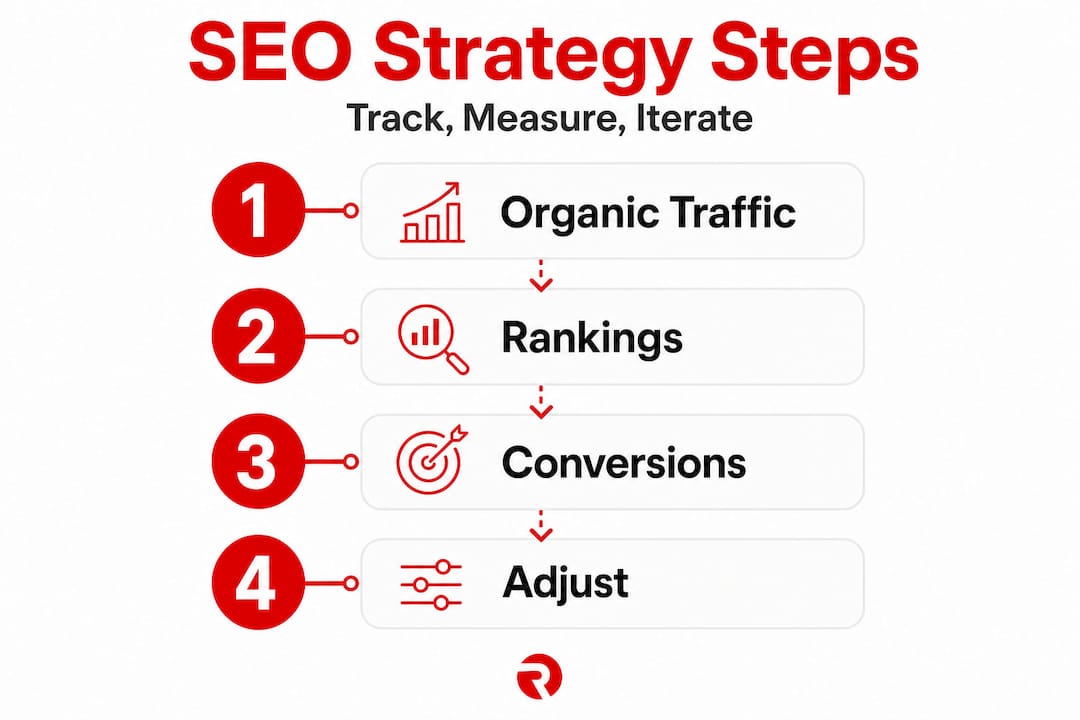
The essential metrics to track for UK business SEO include: organic traffic (the number of visitors arriving from unpaid search results), keyword rankings (where your pages appear for target queries), click-through rate from search results, conversion rate from organic traffic, and index coverage (the number of pages Google has actually indexed).
Google notes that new pages can take time to appear in indexing, and recommends submitting updated sitemaps or requesting indexing directly through Search Console when changes occur. For larger sites, the Coverage and Indexing reports are indispensable for identifying which URLs are genuinely indexed versus simply crawled.
| Tool | Primary strength | Limitation |
|---|---|---|
| Google Search Console | Indexing, clicks, impressions, Core Web Vitals | Limited historical data (16 months) |
| Google Analytics 4 | Conversion tracking, user behaviour, traffic sources | Requires setup and goal configuration |
| Ahrefs or SEMrush | Keyword ranking, backlink analysis, competitor insights | Paid tools with ongoing subscription cost |
| Screaming Frog | Technical crawl, on-page audit | Desktop tool, less intuitive for beginners |
| Moz Local | Local citation management, listing accuracy | Primarily useful for local-focused businesses |
Here is how to act on your reporting insights each month:
- Review Search Console for new errors. Address any newly discovered crawl or indexing issues before they compound.
- Identify your top-performing pages. Double down on topics and formats that already generate clicks and impressions.
- Find pages with high impressions but low CTR. These are quick wins. Rewrite the title tag and meta description to be more compelling.
- Track ranking changes after updates. If rankings drop after a Google algorithm update, review whether your content still aligns with current search intent.
- Set a quarterly review cadence. SEO evolves slowly. Monthly tweaks informed by quarterly strategy reviews keep you responsive without being reactive.
Connecting your SEO data with your broader marketing campaign strategy ensures that organic growth and paid or social activity reinforce one another rather than operating in isolation.
What most UK business owners get wrong about SEO
Here is an uncomfortable truth we see repeatedly when working with UK brands: most SEO failures are not caused by technical complexity. They are caused by impatience and misplaced effort.
Business owners chase quick fixes. Keyword stuffing, duplicate content across service pages, and low-quality link schemes feel productive in the short term. They are not. Google’s algorithms are increasingly adept at identifying and discounting these tactics, and in many cases actively penalising them. The time spent chasing shortcuts is time not spent building the genuine authority that compounds over years.
One of the most overlooked issues, particularly for businesses serving multiple locations or offering multiple services, is page-level uniqueness. Google’s snippet and meta guidelines are clear: if you have multiple location or service area pages, avoid one-size-fits-all metadata and content. Each page should have unique descriptions and prioritised, high-quality content that reflects the specific intent of someone searching in that location or for that service. We see businesses with 20 location pages that are essentially identical except for the city name swapped in. That is not local SEO. That is a waste of a page.
The other mistake is chasing vanity metrics. Ranking number one for a keyword that nobody searches for, or driving traffic that never converts, looks impressive in a spreadsheet and does nothing for revenue. Focus on what drives measurable user value: pages that answer real questions, reduce friction in the buying journey, and build genuine trust.
Our advice: set realistic timelines before you start. Expect six to twelve months before meaningful ranking changes, and use early data to refine your approach rather than abandoning it. Reviewing proven sales strategies for brand visibility alongside your SEO plan helps align your organic growth with commercial outcomes from the outset.
Partner with experts for lasting SEO results
Building and executing a robust SEO strategy demands sustained effort, technical know-how, and an understanding of how the UK market behaves online. If you have read this article and realise the scope of work involved, you are not alone. Many ambitious UK brands reach a point where self-managed SEO simply cannot keep pace with their growth ambitions.
At Radka Advertising, we specialise in helping UK businesses and ambitious brands translate strategic SEO thinking into measurable results. From technical audits and content strategy to authority-building and ongoing performance reporting, our team brings the rigour and creativity needed to make organic growth a genuine business asset. If you are ready to take the next step, log into your client portal to explore the tools and resources available to you, or get in touch to discuss a bespoke SEO engagement tailored to your sector and growth targets.
Frequently asked questions
How long does it take for SEO to produce results?
SEO typically takes months to show meaningful improvements, as organic rankings and traffic build gradually rather than switching on overnight. Most businesses see their first significant shifts between four and nine months after consistent implementation.
What is the best first step for a new UK business starting SEO?
Begin by researching keywords tied to UK search behaviour and ensuring your website is technically sound, with no crawl errors and fast load times, before moving onto content and authority-building.
How can I track whether my SEO is working?
Use Google Search Console coverage data alongside Google Analytics 4 to monitor changes in organic traffic, keyword rankings, and indexed pages on a regular basis.
Does local optimisation matter if my business serves the whole UK?
Yes. Even national businesses benefit from local optimisation via GBP and region-specific content, particularly when targeting customers in your primary commercial hubs such as London, Manchester, or Birmingham.
What mistakes should UK business owners avoid with SEO?
Avoid duplicating content across pages, keyword stuffing, and neglecting technical audits. Focus on building unique, user-focused pages with genuine depth, and invest in steady, quality-led improvements rather than chasing algorithm shortcuts.