How SEO drives branding and growth for UK SMEs

TL;DR:
- SEO enhances brand visibility by improving search rankings and entity recognition for SMEs.
- Consistent branding across digital platforms strengthens SEO signals and builds trust.
- Integrating brand strategy with SEO is essential for long-term growth and effective search performance.
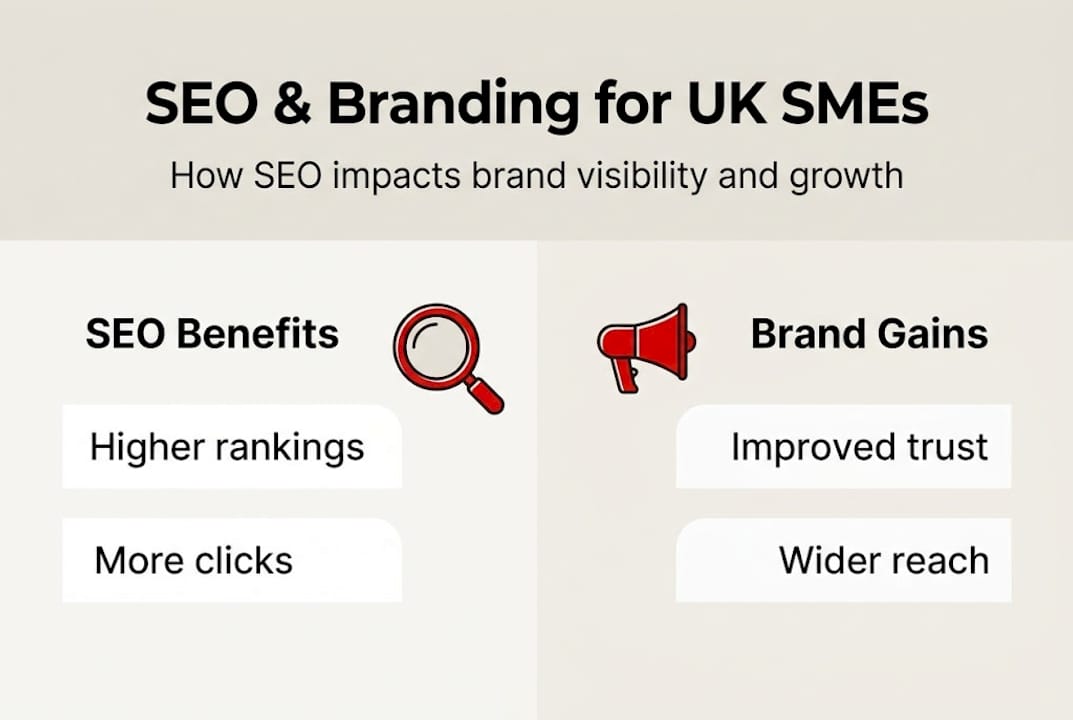
Most marketing managers at UK SMEs treat SEO as a technical task for the IT team. Rankings go up, traffic ticks along, and the job seems done. But this view leaves serious brand value on the table. SEO supports brand growth by shaping how potential customers first encounter, perceive, and remember your company. Every search result is a brand impression. This guide will show you exactly how SEO connects to brand visibility, what brand consistency does for your search performance, and which strategies will deliver measurable growth for your SME in 2026.
Table of Contents
- Understanding SEO’s influence on brand visibility
- The effects of brand consistency in SEO performance
- Core SEO strategies for building brand recognition
- SEO’s evolving role in brand performance measurement
- What conventional wisdom on SEO and branding gets wrong
- Take your brand visibility further with expert SEO support
- Frequently asked questions
Key Takeaways
| Point | Details |
|---|---|
| Visibility drives branding | Higher search engine visibility directly increases brand awareness and recall among your target audience. |
| Consistency improves results | Unified branding across digital platforms boosts search entity recognition and click-through rates. |
| SEO is evolving | Modern SEO measures branded influence and uses AI to track and enhance brand performance online. |
| Practical strategies matter | Implementing strong content, targeted keywords, and quality backlinks supports robust brand growth. |
Understanding SEO’s influence on brand visibility
Organic search is often the very first place a potential customer meets your brand. Not a social media post, not a paid advert. A search result. That moment shapes everything: whether they click, whether they trust you, and whether they remember your name. For UK SMEs operating in competitive markets, this is a channel you cannot afford to treat as an afterthought.
Search engine optimisation improves where and how your brand appears in those results. Higher positions mean more impressions, and more impressions mean stronger brand recall over time. Think of it this way: if your brand appears consistently at the top of results for relevant queries, customers begin to associate your name with authority in that space. You become the familiar face in an unfamiliar room.
Beyond rankings, there is a concept called entity recognition. Search engines like Google do not just index pages. They build a knowledge graph of real-world entities, including businesses. When your brand signals are clear and consistent, Google recognises your company as a distinct, trustworthy entity. This leads to features like knowledge panels, branded search results, and enhanced listings that make your brand stand out visually.
Here is what strong SEO-driven brand visibility looks like in practice:
- Appearing in featured snippets for industry questions your customers are already asking
- Showing a branded knowledge panel when someone searches your company name
- Ranking for your own brand terms so competitors cannot intercept your audience
- Generating consistent organic traffic that builds familiarity over time
Using a dedicated SEO audit tool will help you identify where your brand signals are weak or inconsistent. Pair that with content analytics insight to understand which pages are already building brand authority and which need attention.
Pro Tip: Use the same brand name format, logo alt text, and business description across every platform, from your Google Business Profile to your LinkedIn page. These consistent signals help search engines confirm your entity and reward you with better visibility.
The bottom line is straightforward. SEO is not a traffic lever. It is a brand amplifier. Every optimised page is an opportunity to make your brand more recognisable, more trusted, and more present in the moments that matter.
The effects of brand consistency in SEO performance
Brand consistency is not just a marketing nicety. It is a measurable SEO signal. When your brand name, visual identity, and messaging appear uniformly across your website, social profiles, directories, and third-party mentions, search engines build a clearer picture of who you are. That clarity translates directly into better search performance.
“Unified branding grew Bing traffic by 26.5% for a UK organisation after a branding unification exercise, with improvements in entity recognition and click-through rates across platforms.”
This is not an isolated result. When a UK SME standardises its brand name, description, and visual cues across all digital properties, search engines reward that coherence. Entity recognition improves, which means your brand appears in more relevant contexts. Click-through rates rise because a familiar, consistent brand name earns more trust in a list of results.

Here is a comparison of what inconsistent versus consistent branding does to your SEO metrics:
| SEO metric | Inconsistent branding | Consistent branding |
|---|---|---|
| Entity recognition | Fragmented, low confidence | Strong, clearly identified |
| Click-through rate | Below average | Above average |
| Branded search volume | Flat or declining | Growing over time |
| Knowledge panel eligibility | Unlikely | Highly likely |
| Directory listing authority | Diluted | Consolidated and strong |
The practical implication for your SME is clear. Before spending more on content or link building, audit your existing digital footprint. Check how your brand name appears across Google Business, Companies House listings, social profiles, and third-party review sites. Variations in spelling, punctuation, or description all weaken your entity signals.
Our branding case studies show how brands that invest in consistency before scaling their SEO activity see faster and more durable results.
Key areas to standardise include:
- Business name format (including Ltd, punctuation, and spacing)
- Brand description and tagline across all platforms
- Logo alt text and image file naming conventions
- NAP data (name, address, phone number) in every directory
Pro Tip: Run a quarterly audit of your digital properties specifically looking for branding variations. A single inconsistency in your Google Business Profile versus your website can suppress your local search visibility more than a technical error would.
Core SEO strategies for building brand recognition
Once your brand signals are consistent, the next step is actively building brand recognition through targeted SEO strategies. These are not generic tips. They are the specific levers that connect search performance to brand authority for SMEs.
SEO effectiveness is shaped by three core factors: content quality, keyword targeting, and backlink development. Each one has a direct branding dimension that most SMEs overlook.
- Publish content that demonstrates genuine expertise. Google’s quality guidelines reward content that shows real knowledge. For your brand, this means writing about topics where you have actual authority, not just keyword volume. A well-researched article positions your brand as the expert your customers should trust.
- Target keywords that reflect your brand positioning. Do not just chase high-volume terms. Choose keywords that align with how you want your brand to be perceived. A content quality analysis can reveal which topics already associate your brand with authority and where gaps exist.
- Build backlinks from credible, relevant sources. Every quality backlink is a vote of confidence in your brand from another website. Prioritise links from industry publications, trade associations, and respected UK media. These links do more than boost rankings. They build brand credibility.
- Implement structured data markup. Schema markup tells search engines exactly what your brand is, what you do, and how to categorise you. This supports richer search results and stronger entity recognition.
Here is a summary of the top strategies and their branding effects:
| Strategy | Primary SEO benefit | Branding effect |
|---|---|---|
| High-quality content | Improved rankings and dwell time | Positions brand as an authority |
| Keyword targeting | Higher relevance and visibility | Aligns brand with customer intent |
| Backlink development | Domain authority growth | Builds third-party brand credibility |
| Structured data | Enhanced search features | Clarifies brand identity to search engines |
| Technical site health | Better crawlability and indexing | Ensures brand is fully visible |
A technical SEO audit is a practical starting point. It surfaces the issues that prevent your brand from being fully visible, from slow page speeds to missing metadata, all of which affect how your brand is perceived in search.
SEO’s evolving role in brand performance measurement
The way we measure SEO success is changing, and it matters for how you think about brand investment. For years, the primary metric was organic traffic. More clicks meant better SEO. But in 2026, that view is outdated.
“SEO is now brand-dependent, with experts shifting focus from traffic metrics to influence and fame in the AI era, where brand experience shapes search visibility.”
AI-powered search tools are changing what gets surfaced and why. Google’s AI Overviews, Bing Copilot, and similar features do not just rank pages. They synthesise information from brands they recognise and trust. If your brand lacks a clear identity in the search ecosystem, you risk being invisible in these new formats entirely.
The metrics that matter most are shifting. Here is what forward-thinking SME marketers are now tracking:
- Branded search volume: Are more people searching for your company name? This is a direct measure of brand awareness driven by SEO.
- Share of voice: How often does your brand appear versus competitors for key industry terms?
- Sentiment in search results: What do the snippets, reviews, and featured content say about your brand?
- AI citation frequency: Is your brand being referenced in AI-generated answers and summaries?
- Click-through rate trends: Rising CTR for branded terms signals growing trust and recognition.
An AI SEO package designed for brand performance will help you track these metrics and connect search behaviour to real brand sentiment. This is where SEO becomes a genuine brand intelligence tool, not just a traffic report.
The implication is significant. SMEs that continue to measure SEO by clicks alone will underinvest in brand-building activities that deliver long-term competitive advantage. The brands winning in search in 2026 are the ones that have made brand experience central to their SEO strategy.
What conventional wisdom on SEO and branding gets wrong
Here is the uncomfortable truth: most SMEs treat SEO and branding as parallel tracks that occasionally intersect. SEO sits with the digital team. Branding sits with marketing. They share a spreadsheet once a quarter and call it integration.
This separation is expensive. The evidence is clear. Brand consistency delivers measurable increases in SEO-driven traffic and click-through rates. Yet the majority of SMEs we work with have never audited their brand signals for SEO coherence.
The conventional wisdom says: fix your technical SEO first, then worry about brand. We disagree. Brand signals are technical SEO. Entity recognition, consistent NAP data, and authoritative backlinks are all brand decisions with direct search consequences. Separating them wastes time and budget.
What we see in our branding results is that SMEs who integrate brand strategy with search strategy from the outset grow faster and sustain that growth longer. AI tools amplify this effect. When your brand identity is clear and consistent, AI-driven search features amplify your visibility. When it is fragmented, they ignore you.
The practical shift is this: bring your brand manager and your SEO lead into the same room. Review your branding services through the lens of search performance. The two disciplines are not just compatible. They are inseparable.
Take your brand visibility further with expert SEO support
If this article has shown you anything, it is that SEO and branding are two sides of the same coin. At Radka Advertising, we build integrated strategies that connect search performance with brand identity, so your SME grows in visibility and reputation simultaneously. As a full-service agency based in London, we work with SMEs across the UK to align brand signals, content strategy, and technical SEO into one coherent programme. Explore our AI SEO and branding package to see how AI-driven insights can accelerate your brand’s search presence. Or browse our full range of branding and marketing solutions and book a consultation with our team today.
Frequently asked questions
How can SEO help my SME brand become more visible?
SEO boosts organic rankings and drives traffic that increases brand exposure and recall among potential customers who are actively searching for what you offer.
What does brand consistency mean for SEO?
Brand consistency means using your brand name, colours, and messaging uniformly across all platforms, which helps search engines identify your entity and directly improves click-through rates and search visibility.
Which SEO strategies have the biggest impact on branding?
The most effective strategies are high-quality content, targeted keywords, and authoritative backlinks, as these three factors directly shape both search performance and brand credibility.
How is SEO’s role in branding changing with AI?
SEO now focuses on brand influence and sentiment rather than traffic alone, with AI shifting focus towards brand experience as the primary driver of search visibility in 2026.