Why digital marketing matters for UK businesses

TL;DR:
Digital marketing is essential for UK businesses to achieve visibility and credibility in online searches.
It enables precise targeting, measurable ROI, and long-term asset building that surpasses traditional channels.
Most business owners assume that if they have a decent product and a few happy customers, word will spread. It doesn’t. Not reliably, and certainly not fast enough to keep pace with competitors who are showing up everywhere your customers are already looking. 83% of consumers research products online before making a purchase. That means the moment they start looking, you need to be visible, credible, and compelling. Understanding why digital marketing matters is not an academic exercise. It is a practical necessity for every UK business owner who wants consistent growth in 2026.
Table of Contents
Key takeaways
| Point | Details |
|---|---|
| Visibility is non-negotiable | Customers research online before buying, so your business must appear where they are searching. |
| Targeting beats volume | Digital marketing reaches the right people by demographic, location, and behaviour rather than broadcasting to everyone. |
| Measurable ROI | Every click and conversion is trackable, giving you clear evidence of what works and what to cut. |
| Owned assets compound | Email lists and organic content reduce paid ad dependency and build lasting brand authority. |
| Small budgets can win | Focused digital strategies let smaller UK businesses compete directly against larger, less nimble rivals. |
Why digital marketing matters for brand visibility
The old approach to visibility was simple: buy space in a newspaper, put up a billboard, sponsor a local event. The problem is those channels cannot tell you who saw your ad, whether they were interested, or whether they eventually bought. Digital marketing solves all three of those problems simultaneously.
When your business ranks on Google for the terms your customers type, you do not pay for that traffic every time someone clicks. When your content appears in AI-generated search summaries, your brand earns credibility from a recommendation rather than a paid slot. Digital marketing in 2026 requires content that works for both human readers and AI systems, as Generative Engine Optimisation builds on traditional SEO to keep brands visible in AI-powered search results.
The reach available through digital channels is genuinely staggering compared to traditional media. A single well-optimised blog post can attract visitors from Manchester, Edinburgh, and Singapore simultaneously. A targeted paid campaign on social media can hit 50,000 people in a specific postcode who match an exact customer profile. Traditional media simply cannot offer that granularity.
Key visibility levers to focus on:
-
Search engine optimisation (SEO): Ensures your website ranks for the queries your customers are already using. Start with a site visibility audit to identify where you are losing ground.
-
Pay-per-click advertising (PPC): Puts your brand at the top of results pages immediately, with full control over budget and audience.
-
Content marketing: Blog posts, videos, and guides build organic traffic and establish your expertise over time.
-
Social media presence: Creates discovery touchpoints where customers spend time, even when they are not actively searching.
The importance of digital marketing for visibility is not just about being found. It is about being found consistently, across multiple channels, at every stage of the buying process.
Precise targeting and customer engagement
Here is where digital marketing separates itself entirely from traditional methods. A full-page newspaper ad goes to everyone who reads that paper. A digital campaign goes to 38-year-old women in Birmingham who have shown interest in sustainable home products, visited a competitor website in the past 30 days, and primarily browse on their phones.
Digital marketing allows targeting by age, location, interests, behaviours, and device type simultaneously, and personalisation based on this data measurably improves both engagement and lead quality. That precision is the core reason why businesses that invest in digital advertising consistently see better results per pound spent.
A practical approach to audience targeting looks like this:
-
Define your customer profile. Age, income bracket, interests, and buying triggers. The more specific, the better.
-
Choose the right platform. LinkedIn works for B2B. Instagram works for lifestyle products. Google Search captures active purchase intent.
-
Build audience segments. Separate cold audiences from warm retargeting audiences. Speak differently to each.
-
Test creative variations. Run two versions of the same ad to see which message resonates, then scale the winner.
-
Adjust in real time. AI-powered ad optimisation improves efficiency continuously, unlike a printed flyer that cannot be changed once it leaves the print shop.
Pro Tip: Set up separate campaigns for retargeting people who have already visited your website. These audiences convert at significantly higher rates than cold traffic because they already know your brand. Even a small daily budget on retargeting ads typically delivers a lower cost per acquisition than acquisition campaigns.
The difference between reaching people and reaching the right people is not marginal. It is the difference between a marketing budget that feels like a cost and one that behaves like an investment.
Measuring success and tracking ROI
Traditional marketing has always had a measurement problem. You run a radio ad, sales go up slightly, and you are left wondering whether the ad caused it or whether something else did. Digital marketing eliminates that ambiguity almost entirely.
Every click and conversion is trackable, giving you clear data on which campaigns, channels, and messages are driving results. You can see exactly how much each new customer cost to acquire, which ad led them to your site, and which page convinced them to buy.
| Metric | What it tells you | Why it matters |
|---|---|---|
| Click-through rate (CTR) | How compelling your ad or content is | Low CTR signals weak messaging or wrong audience |
| Cost per acquisition (CPA) | What you pay for each customer | Measures true campaign profitability |
| Return on ad spend (ROAS) | Revenue generated per pound spent | Guides budget allocation across channels |
| Bounce rate | Whether landing pages hold attention | High bounce rate means a disconnect between ad and page |
| Conversion rate | Percentage of visitors who take action | Reveals friction points in your customer journey |
This transparency is what makes digital marketing genuinely different. You stop guessing and start making decisions based on evidence. Businesses using data-driven campaign optimisation improve both effectiveness and ROI faster than those relying on instinct alone.
Pro Tip: Use an analytics dashboard to monitor your key metrics weekly, not monthly. Digital campaigns can waste significant budget in a short time if underperforming ads are left running. Weekly reviews let you catch problems early and reallocate spend to what is working.
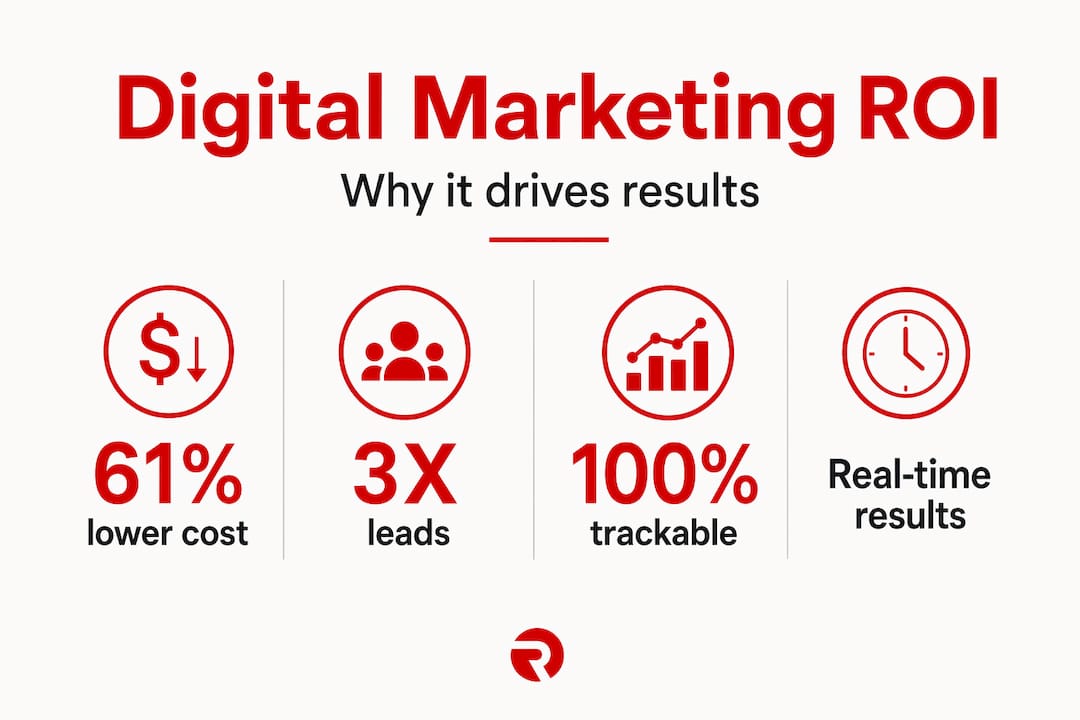
For anyone still weighing up whether to shift budget from print to digital, consider this: digital marketing costs 61% less than traditional marketing and generates three times more leads. That is not a marginal efficiency gain. That is a structural advantage.
Building long-term brand authority
The most underrated benefit of digital marketing is what it builds over time rather than what it delivers immediately. Every paid ad stops the moment you stop paying. But a well-written article that ranks on page one of Google keeps delivering visitors for years. An engaged email list gives you direct access to customers without paying a platform every time.
Building owned digital assets — email lists, branded content, and social communities — reduces your dependency on paid channels and platform algorithms, creating sustainable growth that compounds rather than resets each month.
Consider what a consistent content strategy actually builds:
-
Search authority: Google rewards sites that publish relevant, trustworthy content over time. New articles benefit from the domain reputation you have already built.
-
Email list value: A list of 5,000 engaged subscribers is a business asset. You can reach them at any time, at near-zero cost, with no algorithm standing between you and their inbox.
-
Social proof: Consistent posting, engagement, and community-building creates visible credibility that new visitors notice immediately.
-
Customer retention: Non-linear digital customer journeys mean buyers research and compare multiple times before purchasing. Consistent messaging across channels keeps your brand present during every phase of that decision.
The businesses that treat digital marketing as a long-term system rather than a short-term tactic are the ones that eventually find themselves spending less on paid ads because their organic presence does most of the heavy lifting.
Digital marketing for small businesses in the UK
If you run a small business in the UK and you believe you cannot compete with larger brands on marketing, the data disagrees with you. Smaller businesses with focused digital strategies frequently outperform bigger competitors because they can target precisely and adjust quickly, whilst larger organisations move slowly.
The reason is simple. A national retailer running a broad awareness campaign has to appeal to millions of people. You can focus your entire budget on the 10,000 people in your area who are most likely to buy from you. That concentration of effort produces results that a larger, broader campaign cannot match per pound spent.
The practical numbers make a compelling case:
| Marketing channel | Average monthly cost (small business) | Lead generation potential |
|---|---|---|
| Local newspaper full-page ad | £800 to £2,000 | Limited and untracked |
| Google Ads (targeted local) | £300 to £800 | High and fully measurable |
| Social media ads (targeted) | £200 to £600 | High with retargeting capability |
| SEO content programme | £400 to £1,000 | Compounds over 6 to 12 months |
97% of consumers search online for local businesses, which means a small business without a digital presence is invisible to the vast majority of potential customers in its own neighbourhood. That is not a digital marketing problem. That is a business survival problem.
For entrepreneurs just starting out, pairing a modest paid budget with a consistent content and social media strategy is one of the most effective ways to build brand recognition without requiring the kind of spend that only large companies can sustain. For guidance on overcoming the early barriers, the practical strategies for digital growth outlined here are worth reading alongside your planning.
My perspective: do not wait until you are behind
I have watched too many capable business owners treat digital marketing as something to deal with later, once the product is perfect or the team is bigger or the budget is more comfortable. The cost of that delay is invisible while it is happening and painfully obvious in hindsight.
What I have seen consistently is that the businesses which start building their digital presence early, even imperfectly, end up with structural advantages that latecomers struggle to close. Search authority takes months to build. Email lists require time to grow. Social audiences need consistent attention before they become commercially valuable. None of it happens overnight, and none of it can be fast-tracked by simply spending more later.
My honest view is that digital marketing is not a department or a campaign. It is the operating system of modern customer acquisition. Brands that understand this stop asking “should we be doing digital marketing?” and start asking “how do we get better at it?” That shift in question is where real growth begins.
The digital marketing impact on long-term brand equity is not theoretical. It shows up in valuation, in customer lifetime value, and in the ability to weather disruption without starting from scratch every time conditions change.
— Bart
How Radkaadvertising can help you grow
Understanding why digital marketing matters is one thing. Knowing how to execute it across channels, with limited time and resource, is where most business owners get stuck. Radkaadvertising is a London-based full-service agency that works with entrepreneurs, startups, and established brands to build digital marketing systems that actually produce results.
From brand strategy and content creation to paid campaigns and performance reporting, Radkaadvertising covers the full picture. The team has delivered campaigns for clients including Coca-Cola, Maybelline, and PowerLink Energy, and applies the same data-driven rigour to businesses at every stage of growth.
If you are ready to build visibility, improve targeting, and measure every pound you spend on marketing, explore Radkaadvertising’s services or take the first step by starting your client onboarding process today.
FAQ
Why does digital marketing matter more than traditional marketing?
Digital marketing offers measurable results, precise targeting, and lower costs than traditional channels. Businesses using digital strategies generate three times more leads for 61% less spend compared to traditional marketing.
How does digital marketing help small UK businesses compete?
Precise targeting lets small businesses focus their budgets on the most likely buyers rather than broadcasting broadly. This means a small business with a £500 monthly ad budget can outperform a competitor spending ten times that amount on less targeted channels.
What is the most important digital marketing metric to track?
Cost per acquisition (CPA) is the single most useful metric because it tells you exactly what each new customer costs across every channel. Tracking it alongside conversion rate gives you a clear picture of where to invest and where to cut.
How long does digital marketing take to show results?
Paid campaigns can generate results within days. SEO and content marketing typically take three to six months to build meaningful organic traffic, but those results compound over time rather than stopping when the budget does.
What does digital marketing include for a UK business owner?
A complete digital marketing system covers SEO, content marketing, paid social and search advertising, email marketing, and analytics. Each channel supports a different stage of the customer journey, from initial discovery through to repeat purchase.