How to develop digital strategy: a UK entrepreneur’s guide

TL;DR:
- Developing a digital strategy requires connecting all marketing activities to clear, measurable business goals using structured frameworks like SOSTAC.
- Effective planning starts with audits, SMART objectives, and audience personas to align efforts and avoid common pitfalls such as siloed channels and poor cross-team communication.
If you are an entrepreneur or marketing manager in the UK trying to grow your brand online, you already know the frustration. You are publishing content, running ads, posting on social media — and yet results feel scattered. You are not alone: 30% of marketers struggle with generating leads, and 27% cannot align sales and marketing efforts. The problem is rarely effort. It is the absence of a clear, structured approach to how to develop digital strategy that connects every activity to a measurable outcome. This guide changes that.
Table of Contents
- How to develop a digital strategy that actually delivers results
- Preparing to develop your digital strategy
- Building your digital tools and technology stack
- Executing and optimising your digital strategy
- Common pitfalls and how to avoid them
- Our perspective: why most digital strategies fail before they launch
- Ready to build a strategy that grows your brand?
- Frequently asked questions
Key Takeaways
| Point | Details |
|---|---|
| Structured frameworks matter | Using established frameworks like SOSTAC helps organise your digital strategy effectively. |
| Start with audits | A thorough digital audit reveals gaps and informs clear, SMART objectives aligned with your goals. |
| Leverage AI tools | Adopting AI-driven content creation and automation boosts your marketing efficiency and scalability. |
| Plan execution carefully | Develop a detailed roadmap with timelines, budgets, and KPIs to track and optimise performance. |
| Avoid common pitfalls | Integrate channels fully and allocate enough budget for testing to prevent strategy failure. |
How to develop a digital strategy that actually delivers results
To create your own digital strategy, first understand why it matters and the frameworks that guide it.
A digital strategy is not a content calendar or an ad budget. It is the architecture that connects your business goals to every digital channel, tool, and campaign you run. Without it, you are spending money on activities that feel productive but do not compound. With it, every post, email, and paid campaign reinforces the same direction.
The frameworks used by serious marketers — digital strategy frameworks like SOSTAC, REAN, and PRACE — break strategy into phases: planning, reach, act, convert, and engage. These are not abstract concepts. They are decision filters. SOSTAC, for example, forces you to define your Situation, Objectives, Strategy, Tactics, Actions, and Control before you spend a single penny on execution.
Here is what a coherent digital strategy actually gives you:
- Alignment between marketing activity and revenue goals
- Accountability through defined KPIs at every stage
- Efficiency by cutting channels that do not serve the strategy
- Clarity for your team on priorities and decision-making
- Agility to adapt when market conditions shift
One thing most entrepreneurs underestimate: strategy implementation takes 3 to 6 months to show meaningful results. This is not a reason to delay. It is a reason to start with structured frameworks for lead generation now, so that the compounding effect starts sooner.
Preparing to develop your digital strategy
With the importance and framework understood, next prepare your business with audits and clear objectives.

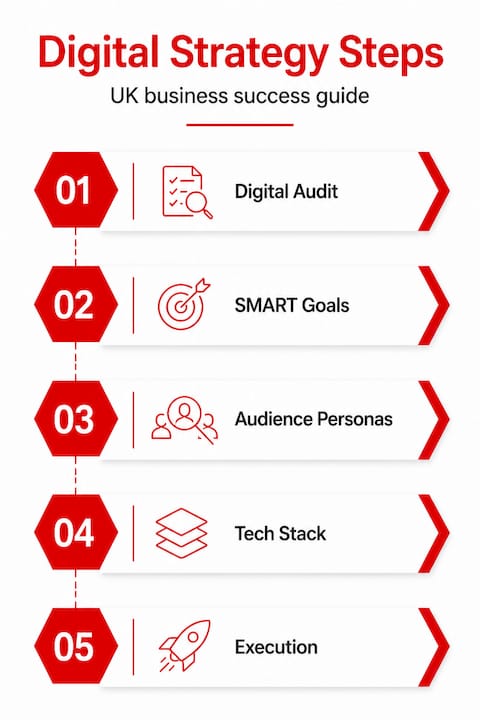
Preparation is where most businesses cut corners and then wonder why their strategy falls apart by month two. There are three non-negotiable steps before you write a single tactical plan.
Step 1: Conduct a digital audit
A digital audit covers five areas: your website (speed, UX, conversion), social media (engagement, follower quality), content (what exists and what is missing), technology (what tools you use and how they connect), and analytics (whether your data is even accurate). Most businesses discover during this stage that their analytics are misconfigured, meaning every decision made so far has been based on flawed data.
Step 2: Define SMART objectives
SMART objectives and STP methods are the backbone of any serious digital planning process. A SMART objective is not “grow our social media presence.” It is “increase Instagram engagement rate from 1.2% to 3.5% within 90 days by publishing three video posts per week targeted at UK-based business owners aged 30 to 45.” The specificity is what makes it executable.
Step 3: Build audience personas using STP
Segmentation, Targeting, and Positioning (STP) is the method that prevents you from writing content for “everyone” and reaching no one. Segment your audience by behaviour, need, and channel preference. Then target the segments with the highest potential value. Position your brand differently for each.
| Persona element | What to define |
|---|---|
| Demographics | Age, location, income, job title |
| Psychographics | Values, motivations, pain points |
| Online behaviour | Preferred platforms, content types, buying triggers |
| Channel preference | Email, search, social, video |
Pro Tip: Run a short survey to your existing customers before building personas from assumptions. Even ten responses will reveal gaps between what you think your audience wants and what they actually need from you.
For a thorough audit of your current digital presence, digital marketing content optimisation is a practical starting point before you move into planning.
Building your digital tools and technology stack
After preparation, building the right tech stack enables efficient execution of your strategy.
Your tools are not your strategy, but the wrong tools will sabotage even the best one. The rule here is simple: choose tools that integrate, not tools that impress.
86.4% of marketers use AI tools for content and media creation. If you are not yet using AI in your workflow, you are already at a speed and cost disadvantage. Start with AI-driven content creation and workflow automation before exploring more complex applications.
Here is how the main categories of tools compare:
| Tool category | Primary function | Best for |
|---|---|---|
| CMS (e.g. WordPress, Webflow) | Website management and content publishing | All businesses |
| CRM (e.g. HubSpot, Salesforce) | Customer relationship and pipeline tracking | Sales-led businesses |
| Marketing automation | Email sequences, lead nurturing, workflows | Scaling campaigns |
| AI content generators | Drafting copy, ad variants, social captions | Speed and volume |
| Analytics platforms | Performance tracking and attribution | Data-driven decisions |
The biggest mistake is buying tools in isolation. A CRM that does not talk to your email platform means your sales team is working with outdated contact data. An analytics tool that is not connected to your ad accounts means you cannot attribute revenue to channels. Integration is not a nice-to-have; it is the entire point.
- Start with a CMS and analytics platform as your foundation
- Add a CRM once you have consistent lead flow to manage
- Layer in marketing automation when your sequences are tested and proven
- Use AI tools for optimising for AI search and content production from day one
- Reserve 15 to 20% of your tool budget for testing new platforms before full adoption
Pro Tip: Before adding any new tool, ask one question: “Which existing tool does this replace or connect to?” If the answer is “neither,” you are building a silo. Use your digital strategy performance measurement framework to validate every tool against your KPIs.
Executing and optimising your digital strategy
With tools in place, successful execution and optimisation keep your strategy agile and impactful.
Execution is where strategy becomes real. Most plans die here because they were built in isolation and handed to teams without clear ownership or deadlines. A clear roadmap with timelines, budget, roles, and KPIs is what separates implementation from intention.
Follow these steps to move from plan to live execution:
- Build a 90-day roadmap. Break your strategy into quarters. Quarter one should focus on foundation: analytics, audience, and core content. Quarter two moves into channel activation. Quarter three is where you optimise based on real data.
- Assign ownership. Every initiative needs a named owner, not a team. If two people are responsible, no one is responsible.
- Set up a live dashboard. Track website traffic, conversion rates, social engagement, email open rates, and cost per lead in one place. If you cannot see it daily, you cannot manage it.
- Schedule fortnightly reviews. Review performance every two weeks. Not to report, but to decide: double down, adjust, or cut.
- Run structured tests. A/B test landing pages, ad creative, and email subject lines before scaling any channel. Data from small tests saves significant budget at scale.
Key metrics to track at each stage:
| Stage | KPIs to monitor |
|---|---|
| Awareness | Organic reach, impressions, branded search volume |
| Engagement | Time on site, pages per session, social shares |
| Conversion | Lead form submissions, email sign-ups, demo requests |
| Revenue | Cost per acquisition, customer lifetime value, ROI by channel |
Pro Tip: Build your review cadence into the calendar before you launch. Teams that schedule optimisation reviews in advance are far more likely to act on data than those who review “when there is time.” Use measuring digital strategy results as part of your monthly reporting rhythm, and connect it to tracking key performance indicators across channels.
Common pitfalls and how to avoid them
Avoiding these common mistakes ensures your strategy is resilient and effective.
Most digital strategies do not fail because of poor ideas. They fail because of predictable, avoidable mistakes that no one flagged at the planning stage. Here are the ones we see most often with UK businesses.
- Siloed channels. Running paid social, SEO, and email as separate programmes with no shared messaging creates a fragmented experience for your audience. A customer who sees one message on Instagram and a contradictory offer in their inbox loses trust fast.
- Underestimating budget for testing. Launching a campaign at full spend before testing is the fastest way to waste a quarter’s budget. Allocate 20 to 30% of your campaign budget to testing integrated campaigns before scaling.
- Ignoring the gap analysis. Your digital audit will reveal capability gaps. Ignoring them does not make them disappear — it delays your implementation by months while the problems compound.
- Poor cross-team communication. Hybrid channel integration failures are frequently caused by marketing and sales teams working without shared goals or shared data.
- Treating strategy as a one-time document. A digital strategy is a living framework. If yours has not been updated since it was written, it is already outdated.
“The most dangerous digital strategy is one that looks good in a presentation but was never designed for the team that has to execute it.”
Pro Tip: When avoiding marketing pitfalls, run a 30-minute “kill session” with your team after each campaign. Ask what slowed you down, what was unclear, and what you would cut next time. This habit surfaces structural problems before they scale.
Our perspective: why most digital strategies fail before they launch
Here is something most strategy guides will not tell you. The failure point in digital strategy development is not execution. It is the meeting where someone decides to begin planning without first deciding who has the authority to stop a failing initiative.
We work with brands across various sectors, and the pattern is consistent. A leadership team commissions a digital strategy. The agency or internal team produces a thorough document. Everyone approves it. Then it hits the reality of a twelve-person business where the content manager is also managing customer service and no one has told the sales team that their CRM is being replaced.
Building a successful digital strategy means building for the constraints of your real organisation, not your ideal one. That means being brutally honest in your audit phase about what your team can actually sustain. A two-post-per-week content plan that gets published consistently beats a five-post plan that collapses by week three.
There is also the question of patience, which is genuinely rare in digital marketing circles. Businesses that see strategy as a quarterly sprint tend to change direction before any initiative has had time to compound. The brands that win online are the ones that commit to a direction for at least six months and optimise within it, rather than abandoning it.
Digital strategy best practices do not change that often. Audience clarity, channel discipline, and data-driven iteration have been the foundations for a decade. What changes is the tooling and the channels. Focus your energy on the fundamentals. Let the tactics follow.
Ready to build a strategy that grows your brand?
At Radka Advertising, we have built and executed digital marketing strategies for brands ranging from London startups to global names like Coca-Cola and Maybelline. We know what a strong strategy looks like from the inside and we know exactly where most plans fall apart. If you want a team that brings both creative thinking and commercial discipline to your digital strategy development, we would like to hear about your brand. Explore how we approach strategic brand development and take the first step toward a strategy built for where your business is going, not just where it is now.
Frequently asked questions
What is the first step in developing a digital strategy?
The first step is conducting a comprehensive digital audit to assess existing digital capabilities, customer needs, market trends, and your competitive landscape before any planning begins.
How do SMART objectives help digital strategy?
SMART objectives in digital planning ensure every campaign is customer-centric, measurable, and tied directly to business priorities, giving teams clear criteria for success and evaluation.
Why is AI important in a digital strategy?
AI tools automate content creation and workflows at scale, and with 86.4% of marketers using AI primarily for content and media creation, not adopting them puts you at a meaningful speed and cost disadvantage.
How long does it usually take to implement a digital strategy?
Digital strategies typically take 3 to 6 months to implement fully across planning, execution, and optimisation phases, so setting realistic timelines at the outset is essential.
What are the most common pitfalls to avoid in digital strategy development?
Avoid siloed channel integration, underbudgeting for testing, and neglecting your gap analysis — ignoring hybrid channel integration and underbudgeting testing consistently leads to siloed failures and costly delays.