Brand and digital strategy for UK international growth

TL;DR:
- Most UK entrepreneurs overlook that integrated brand identity and digital marketing are crucial for successful international expansion. Effective branding involves expressing your values, voice, and promise consistently across all channels to build trust and recognition worldwide. Combining strategic brand development with targeted digital channels creates a competitive advantage and accelerates overseas growth.
Most UK entrepreneurs are sitting on a goldmine of opportunity without realising it. The combination of strategic brand identity and coordinated digital marketing is not just a nice-to-have for international expansion — it is the engine that drives overseas growth. Yet many businesses treat these two disciplines as separate activities, running social media campaigns with no connection to their brand values, or crafting a beautiful visual identity that never translates into digital content. The good news is that proven government support exists, clear frameworks are available, and the path to global reach is far more accessible than you might think.
Table of Contents
- Understanding brand identity for international entrepreneurship
- Essential digital marketing strategies for UK startups expanding overseas
- Connecting brand identity and digital strategy: A proven UK framework
- Setting priorities: What the research tells UK entrepreneurs about digital marketing success
- Building competitive advantage: Brand and digital for UK exporters
- The uncomfortable truth about brand and digital for UK entrepreneurs
- Level up your UK brand and digital strategy with professional support
- Frequently asked questions
Key Takeaways
| Point | Details |
|---|---|
| Align brand and digital | Brand identity and digital marketing must work as one system for global success. |
| Use UK support resources | UK government offers free, expert-led advice and digital export training for businesses expanding overseas. |
| Focus on measurable KPIs | Set clear, market-specific performance indicators rather than following generic averages. |
| Competitive edge via value | Clear value propositions and consistent branding help UK exporters stand out in crowded markets. |
Understanding brand identity for international entrepreneurship
With the challenge established, let’s clarify what “brand identity” really means when crossing UK borders. Many entrepreneurs reduce it to a logo and a colour palette, but that framing is dangerously narrow. Your brand identity is the total expression of who you are as a business — your voice, your values, your visual language, and crucially, the promise you make to every customer who encounters you.
UK government guidance frames “brand” as the way a business connects with customers and sets the tone of presentation to the world — a definition that is as relevant on the streets of Tokyo as it is in central London.
This framing matters enormously when you are entering new international markets. Overseas customers have no pre-existing relationship with your business. They will make rapid judgements based on subtle cues: your tone of voice in written content, the quality of your visual presentation, whether your messaging feels relevant to their specific cultural context, and whether you communicate a clear reason to choose you over local alternatives.
The core elements of a strong brand identity for international use include:
- Voice and tone: How you communicate, whether formal, conversational, technical, or empathetic, and whether that voice translates across cultures
- Visual identity: Your logo, typography, colour system, and imagery style, applied consistently across every touchpoint
- Value proposition: A clear, concise statement of the specific benefit you deliver and why you are the right choice
- Brand values: The principles that guide your decisions and that customers can recognise and trust over time
Building brand-building online requires consistency across every platform. When these elements work together, international customers notice. Trust is built faster, recognition accumulates across channels, and your marketing spend works harder because every touchpoint reinforces the same message. Getting international media coverage becomes more achievable when your brand identity is crisp, coherent, and immediately legible to new audiences.
Essential digital marketing strategies for UK startups expanding overseas
Once your brand identity is established, your next step is building a robust digital presence internationally. This is where strategy meets execution, and where the right channel mix can make or break your overseas ambitions.
The core digital channels for international expansion are SEO, content marketing, social media, and ecommerce platforms. Each serves a distinct purpose, and each requires tailoring for local markets rather than simply duplicating your UK approach.
Here is a practical summary of each channel and the strategic focus required:
| Channel | Strategic focus | Key resource |
|---|---|---|
| International SEO | Local keyword research, hreflang tags, local backlinks | Great.gov.uk Digital Edge training |
| Content marketing | Culturally relevant, locally optimised content | UK Digital Exporting Programme |
| Social media | Platform choice by market, localised creative | Department for Business and Trade |
| Ecommerce platforms | Local payment methods, local fulfilment | great.gov.uk export tools |
Booking an international SEO audit before entering a new market will reveal gaps in your current digital foundation that could undermine every campaign you run. UK SMEs can access free, tailored government support for international digital exporting via the UK Digital Exporting Programme, which includes 1:1 adviser sessions and structured training events.
Here is a straightforward process for UK entrepreneurs building their international digital presence:
- Identify your priority market. Choose one overseas market to start with based on demand signals, cultural proximity, and your capacity to serve it well.
- Audit your current digital assets. Review your website, social profiles, and content library for international readiness, including language, imagery, and localisation.
- Select the channels your target audience actually uses. European markets may favour LinkedIn and Google, while Southeast Asian markets often prioritise platforms you have never marketed on before.
- Tailor your content to local search behaviour. International content marketing and SEO fundamentals taught through the Department for Business and Trade’s Digital Edge training cover exactly how to approach this systematically.
- Set a measurement framework before launch. Define what success looks like in that specific market, using metrics tied to your business goals rather than vanity numbers.
A strong digital content strategy underpins all of this work. Without it, you are producing content reactively rather than building a coherent body of material that compounds in value over time.
Pro Tip: Sign up for the UK Digital Exporting Programme’s events and workshops before spending a single pound on paid international advertising. The structured guidance will save you costly mistakes and introduce you to advisers who have seen what works across dozens of markets.
Connecting brand identity and digital strategy: A proven UK framework
But it is not enough to build brand and digital muscles separately. Here is how UK firms connect the dots for true international advantage.
The most common mistake we see is treating branding as a creative exercise and digital marketing as a technical one, managed by different people with different objectives and no shared language. The result is fragmented customer experiences that undermine trust rather than building it. UK government guidance supports treating brand identity and digital marketing as a single, integrated system, defining how the brand connects with customers and then operationalising that through international content marketing, SEO, and channel-specific execution.

Here is what that looks like in practice — and what it looks like when businesses get it wrong:
| Silos approach | Integrated approach |
|---|---|
| Brand team sets values; digital team ignores them | Brand values inform every piece of content and campaign |
| Different visual styles across website, ads, and social | Consistent visual identity across all digital touchpoints |
| No shared KPIs between brand and digital functions | Shared metrics that tie brand perception to digital performance |
| Content created for SEO with no brand voice | Content optimised for search and written in consistent brand voice |
| Campaign messaging contradicts brand positioning | Campaign messaging directly expresses brand positioning |
The practical actions to integrate your brand and digital strategy are straightforward:
- Translate each of your brand values into a specific digital behaviour. For example, if your brand value is transparency, your digital expression might include open pricing, behind-the-scenes content, and honest customer reviews displayed prominently.
- Build a simple brand and content guide that your digital team, agency partners, and freelancers all use as a reference before creating anything.
- Measure customer response to brand touchpoints, not just conversion metrics, to understand whether your identity is landing as intended in new markets.
- Review a real-world brand strategy case study to see how the integration of brand and digital has produced measurable outcomes for businesses at different stages of international growth.
Pro Tip: Start with one key international market, set up a simple brand perception tracking mechanism such as a regular customer survey or social listening tool, and iterate your messaging based on real feedback rather than internal assumptions. Speed of learning beats perfection of planning every time.
For further grounding in ethical international marketing, understanding cultural nuances in your messaging is just as important as the technical execution. Brands that fail abroad often do so not because of poor SEO but because their messaging felt irrelevant or tone-deaf to local audiences.
Setting priorities: What the research tells UK entrepreneurs about digital marketing success
Learning from others is smart — but applying data in context is crucial for real advantage.
UK-specific benchmarks offer useful direction, provided you treat them as a starting point rather than a prescription. UK digital marketing research from a survey of over 500 UK businesses shows that increasing sales revenue was the top priority for UK firms, with reaching new customer segments and boosting brand awareness also ranking highly. These are not surprising findings, but they confirm that brand and sales are seen as connected objectives, not competing ones.
On the B2B side, the data is particularly striking. 44% of B2B marketers plan to increase brand and creative spend in 2026, the highest planned increase across all marketing categories surveyed. This is a significant signal. Businesses that previously focused almost entirely on performance marketing are recognising that brand investment is not a luxury but a growth lever.
Treating a survey average as a strategic plan is like navigating by someone else’s GPS destination. The benchmark tells you where others are going, but your customers may live somewhere completely different.
Here is how to set market-specific KPIs that are grounded in benchmarks without being enslaved to them:
- Start with the benchmark as a reference range. Use UK or sector-specific data to understand what typical performance looks like for your channel of focus.
- Identify how your target customer differs from the survey population. A B2B software firm entering the German market has different success metrics than a consumer brand entering Australia.
- Define leading indicators specific to your market entry. Early-stage metrics might include branded search volume in the new market, engagement rates on localised content, or inbound enquiries from new geographies.
- Set a review cadence. Revisit your KPIs every 90 days in a new market, adjusting based on what the data reveals about actual customer behaviour.
The biggest trap is averaging your way to mediocrity. If your customer is a niche professional audience in a specific international sector, the fact that brand awareness ranks third on a broad UK survey is irrelevant. What matters is what drives purchase decisions for your actual customer, in your actual market.
Building competitive advantage: Brand and digital for UK exporters
Applying strategy holistically cements your competitive footing abroad.
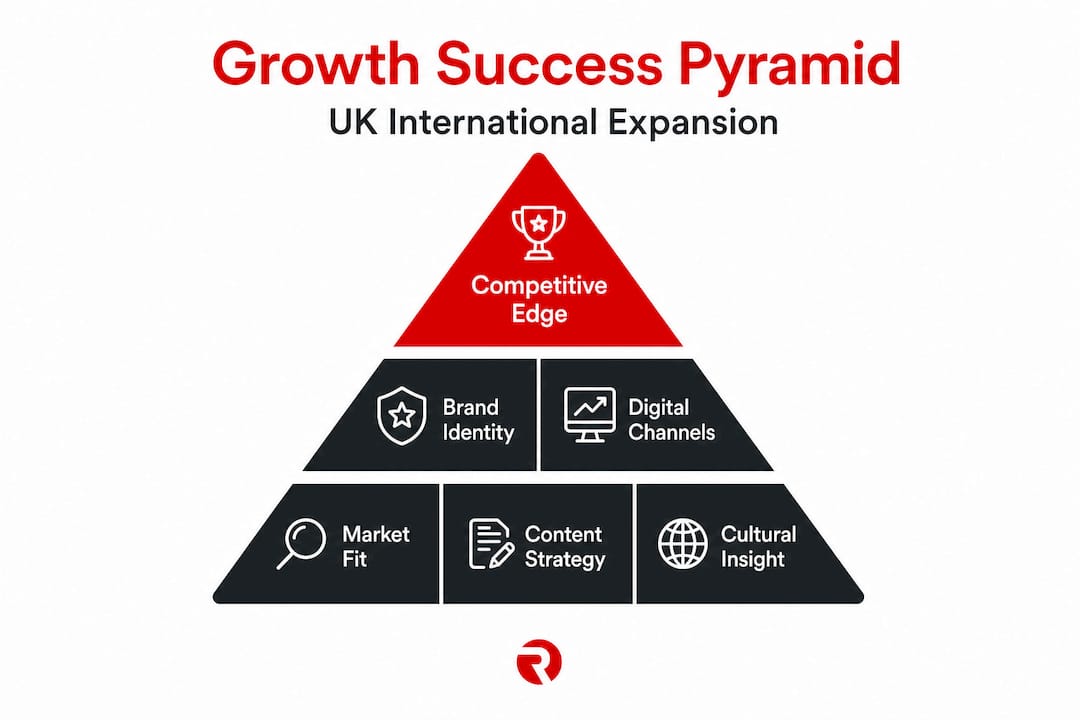
When UK businesses enter developed overseas markets, they encounter sophisticated local competitors and well-informed customers. UK export competitiveness requires a clear value proposition and genuine competitive advantage, including strong branding, when entering those developed markets. This is not a soft recommendation — it is a structural requirement for market entry.
To position your brand for competitive advantage in international markets, focus on:
- Articulating a unique benefit that is specific, credible, and meaningful to your target market rather than generic claims of quality or service
- Maintaining visual and messaging consistency across every digital channel used in the new market, from your website and paid ads to your social content and email communications
- Demonstrating quality through content — case studies, testimonials from credible sources, and detailed product or service information that reduces the perceived risk of choosing an unfamiliar brand
- Building multi-channel presence so that customers encounter your brand repeatedly across different contexts before they make a purchasing decision
The brands that struggle abroad are typically those that treat international marketing as a translation exercise, simply adapting existing UK materials rather than building a genuine market-specific strategy. Strong digital marketing expertise enables you to move beyond surface-level adaptation and build something that genuinely resonates with new audiences.
The uncomfortable truth about brand and digital for UK entrepreneurs
Having covered research, strategy, and benchmarks, let us get candid about what actually trips up most entrepreneurs making the leap abroad.
The most common failure mode is not ignorance of strategy. Most entrepreneurs who have done any reading know that brand and digital should be aligned. The failure is paralysis. Business owners spend months trying to perfect either their brand identity or their digital strategy in isolation, waiting until each is “ready” before connecting them. Meanwhile, competitors who are less precious about perfection are already gathering data, building audiences, and winning customers in the markets they want to enter.
The uncomfortable reality is that the biggest wins come from simple, well-executed alignment. You do not need a 60-page brand strategy document. You need a clear answer to three questions: who you are, who you serve, and why they should choose you. Once those are genuinely clear, your digital marketing becomes significantly easier because every content decision, channel choice, and campaign brief has a filter to run through.
Contrarian view: a well-tested imperfect strategy beats a perfectly designed untested one every single time. The market will always reveal things your internal planning process cannot. See effective strategy in action and notice how the most successful brand and digital work is iterative, not monolithic.
The practical wisdom here is simple. Start with one market, one message, and one primary channel. Get close to your data — not just traffic and conversion numbers, but qualitative signals like customer emails, social comments, and sales calls. Use that feedback to evolve quickly rather than defending your original assumptions.
Level up your UK brand and digital strategy with professional support
If you are ready to turn strategy into results, here is where you can get tailored help.
Understanding the framework is one thing. Implementing it in a way that drives measurable international growth is another. At Radka Advertising, we work with UK entrepreneurs and startups to move from strategic clarity to real-world execution, with a structured client onboarding process designed to get your brand and digital aligned quickly. Our international case studies demonstrate exactly how brand strategy and digital marketing have worked together to produce growth for businesses across sectors. If you are serious about building an international presence with a strong foundation, expert brand support from a team that has done this across global markets is the most efficient next step you can take.
Frequently asked questions
What UK government support is available for exporting my brand digitally?
UK-based businesses can access free support like the Digital Exporting Programme, which connects you with expert advisers and structured training for selling internationally online.
How important is a clear brand identity for entering new markets abroad?
A clear brand identity is essential for building trust with international customers. UK government brand guidance frames it as the foundation of how a business connects with customers globally.
What digital marketing channels are most effective for UK SMEs going global?
Core channels include international SEO, targeted content marketing, and localised social media. Digital Edge training from the Department for Business and Trade covers all three in depth.
How do I prioritise digital marketing spend as a UK entrepreneur?
Focus spend where it drives measurable results for your specific customer base. UK State of Digital Marketing research provides useful benchmarks, but always validate against your own audience data.
Does a clear value proposition really make UK exports more competitive?
Yes. Entering developed markets demands a strong, clearly communicated value proposition and well-executed branding as a baseline expectation, not a differentiator.