What is creative content? A guide for UK businesses

TL;DR:
- Creative content is original, emotionally engaging media that shapes brand identity and influences audience decisions across marketing channels. It complements traditional content by fostering emotional connection and short-term engagement, requiring strategic planning and resource investment. Consistently producing and reusing creative assets while aligning them with commercial goals ensures sustained marketing impact and brand differentiation.
Creative content is the visual, written, and experiential material a brand produces to communicate ideas, tell stories, and influence decisions. Unlike generic marketing copy, it is intent-led media built around storytelling, emotional appeal, and brand expression. For UK businesses and entrepreneurs competing in crowded digital spaces, understanding what is creative content and how to deploy it strategically is no longer optional. It shapes how audiences discover, recognise, and choose your brand. Tools like Adobe Creative Suite, Grammarly, and platforms such as Instagram and LinkedIn sit at the centre of modern creative content production and distribution.
What is creative content and what forms does it take?
Creative content is defined as original, engaging media that a brand creates to inform, entertain, or inspire its audience. It encompasses campaigns, copy, templates, interactive assets, videos, and brand imagery, all tied to a consistent tone and storytelling approach. The term “creative content” is widely used in marketing, but the recognised industry term across brand and agency circles is branded content or creative marketing assets, depending on context. Both refer to the same intent: media that does more than inform.
The formats UK businesses use most frequently include:
- Video content: Product films, brand stories, testimonials, and short-form social clips for platforms like TikTok and YouTube
- Blog posts and long-form articles: Thought leadership, how-to guides, and opinion pieces that build authority and search visibility
- Social media graphics and carousels: Designed posts for Instagram, LinkedIn, and Facebook that communicate brand personality at a glance
- Animations and motion graphics: Explainer videos and animated brand assets that simplify complex ideas
- Podcasts and audio content: Branded series or guest interviews that build community and loyalty
- Interactive media: Quizzes, calculators, polls, and assessments that drive participation and data collection
Each format engages audiences differently. A short Instagram Reel builds awareness in seconds, while a detailed podcast episode deepens trust over thirty minutes. Storytelling and emotional appeal drive engagement across all of them. The most effective creative content strategies use a mix of formats, matching each to a specific stage of the customer journey rather than defaulting to one channel.
How does creative content differ from traditional content?

Creative content prioritises emotion and storytelling, whereas traditional content focuses on clarity, information delivery, and credibility. A press release, a product specification sheet, or a company FAQ page are all traditional content. They serve a purpose, but they do not build emotional connection or brand affinity. Creative content does both.
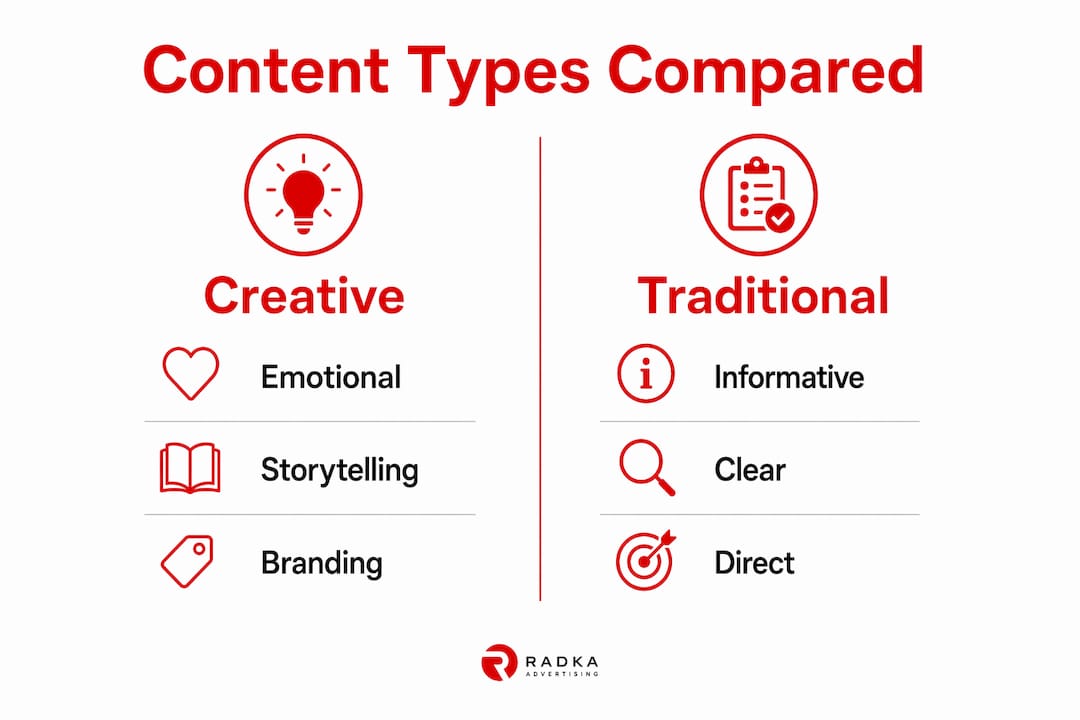
The distinction matters for UK businesses because the two types serve different goals and require different resources. Creative content demands more investment in design, copywriting, and production. It also tends to have a shorter lifespan, particularly on social media where trends shift rapidly. Traditional content, by contrast, can remain relevant for years with minimal updates.
| Attribute | Creative content | Traditional content |
|---|---|---|
| Primary goal | Emotional engagement and brand expression | Information delivery and credibility |
| Formats | Videos, graphics, campaigns, interactive media | Reports, FAQs, press releases, product specs |
| Lifespan | Often short, especially on social platforms | Longer, particularly for evergreen reference material |
| Resource requirement | Higher investment in design and production | Lower production cost, higher research investment |
| Audience response | Emotional, shareable, identity-driven | Rational, informational, trust-building |
| Best use case | Awareness, brand building, community engagement | Decision-making, credibility, SEO authority |
Neither type is superior. The strongest marketing plans use both in combination. A business might publish a detailed white paper (traditional) and then create a short animated summary (creative) to distribute it on social media. The white paper builds credibility; the animation earns reach.
Pro Tip: When planning a campaign, map each piece of content to a specific audience intent. Creative content works best at the top and middle of the funnel. Traditional content closes the gap at the decision stage.
What role does creative content play in brand identity and marketing?
Creative content is the primary vehicle through which a brand’s identity becomes visible and felt by its audience. Brand identity is not just a logo or a colour palette. It is the cumulative impression created by every piece of content a business publishes. Creative content carries that impression consistently across channels.
The role of creative content in marketing extends across the full funnel:
- Awareness: A striking visual campaign or viral video introduces your brand to new audiences who have never heard of you
- Engagement: Consistent, personality-driven social content keeps existing followers interested and encourages conversation
- Conversion: Creative product demonstrations, customer stories, and testimonial videos reduce purchase hesitation and build trust
- Loyalty: Behind-the-scenes content, brand values storytelling, and community-focused posts deepen the relationship with existing customers
Brands that invest in creative content consistently outperform those that rely solely on paid advertising or informational posts. Coca-Cola’s “Share a Coke” campaign is a textbook example: by replacing its logo with customer names, the brand turned a product into a personal, shareable experience. Maybelline’s influencer-led content on TikTok demonstrates how creative formats can generate millions of organic impressions without a traditional advertising budget.
For UK entrepreneurs and startups, the importance of creative content lies in differentiation. When your product or service is similar to competitors, your content is often the deciding factor. Audiences buy from brands they feel connected to, and creative content builds that connection faster than any other marketing tool.
How to design creative content that works for your business
Designing effective creative content requires a clear framework. Purpose, audience, messaging, format, and measurement must all align before production begins. Skipping this stage is the most common reason creative content fails to deliver results.
Follow these steps to build a repeatable creative content process:
- Define your purpose. Every piece of content must have a single, clear objective. Is it to build awareness, generate leads, or retain customers? Vague goals produce vague content.
- Know your audience. Go beyond demographics. Understand what your audience values, what frustrates them, and what kind of content they already engage with on the platforms you are targeting.
- Develop your core message. One central idea per piece of content. If you cannot summarise the message in one sentence, the content is not ready to produce.
- Choose the right format. Match format to platform and audience behaviour. LinkedIn audiences respond to long-form thought leadership and data-driven graphics. Instagram audiences respond to visual storytelling and short video.
- Run a divergent ideation phase. Divergent and convergent thinking must be separated. Generate as many ideas as possible first, without filtering. Then apply practical constraints to select the most feasible and aligned options.
- Produce with brand consistency. Tools like Adobe Creative Suite maintain visual standards across formats. Grammarly and similar copy editors maintain tone and quality in written content.
- Establish governance. Brand consistency and rights management protect the long-term value of your creative assets. Define who can use what, where, and how.
- Measure and iterate. Track engagement, reach, and conversion metrics. Use the data to refine your next content cycle.
Pro Tip: Separate your ideation sessions from your production planning sessions. When creatives and strategists brainstorm together without constraints, the ideas are richer. Bring in budget and timeline realities only after the ideation phase closes.
How to sustain creative content for ongoing marketing impact
Social content shelf life can be as short as a few hours, which means freshness and pipeline planning are central to any creative content strategy. A single campaign is not enough. Sustained impact requires a content pipeline that produces, publishes, and refreshes assets continuously.
The most common pitfalls UK businesses face when scaling creative content include:
- Inconsistent output: Posting sporadically signals to audiences and algorithms that your brand is not active. A content calendar with planned themes and formats prevents this.
- Creativity without strategy: Visually impressive content that does not align with brand values or commercial goals wastes budget and confuses audiences.
- Ignoring content reuse: A long-form video can be repurposed into short clips, quote graphics, blog summaries, and podcast audio. Reuse multiplies the return on every production investment.
- Neglecting discoverability: Creative work functions as commerce infrastructure, shaping how brands are found and acted upon in environments where discovery and transaction increasingly overlap. SEO, hashtags, and platform algorithms must inform creative decisions, not just aesthetics.
Integrating creative content sustainably means treating it as an ongoing operational function, not a one-off project. Assign ownership, set production cadences, and build review processes that maintain quality without slowing output. A digital marketing strategy that embeds creative content as a core channel will consistently outperform one that treats it as an afterthought.
Key takeaways
Creative content is intent-driven, original media that builds brand identity, drives engagement, and functions as commerce infrastructure across every stage of the marketing funnel.
| Point | Details |
|---|---|
| Definition of creative content | Original, emotionally engaging media tied to brand identity, storytelling, and audience influence. |
| Creative vs traditional content | Creative content builds emotional connection; traditional content delivers information and credibility. Use both. |
| Role in brand building | Creative content carries brand identity across channels and drives awareness, engagement, and loyalty. |
| Design framework | Define purpose, audience, message, format, and governance before production begins. |
| Sustaining output | Plan a content pipeline, reuse assets across formats, and align creativity with commercial goals. |
Why creativity without strategy is a false economy
Working with UK businesses over the years, the pattern I see most often is this: a brand invests in a visually impressive campaign, gets a spike in engagement, and then wonders why sales did not follow. The content was creative. The strategy was absent.
The most effective creative content I have seen produced does not start with a brief about aesthetics. It starts with a question: what do we want the audience to feel, believe, or do after seeing this? That question forces alignment between the creative team and the commercial goal before a single asset is produced.
I am also sceptical of the idea that creativity requires complete freedom. In my experience, constraints produce better work. A tight brief, a clear audience, and a defined message give creative teams something to push against. The ideation framework of separating divergent and convergent thinking phases is one of the most practical tools I have seen applied in agency settings. It protects creative exploration while preventing the endless ideation loops that kill deadlines.
For UK entrepreneurs specifically, the temptation is to copy what larger brands do. Resist it. Your creative content advantage is authenticity and specificity. A founder-led video explaining why you started the business will outperform a polished brand film with no personality every time. Audiences in 2026 are sophisticated. They recognise performance. They reward honesty.
— Bart
How Radkaadvertising helps UK businesses with creative content
Radkaadvertising is a London-based agency that works with UK entrepreneurs and established brands to build creative content strategies that deliver measurable results. From brand identity and social media content to multi-channel campaigns, the team brings together strategic thinking and production expertise to create content that earns attention and drives action. If you are ready to move beyond ad hoc content and build a system that works, explore the client onboarding process to see how Radkaadvertising approaches each brief. For a closer look at results across industries, the case studies portfolio covers work for clients including Coca-Cola, Maybelline, and PowerLink Energy.
FAQ
What is the definition of creative content?
Creative content is original, intent-led media that a brand produces to communicate ideas, tell stories, and influence audience decisions. It includes formats such as videos, graphics, blog posts, animations, and interactive assets, all tied to brand identity and storytelling.
What are the main types of creative content?
The main types include video content, social media graphics, blog posts, animations, podcasts, and interactive media such as quizzes and calculators. Each format serves a different audience need and stage of the marketing funnel.
How does creative content differ from traditional content?
Creative content prioritises emotional engagement and brand expression, while traditional content focuses on information delivery and credibility. Both serve distinct purposes and work best when used together within a broader marketing strategy.
Why is creative content important for UK businesses?
Creative content builds brand recognition, emotional connection, and customer loyalty in competitive digital markets. It also functions as commerce infrastructure, shaping how brands are discovered and acted upon across social media, search, and e-commerce platforms.
How do you create creative content that performs?
Start by defining a clear purpose, audience, and core message before choosing a format. Separate ideation from production planning, maintain brand consistency across assets, and measure performance to refine each content cycle.