What is brand identity and why it matters for your business
TL;DR:
- Brand identity encompasses the full system of visual, verbal, and experiential signals that communicate your business’s core values and positioning.
- For small UK entrepreneurs, maintaining consistency across touchpoints builds trust, recognition, and long-term growth.
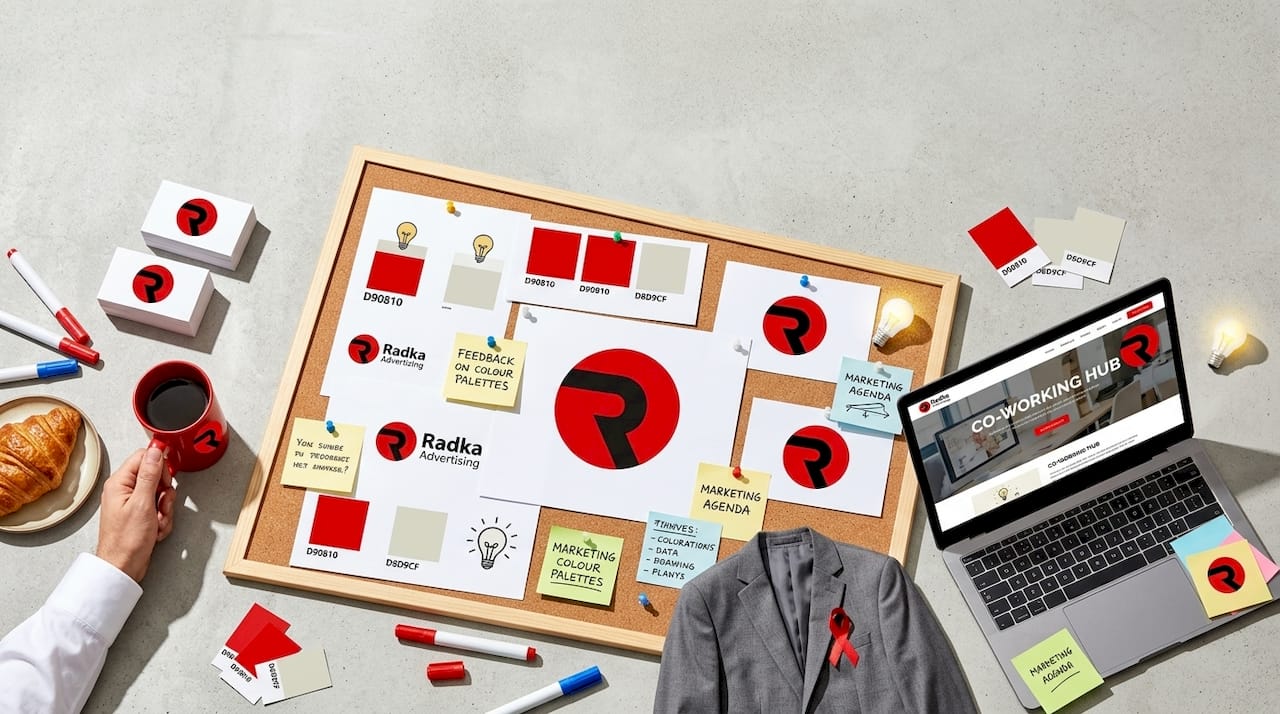
Most people, when asked what brand identity is, will point to a logo. Perhaps a colour scheme. Maybe a font. That answer is not wrong, but it is dangerously incomplete. Brand identity is the full system of visual, verbal, and experiential signals that communicate who you are, what you stand for, and why anyone should choose you over the competition. For UK entrepreneurs, small business owners, and freelancers trying to carve out a meaningful position in crowded markets, understanding this distinction is not a minor detail. It is the difference between a business that gets noticed once and one that gets remembered, trusted, and recommended.
Table of Contents
- Key takeaways
- What is brand identity: definition and components
- Why brand identity matters for UK entrepreneurs
- Key elements to include in your brand identity
- Steps to build a strong brand identity
- My honest take on where brand identity goes wrong
- How Radkaadvertising helps you build your brand identity
- FAQ
Key takeaways
| Point | Details |
|---|---|
| Brand identity is a system | It covers visual and verbal elements, not just logos or colours. |
| Identity differs from image | You control your identity; your audience forms their image of you. |
| Consistency builds trust | Inconsistent visuals or tone across touchpoints weaken recognition and credibility. |
| Positioning comes first | Your identity should be built on clear positioning and authentic values, not aesthetics alone. |
| Small businesses benefit most | A cohesive brand identity helps freelancers and small businesses compete on trust, not just price. |
What is brand identity: definition and components
The clearest way to understand brand identity is to think of it as a combination of visual and symbolic elements that create recognition and shape perception. It is everything your business deliberately puts out into the world to communicate who you are.
That includes two distinct layers. First, the visual layer:
- Logo and wordmark: the most recognisable shorthand for your business
- Colour palette: typically two to four colours used consistently across all materials
- Typography: the specific fonts that carry your personality, whether that is authoritative, warm, playful, or minimal
- Imagery style: the kinds of photographs, illustrations, or graphics you use and how they feel
Second, the verbal layer. This is where many businesses fall short. Visual and verbal identity elements work together to support your positioning. Verbal identity includes your brand voice (how you sound), your tone (how you adjust that voice in different contexts), your messaging (the specific phrases and ideas you consistently communicate), and your mission and values (the reason your business exists beyond making money).
It is also worth distinguishing brand identity from two related concepts that often get conflated. Brand identity is what your business intends to project. Brand image is customer perception, formed in the minds of people who interact with you. The gap between the two is where brand problems hide. Separately, branding is the activity of creating and managing that identity. Think of branding as the verb and brand identity as the noun.
Pro Tip: Write down your brand voice in three adjectives, then test every piece of content you publish against those words. If a social media post or a client proposal does not match, it is eroding your identity.
Why brand identity matters for UK entrepreneurs
The role of brand identity goes well beyond looking professional. It shapes how potential customers perceive your business before you have even spoken to them.
“Brand identity matters especially for small businesses competing on trust, as it affects how people perceive and feel about a business.” American Marketing Association
Think about what happens when someone finds your website through a Google search, then looks you up on Instagram, then receives a proposal from you by email. If the visual style, the tone of voice, and the core message feel different across each of those touchpoints, confusion sets in. Inconsistent visuals or messaging actively confuse customers and weaken the trust you are trying to build.
For freelancers and small business owners specifically, brand identity is one of the few things that levels the playing field against larger competitors. You may not have their budget or their reach, but you can absolutely out-position them on clarity, personality, and authenticity. Brand consistency across channels is directly linked to business growth, precisely because it compounds over time.
Several specific pitfalls tend to trip up UK small business owners:
- Treating brand identity as a one-off design project rather than an ongoing commitment
- Updating the logo without revisiting the verbal identity
- Using a completely different tone on LinkedIn versus a client email
- Borrowing visual styles from competitors rather than building something that reflects your actual positioning
- Believing that a polished aesthetic is sufficient without connecting it to a clear market position
The buying decision research is equally sobering. Brand identity shapes emotional connection, which is a critical factor in purchase decisions, particularly for service-based businesses where the product is intangible and trust is everything.
Key elements to include in your brand identity
Building a brand identity means making deliberate decisions across several interconnected elements. Here is a practical framework for doing it in the right order.
- Brand name and logo. Your name and logo are the entry points for recognition. The logo should work in multiple formats, at small and large sizes, in colour and in black and white.
- Colour palette. Choose three to five colours and assign them specific roles. A primary colour for key brand moments, a secondary palette for supporting elements, and a neutral for backgrounds and text. Colour carries significant psychological weight and communicates personality without a single word.
- Typography. Select one to two typefaces and stick to them. One for headlines, one for body text. Typography that is inconsistently applied creates a subconscious sense of disorder, even if readers cannot articulate why.
- Brand voice and tone. Define how your brand sounds. A financial adviser and a children’s activity brand may both be friendly, but their voices should sound entirely different. Document this with real examples, not abstract descriptions.
- Mission, values, and story. These are the foundation that everything else sits on. Your mission explains what you do and for whom. Your values determine how you behave. Your story gives people a reason to care.
- Brand positioning. This is how you define your place in the market relative to alternatives. It answers the question: why you, and not someone else?
The following table illustrates how these elements work together:
| Element | What it communicates | Common mistake |
|---|---|---|
| Logo and colour palette | Immediate recognition and personality | Changing it too frequently |
| Typography | Professionalism and tone | Using too many fonts |
| Brand voice | Personality and approachability | Being inconsistent across channels |
| Mission and values | Purpose and trustworthiness | Keeping it vague or corporate-sounding |
| Positioning statement | Differentiation and relevance | Copying competitor positioning |
Pro Tip: When creating your brand identity, write your positioning statement before you brief a designer. If the designer does not know who you are for and what makes you different, the visual output will be generic regardless of their skill.
Steps to build a strong brand identity
Knowing the components is one thing. Building a brand identity that actually holds together in practice requires a clear sequence.
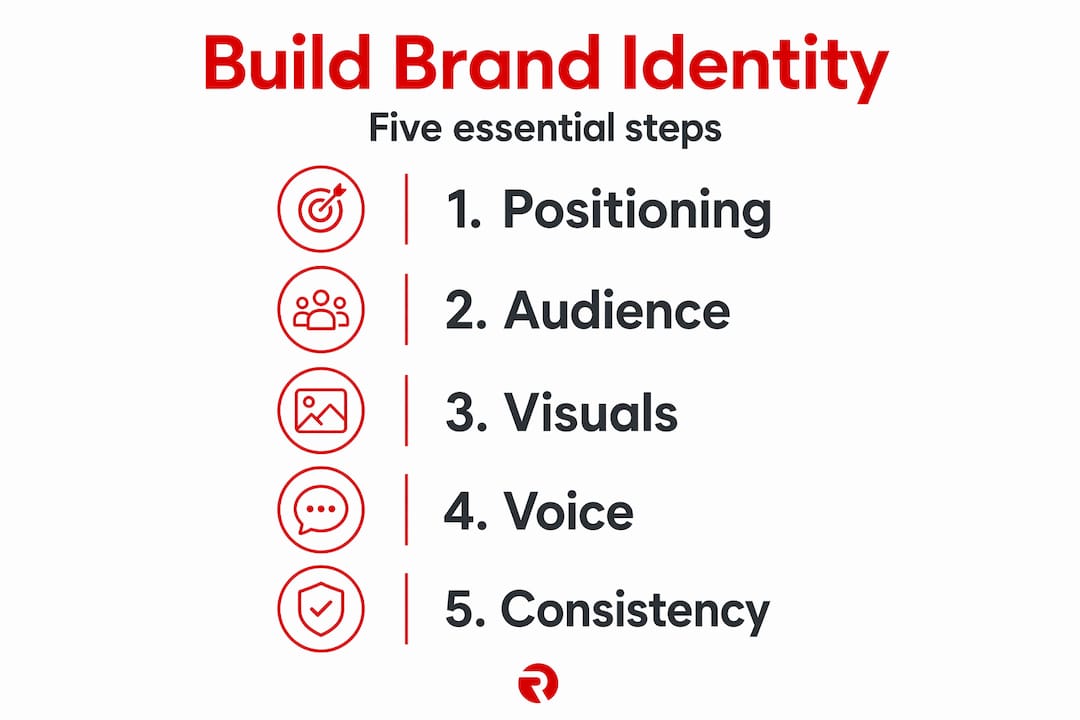
The first step is not picking colours. It is clarity about your positioning and your audience. Before any visual work begins, you need to know who you are serving, what problem you solve, and why you do it differently or better than others. Everything else flows from that.
Once your positioning is clear, you develop your visual and verbal identity purposefully, not by choosing what looks nice, but by choosing what accurately reflects your positioning. A premium service business should not use playful cartoon-style illustrations. A creative studio for young entrepreneurs should not use stiff, formal typography.
Centralising approved brand assets in one place is then critical for consistent application. For freelancers and small teams, this might be a simple shared folder with clearly labelled logo files, colour codes, font files, and a one-page brand guidelines document. For growing businesses, it might be a proper brand management platform.
From there, the ongoing steps are:
- Audit your touchpoints regularly. Go through your website, social profiles, email templates, invoices, proposals, and any physical materials. Do they all look and sound like the same brand?
- Brief everyone in your brand. If you work with contractors, virtual assistants, or collaborators, they need to understand your brand guidelines, not just receive a logo file.
- Evolve without abandoning your core. As your business grows, your identity will need to mature. That is healthy. But the values and positioning at the centre should remain consistent so that existing customers still recognise you.
My honest take on where brand identity goes wrong
I have worked with enough businesses to know that the most common brand identity problem is not bad design. It is a disconnection between what the brand says it stands for and what it actually does.
I have seen beautifully designed brands that feel hollow the moment you read their content, because the mission statement on the website has no relationship to how the business actually behaves. And I have seen scrappy, imperfect visual identities that feel completely compelling because the founder’s genuine purpose is woven into every interaction. Lack of alignment with positioning and values is the actual root cause of most branding failures, not poor visual execution.
What I tell UK entrepreneurs is this: treat your brand identity as a strategic asset, not a design task to tick off once and forget. The businesses that build lasting brand equity do so by consistently expressing authentic values outward. Authenticity in branding builds trust in a way that no colour palette alone ever will.
If your brand identity does not feel true to who you actually are and who you actually serve, no amount of polish will compensate for that. Start with honesty about your positioning, and the identity will have something real to stand on.
— Bart
How Radkaadvertising helps you build your brand identity
If you are ready to move beyond guesswork and build a brand identity that genuinely reflects your positioning, Radkaadvertising is a London-based agency with the expertise to make that happen. From initial brand strategy through to visual and verbal identity development, the team works with UK entrepreneurs, startups, and growing businesses to create brand identities that hold together across every channel. You can explore successful brand projects across industries ranging from energy to beauty to see how the approach translates into results. When you are ready to get started, the client onboarding process is the clearest first step toward a brand that works as hard as you do.
FAQ
What is brand identity, exactly?
Brand identity is the full system of visual and verbal elements a business uses to present itself consistently, including logo, colour palette, typography, brand voice, messaging, and values. It is what your business intentionally projects to the world.
How does brand identity differ from brand image?
Brand identity is what your business intends to communicate. Brand image is what your audience actually perceives. The closer these two align, the stronger and more trusted your brand becomes.
How do you create a brand identity for a small business?
Start with your positioning and audience, then build your visual and verbal elements around those foundations. Document everything in a simple brand guidelines document and apply it consistently across all touchpoints.
Why does brand identity matter for freelancers?
For freelancers, brand identity is what distinguishes you from every other person offering similar services. A consistent, authentic identity builds recognition and trust, which makes buying decisions easier for prospective clients.
How often should you update your brand identity?
There is no fixed schedule, but a brand identity review makes sense every two to three years or when your positioning, audience, or services change significantly. The goal is to evolve while keeping your core values and recognisable elements intact.