Digital marketing strategy guide for business owners

TL;DR:
- Many business owners understand the importance of being online but struggle with creating effective digital marketing strategies. Setting SMART goals, knowing your audience through lean buyer personas, and selecting channels based on audience behavior are key steps to building a successful plan. Regular measurement, continuous optimization, and clear ownership of tasks are essential for translating strategy into measurable revenue growth.
Most business owners know they need to be online. Fewer know what to actually do once they get there. Without a clear digital marketing strategy guide to follow, you end up posting sporadically, running ads that barely break even, and wondering why your competitors seem to pull in customers effortlessly. This guide cuts through the confusion. You will learn how to set goals that mean something, choose channels that fit your audience, allocate budget without guesswork, and measure results that actually connect to revenue. Whether you are starting from scratch or fixing a plan that is not working, this is where you begin.
Table of Contents
- Key takeaways
- Building a digital marketing strategy that actually works
- Choosing the right channels and tactics
- Planning your budget, roles, and timelines
- Measuring, optimising, and evolving performance
- My honest take on what separates good strategies from great ones
- How Radkaadvertising can build your strategy with you
- FAQ
Key takeaways
| Point | Details |
|---|---|
| Start with SMART goals | Tie every marketing objective to a specific, measurable business outcome before choosing any channel. |
| Build lean buyer personas | Focus on your audience’s role, goals, and pain points to identify the highest-impact touchpoints. |
| Choose channels deliberately | Prioritise channels based on where your audience spends time, not where you feel most comfortable. |
| Budget with clear roles | Assign a Directly Responsible Individual to each campaign area to keep execution accountable. |
| Optimise continuously | Use ICE scoring and test-and-learn cycles to improve performance rather than relying on one-off audits. |
Building a digital marketing strategy that actually works
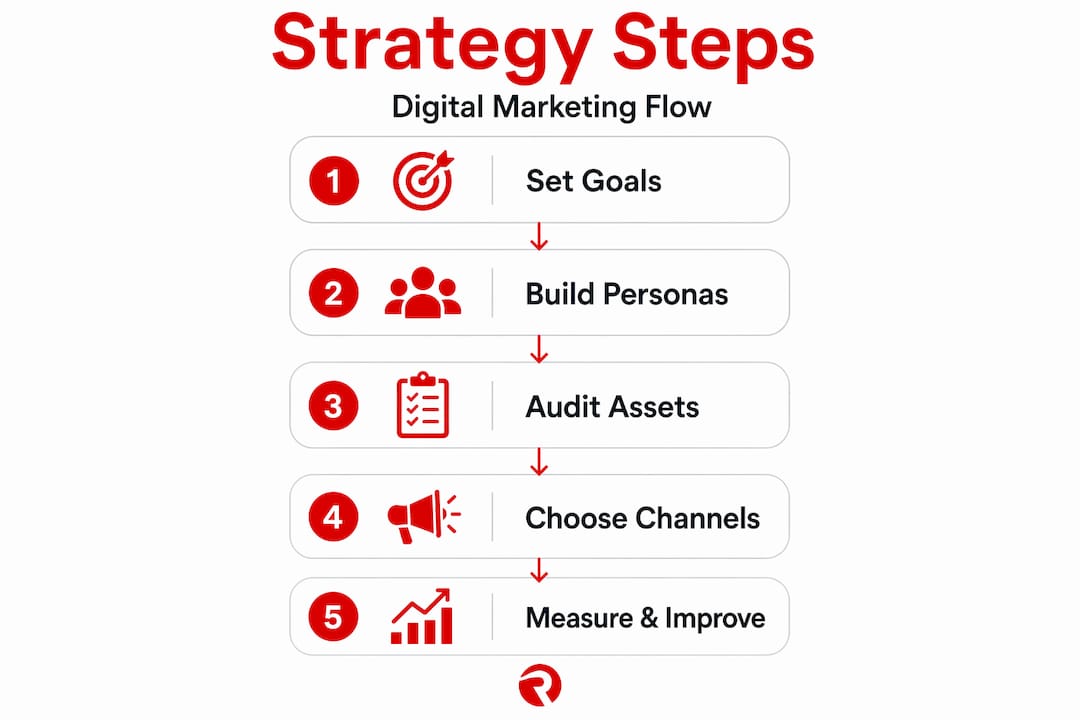
Every solid digital marketing strategy starts in the same place: clarity. Clarity about what you want to achieve, who you are trying to reach, and what you currently have to work with. Skip this stage and every channel decision and budget choice you make later will be built on guesswork.
Set goals you can actually measure
The most common mistake business owners make is setting goals like “grow our social media presence” or “get more leads.” These are directions, not destinations. SMART goals tie your marketing activity to real business outcomes. Think: “Generate 150 qualified leads per month by Q3, at a cost per lead below £40.”
Each goal should answer five questions. Is it specific enough to guide decisions? Can you measure it with data you already collect? Is it achievable given your resources? Does it connect to a real business priority? And does it have a deadline that creates accountability?
Your goals also need to sit at different levels. A top-line goal might be increasing revenue by 25% over 12 months. The marketing goal beneath it might be increasing website conversion rates from 1.8% to 3.2%. The campaign goal beneath that might be running a paid search test that generates 50 conversions in 30 days. This cascade is what turns strategy into something executable.
Know exactly who you are marketing to
Lean buyer personas focus on five things: the person’s role, their primary goals, their key pain points, what drives their purchase decisions, and which channels they actually use. You do not need a 20-page persona document. You need a one-page profile that every person on your team can reference instantly.
Once you have your personas, map them to your customer journey. Where do they first become aware of a problem? Where do they research solutions? What finally tips them into buying? The answers tell you which content to create, which channels to invest in, and what messages will land at each stage.
Pro Tip: Interview five to ten existing customers directly. Ask them what almost stopped them from buying from you. Their answers will reshape your messaging more than any analytics report.
Audit what you already have
Before building anything new, take stock of what exists. Review your website performance, your current organic rankings, your social media engagement rates, your email list health, and any paid campaign history. A proper digital marketing audit reveals where your strengths are being underused and where budget has been leaking.

The RACE framework offers a structured way to think through this. It breaks marketing activity into Reach, Act, Convert, and Engage stages, giving you a map of 25 tasks across the full funnel. Use it as a checklist to identify the gaps between where you are now and where your strategy needs to take you.
Choosing the right channels and tactics
Once you know your goals and your audience, channel selection becomes far more straightforward. The mistake most business owners make is choosing channels based on personal preference rather than audience behaviour. Your audience’s habits should drive every channel decision you make.
Here is a practical way to think about your channel mix:
- Website and SEO. Your website is the one digital asset you fully control. Organic search drives long-term, compounding traffic. Invest in it consistently, not just when paid campaigns feel expensive.
- Content marketing. Blog posts, guides, video, and podcasts build trust over time and support every other channel. Content is what gives paid ads something worth clicking through to.
- Paid search. Google Ads and similar platforms put you in front of people who are actively looking for what you sell. Best suited to audiences with clear purchase intent.
- Social media. Choose one or two platforms where your audience is genuinely active. LinkedIn works for B2B. Instagram and TikTok work for visual consumer brands. Being mediocre on five platforms is worse than being excellent on two.
- Email marketing. Still one of the highest-ROI channels available. An engaged email list you own outperforms rented social audiences every time.
- Influencer and partnership marketing. Particularly effective for building credibility with a new audience quickly, especially in saturated markets.
When integrating these channels, keep your brand voice and visual identity consistent across every touchpoint. A customer who sees your LinkedIn post, clicks through to a blog, and then lands on a remarketing ad should feel they are in the same world throughout. Fragmented experiences break trust faster than most businesses realise.
Prioritise channels by asking three questions about each one:
- Does my audience use this channel during the stage of the funnel I am targeting?
- Do I have the budget and skills to execute here at a quality level?
- Can I measure the impact clearly enough to learn and improve?
If a channel fails any of these tests, deprioritise it regardless of how popular it is with other businesses.
Planning your budget, roles, and timelines
Strategy without resources is just a wish list. This section is where most digital marketing plans fall apart, not because of bad ideas, but because of vague ownership and unrealistic timelines.
A practical way to split a quarterly marketing budget is shown below:
| Budget category | Suggested allocation | Notes |
|---|---|---|
| Paid media | 40-50% | Includes paid search, paid social, and display |
| Content production | 20-25% | Copy, design, video, photography |
| Tools and software | 10-15% | Analytics, CRM, scheduling, automation |
| Testing and experiments | 10-15% | Small budget tests before scaling |
Every campaign area needs a Directly Responsible Individual. This is the one person who owns the outcome, not just the task. Marketing plan templates that assign DRIs and connect daily tasks to strategic goals consistently outperform those that list activities without clear ownership.
AI and automation tools now handle content drafting, ad copy variant testing, and performance reporting with genuine efficiency. The rule is simple: use AI to handle the repetitive and time-consuming tasks, but keep a human responsible for brand voice, strategy calls, and creative direction. AI accelerates execution. It does not replace judgement.
Pro Tip: Build your quarterly timeline backwards from your key launch date. Identify the three or four milestones that must hit on time and protect those above everything else. Everything else can flex.
Tools like AI-assisted campaign planning make it easier to model scenarios, allocate spend across channels, and spot where your plan has gaps before you commit budget.
Measuring, optimising, and evolving performance
Getting your strategy live is not the finish line. It is where the real work begins. The best digital marketing strategies are built to learn, not just to execute.
Start by establishing KPIs at each stage of your funnel:
- Top of funnel: Impressions, reach, organic traffic, new visitors
- Middle of funnel: Engagement rate, time on page, email open rates, lead volume
- Bottom of funnel: Conversion rate, cost per acquisition, return on ad spend
Continuous optimisation requires unified data and a shared measurement system across your team. Multi-touch attribution and incrementality testing help you understand which channels are genuinely driving results versus simply taking credit for conversions that would have happened anyway.
Use the ICE framework to prioritise what to test next. Score each potential improvement on three factors: Impact (how much could this move the needle?), Confidence (how sure are you it will work?), and Ease (how quickly and cheaply can you test it?). High ICE scores get tested first. Low scores wait.
One area that dramatically changes optimisation outcomes is value-based bidding. Rather than optimising for conversion volume, value-based bidding tells your ad platform to prioritise conversions that are worth more to your business. Mitsubishi Motors boosted ROAS by 107% using this approach. The prerequisite is assigning realistic monetary values to each conversion type in your account.
As third-party cookies continue to disappear, first-party data becomes your most valuable measurement asset. Build your email list, invest in server-side tagging, and use privacy-safe attribution tools to maintain tracking accuracy without depending on cross-site data.
The businesses that outperform their competitors over the long term are not the ones with the biggest budgets. They are the ones with the most disciplined measurement systems and the willingness to act on what they find.
Avoid the common trap of chasing vanity metrics. Follower counts and page views feel good but rarely correlate to revenue. Link every KPI you report to a business outcome, or remove it from your dashboard entirely.
My honest take on what separates good strategies from great ones
I have worked with business owners at every stage, from first-time founders spending their first £500 on ads to established brands running seven-figure campaigns. The gap between the ones who struggle and the ones who scale is almost never budget or creativity. It is discipline around the fundamentals.
In my experience, the single biggest missed opportunity is failing to assign proper monetary values to conversions from the start. Most businesses treat conversions as equal. A newsletter sign-up and a high-intent product enquiry are not the same thing, and your ad platform should know the difference. When you give the system the right signals, the results shift noticeably. I have seen this change the trajectory of campaigns that were otherwise well set up but underperforming.
The other thing I keep coming back to is adaptability. A digital marketing plan should not be something you file away after writing it. The AI tools, the platform algorithms, the audience behaviours: all of it changes faster than most planning cycles account for. Build in a monthly review, treat the plan as a living document, and do not be too proud to change direction when the data tells you something is not working.
Balancing creativity with data is genuinely difficult and worth taking seriously. Data without creativity produces bland campaigns nobody remembers. Creativity without data produces beautiful campaigns that do not convert. The goal is both, and the role of AI in marketing is making it easier to test creative variants at a scale that was previously only available to large agencies.
— Bart
How Radkaadvertising can build your strategy with you
Radkaadvertising works with business owners and entrepreneurs to develop digital marketing strategies that are grounded in data, built around real audience behaviour, and designed to perform across multiple channels. From goal-setting workshops to full campaign execution, the team brings the structure and expertise that turns ambition into measurable results.
If you are ready to move beyond scattered tactics and build a plan with clear ownership, timelines, and KPIs, the best place to start is the client onboarding process. You can also explore the analytics dashboard to see how Radkaadvertising tracks and reports performance for clients across industries. For a closer look at real results, the case studies show exactly what structured strategy looks like in practice.
FAQ
What is a digital marketing strategy guide?
A digital marketing strategy guide is a structured framework that helps businesses plan, execute, and measure their online marketing efforts. It covers goal-setting, audience research, channel selection, budgeting, and performance measurement.
How do I create a digital marketing strategy from scratch?
Start by setting SMART goals tied to business outcomes, then build buyer personas, audit your existing assets, choose your channels based on audience behaviour, and establish KPIs before launching any campaigns.
What should a digital marketing plan template include?
A practical template should cover your business objectives, audience personas, channel mix, content plan, budget breakdown by category, assigned roles, campaign timeline, and a measurement framework with linked KPIs.
How do I know which digital marketing channels to prioritise?
Prioritise channels where your audience is active during the funnel stage you are targeting, where you can execute at a quality level, and where you can measure results clearly enough to improve over time.
What is value-based bidding and why does it matter?
Value-based bidding instructs your ad platform to optimise for the conversions worth most to your business, rather than treating all conversions equally. Assigning monetary values to different conversion types gives AI platforms the right signals to allocate spend far more efficiently.