Improve customer engagement with smarter UX research

TL;DR:
- Most digital strategies fail because of poorly applied or missing research rather than creative or budget issues. Proper UX research, combining qualitative and quantitative methods, provides actionable insights that improve user retention, trust, and ROI. Building a continuous research culture focused on edge cases and aligning findings with business KPIs ensures measurable strategic impact.
Most digital strategies stall not because of poor creative or weak media spend, but because the research underpinning them is either missing or misapplied. Marketing teams frequently confuse user interviews with usability testing, treating them as interchangeable when they serve entirely different purposes. As Nielsen Norman Group cautions, this kind of methodological confusion has real consequences: you end up designing for assumptions rather than reality, and your customers feel it every time they interact with your brand.
Table of Contents
- Why UX research is essential for digital strategy success
- Key UX research methods and when to use them
- Common pitfalls and how to avoid them
- Customising UX research for expert or complex customer journeys
- Turning UX insights into strategic impact
- Why most businesses get UX research wrong—and what actually works
- How Radka Advertising makes UX research work for you
- Frequently asked questions
Key Takeaways
| Point | Details |
|---|---|
| Method matters | Choosing and correctly applying the right UX research method is essential for effective customer engagement results. |
| Involve edge cases | Research must address real-life edge cases to protect trust and satisfaction. |
| Adapt for complexity | Specialised journeys require expert partnerships and nuanced, mixed-method research strategies. |
| Link to KPIs | UX research should always be tied to clear business objectives and marketing metrics. |
| Pilot and iterate | Test research setups internally before launching to catch common confusion or setup errors. |
Why UX research is essential for digital strategy success
UX research is the structured process of understanding how real users think, feel, and behave when they interact with your digital products or services. It is not a one-off audit or a box-ticking exercise. Done properly, it is a continuous feedback loop that keeps your digital strategy anchored to genuine customer needs rather than internal opinion.
Many marketing teams treat UX research as optional. They launch campaigns, redesign pages, or roll out new features based on analytics data alone, then wonder why conversion rates plateau or why bounce rates creep upward. Analytics tells you what is happening; UX research tells you why. Without both, you are navigating with half a map.
When you invest in rigorous UX research, the outcomes are measurable and significant:
- Higher user retention because journeys are designed around real behaviour patterns
- Lower drop-off rates at key funnel stages because friction is identified and removed
- Increased trust and brand credibility because edge cases and failure states are handled thoughtfully
- Better ROI on digital marketing spend because campaigns reach users with messaging that genuinely resonates
- Stronger alignment between product teams and marketing, since both are working from the same evidence base
“Methodological confusion blurs distinct UX research methods. Mixing up user interviews and usability tests leads to wasted effort and unreliable findings that can actively mislead design and marketing decisions.” — Nielsen Norman Group
Pro Tip: Use qualitative methods such as interviews and observation during the discovery phase to generate hypotheses, then switch to quantitative methods like surveys and usability benchmarking to validate them. Conflating these two stages is one of the most expensive mistakes you can make.
For projects requiring a deeper understanding of user behaviour over time, longitudinal research methods such as diary studies and repeated usability sessions allow you to triangulate findings and understand how engagement evolves. This is particularly valuable for subscription platforms, apps, or any product where long-term retention is a key business objective.
Key UX research methods and when to use them
Understanding which method to use, and when, is the foundation of any effective UX research programme. Each method is designed to answer a specific type of question, and using the wrong tool produces unreliable data that can mislead your entire strategy.
| Method | Goal | Ideal use case | Sample size | Common pitfall |
|---|---|---|---|---|
| User interviews | Explore attitudes and motivations | Discovery phase | 5 to 10 per segment | Leading questions that bias responses |
| Usability testing | Observe task performance | Pre-launch or redesign | 5 (qualitative), 40+ (quantitative) | Testing with wrong user profiles |
| Surveys | Measure attitudes at scale | Validation and benchmarking | 100+ for reliable data | Poorly worded questions skew results |
| Diary studies | Track behaviour over time | Habit-forming products or services | 10 to 20 | Low completion rates without incentives |
| Contextual observation | Understand real environment | Complex workflows or B2B tools | 5 to 8 sessions | Observer effect influences behaviour |
| A/B testing | Compare two variants | Optimisation of live products | Statistically significant volume | Treating correlation as causation |
One of the most cited points of confusion is between user interviews and usability testing. Interviews are conversational; you are exploring a person’s world, their goals, frustrations, and mental models. Usability testing is observational; you are watching someone attempt specific tasks to identify where the design breaks down. The methodological confusion between them is so common it has become a known risk in the industry.
For quantitative work, sample sizes matter significantly. Nielsen Norman Group’s sampling guidance for usability is clear: you need at least 40 participants for quantitative usability testing to draw reliable conclusions, and a minimum of 100 respondents for surveys. Many teams run surveys with 15 or 20 responses and treat the findings as definitive, which leads to misguided decisions further down the line.
Here is a straightforward process for selecting the right method for your situation:
- Define the question you need answered. Is it “why do users abandon checkout?” or “how many users complete checkout successfully?” These require different methods.
- Identify your research phase. Discovery calls for qualitative methods; validation calls for quantitative ones.
- Consider your timeline and resources. Diary studies take weeks; guerrilla usability testing can be done in days.
- Match the method to the fidelity of your product. Early prototypes suit interviews and low-fidelity testing; live products suit A/B testing and surveys.
- Plan for triangulation. Wherever possible, use at least two methods to cross-reference findings before committing to a strategic direction.
Common pitfalls and how to avoid them
Even experienced teams fall into the same traps repeatedly. Knowing what to watch for is half the battle.

The most significant and frequently overlooked mistake is ignoring edge cases. Many teams design and test for the “happy path,” the ideal user who completes tasks without friction, errors, or unusual contexts. Real customers are messier. They mistype passwords, share accounts, encounter accessibility barriers, or arrive at your platform in stressful circumstances.
As Nielsen Norman Group makes clear, edge cases in UX are not rare. Scenarios involving harassment, account lockouts, error recovery, and unexpected user behaviour are not exceptions to design for later. They are the situations that define whether users trust your product or abandon it entirely. Failing to research these scenarios means failing a substantial portion of your actual user base.
Common planning errors in UX research include:
- Recruiting participants who are too similar to your internal team or ideal customer persona
- Writing research questions that lead participants toward preferred answers
- Running research without a clear link to business objectives or KPIs
- Analysing findings in isolation without sharing them across marketing, product, and service teams
- Treating a single round of research as sufficient rather than building an ongoing programme
- Using internal stakeholders as proxies for real users
| Pitfall | Business impact | How to avoid it |
|---|---|---|
| Ignoring edge cases | Loss of trust, churn among vulnerable users | Recruit participants who have experienced failure states |
| Leading questions in interviews | Biased findings that confirm existing assumptions | Use open, neutral question frameworks |
| Under-recruiting for quantitative studies | Statistically unreliable results | Follow recommended sample sizes from credible sources |
| Siloing research findings | Missed opportunities for cross-functional improvement | Create shared research repositories and regular read-outs |
| Over-relying on internal panels | Risk of duplication, privacy issues, and sample homogeneity | Balance internal panels with external recruitment |
On the subject of internal panels, NN/G’s guidance on user panels highlights a genuine trade-off: they reduce recruiting cost and time, but as your panel grows, so do the risks of record-keeping errors, participant fatigue, and privacy management issues. Use internal panels strategically, not as a default shortcut.
Pro Tip: Deliberately recruit dissatisfied users and those who represent edge cases at the very beginning of your research programme, not as an afterthought. Their experience will often reveal the most critical design and communication failures that satisfied users simply never encounter.
Customising UX research for expert or complex customer journeys
Standard UX research methods work well for consumer-facing platforms with broad audiences. But if your business operates in a specialist sector, serves professional users, or manages complex B2B customer journeys, the same methods need significant adaptation.
Expert users do not behave like novice users. They have developed mental models, workarounds, and expectations shaped by years of experience with similar tools. Running a standard five-second test or a basic task-completion exercise with a senior financial analyst or an experienced logistics manager will not yield useful data. The tasks need to be realistic, the scenarios need to reflect genuine complexity, and the moderator needs enough domain literacy to interpret what they are observing.
Nielsen Norman Group’s guidance on complex application design recommends partnering with domain experts for evaluation, and adapting conventional task-based testing towards scenario-based interviews and contextual observation. Watching an expert use a tool in their actual working environment reveals far more than any lab session can.
For B2B, SaaS, or niche sector research, consider the following adjustments:
- Replace generic task scenarios with role-specific workflows drawn from real job descriptions
- Conduct contextual interviews in participants’ working environment rather than a neutral setting
- Include stakeholder mapping to understand who influences decisions versus who uses the product daily
- Use diary studies to capture how usage patterns change across a working week or project cycle
- Supplement interviews with retrospective think-aloud sessions, where users walk through recent experiences with your platform
For platforms designed for long-term engagement, longitudinal UX studies that combine surveys, usability testing, diary studies, and interviews over several months provide a far richer picture than any single-session method. The value comes from triangulation: when multiple methods point to the same friction point, you can act with confidence.
If you want to see how this type of research shapes real campaign outcomes, our case study insights demonstrate the impact of evidence-led strategy across complex and diverse industries. We also apply a rigorous SEO audit approach that complements UX research by identifying where organic traffic meets or misses user intent. Our client onboarding process is built around understanding your sector’s specific research challenges before we recommend any method.
Pro Tip: When working in a specialist domain, bring in a subject matter expert as a research observer rather than relying solely on a UX practitioner to interpret responses. The combination of research rigour and domain fluency produces far sharper insights.
Turning UX insights into strategic impact
Gathering insights is only valuable if they translate into measurable change. Many marketing teams invest in research, produce reports, and then watch the findings gather dust. The difference between research that drives strategy and research that gets filed away comes down to how you connect insights to business objectives from the very start.
Tying your UX research to specific KPIs gives every finding a commercial context. If a usability test reveals that 40% of users struggle to locate your pricing page, that is not just a UX observation. It is a conversion rate problem with a quantifiable cost. When research findings are framed in terms of business impact, they get acted upon.
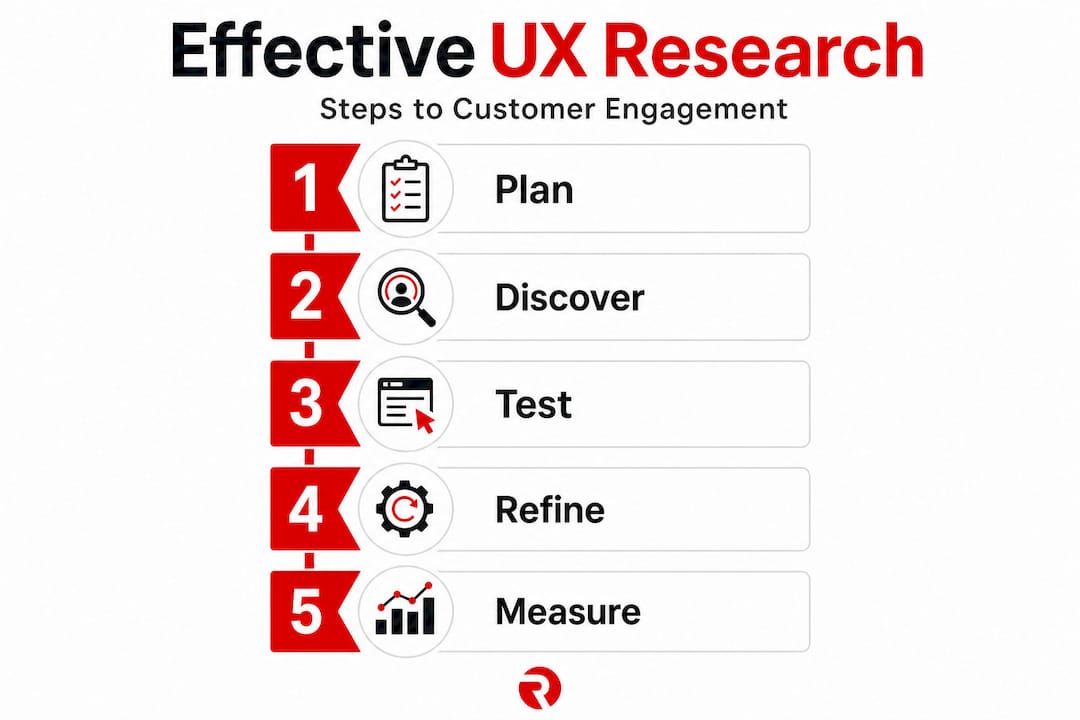
Follow these steps to integrate UX findings across your marketing funnel effectively:
- Set research objectives that map directly to business KPIs before any data collection begins. Know whether you are measuring task completion, satisfaction, engagement, or conversion.
- Choose benchmarking metrics that match the type of research. Behavioural metrics such as task success rate suit usability testing; attitudinal metrics such as Net Promoter Score suit surveys.
- Share findings across teams. Present insights to product, marketing, content, and service teams simultaneously to maximise the chance of coordinated action.
- Prioritise by impact and effort. Not every finding deserves equal attention. Focus on changes that address high-frequency user failures with significant commercial consequences.
- Measure again after changes are implemented. Research that does not loop back into further testing is incomplete.
As Maze’s benchmarking guidance emphasises, piloting your research setup with internal users before public rollout helps you catch confusing instructions, ambiguous tasks, or technical issues that would otherwise corrupt your data. It is a small investment that protects the integrity of the entire study.
Pro Tip: Set your benchmarks before you make any design or content changes, not after. A post-change measurement without a pre-change baseline tells you nothing about whether your intervention actually worked.
Why most businesses get UX research wrong—and what actually works
Here is the uncomfortable reality: most businesses do not have a UX research problem. They have a research culture problem. The methods exist, the guidance is publicly available, and the tools are accessible. What is missing is the organisational willingness to treat research as a continuous discipline rather than a project-by-project checkbox.
The most common failure pattern we see is this: a business runs a round of user interviews, concludes that users “basically like” the product, and moves on. No usability testing to validate those positive impressions. No edge-case recruitment to pressure-test the experience. No longitudinal follow-up to understand whether initial satisfaction translates into retention.
Qualitative and quantitative methods are not alternatives. They are sequential partners. Qualitative research generates hypotheses. Quantitative research tests them at scale. Using one without the other is like publishing a campaign without checking whether your targeting is correct.
Edge cases deserve a particular mention because they are where trust is won or lost. The user who gets locked out of their account, the customer whose accessibility needs are not met, the person whose use case sits outside your primary persona: these are not fringe concerns. They are the scenarios that generate the most vocal negative feedback, the worst reviews, and the most damaging word-of-mouth. Including them in research is not an act of generosity; it is strategic intelligence.
For complex customer journeys, partnering with domain experts in your research process is not optional; it is the only way to get results worth acting on. Our onboarding strategy is built around this principle: we learn your domain before we design your research.
How Radka Advertising makes UX research work for you
At Radka Advertising, we approach UX research as a core component of digital strategy rather than a separate service. Every campaign we build, every brand identity we develop, and every content programme we run is informed by structured research that connects user behaviour to commercial outcomes. Our work with clients across sectors, including high-profile brands in FMCG, energy, and beauty, is grounded in the kind of evidence-led thinking this guide has outlined.
If you are ready to move from assumption-led marketing to research-backed strategy, our client onboarding process is designed to get you there efficiently, identifying the right research methods for your specific sector and objectives from day one. Explore our recent case studies to see how research-driven decisions have produced measurable results for ambitious brands. The gap between a strategy that performs and one that underdelivers is almost always research. Let us help you close it.
Frequently asked questions
What is the difference between user interviews and usability testing?
User interviews explore experiences, opinions, and motivations through open conversation, while usability testing observes how people actually interact with a design to complete specific tasks. Conflating these two methods produces findings that are neither exploratory nor diagnostic.
How many participants do I need for valid UX research?
For quantitative usability testing, at least 40 participants are recommended, and surveys require a minimum of 100 respondents for statistically meaningful results.
Why include edge cases in UX research?
Edge cases represent real scenarios that significant numbers of users encounter, including account errors, accessibility needs, and unusual contexts. Designing without researching them means your product fails the users who are already most at risk of churning.
When is longitudinal UX research appropriate?
Longitudinal research suits any platform or service where long-term engagement matters, such as subscriptions, apps, or B2B tools. Using multiple methods over time allows you to triangulate findings and understand how behaviour evolves.
How can we make sure our UX research influences business KPIs?
Link research objectives to specific KPIs before data collection begins, and pilot your benchmarks with internal users first to catch setup issues before they compromise the wider study.