What is brand equity? Foundations and strategies for growth

TL;DR:
- Brand equity shapes customer perception, loyalty, and pricing power beyond just brand awareness.
- Strong brand equity leads to higher profits, resilience in downturns, and faster product adoption.
- Effective management combines emotional understanding with strategic measurement to build lasting brand value.
A great product alone does not guarantee market dominance. Some brands charge twice the price of near-identical competitors and still outsell them. Others survive product failures, negative press, and economic downturns with barely a dent in customer loyalty. The invisible force behind this resilience is brand equity. For business owners and marketing professionals, understanding brand equity is not optional — it is a strategic imperative. This guide breaks down exactly what brand equity means, how its five core pillars work, how to measure it accurately, and why the financial stakes are far higher than most people realise.
Table of Contents
- Defining brand equity: More than a logo or tagline
- The five pillars: What drives strong brand equity?
- How to measure brand equity: Proven methods and practical tools
- Why brand equity matters: Real financial and market outcomes
- A fresh perspective: What most brand equity advice overlooks
- Accelerating your brand equity journey
- Frequently asked questions
Key Takeaways
| Point | Details |
|---|---|
| Brand equity definition | Brand equity is the value a brand adds or subtracts through perceptions, loyalty, and proprietary assets. |
| Key components | Brand equity depends on loyalty, awareness, perceived quality, associations, and assets. |
| Measuring equity | Combine survey data, digital analytics, and financial outcomes to track brand equity’s strength. |
| Business impact | Brands with strong equity attract loyal customers, negotiate higher prices, and outperform competitors. |
| Action steps | Integrate diagnostic and building frameworks for practical, sustainable brand equity growth. |
Defining brand equity: More than a logo or tagline
Brand equity is one of the most misunderstood concepts in marketing. Many businesses treat it as a synonym for brand awareness or visual identity. In reality, it is far broader and more consequential than either.
At its core, brand equity is an intangible asset. It shapes how customers perceive your brand, what they are willing to pay, and how much competitive power you hold in your category. The most widely cited and practically useful definition comes from David Aaker, whose work remains the foundation of modern brand management. Brand equity is defined as the set of assets and liabilities linked to a brand’s name and symbol that add to or subtract from the value provided by a product or service to the firm and its customers.
Notice the word liabilities. Brand equity is not purely additive. Negative associations, broken promises, and inconsistent experiences all erode it. This bidirectional nature is what makes brand equity so strategically important. It is not simply built — it must be actively managed and protected.
Some common misconceptions worth clearing up:
- Brand equity is not brand awareness. A brand can be widely known and still carry negative equity if perceptions are poor.
- Brand equity is not brand identity. Your logo, colours, and typography are inputs to equity, not the equity itself.
- Brand equity is not static. It shifts with every customer interaction, campaign, and competitor move.
- Brand equity is not exclusive to large corporations. A local bakery with fierce neighbourhood loyalty has genuine brand equity.
“The value of a brand lives in the minds of customers, not in the boardroom. Managing equity means managing perception at every touchpoint.”
Understanding this distinction sets the stage for everything else. When you explore brand strategies with real-world examples, you will see that the most effective approaches are built on a clear-eyed understanding of equity, not just creative executions.
The five pillars: What drives strong brand equity?
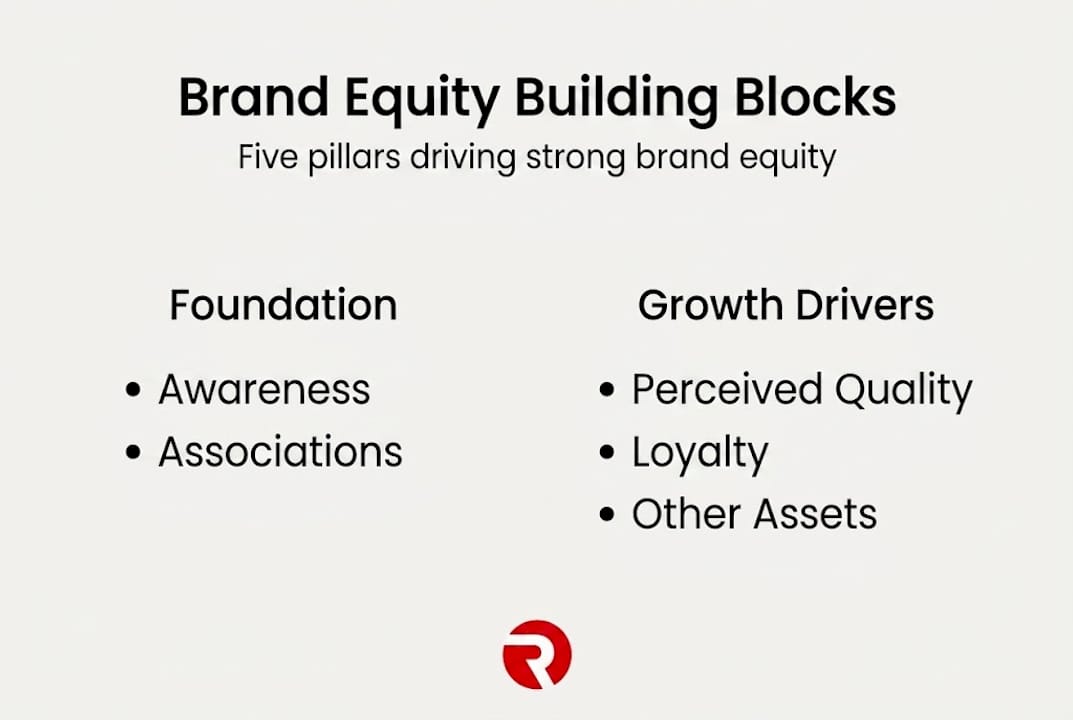
Aaker’s model provides a structured way to understand what actually creates or destroys brand equity. Key components include brand loyalty, awareness, perceived quality, brand associations, and other proprietary brand assets such as patents and trademarks. Each pillar operates differently and requires a distinct management approach.
Here is how each pillar affects your business in practice:
| Pillar | What it measures | Business impact |
|---|---|---|
| Brand loyalty | Repeat purchase and advocacy rates | Lower acquisition costs, higher lifetime value |
| Brand awareness | Recognition and recall in the category | Faster consideration, reduced media spend |
| Perceived quality | Customer judgement of overall excellence | Justifies price premiums, drives trial |
| Brand associations | Emotional and functional connections | Differentiates from competitors |
| Proprietary assets | Patents, trademarks, exclusive channels | Creates legal and structural moats |
Let us look at how these play out in real operations:
- Brand loyalty is the most financially valuable pillar. A loyal customer costs five times less to retain than to acquire a new one. Loyalty programmes, consistent service, and community-building all strengthen this pillar.
- Brand awareness is the entry point. Without it, the other pillars cannot function. Consistent visual branding for recognition across every channel is the most reliable way to build it.
- Perceived quality is not the same as actual quality. It is the customer’s subjective assessment. Premium packaging, expert endorsements, and polished communications all raise perceived quality even before a product is used.
- Brand associations are the emotional shortcuts customers use to categorise your brand. Think of the associations you hold for Volvo (safety) or Apple (innovation). These are built over years of consistent messaging.
- Proprietary brand assets include everything from a trademarked slogan to an exclusive retail partnership. They create barriers that competitors simply cannot replicate.
Pro Tip: Audit your brand against each of these five pillars annually. Identifying your weakest pillar is far more valuable than celebrating your strongest one. If you are considering refreshing your brand image, start with the pillar that is dragging down your overall equity score.
How to measure brand equity: Proven methods and practical tools
Knowing that brand equity exists is one thing. Tracking it with enough precision to make strategic decisions is another. The good news is that measurement methodologies now include survey-based tracking, sentiment analysis, attribute mapping, digital analytics such as share of search, and financial correlations including price premium and market share.

Here is a comparison of the main approaches:
| Method | Speed | Cost | Depth of insight |
|---|---|---|---|
| Brand tracking surveys | Medium | Medium | High (loyalty, NPS, awareness) |
| Sentiment analysis | Fast | Low | Medium (tone, associations) |
| Share of search | Fast | Low | Medium (relative awareness) |
| Price premium analysis | Slow | Low | High (financial impact) |
| Qualitative interviews | Slow | High | Very high (emotional drivers) |
No single method tells the full story. The most effective approach blends quantitative metrics with qualitative brand health signals. Here is what a practical measurement programme looks like:
- Run a quarterly brand tracking survey covering awareness, perceived quality, and Net Promoter Score.
- Monitor share of search monthly as a fast, low-cost proxy for relative brand awareness in your category.
- Conduct annual qualitative interviews with loyal customers and lapsed customers to surface emotional associations you cannot capture in a survey.
- Track price premium by comparing your average selling price to the category average over time.
Pro Tip: Do not just measure brand equity in isolation. Correlate your equity scores with revenue data. If your perceived quality score rises but revenue stays flat, something in your conversion funnel is broken, not your brand. Understanding how SEO’s effect on brand value compounds over time is one example of how digital signals and brand health connect in measurable ways.
For businesses investing in traditional media, tracking brand recall after magazine advertising strategies provides a useful benchmark for awareness-building ROI.
Why brand equity matters: Real financial and market outcomes
If brand equity feels abstract, the financial data makes it concrete very quickly. The Kantar BrandZ Top 100 Most Valuable Global Brands 2025 report shows Apple valued at $1.3 trillion, Google at $944 billion, and Microsoft at $885 billion, with the total top 100 reaching $10.7 trillion, up 29% year on year. More strikingly, strong brands have grown share prices 83% more than the S&P 500 over the same period.
These are not coincidences. They are the compounding returns of decades of deliberate brand equity investment. Here is how strong equity translates into tangible business outcomes:
- Price premiums. Customers pay more for brands they trust and admire. Apple’s average selling price for a smartphone is roughly three times the global average.
- Lower customer acquisition costs. Strong awareness and positive associations mean customers come to you, reducing reliance on paid media.
- Resilience in downturns. During economic pressure, customers cut spending on unknown brands first. Strong equity brands retain loyalty when it matters most.
- Faster new product adoption. A trusted brand name reduces the perceived risk of trying something new, accelerating launch cycles.
“Brand equity is not a marketing metric. It is a balance sheet asset that compounds quietly until it becomes the most valuable thing a business owns.”
These dynamics apply at every scale. Exploring real-world growth strategies reveals how businesses of all sizes leverage equity to outperform competitors with larger budgets. Our brand case studies illustrate this across sectors from energy to beauty.
A fresh perspective: What most brand equity advice overlooks
Most articles on brand equity stop at measurement frameworks. Track your NPS. Monitor your awareness scores. Build a dashboard. That is useful, but it misses the deeper challenge.
The businesses that build lasting brand equity do not just measure it — they feel it. They understand the emotional texture of their brand from the customer’s perspective, not just the data analyst’s spreadsheet.
Our view is that the most powerful approach pairs Aaker’s model with Keller’s sequential pyramid. Use Aaker for diagnostics and management, tracking and correlating dimensions to outcomes, while using Keller’s pyramid to build equity sequentially from identity through to resonance. Aaker tells you where your equity is weak. Keller tells you how to rebuild it.
The second overlooked point is customisation. Generic equity indices weight all pillars equally. But in a category driven by trust (financial services, healthcare), perceived quality and associations matter far more than awareness. In a fast-moving consumer goods category, awareness and loyalty dominate. Calibrate your equity index to what actually drives purchasing decisions in your specific market. Investing in visual branding and resonance means very different things depending on your category economics.
Accelerating your brand equity journey
Building brand equity is a long game, but you do not have to navigate it alone. At Radka Advertising, we work with businesses at every stage — from early-stage startups defining their positioning to established brands recalibrating their equity strategy for new markets. Our team brings together brand strategy, measurement frameworks, and creative execution under one roof, so diagnostic insights translate directly into campaigns that move the needle. Whether you need a full equity audit, a brand refresh, or a multi-channel growth programme, our branding and marketing services are designed to deliver measurable outcomes. Get in touch to explore how we can help you build brand equity that compounds.
Frequently asked questions
How does brand equity increase profits?
Brands with strong equity can command price premiums and higher market share, which directly increases revenue while reducing the cost of customer acquisition over time.
What is the difference between brand equity and brand value?
Brand equity is about intangible asset value influencing consumer behaviour, while brand value is the derived financial figure that equity generates, typically expressed in monetary terms.
Can small businesses build meaningful brand equity?
Absolutely. Aaker’s model applies universally, and small businesses can build strong equity by focusing on loyalty, consistency, and positive associations within their specific community or niche.
What is Keller’s brand equity model?
Keller’s pyramid focuses on building resonance through four sequential steps: brand identity, brand meaning, brand response, and brand resonance, each layer depending on the one beneath it.
Recommended
- Proven brand strategies: Real-world examples for growth | Radka Advertising
- How SEO drives branding and growth for UK SMEs | Radka Advertising
- Full-Service Advertising Agency — London | Radka Advertising
- Types of visual branding to boost market recognition | Radka Advertising
- Brand strategy for SMEs: growth and market impact explained
- Why build an online brand: unlock consistent sales growth - Jarrod Harman