How to refresh your brand image for lasting impact
TL;DR:
- An outdated brand image can erode trust and hinder growth for SMEs.
- A strategic brand refresh aligns visuals and messaging with business goals for lasting impact.
- Measuring success after implementation ensures continuous improvement and prevents superficial updates.
Your brand image is working for you or against you right now. For many UK small and medium-sized businesses, an outdated identity quietly erodes trust, repels potential clients, and hands competitors an easy advantage. The good news is that a well-executed brand refresh can reverse all of that. But here is the critical point: purely cosmetic refreshes can backfire when they are misaligned with core business goals. This guide walks you through every stage of a strategic brand refresh, from recognising the warning signs to measuring real results.
Table of Contents
- Understand when and why a brand refresh is needed
- Prepare for your brand refresh: goals, audience and assets
- Execute your brand refresh: steps for a modern transformation
- Measure success and adjust your new brand image
- Why most brand refreshes fail (and how to avoid it)
- Get expert help for your brand refresh
- Frequently asked questions
Key Takeaways
| Point | Details |
|---|---|
| Strategic refresh first | Focus on aligning your new image with business goals instead of just changing your logo. |
| Audit and prepare | Assess your current brand, set clear objectives, and gather assets and insight before making changes. |
| Follow a stepwise process | Update visuals, messaging, and digital presence in a deliberate sequence for best results. |
| Measure and improve | Track KPIs and feedback after your launch and be ready to adjust your new brand. |
| Get expert support | Work with experienced agencies for a brand refresh that delivers lasting impact. |
Understand when and why a brand refresh is needed
Most business owners sense something is off before they can name it. Enquiries slow down. Customers seem hesitant. Your website feels like it belongs to a different era. These are not random fluctuations; they are signals worth taking seriously.
Here are the most telling warning signs that a brand refresh is overdue:
- Your visual identity looks noticeably older than your competitors’
- Your messaging no longer reflects what you actually do or who you serve
- You have pivoted your services but your branding has not followed
- Customers describe you inaccurately when referring others
- Staff feel disconnected from or embarrassed by brand materials
- Your website conversion rate has steadily declined
A strategic refresh addresses these problems at the root. It sharpens your positioning, modernises your visual language, and realigns your communications with where the business is heading. The benefits go beyond aesthetics: stronger customer trust, clearer differentiation, and improved performance across marketing channels.
The risk of skipping strategy is significant. Many businesses invest in a new logo and updated colours, then wonder why nothing changed. That is because visuals are the surface. A true brand refresh must be driven by changing business goals or market realities, not just a desire to look fresher.
“The most effective refreshes happen when a business is honest about where it is now versus where it wants to go. Visuals follow strategy, not the other way around.”
Aligning your refresh with your company vision is what separates a meaningful transformation from an expensive distraction. Before you commission a single design, ask yourself: what do we want our brand to achieve in the next three years? Your answer should shape every decision that follows. Connecting brand image and business goals from the outset is what makes the difference between a refresh that sticks and one that fades.
Pro Tip: Run a quick internal survey asking your team how they would describe your brand to a stranger. If the answers vary wildly, your brand clarity needs attention before anything visual changes.
Prepare for your brand refresh: goals, audience and assets
Preparation is where most SMEs cut corners, and it is precisely where the groundwork for success is laid. Before touching a single asset, you need three things: clear objectives, a thorough audit, and a sharp understanding of your customers.
Start by setting business-driven objectives. Vague goals like “look more modern” will not guide decisions or help you measure success. Instead, aim for specifics: increase website enquiries by 20%, improve social media engagement by 30%, or attract a new customer segment by Q3. Alignment with business strategy is vital for lasting results, and written objectives keep the whole project anchored.
Next, audit your current brand assets and market position. Here is a simple framework:
| Asset | What to assess | Key question |
|---|---|---|
| Logo and visuals | Relevance, quality, consistency | Does it reflect who we are today? |
| Website | UX, messaging, SEO performance | Is it converting visitors? |
| Social media | Tone, engagement, visual style | Does it attract our ideal customer? |
| Marketing materials | Accuracy, design quality | Are these still fit for purpose? |
| Customer reviews | Sentiment, recurring themes | What do people actually say about us? |
Then, research your audience. Conduct short interviews with existing customers, run a survey, or analyse your social media comments. You want to understand what they value, how they describe your brand, and what would make them refer you more readily.
Here is a practical preparation checklist:
- Define three to five measurable refresh objectives
- Complete a full brand asset audit
- Gather customer feedback through surveys or interviews
- Analyse competitor positioning to identify gaps
- Assemble your brand refresh team or identify agency support
Staying current with brand refresh trends helps you make informed choices rather than chasing passing fads.
Pro Tip: Do not rely solely on internal opinions during your audit. Bring in at least five customers for a 15-minute conversation. Their language and perceptions will surprise you and sharpen your strategy considerably.
Execute your brand refresh: steps for a modern transformation
With your objectives set and your audit complete, execution becomes far more straightforward. The key is to work through the refresh in a logical sequence rather than tackling everything at once.
Follow these steps for a structured rollout:
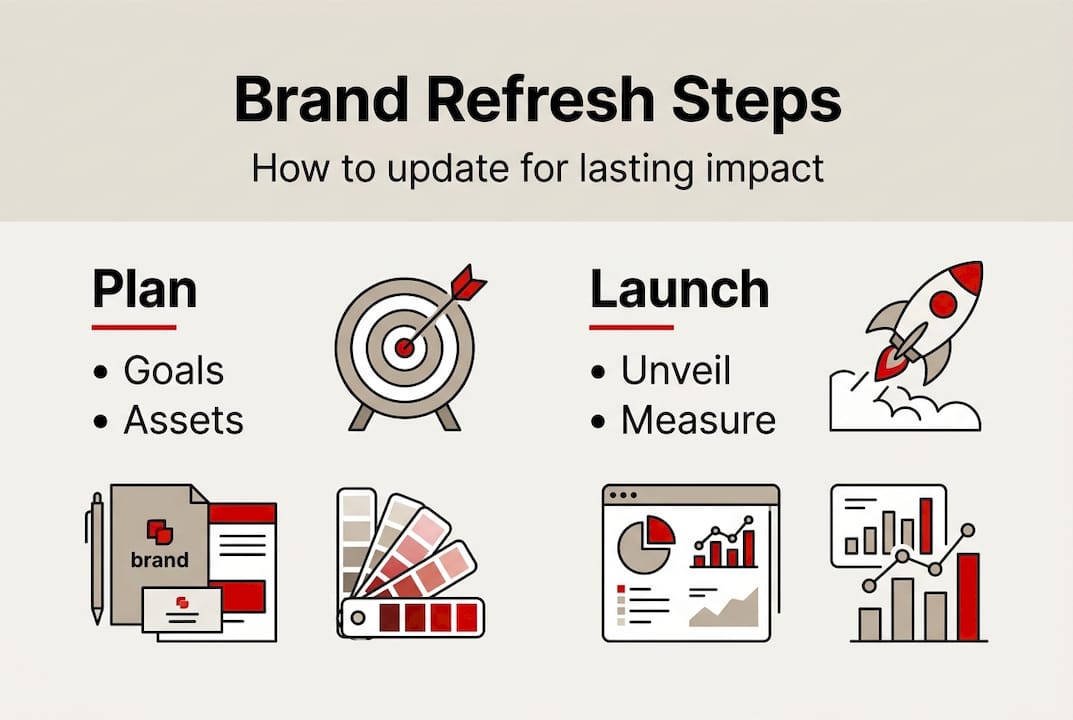
- Refresh your brand strategy first: Update your positioning statement, core values, and tone of voice before touching visuals
- Modernise your visual identity: Update logo, colour palette, typography, and imagery style in line with your strategy
- Rewrite your core messaging: Homepage copy, tagline, and key service descriptions should reflect your refreshed positioning
- Update your digital presence: Apply changes to your website, social media profiles, and email templates
- Roll out offline materials: Business cards, signage, and printed collateral should follow once digital assets are approved
- Communicate the change: Tell your audience why you have refreshed and what it means for them
One of the most important decisions is whether to manage this in-house or work with an agency. Here is an honest comparison:
| Approach | Advantages | Disadvantages |
|---|---|---|
| DIY | Lower cost, full control | Risk of bias, slower, skill gaps |
| Agency-led | Strategic expertise, faster, objective | Higher investment, requires briefing |
| Hybrid | Cost-effective, blends skills | Needs clear role boundaries |
For most SMEs, a hybrid approach works well: handle internal communications and asset gathering yourself, and bring in specialists for strategy, design, and digital execution. Browsing real-world brand refresh examples gives you a clear sense of what a well-executed transformation looks like across different industries.

Strategic refreshes enhance customer trust and market positioning when they are executed with consistency across every touchpoint.
Pro Tip: Create a brand style guide as part of your refresh. Even a simple two-page document covering logo usage, colours, fonts, and tone of voice will prevent inconsistency as your team grows.
Measure success and adjust your new brand image
Launching your refreshed brand is not the finish line. It is the starting point for a new phase of learning. Without measurement, you cannot know what is working or where to improve.
Begin by setting clear KPIs before launch so you have a baseline to compare against. Useful metrics to track include:
- Brand awareness: Direct website traffic, branded search volume, social media reach
- Engagement: Time on site, social media interactions, email open rates
- Lead generation: Enquiry volume, contact form completions, consultation bookings
- Customer sentiment: Review scores, net promoter score, repeat purchase rate
- Sales performance: Revenue trends, average order value, conversion rate
Gather feedback from both customers and staff within the first 90 days. Customers will tell you how the new brand feels from the outside. Staff will flag inconsistencies or confusion in day-to-day use. Both perspectives are valuable.
Here is a simple framework for tracking progress over time:
| Metric | Baseline (pre-refresh) | Month 3 | Month 6 | Target |
|---|---|---|---|---|
| Website enquiries | Record before launch | Track monthly | Track monthly | Define at outset |
| Social engagement rate | Record before launch | Track monthly | Track monthly | Define at outset |
| Brand search volume | Record before launch | Track monthly | Track monthly | Define at outset |
| Customer review score | Record before launch | Track monthly | Track monthly | Define at outset |
Data-driven evaluation of your brand refresh ensures tangible results rather than guesswork. Use tools to monitor brand performance metrics and track online brand presence so you can make informed adjustments quickly.
Iteration is not a sign of failure. It is the mark of a business that takes its brand seriously. Adjust messaging, test different visuals, and refine your tone based on what the data tells you.
Why most brand refreshes fail (and how to avoid it)
Here is something most agencies will not say out loud: the majority of brand refreshes do not fail because of bad design. They fail because the business treated the refresh as a design project rather than a business strategy project.
We have seen it repeatedly. A business invests significantly in a new visual identity, launches with enthusiasm, and then sees no meaningful change in enquiries, conversions, or customer perception. The reason is almost always the same: the strategy was skipped or rushed.
Superficial revamps without strategic backing often achieve very little beyond a short-term boost in internal morale. That is not a return on investment.
The businesses that get lasting results from a refresh are those that start with honest questions: Who are we serving? What do they actually need from us? How are we different? Only then do they pick up a design brief. Reviewing brand transformation outcomes across industries shows a clear pattern: strategy first, aesthetics second, measurement always.
The other common pitfall is treating the refresh as a one-time event. Your brand should evolve continuously, informed by customer feedback and market shifts. Build in a quarterly review from day one.
Get expert help for your brand refresh
A strategic brand refresh is one of the most valuable investments a UK SME can make, but only when it is done with the right support. If you want a refresh that drives real business results rather than just a new look, working with specialists makes the process faster, sharper, and more effective.
Radka Advertising is a London-based full-service agency that helps SMEs transform their brands through strategy-led design, digital marketing, and creative content. From positioning and identity to multi-channel campaigns, our advertising and marketing services are built around your business goals, not generic templates. Get in touch to find out how we can help your brand make a lasting impression.
Frequently asked questions
What is the difference between a brand refresh and a rebrand?
A brand refresh updates visuals and messaging while preserving the core identity, whereas a rebrand is a deeper change that may alter market focus, name, or fundamental positioning.
How often should small businesses refresh their brand image?
Most SMEs benefit from a refresh every five to seven years, though timing should match significant shifts in business strategy or market conditions rather than following a fixed schedule.
What are early signs a brand image is outdated?
Falling engagement, inconsistent customer descriptions, and looking dated beside competitors are clear signals. An outdated brand image leads to competitive disadvantage if left unaddressed.
Is it risky to use only internal staff for a brand refresh?
Yes. Relying solely on internal staff risks strategic blind spots and missed market trends. Expert advice ensures the refresh is properly aligned with current market realities and customer expectations.