Why invest in digital presence: grow your UK business online
TL;DR:
- Most UK consumers are active online and on social media, making digital presence crucial.
- Investing in digital marketing is significantly cost-effective, increasing customer acquisition and brand credibility.
- Building a cohesive digital strategy with SEO, website optimization, and AI tools ensures future-proof business growth.
Nearly 97.8% of the UK population is online in 2025, with 79% actively using social media. Yet a surprising number of British businesses still treat their digital presence as an afterthought, something to sort out later, after the “real” work is done. That thinking is expensive. Customers are searching, comparing, and deciding online before they ever contact a business directly. If your brand is not visible, credible, and active in those digital spaces, you are not losing ground slowly. You are losing it instantly, to competitors who understood this sooner.
Table of Contents
- The changing digital landscape in the UK
- Key benefits of investing in digital presence
- Core elements of a powerful digital presence
- The next frontier: AI and the digital future
- Our take: why digital presence is your future-proof investment
- Partner with experts to maximise your digital growth
- Frequently asked questions
Key Takeaways
| Point | Details |
|---|---|
| UK is digital-first | Nearly every UK consumer is online, making digital visibility non-negotiable for businesses. |
| Digital investment saves money | Switching from traditional to digital marketing can reduce costs by up to 70% for UK SMEs. |
| Build trust and growth | A credible online presence boosts customer trust and accelerates business growth. |
| AI is a new advantage | Adopting AI tools increases UK SME productivity and revenue, setting leaders apart from lagging competitors. |
The changing digital landscape in the UK
The internet is no longer a supplement to British commerce. It is the primary arena where reputations are built, customers are won, and brands either thrive or stagnate. Understanding this shift is not optional for business owners. It is foundational to every growth decision you will make.
UK consumers now spend an average of six hours per day online. Social media platforms including Instagram, LinkedIn, TikTok, and YouTube have become core discovery tools. Buyers research products, read reviews, watch demos, and form strong brand opinions long before they speak to a sales representative or walk into a physical location. The purchase journey has moved almost entirely into digital spaces, and businesses that are invisible in those spaces simply do not exist in the buyer’s mind.
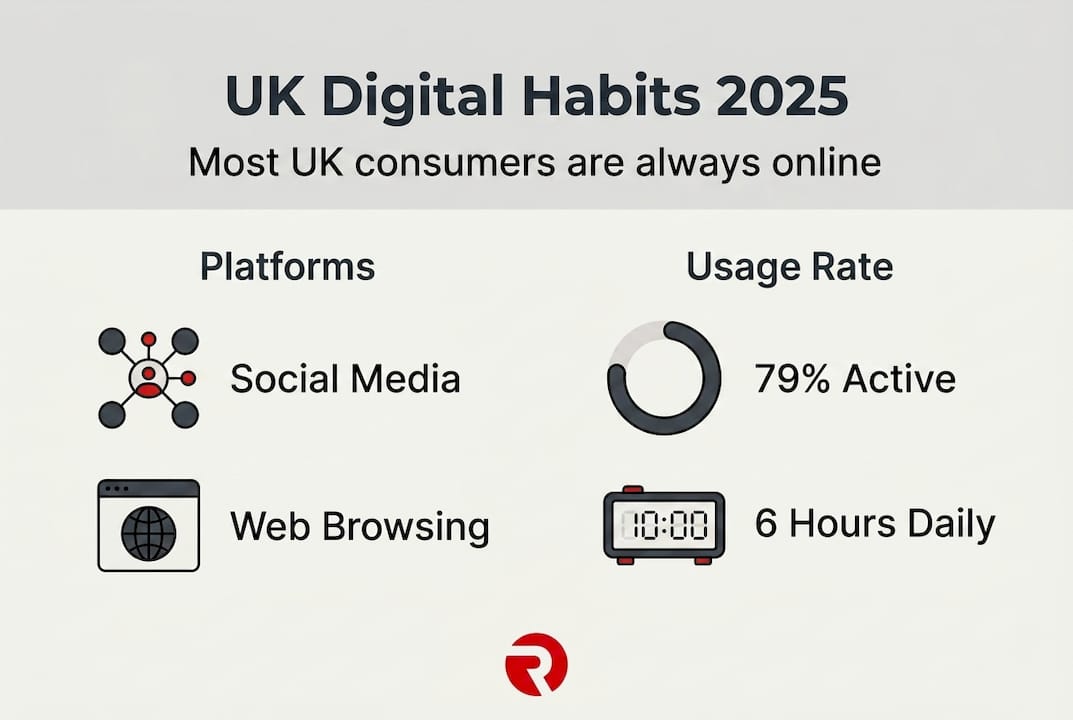
According to recent data, 79% of UK users are active on social media, making it one of the most powerful channels for reaching consumers at scale. That is not a niche audience. That is the majority of your potential customers, spending time in places where your brand could be present every single day.
UK digital adoption snapshot (2025)
| Digital activity | UK adoption rate |
|---|---|
| Internet usage | 97.8% of population |
| Social media usage | 79% of internet users |
| Mobile internet access | 88% of adults |
| Online shopping | 82% of UK adults |
| Search engine usage for local business | 76% of consumers |
The numbers tell a clear story. Yet many brands still rely on word of mouth, print advertising, or static websites that have not been updated in years. This is precisely where the gap opens between businesses that grow and those that plateau. Proven brand strategies consistently show that digital visibility is the common thread among brands that achieve sustained growth across sectors.
The consequences for brands left behind are real and measurable. Lost leads, declining market share, and eroded trust are the typical outcomes. Customers who cannot find you online assume you are either out of business or not worth their time. Neither perception helps you. Refreshing your brand image for digital channels is no longer a creative luxury. It is a competitive necessity.
Key digital shifts shaping UK business visibility right now include:
- Voice search is growing rapidly, changing how local queries are structured
- Google’s E-E-A-T guidelines now reward brands that demonstrate real expertise and credibility
- Social commerce allows consumers to buy directly through platforms like Instagram and TikTok
- Review platforms like Trustpilot and Google Business Profile carry enormous influence over purchase decisions
- Video content now generates significantly higher engagement than static posts across all major platforms
Brands that engage with these shifts proactively are building compounding advantages. Those that ignore them are compounding their own disadvantage.
Key benefits of investing in digital presence
Once you accept that digital presence is essential, the next question is straightforward: what do you actually gain from investing in it properly? The answer is both measurable and substantial.
The most immediate benefit for UK SMEs is cost efficiency. Traditional marketing methods, such as print, outdoor advertising, radio, and direct mail, carry significant upfront costs with limited targeting capability and notoriously difficult attribution. Digital marketing changes this equation dramatically. Digital campaigns cost 50 to 70% less than traditional methods for UK small and medium-sized businesses, while driving up to 50% more customer acquisition. That is not a marginal improvement. That is a structural shift in what your marketing budget can achieve.

Digital vs traditional marketing: a practical comparison
| Factor | Traditional marketing | Digital marketing |
|---|---|---|
| Cost per campaign | High, often fixed | Scalable, flexible |
| Audience targeting | Broad, limited precision | Granular, data-driven |
| Measurability | Difficult to track | Real-time analytics |
| Speed to market | Weeks to months | Days or even hours |
| Interaction with customers | One-way broadcast | Two-way dialogue |
| Reach | Geographically limited | National or global |
Beyond cost, digital presence builds credibility at a pace that traditional methods simply cannot match. A consistent brand voice across your website, social channels, and content builds trust with audiences who have never met you. This matters enormously for service-based businesses, B2B companies, and any brand where trust precedes purchase.
Tangible benefits UK businesses commonly report after committing to digital investment include:
- Increased organic search traffic from well-optimised content
- Higher quality lead generation through targeted paid campaigns
- Stronger customer retention through email marketing and social engagement
- Better brand recall from consistent visual identity and messaging
- Improved reputation management through proactive review monitoring
Understanding digital vs traditional advertising is not about dismissing one and embracing the other wholesale. It is about allocating budget where it generates the strongest return. And increasingly, that means digital channels deserve a larger share of the investment. When you add online advertising strategies that are properly targeted and continuously optimised, the compounding returns over time become genuinely transformative.
“Digital marketing is not about being everywhere. It is about being exactly where your customers are, at the exact moment they are ready to engage.”
Pro Tip: Start by auditing which three digital channels your best existing customers use most. Invest there first before spreading budget across every platform simultaneously.
Core elements of a powerful digital presence
Knowing that you need a strong digital presence is one thing. Understanding precisely what it consists of is another. Many businesses invest in bits and pieces without ever building the cohesive foundation that makes digital marketing genuinely effective.
Here is a practical sequence for building that foundation:
- Build a fast, mobile-responsive website. Over 88% of UK adults access the internet via mobile devices. If your site is slow, cluttered, or difficult to navigate on a smartphone, you are losing visitors within seconds of them arriving. Google also ranks mobile-friendly sites higher.
- Invest in strategic SEO. Search engine optimisation covers keyword research, local search visibility, and technical performance metrics known as Core Web Vitals. These determine whether Google considers your site worth showing to searchers.
- Claim and optimise your Google Business Profile. For local businesses, this single step has outsized impact on visibility in map results and local searches.
- Establish consistent social media presence. This does not mean posting on every platform daily. It means choosing the right platforms for your audience and maintaining a consistent brand voice, cadence, and visual identity across them.
- Implement analytics from day one. You cannot improve what you do not measure. Google Analytics, Search Console, and social platform insights give you the data to refine your strategy continuously.
The technical side of this matters more than many business owners realise. London businesses specifically operate in some of the most competitive digital markets in Europe. Core Web Vitals scores, page load speeds, and schema markup are not developer concerns alone. They directly affect your search rankings and the user experience that determines whether visitors convert or leave.
A proper technical SEO audit can reveal issues that have been quietly suppressing your rankings for months or even years. Broken links, duplicate content, slow server response times, and missing meta descriptions all carry a cumulative cost in lost visibility. Fixing them is not glamorous work, but it is reliably impactful.
Pro Tip: Google’s Core Web Vitals are now a confirmed ranking factor. Use Google’s free PageSpeed Insights tool monthly to monitor your scores and prioritise improvements before they affect your position in search results.
Consistency is just as important as technical quality. A brand that posts sporadically, uses different logos across platforms, or has conflicting messaging between its website and social profiles sends confusion signals to both customers and algorithms. Using analytics for improvement regularly allows you to identify which content resonates, which channels convert, and where your budget is working hardest.
The next frontier: AI and the digital future
Artificial intelligence is reshaping digital marketing faster than most business owners have yet fully processed. This is not speculation about the distant future. It is happening now, in practical, measurable ways, across businesses of all sizes in the UK.
The adoption figures are striking. AI tools are now used by 70% of UK SMEs, with businesses reporting productivity gains of 77% and revenue increases of 43% as a direct result. These are not marginal improvements. They represent a genuine competitive edge for businesses that move early and a growing disadvantage for those that delay.
AI adoption impact on UK SMEs
| AI application | Business impact |
|---|---|
| Content creation and copywriting | Faster production, lower costs |
| Customer service chatbots | 24/7 availability, reduced support load |
| Predictive analytics | Better campaign targeting |
| Email personalisation | Higher open and conversion rates |
| Social media scheduling | Consistent posting with minimal effort |
One area that deserves particular attention right now is Answer Engine Optimisation, commonly referred to as AEO. As AI-powered search tools like Google’s AI Overviews and platforms like ChatGPT, Perplexity, and Gemini increasingly answer user queries directly, the traditional click-through model of search is evolving. AI-driven search now captures approximately 25% of search traffic, a figure that is growing month on month.
AEO means structuring your content so that AI engines surface your brand as an authoritative answer to relevant questions. This requires clear, factual, well-organised content, strong E-E-A-T signals, and schema markup that helps machines understand your expertise. Businesses that combine AI marketing tools with smart human strategy are the ones appearing in these AI-generated answers, capturing visibility their competitors are missing.
Practical starting points for UK businesses exploring AI in their digital marketing include:
- Use AI writing assistants to accelerate content production without sacrificing quality
- Deploy chatbots on your website to handle common queries and qualify leads outside business hours
- Use AI-powered ad platforms like Google Performance Max to optimise campaign targeting automatically
- Explore AI analytics tools that surface insights from your data faster than manual review allows
- Structure FAQ content on your site specifically to address the questions your customers are typing into AI search tools
Understanding the relationship between AEO and SEO is becoming a critical skill for marketing decision-makers in 2026. These are complementary disciplines, not competing ones. Businesses that build both simultaneously are creating the kind of durable digital visibility that compounds over time.
Pro Tip: Audit your existing website content for question-based headings. Rewrite key pages using clear “question and answer” structures to improve your chances of appearing in AI-generated search responses.
Our take: why digital presence is your future-proof investment
After working across brand strategy and digital marketing with businesses ranging from ambitious startups to established global names, one lesson stands out above all others: the brands that weather market disruption best are those with a strong, active digital presence before the disruption arrives.
Physical-only businesses discovered this painfully during periods of economic uncertainty and sudden consumer behaviour shifts. Brands with established digital channels, loyal online communities, and diversified revenue streams adapted. Those without them struggled badly, or did not survive at all.
There is a misconception that digital investment is something you do when you have reached a certain size or revenue threshold. In our experience, that thinking has it entirely backwards. Digital presence is not a reward for success. It is one of the primary mechanisms that creates it. Proven strategies for digital growth consistently demonstrate that the businesses which invest early, build deliberately, and optimise continuously are the ones that achieve sustainable competitive advantage.
The businesses falling behind are not failing because of bad products or poor service. They are failing because they are invisible to the customers who would choose them, if only they could find them.
Partner with experts to maximise your digital growth
Building a powerful digital presence requires both strategic clarity and technical execution. At Radka Advertising, we work as a full-service London agency partnering with entrepreneurs, SMEs, and established brands to build digital foundations that genuinely drive growth. From brand strategy and SEO through to AI-powered campaigns and content creation, our digital marketing services are designed to deliver measurable results in competitive markets. Whether you are starting from scratch or looking to sharpen an existing digital strategy, we can map the right path forward. Visit our Client Portal to start the conversation and take the first step towards a stronger, more visible, and more resilient business online.
Frequently asked questions
How does a digital presence affect customer trust in the UK?
A professional, up-to-date website and active social profiles make UK customers significantly more likely to trust your business. Research confirms that mobile-friendly sites, consistent branding, and strong Core Web Vitals scores all contribute directly to perceived credibility.
Is digital marketing really cheaper than traditional marketing in the UK?
Yes. Digital campaigns cost 50 to 70% less than traditional methods for UK SMEs, while generating up to 50% more customers, making digital investment substantially more efficient for most business objectives.
What should my UK business prioritise for online visibility?
Focus on SEO, a fast mobile-friendly website, consistent social media, and regular analytics review. Core Web Vitals, local search optimisation, and content consistency are the technical foundations that deliver the strongest results over time.
How is AI changing digital marketing for UK SMEs?
AI is now adopted by 70% of UK SMEs, boosting productivity by 77% and revenue by 43%, primarily through content automation, smarter targeting, and the emergence of AEO as AI-powered search captures a growing share of consumer queries.