How to target the Polish audience in the UK: 2026 guide

TL;DR:
- The Polish community in the UK is highly active online, with nearly a million residents and 92% social media usage. Effective marketing involves cultural localisation, bilingual content, and sustained multi-channel engagement that reflects their values and preferences. Brands that understand their audience’s habits and build genuine, consistent connections gain trust and loyalty.
The Polish diaspora in the UK represents one of the most commercially active minority demographics in the country. With approximately 900,000 residents and 92% active on social media, this audience demands more than a translated leaflet. Knowing how to target the Polish audience means understanding their digital habits, cultural values, and loyalty behaviours. UK businesses that get this right gain access to a high-trust, high-engagement consumer base that responds strongly to brands that treat them as more than an afterthought.
How to target the Polish audience: who they are and how they behave online
The Polish community in the UK is large, settled, and digitally engaged. Polish adults average 2 hours 12 minutes on social media daily, exceeding the UK national average. That figure signals a community that is reachable, active, and open to brand communication through digital channels.

Their platform preferences lean towards Instagram, TikTok, YouTube, and LinkedIn, depending on age and professional context. Younger Polish consumers engage heavily with short-form video content, while Polish entrepreneurs and professionals favour LinkedIn for business networking. Understanding this split is the first step in building a channel strategy that actually reaches the right people.
Language plays a significant role in trust. Polish consumers in the UK are bilingual, but they respond more warmly to brands that acknowledge their heritage language. Content published entirely in English is not wrong, but bilingual content signals respect and cultural awareness. That signal builds the kind of trust that drives conversions.
Polish-owned businesses are also deeply embedded in the UK economy. 82.1% of Polish-owned businesses in the UK have operated successfully for over five years, and 74.2% are registered as UK Limited Companies. This level of market integration means Polish entrepreneurs are not a niche audience. They are a commercially mature segment worth targeting with dedicated B2B strategies.
Key audience segments to define before you launch
- General Polish consumers in the UK: price-conscious, loyalty-driven, and responsive to culturally familiar messaging
- Polish entrepreneurs and business owners: professionally ambitious, UK-market integrated, and receptive to B2B services
- First-generation diaspora: strong ties to Polish culture, heritage language content resonates deeply
- Second-generation Polish-British consumers: bilingual, culturally hybrid, and influenced by both UK trends and Polish identity
Segmented campaigns yield higher engagement than generic messaging. Defining your segment before writing a single word of copy is not optional. It is the foundation of every decision that follows.
How do you culturally localise marketing messages for Polish consumers?
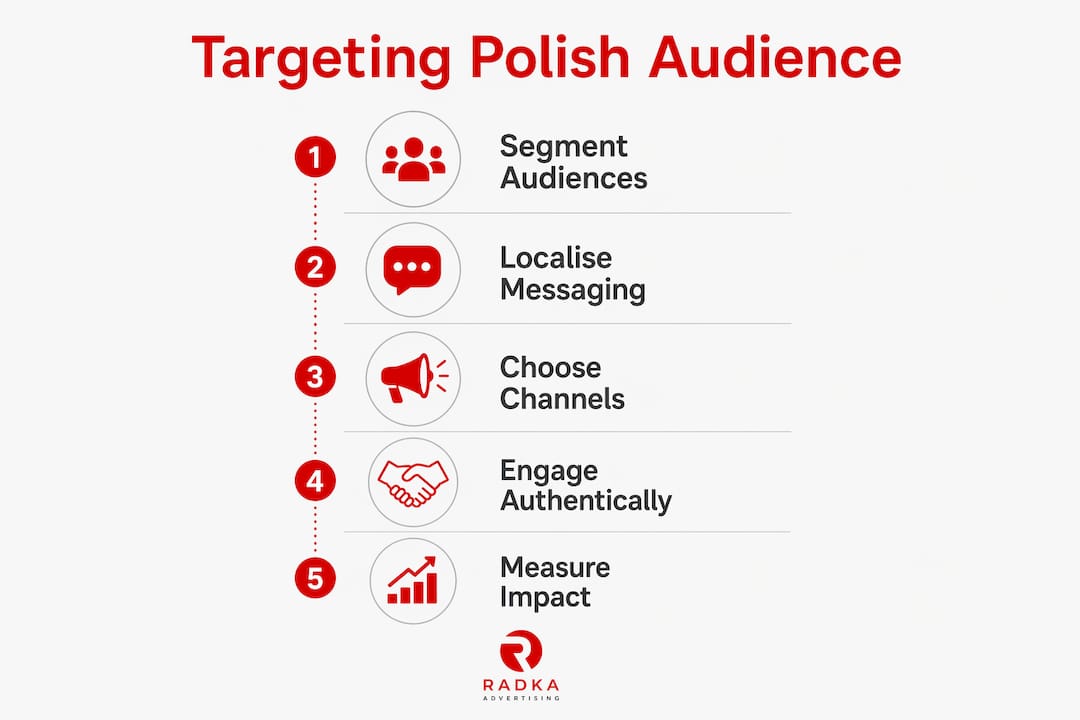
Cultural localisation is the practice of adapting your brand’s tone, imagery, and storytelling to fit the values and expectations of a specific cultural group. It goes well beyond translation. A Polish consumer in the UK does not simply want English content in Polish. They want content that reflects how Polish people think, communicate, and make decisions.
Polish communication culture tends to value directness, substance, and authenticity. Overly polished, corporate-sounding messaging often falls flat. Founder-led content performs particularly well because it puts a real person behind the brand. A short video from a company founder speaking directly to the Polish community, in both Polish and English, builds credibility faster than any paid display campaign.
Storytelling is the mechanism that connects cultural values to brand identity. Polish consumers respond to narratives about hard work, family, community, and quality. Brands that weave these themes into their content, rather than defaulting to generic benefit statements, see stronger emotional engagement. This is not about stereotyping. It is about understanding what genuinely resonates.
Loyalty programmes are a particularly powerful tool with this audience. Polish consumers have the highest loyalty programme sign-up rate in Europe at 53%, and 67% belong to at least one programme. That statistic reflects a consumer base that actively seeks ongoing relationships with brands, not one-off transactions.
Pro Tip: Design loyalty programmes that combine financial rewards with instant gratification mechanics, such as app-based lotteries or time-limited exclusive offers. Polish consumers respond to programmes that feel personal and rewarding in the moment, not just at the end of a points cycle.
- Adapt imagery to reflect Polish cultural references, not just UK stock photography
- Use bilingual captions on social media posts, even when the primary language is English
- Acknowledge Polish national holidays and cultural events in your content calendar
- Avoid generic “community” messaging. Name the Polish community specifically and directly
- Test founder-led video content against polished brand video to measure trust and engagement
Brand positioning that reflects cultural sensitivity consistently outperforms generic messaging when targeting diaspora communities. The Polish audience in the UK is no exception.
Which channels and tactics work best for reaching Polish consumers in the UK?
Multi-channel marketing is the standard approach for reaching the Polish audience effectively. No single platform captures the full demographic. A well-structured campaign uses social media, SEO, PR, and loyalty mechanics in combination.
Social media
Bilingual content across Instagram, TikTok, YouTube, and LinkedIn reaches both the Polish diaspora and the wider UK audience simultaneously. Instagram and TikTok work best for consumer brands targeting younger Polish adults. LinkedIn is the right channel for businesses targeting Polish entrepreneurs. YouTube supports longer-form storytelling and product demonstrations that build deeper trust over time.
Influencer partnerships with Polish-British content creators add authenticity that paid advertising cannot replicate. A Polish-British influencer with 30,000 engaged followers delivers more qualified reach than a broad UK campaign with ten times the budget. The key is choosing creators whose audience profile matches your target segment.
SEO and content marketing
Localised SEO enables better organic reach among the Polish diaspora in the UK. This means auditing your website for UK spelling, Polish-relevant search terms, and technical performance. Polish consumers searching in English will use different search queries than the general UK population. Phrases like “Polish food delivery London,” “Polish accountant UK,” or “Polish community events Birmingham” represent real search behaviour worth capturing.
A data-driven marketing process helps identify which search terms your Polish audience actually uses, rather than which ones you assume they use. Building content around real search data closes the gap between what you publish and what your audience finds.
PR and media presence
Digital PR combined with influencer marketing and founder-led messaging builds credibility in both UK and Polish markets. Coverage in Polish-language UK media outlets, such as community newspapers and online portals, carries significant trust weight with first-generation diaspora consumers. UK mainstream media coverage adds legitimacy for second-generation and broader audiences.
Consistent brand presence requires multiple UK media mentions at launch, followed by ongoing localised content. A single press release does not build a reputation. A sustained cadence of relevant, culturally aware content does.
- Define your audience segment before selecting channels
- Build bilingual social media content for Instagram, TikTok, and LinkedIn
- Partner with Polish-British influencers whose audience matches your target profile
- Audit your website for Polish-relevant SEO terms and UK technical standards
- Secure coverage in Polish-language UK media at launch
- Launch a loyalty programme with instant reward mechanics
- Measure engagement by segment and adjust content accordingly
| Channel | Best for | Content type |
|---|---|---|
| Consumer brands, lifestyle | Bilingual posts, reels, stories | |
| TikTok | Younger Polish consumers | Short-form video, cultural content |
| Polish entrepreneurs, B2B | Thought leadership, founder content | |
| YouTube | Trust-building, product demos | Long-form bilingual video |
| SEO/Blog | Organic discovery | Polish-relevant search content |
What are the most common mistakes when targeting the Polish audience?
The most damaging mistake is treating translation as localisation. A Polish translation of an English campaign is not a Polish campaign. It is an English campaign in a different language. Polish consumers notice the difference immediately, and it signals that the brand has not made a genuine effort to understand them.
Neglecting content cadence after launch is the second most common failure. Many UK businesses invest in a launch campaign, see initial engagement, and then go quiet. Polish consumers, like all diaspora audiences, respond to brands that maintain a consistent presence. Disappearing after launch erodes the trust that the initial campaign built.
Underestimating founder visibility is a specific mistake that costs brands significant credibility. Founder-led messaging secures credibility and momentum. A brand without a visible human voice feels distant to a community that values personal relationships and direct communication.
- Assuming all Polish consumers in the UK have identical preferences. First-generation and second-generation consumers differ significantly in their cultural orientation
- Ignoring loyalty programme design. Generic points schemes do not resonate. Effective programmes use personalisation and time-limited offers to drive repeat engagement
- Overlooking Polish-language UK media. Advertising only in English misses a significant portion of the first-generation diaspora
- Measuring success only by reach. Engagement rate, loyalty sign-ups, and repeat purchase behaviour are more meaningful metrics for this audience
Pro Tip: Run a small bilingual test campaign before committing to a full-scale launch. Split your budget between English-only and bilingual versions of the same ad. The engagement difference will tell you exactly how much the language investment is worth for your specific product.
A strong digital presence is the foundation that makes every other tactic work. Without it, even well-localised campaigns lack the credibility infrastructure to convert interest into action.
Key takeaways
Reaching Polish consumers in the UK requires cultural localisation, bilingual content, and sustained multi-channel presence, not just translation.
| Point | Details |
|---|---|
| Audience size and activity | The Polish diaspora numbers approximately 900,000 in the UK, with 92% active on social media daily. |
| Loyalty programme priority | Polish consumers have Europe’s highest loyalty sign-up rate at 53%. Design programmes with instant and personalised rewards. |
| Cultural localisation over translation | Adapt storytelling, imagery, and tone to Polish cultural values. A translated English campaign is not a Polish campaign. |
| Founder-led messaging | Visible founders build trust faster than polished brand content. Use bilingual video to connect directly with the community. |
| Sustained content cadence | Launch coverage alone does not build reputation. Consistent, culturally relevant content sustains visibility and organic growth. |
What I have learned from working with Polish-UK campaigns
The single biggest misconception I see from UK businesses is that the Polish audience is easy to reach because Polish people speak English. They do. But speaking English and feeling spoken to are entirely different things.
The campaigns that perform best are the ones where the brand has clearly done its homework. Not just translated a tagline, but genuinely thought about what matters to a Polish person living in the UK. That might mean referencing the experience of building a life in a new country. It might mean acknowledging Polish national pride without being patronising about it. It always means showing up consistently, not just at launch.
I have seen brands with modest budgets outperform much larger competitors simply because they committed to bilingual content and founder visibility. A founder who speaks directly to the Polish community, in Polish, even imperfectly, earns more trust than a polished campaign from a brand that has never acknowledged the community exists.
The other thing I would push back on is the assumption that loyalty programmes are a “nice to have.” For this audience, they are a primary engagement mechanism. Polish consumers are among the most loyalty-programme-active in Europe. If you are not offering one, you are leaving a significant retention tool unused.
Long-term relationship building is what separates brands that succeed with the Polish audience from those that see a spike and then fade. One campaign is a conversation starter. Sustained presence is what builds a brand.
— Bart
How Radkaadvertising helps UK businesses reach the Polish market
Radkaadvertising works with UK businesses that want to engage the Polish demographic with campaigns that go beyond surface-level translation. The agency brings together bilingual content creation, digital PR services, and culturally nuanced brand strategy to build genuine connections with Polish consumers and entrepreneurs in the UK. From founder-led video campaigns to loyalty programme design and localised SEO, Radkaadvertising builds the full picture. The agency’s case studies demonstrate measurable results across consumer and B2B campaigns targeting Polish-UK audiences. If your business is ready to move beyond generic messaging and build real traction with this commercially significant community, Radkaadvertising is the partner to make it happen.
FAQ
How large is the Polish audience in the UK?
The Polish diaspora in the UK numbers approximately 900,000 residents. This makes it one of the largest non-British ethnic communities in the country.
Why does cultural localisation matter more than translation?
Translation changes the language. Localisation changes the meaning, tone, and cultural relevance of the message. Polish consumers respond to content that reflects their values, not just their language.
What social media platforms work best for reaching Polish consumers?
Instagram, TikTok, YouTube, and LinkedIn are the most effective platforms. Platform choice depends on whether you are targeting general consumers, younger audiences, or Polish entrepreneurs.
How do loyalty programmes help with marketing to the Polish audience?
Polish consumers have the highest loyalty programme sign-up rate in Europe at 53%. Programmes that combine financial rewards with personalised, instant mechanics drive the strongest repeat engagement.
What is the biggest mistake UK businesses make when targeting Polish consumers?
The most common mistake is treating a Polish translation of an English campaign as a localised strategy. Genuine localisation requires adapting storytelling, imagery, and tone to Polish cultural values, not just the language.