Brand storytelling: a guide to stronger marketing

TL;DR:
- Effective brand storytelling creates emotional connections, leading to greater loyalty than factual communication.
- Using frameworks like the Hero’s Journey and maintaining authenticity are key to resonant narratives.
- Measuring success involves tracking engagement, sentiment, and long-term perception shifts.
Brands that lead with facts alone are leaving loyalty on the table. Research consistently shows that storytelling builds emotional connection in ways that product specs and feature lists simply cannot replicate. Yet most marketing teams still default to rational, data-heavy messaging, assuming audiences make decisions based on logic. They rarely do. This article defines brand storytelling, explains why it works at a neurological level, walks through the most effective frameworks, addresses common pitfalls including authenticity gaps and B2B-specific challenges, and gives you a clear method for measuring whether your stories are actually landing.
Table of Contents
- What is brand storytelling?
- Core frameworks and mechanics explained
- Nuances and pitfalls: authenticity, channel consistency, and B2B strategy
- Measuring storytelling success: metrics that matter
- A brand strategist’s take: what most marketing stories miss
- Partner with story-led experts for brand growth
- Frequently asked questions
Key Takeaways
| Point | Details |
|---|---|
| Stories build connection | Brand storytelling forges emotional links that make your brand memorable. |
| Frameworks guide impact | Using proven narrative structures helps you craft stories that engage, not just inform. |
| Authenticity is vital | Your brand story must align with real values and actions to earn trust. |
| Data refines your story | Track both engagement and sentiment to continually improve your brand narrative. |
What is brand storytelling?
Brand storytelling is using narratives to communicate a brand’s identity, values, and messages in a way that resonates emotionally with audiences. It is a deliberate marketing strategy, not simply a creative exercise. The goal is to move people from passive awareness to genuine connection, and eventually to loyalty.
The reason stories work so powerfully in marketing comes down to how the brain processes information. When you present facts, the brain activates language-processing regions and little else. When you tell a story, sensory, emotional, and motor regions all fire simultaneously. This is sometimes called neural coupling, and it explains why a well-told brand narrative sticks far longer than a list of product benefits.
Consider the difference between these two approaches:
- Facts-first: “Our running shoes use carbon-fibre plates and a 40mm stack height for maximum energy return.”
- Story-first: “Maria trained for three years after a knee injury. On race day, she crossed the finish line in tears. These are the shoes she wore.”
Both communicate quality. Only one makes you feel something.
Effective brand storytelling typically shares several characteristics:
- It centres a human experience, not a product feature
- It communicates values implicitly, through action rather than declaration
- It creates tension and resolution, giving audiences something to follow
- It is consistent across every channel and touchpoint
- It invites the audience to see themselves in the story
“People will forget what you said, but they will never forget how you made them feel.” This principle sits at the heart of every successful brand narrative.
Building this kind of emotional architecture requires more than good copywriting. It requires a clear understanding of brand marketing foundations, including your positioning, your audience’s deepest motivations, and the values your brand genuinely holds. Without that groundwork, even the most beautifully crafted story will feel hollow.
Core frameworks and mechanics explained
With a clear definition in place, the next question is how to structure your stories. Proven frameworks exist precisely because narrative has patterns, and those patterns work on audiences regardless of industry or medium.
Key storytelling mechanics include identifying customer pain points, positioning the brand as a guide rather than a hero, and selecting a structure that suits your campaign objective. The two most widely used frameworks are the Hero’s Journey and the five-part narrative structure.
The Hero’s Journey places the customer as the hero facing a challenge. The brand enters as a mentor or guide, equipping the hero with tools, knowledge, or support to overcome the obstacle and reach transformation. Think of how Dove’s “Real Beauty” campaign positioned women as the heroes of their own stories, with Dove as the brand that simply removed the barriers.

The five-part narrative structure follows: situation, complication, turning point, resolution, and lesson. This is particularly effective for longer-form content such as case studies, video campaigns, and brand documentaries.
| Framework | Best suited for | Core tension | Audience role |
|---|---|---|---|
| Hero’s Journey | Emotional campaigns, brand films | Struggle to transformation | Sees themselves as hero |
| Five-part narrative | Case studies, long-form content | Problem to resolution | Witnesses the journey |
| Before and after | Social media, product launches | Pain point to solution | Identifies with the before |
| In medias res | Short video, ads | Immediate conflict | Drawn in without context |
To match frameworks to campaign objectives, follow this process:
- Define the emotional outcome you want the audience to feel
- Identify the tension or challenge your audience genuinely faces
- Choose the framework that best maps to your content format and channel
- Position your brand as the guide, never the protagonist
- Test the story with a small segment before full deployment
Pro Tip: The same core story can be adapted across channels without losing coherence. A Hero’s Journey campaign might run as a 90-second film on YouTube, a three-post series on LinkedIn, and a single image with a caption on Instagram. The emotional arc stays intact; only the format changes.
Nuances and pitfalls: authenticity, channel consistency, and B2B strategy
Frameworks are only as effective as the truth behind them. Authenticity is critical because any gap between a brand’s story and its actual behaviour erodes trust rapidly and publicly.
The consequences of inauthenticity are not abstract. OpenAI faced significant backlash when its public narrative around safety and transparency clashed with internal governance decisions. WeWork built an entire brand mythology around community and purpose, only for that story to collapse spectacularly when its operational reality came to light. Audiences are not naive. They cross-reference stories against actions, reviews, news coverage, and employee accounts.
Common authenticity pitfalls include:
- Overclaiming values your organisation has not yet demonstrated through action
- Copying competitor narratives rather than finding your own genuine angle
- Ignoring employee experience, which is often the most credible signal of brand culture
- Treating storytelling as a campaign, rather than an ongoing organisational commitment
| Channel | Risk of misalignment | Benefit of consistency |
|---|---|---|
| Social media | High visibility of contradictions | Builds community loyalty rapidly |
| PR and media | Scrutiny from journalists | Amplifies credibility at scale |
| Internal comms | Disengaged employees undermine narrative | Turns staff into brand advocates |
| Customer service | Tone mismatch destroys trust | Reinforces brand values at key moments |
For B2B storytelling best practices, the approach requires a specific calibration. B2B buyers are not immune to emotion, but they operate within organisations where decisions must be justified rationally. The most effective narrative marketing for B2B combines emotional resonance with evidence. Use case studies that show measurable outcomes. Frame the customer’s business challenge as the central tension. Let data reinforce the story rather than replace it.
Pro Tip: Before publishing any brand story, stress-test it internally. Ask: “Would our customers, employees, and critics all recognise this as true?” If the answer is no, revise the story or change the behaviour it describes.
Measuring storytelling success: metrics that matter
Effective storytelling is not measured by how beautiful the narrative is. It is measured by what changes in your audience’s behaviour, perception, and relationship with your brand.
Storytelling engagement is measured primarily through growth metrics (27%), sentiment tracking (26%), and return on investment. These three categories give you a layered view of whether your stories are reaching, resonating, and converting.
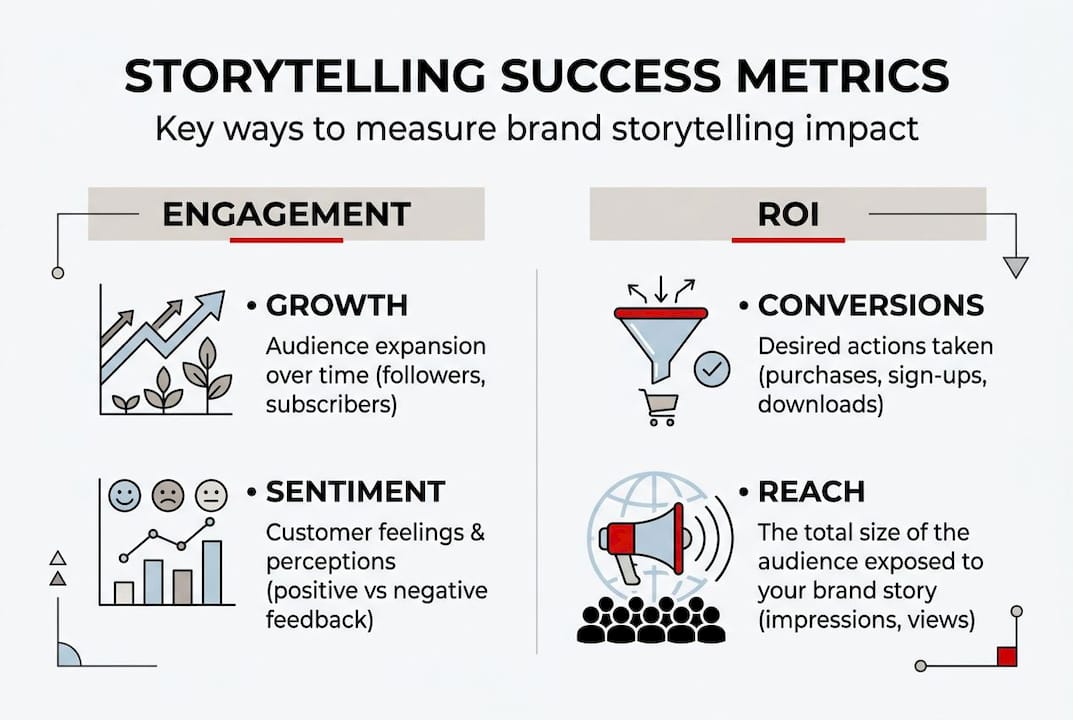
The metrics worth tracking fall into two categories:
Quantitative indicators:
- Engagement rate across content formats (video completion, shares, saves)
- Audience growth tied to specific narrative campaigns
- Conversion rate from story-led content versus feature-led content
- Brand search volume uplift following campaign periods
Qualitative indicators:
- Sentiment analysis of comments, reviews, and social mentions
- Unsolicited customer feedback referencing brand values or story themes
- Media coverage tone and framing
- Employee advocacy levels and internal story adoption
Statistic to note: Engagement growth (27%) and sentiment tracking (26%) are the leading measures marketers use to evaluate storytelling impact, making them your primary diagnostic tools.
The most common mistake is measuring storytelling with the same metrics used for direct response advertising. Story-driven content builds brand equity over time. You need a longer measurement window, typically 90 days minimum, and you need to track sentiment alongside volume.
For analysing marketing effectiveness, build a feedback loop into every campaign. Gather data at the midpoint, not just at the end. Adjust narrative tone, format, or distribution based on what the data tells you, and document those learnings for the next campaign cycle.
Pro Tip: Set up a simple sentiment dashboard using social listening tools before your campaign launches. This gives you a baseline, so you can measure genuine shifts in audience perception rather than guessing.
A brand strategist’s take: what most marketing stories miss
Here is the uncomfortable truth we see repeatedly: most brand stories are about the brand, not the customer. The company is positioned as the hero, the product is the solution, and the customer is a passive recipient of value. This structure is backwards, and it is why so many campaigns generate impressions but not loyalty.
The brands that build enduring market positions do something different. They make the customer’s transformation the centre of gravity. Every story element, the tension, the guide, the resolution, orbits around what changes for the person, not what the brand achieves.
Consistency is the other underestimated factor. A brilliant campaign that contradicts your customer service tone, your hiring behaviour, or your leadership’s public statements will not hold. Story is not a communications layer. It is an organisational commitment.
We have seen this play out across real campaign lessons from brands in competitive markets. The ones that sustain growth treat storytelling as infrastructure, not decoration. They build it into strategy, not just creative briefs.
Partner with story-led experts for brand growth
If you are ready to move from understanding brand storytelling to actually implementing it at scale, working with specialists accelerates the process considerably. At Radka Advertising, we are brand storytelling experts who combine strategic rigour with creative execution to build narratives that perform across every channel.
Our approach is data-informed and audience-led. We do not apply generic frameworks to your brand. We build bespoke storytelling strategies grounded in your positioning, your audience’s real motivations, and measurable campaign objectives. Whether you are launching a new brand or repositioning an established one, our AI-powered growth capabilities ensure your stories reach the right people with precision and impact.

Frequently asked questions
How is brand storytelling different from traditional advertising?
Unlike traditional ads that focus on features and benefits, brand storytelling uses narrative to evoke emotions and build deeper audience connection over time, rather than simply prompting an immediate transaction.
What frameworks are most effective for brand storytelling?
The Hero’s Journey and five-part narrative structure are the most widely used and effective frameworks, as they centre the customer’s experience and create clear emotional arcs that audiences follow naturally.
Why is authenticity so important in brand storytelling?
Because gaps between story and actions erode trust quickly and visibly. Audiences today have more tools than ever to verify whether a brand’s narrative matches its real behaviour.
How can B2B brands use storytelling effectively?
B2B brands succeed by pairing emotional resonance with data-backed narratives that address real business challenges, using case studies and measurable outcomes to justify decisions within organisations.
Recommended
- Full-Service Advertising Agency — London | Radka Advertising
- ClientPortal | RADKA ADVERTISING
- Services — Full-Service Advertising & Marketing | Radka Advertising
- Blog — Insights & Strategy | Radka Advertising
- How SEO shapes branding for sustainable business growth
- 6 voorbeelden van sterke merken en wat jij ervan kunt leren