Brand transformation: key steps for UK business growth

TL;DR:
- Brand transformation involves strategic repositioning, not just visual updates.
- It is driven by market shifts, consumer values, and digital integration.
- Successful transformation balances evolution with preserving brand equity through phased approaches.
Many UK business owners treat brand transformation as a last resort, something you do when things go wrong. But the data tells a different story. Brands evolving positioning with market shifts outperform competitors by 33% in customer retention and 40% in innovation perception. That is not a marginal gain. It is a structural advantage. The real challenge is not whether to transform, but how to do it without losing the trust and recognition you have already built. This article breaks down what brand transformation actually means, what triggers it, and how UK businesses can apply it without gambling their hard-earned brand equity.
Table of Contents
- Defining brand transformation and why it matters
- Key drivers and triggers for brand transformation
- Balancing transformation and brand equity
- Practical steps for successful brand transformation in the UK
- Our perspective: What most businesses miss about brand transformation
- How Radka Advertising supports brand transformation in the UK
- Frequently asked questions
Key Takeaways
| Point | Details |
|---|---|
| Strategic transformation | Brand transformation means repositioning for long-term relevance, not just a new logo. |
| Balance consistency | Effective transformation balances adaptation with preserving brand equity and trust. |
| Customer-led audits | Start with customer insights and phased rollouts to ensure sustainable change and market fit. |
| Measure impact | Use retention, innovation perception, and sales benchmarks to assess transformation success. |
Defining brand transformation and why it matters
Brand transformation is one of those terms that gets used loosely, often confused with a logo refresh or a new colour palette. In reality, it is something far more significant. Brand transformation is a deliberate, strategic repositioning of how your business is perceived, not just how it looks. It touches your values, your audience targeting, your tone of voice, and your place in the market.
The distinction matters enormously. A rebrand might mean updating your visual identity. Brand transformation means reconsidering the entire relationship between your business and its customers. It is driven by a need to stay relevant as markets shift, audiences evolve, and technology changes the rules of engagement.
Consider what Nike achieved through its direct-to-consumer (DTC) strategy. By repositioning around digital engagement and community, Nike DTC revenue doubled from 2017 to 2023, reaching £21 billion and representing 44% of total revenue, with digital sales accounting for 26%. That is not the result of a new logo. It is the result of a strategic transformation in how the brand connects with people.
For UK businesses, the benefits of getting this right are significant:
- Improved customer retention through stronger emotional relevance
- Boosted innovation perception that attracts new audiences and partnerships
- Digital sales growth as transformation often accelerates online channel performance
- Competitive differentiation in crowded markets where products alone no longer separate brands
There is a risk, though. Over-frequent transformation dilutes equity. If your brand changes direction every eighteen months, customers stop trusting it. Consistency and evolution must work together, not against each other.
“Brand transformation is not about abandoning who you are. It is about becoming more of what your customers need you to be.”
You can explore how this plays out across different sectors through our brand transformation portal, which offers resources and case-study access for businesses at every stage. For broader strategic context, expert marketing consultations can also help you frame the right questions before committing to a direction.
Key drivers and triggers for brand transformation
Understanding what brand transformation is only gets you halfway. The more pressing question for most UK business owners is: when does it become necessary?
The triggers are rarely dramatic. They tend to build quietly until the gap between your current brand and your market reality becomes impossible to ignore. Here are the most common drivers:
- Market disruption: New competitors, new technologies, or new business models that shift customer expectations
- Changing consumer values: Audiences increasingly favour brands aligned with sustainability, transparency, and social responsibility
- Digital integration demands: Customers now expect seamless digital experiences across every touchpoint
- UK-specific pressures: Regulatory changes, post-Brexit trade dynamics, and rapid digital adoption across sectors
- Audience evolution: Your original customer base has aged, moved on, or changed priorities
In the UK context, digital adoption has accelerated sharply since 2020. Businesses that delayed integrating digital channels into their brand experience have found themselves losing ground to competitors who moved faster. This is particularly acute in retail, financial services, and professional services.
| Driver | Example | Transformation response |
|---|---|---|
| Market disruption | Fintech challenging high street banks | Digital-first brand repositioning |
| Consumer values shift | Demand for ethical sourcing | Purpose-led brand narrative |
| Regulatory change | Post-Brexit compliance requirements | Brand communication overhaul |
| Digital adoption | E-commerce growth | DTC channel and identity alignment |
Brands evolving with market shifts outperform peers by 33% in retention and 40% in innovation perception, which makes a compelling case for proactive rather than reactive transformation.
As a London advertising agency working with businesses across sectors, we consistently see that the brands who transform most successfully are those who start with their customers, not their competitors.

Pro Tip: Before planning any transformation, conduct a customer-led audit. Survey existing customers about what they value most in your brand, then cross-reference this with what new audiences say they need. The gap between those two answers is your transformation brief.
Balancing transformation and brand equity
Brand equity is the accumulated trust, recognition, and goodwill your brand has earned over time. It is genuinely valuable, and it is also genuinely fragile. The tension every business faces is this: how do you evolve without eroding what you have already built?
Research from Les Binet and Peter Field, two of the most respected voices in marketing effectiveness, offers a useful benchmark. They advocate 3 to 5 years of brand consistency to optimise growth, arguing that frequent shifts in brand direction undermine the cumulative effect of marketing investment.
This does not mean brands should never change. It means change should be deliberate and phased, not reactive and rushed.
“The brands that win long-term are not the ones that change the most. They are the ones that change wisely.”
Aviva, the UK insurance and financial services group, offers a strong example. Rather than overhauling its brand overnight, Aviva used a phased approach, maintaining its core values of trust and reliability while modernising its digital presence and customer communication. The result was transformation that felt like evolution, not disruption.
How to balance transformation with equity:
- Audit your brand assets to identify which elements carry the most equity (name, visual identity, tone, values)
- Define your non-negotiables before planning any change, these are the elements you will protect regardless
- Test changes incrementally with smaller audience segments before full rollout
- Communicate the continuity to existing customers, make clear what is staying the same and why
- Review impact at six-month intervals to catch any equity erosion early
| Approach | Risk level | Equity impact | Best for |
|---|---|---|---|
| Full rebrand | High | Significant disruption | Crisis recovery or complete pivot |
| Phased transformation | Medium | Manageable if monitored | Growth-stage businesses |
| Incremental evolution | Low | Minimal if consistent | Established brands with strong equity |
You can see how this balance plays out across real businesses in our brand transformation case studies, covering sectors from energy to consumer goods. For a deeper look at the academic argument, this brand consistency analysis from Management Today is well worth reading.
Practical steps for successful brand transformation in the UK
Knowing the theory is one thing. Executing transformation in a real UK business context is another. Here is a practical framework that works across sectors and business sizes.
Step 1: Conduct a brand audit Start with an honest assessment of where your brand currently stands. Gather customer feedback, review competitor positioning, and analyse your digital presence. Look for gaps between how you see your brand and how your market perceives it.
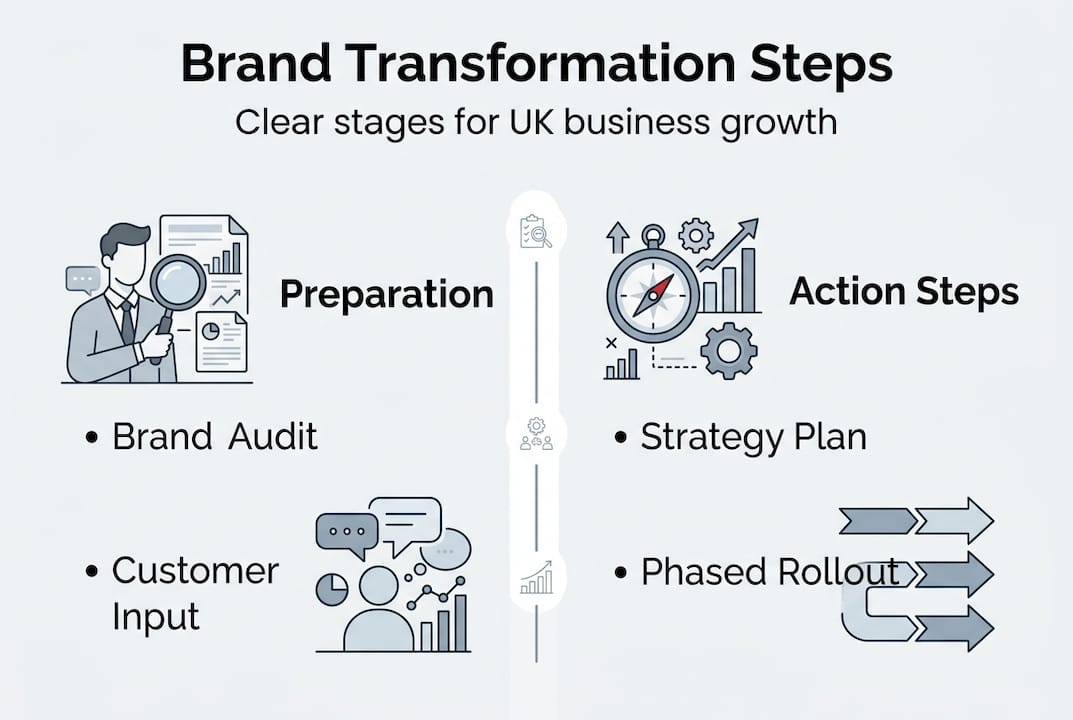
Step 2: Define your transformation strategy Set clear objectives. Are you repositioning for a new audience? Responding to a market shift? Integrating digital channels more effectively? Your strategy should answer these questions before any creative work begins.
Step 3: Plan a phased rollout Avoid the temptation to change everything at once. Aviva’s phased rollouts and customer-led audits demonstrate how gradual implementation reduces risk and allows for course correction.
Step 4: Ensure compliance and local relevance UK businesses must account for regulatory requirements, particularly in financial services, healthcare, and data-driven marketing. Build compliance review into your transformation timeline, not as an afterthought.
Step 5: Measure and review Track both quantitative metrics (retention rates, digital sales, customer acquisition cost) and qualitative indicators (brand sentiment, customer feedback, press coverage). Review at regular intervals and be prepared to adjust.
- Brand audit and gap analysis
- Strategic positioning and objective-setting
- Phased creative and channel rollout
- Compliance and stakeholder review
- Performance measurement and iteration
Pro Tip: Monitor both qualitative and quantitative indicators during transformation. Numbers tell you what is happening. Customer conversations tell you why. You need both to make smart decisions.
Our brand transformation services are structured around exactly this framework, giving UK businesses a clear path from audit to measurable results.
Our perspective: What most businesses miss about brand transformation
Most businesses approach transformation backwards. They start with the visual, the logo, the website, the campaign, and then try to retrofit a strategy around it. The result looks like transformation but functions like decoration.
What we see consistently, across the brands we work with at Radka Advertising, is that the businesses who transform successfully start with customer insight, not creative instinct. They ask hard questions before they commission anything. They treat transformation as a phased, data-driven process rather than a single moment of reinvention.
There is also a tendency to treat transformation and consistency as opposites. They are not. The most resilient brands hold their core values constant while evolving how those values are expressed. That distinction is everything.
UK businesses, in particular, have a tendency to either over-index on global trends without local nuance, or to stay so locally focused that they miss the broader market shifts shaping their sector. The sweet spot is a transformation strategy that is globally informed and locally grounded.
Our brand transformation insights reflect this balance across every project we take on.
How Radka Advertising supports brand transformation in the UK
At Radka Advertising, we work with UK entrepreneurs and established businesses to make brand transformation strategic, measurable, and sustainable. Our approach covers every stage of the process, from the initial customer-led audit through to creative execution and performance review.
We do not believe in transformation for its own sake. Every recommendation we make is grounded in data, shaped by your market, and designed to protect the equity you have already built while opening new ground. Whether you are repositioning for a new audience or integrating digital channels for the first time, our brand transformation services give you the structure and expertise to do it confidently. Access resources and begin your journey through our ClientPortal.
Frequently asked questions
What is the difference between brand transformation and rebranding?
Brand transformation is a strategic repositioning of your brand’s perception, values, and market position, while rebranding typically refers to visual or surface-level updates such as a new logo or colour scheme.
How often should businesses undertake brand transformation?
Experts including Les Binet and Peter Field recommend 3 to 5 years of consistency between major brand changes, ensuring you stay relevant without eroding the trust you have built.
What measurable benefits does brand transformation provide?
Well-executed transformation can deliver 33% higher retention and a 40% improvement in innovation perception compared to brands that do not evolve with their market.
What is a phased brand transformation?
A phased transformation rolls out changes gradually, using customer-led audits and staged implementation to test impact and protect brand equity throughout the process.