Brand strategy basics: Build a powerful identity

TL;DR:
- A deliberate brand strategy defines purpose, target audience, values, and messaging for ongoing growth.
- Visual identity should align with strategy, reinforcing brand recognition and consistency across channels.
- Regularly revisiting and refining brand strategy ensures lasting market relevance and competitive edge.
Most UK entrepreneurs launch their business with a logo, pick a colour palette, and call it branding. It feels complete. It looks the part. But without a deliberate brand strategy underneath, that visual shell is doing very little heavy lifting for your growth. A long-term brand plan defines your purpose, target audience, positioning, values, personality, messaging, and visual identity to shape how the market sees and remembers you. This guide unpacks every essential layer so that UK business owners can build a brand that does far more than look good.
Table of Contents
- What is brand strategy and why does it matter?
- The 7 fundamentals of a successful brand strategy
- Building your brand identity: From strategy to visual presence
- Applying your brand strategy for growth and digital impact
- What most UK businesses miss about brand strategy
- Propel your brand strategy with expert support
- Frequently asked questions
Key Takeaways
| Point | Details |
|---|---|
| Branding goes beyond logos | True brand strategy covers purpose, values, and your unique business position. |
| Seven fundamentals matter | Every brand needs to define purpose, audience, positioning, values, personality, messaging, and visuals for cohesive growth. |
| Consistency drives trust | Unified messaging and identity across platforms build credibility and customer loyalty. |
| Strategy informs action | Translating your brand strategy into real marketing increases digital impact and long-term results. |
What is brand strategy and why does it matter?
A brand strategy is not a mood board or a tagline. It is a structured, long-term plan that determines how your business presents itself, what it stands for, and how it connects with the right people. According to HubSpot, brand strategy encompasses purpose, audience, positioning, values, personality, messaging, and visuals working together as one system. When these elements align, your business becomes instantly recognisable and far more trusted.
For UK entrepreneurs competing in crowded markets, a clear strategy is the difference between being forgettable and being the obvious choice. Think about how brands like Innocent Drinks or Monzo built fierce loyalty not through massive ad budgets, but through strategic clarity. They knew exactly who they were and who they were speaking to.
“Your brand is what other people say about you when you’re not in the room.” — Jeff Bezos
Understanding brand image essentials is a strong starting point, but strategy is the engine underneath that image. The table below shows how strategy directly impacts key business outcomes.
| Business area | Without strategy | With strategy |
|---|---|---|
| Market perception | Inconsistent, confusing | Clear, trustworthy |
| Customer loyalty | Transactional | Emotional and lasting |
| Marketing ROI | Unpredictable | Measurable and improving |
| Competitive edge | Reactive | Proactive and distinctive |
Here are the most common pitfalls businesses face when they skip the strategy stage:
- Inconsistent messaging across channels that confuses potential customers
- No clear differentiation from competitors, leading to price-driven competition
- Wasted marketing spend because campaigns lack a unified direction
- Poor internal alignment, with teams unsure of the brand’s purpose or tone
- Difficulty scaling, as there is no strategic framework to guide new decisions
Looking at real-world brand strategy examples shows exactly how costly these gaps can become over time.
The 7 fundamentals of a successful brand strategy
Breaking down a brand strategy into its components makes it manageable. The seven key elements are purpose, audience, positioning, values, personality, messaging, and visual identity. Each one plays a distinct role, and weakness in any single area undermines the whole.
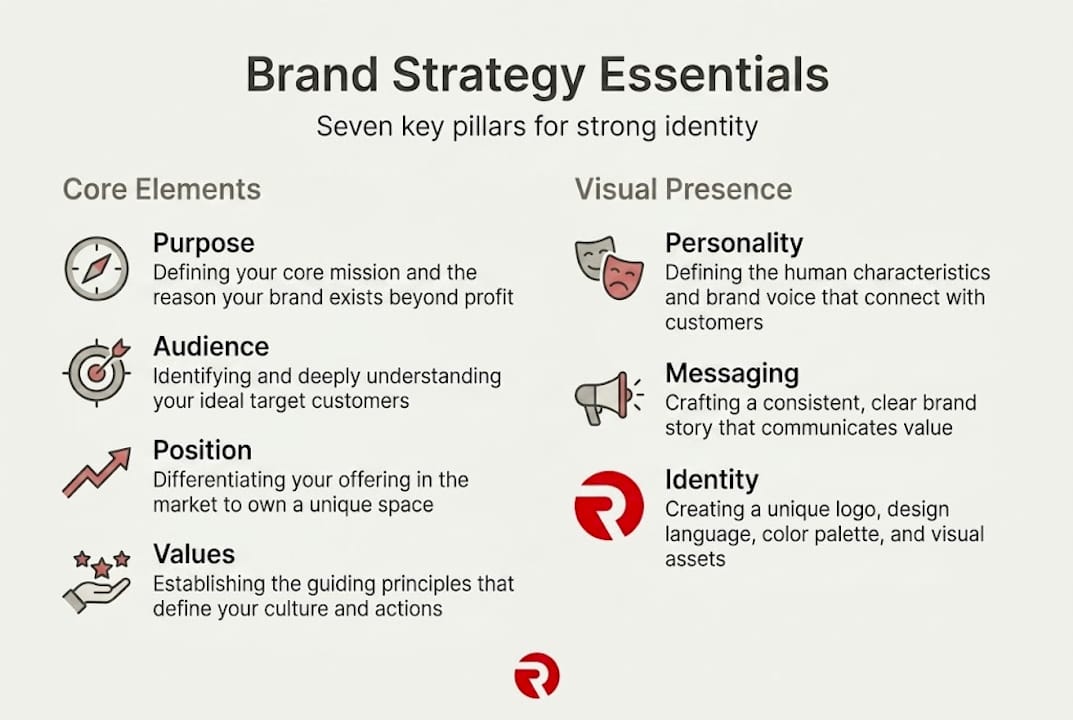
Here is a comparison of weak versus strong execution across these elements:
| Element | Weak example | Strong example |
|---|---|---|
| Purpose | “To sell products” | “To make sustainable living accessible to everyone” |
| Audience | “Everyone” | “Eco-conscious 25 to 40 year-olds in urban UK cities” |
| Positioning | Vague or undefined | “The most affordable certified organic skincare in the UK” |
| Personality | Inconsistent tone | Warm, knowledgeable, and refreshingly honest |
| Messaging | Generic slogans | Specific, audience-driven value propositions |
Follow these steps to clarify your audience and positioning before anything else:
- Define your ideal customer by age, income, lifestyle, and buying motivations.
- Research your competitors and identify the gaps in how they speak to customers.
- Write a positioning statement that captures who you serve, what you offer, and why you are different.
- Test your positioning with real feedback from a small group of target customers.
- Review quarterly to ensure your positioning still reflects market reality.
For the visual side, reviewing visual branding types will help you select the right identity assets to match your strategic direction. You can also study more brand strategy examples to see how top brands bring these elements together in practice.
Pro Tip: UK consumers increasingly favour brands whose values reflect social responsibility, sustainability, and transparency. When building your brand values, do not just list what sounds good. Choose values your business can genuinely demonstrate through its actions and decisions.
Building your brand identity: From strategy to visual presence
Once your strategy is clear, the visual identity work can begin in earnest. This is where most entrepreneurs rush, jumping straight to logo design before they have defined their purpose or audience. A clearly defined purpose and visual identity enhance strategic unity and shape how the market perceives your business at every touchpoint.
Your visual identity is not just a logo. It is the full suite of assets that communicate your brand’s character without a single word. Colours signal emotion. Typography sets tone. Imagery builds world. Every visual choice either reinforces or undermines what your strategy says.
Here are the core identity assets every UK SME should have in place:
- Logo suite including primary, secondary, and icon versions
- Brand colour palette with primary, secondary, and neutral tones
- Typography system with defined fonts for headings, body, and accent text
- Imagery style guide defining photography tone, subject matter, and filters
- Brand voice guidelines covering tone, vocabulary, and messaging dos and don’ts
- Template library for social media, presentations, and print materials
Consistency across every channel is what builds recognition. Whether a customer finds you on Instagram, visits your website, or picks up a leaflet at a trade show, the experience should feel unmistakably you. Exploring visual brand boosting strategies can help identify where your current assets may be falling short.
Pro Tip: Avoid designing your own brand assets without a strategic brief. Even if you are design-savvy, the risk is producing visuals that look appealing in isolation but do not carry your brand’s values or speak to your audience. Brief your designer with your purpose, audience profile, and personality descriptors before a single concept is created.
If your current visuals feel dated or misaligned, consider refreshing your visual presence as a strategic exercise, not just a cosmetic one.
Applying your brand strategy for growth and digital impact
Having a strategy documented is only half the job. The real value comes from activating it consistently across your marketing, your digital channels, and your everyday business decisions. A brand strategy guides ongoing marketing by clarifying messaging, values, and visual identity for all public-facing activity.
Follow these steps to activate your brand strategy in the digital landscape:
- Audit your existing digital presence against your brand guidelines. Look for inconsistencies in tone, visuals, and messaging across your website and social channels.
- Rewrite your website copy using your brand’s voice and value proposition as the filter for every sentence.
- Build a content plan aligned to your brand’s purpose and audience interests, not just trending topics.
- Apply your visual identity consistently across all digital assets, including social templates, email newsletters, and paid advertising.
- Track brand-specific metrics such as direct traffic, branded search volume, and social sentiment to measure awareness over time.
- Use SEO as a brand amplifier. Understanding SEO’s impact on branding shows how organic search can reinforce your authority and reach over the long term.
“Strategy without tactics is the slowest route to victory. Tactics without strategy is the noise before defeat.” — Sun Tzu
This applies directly to digital marketing. Many UK SMEs invest in paid social or Google Ads without first establishing what they stand for. The result is traffic that does not convert and spend that does not compound. When your brand strategy is solid, every campaign has a clear identity to build upon. Reviewing brand growth examples can give you a clearer picture of how activation translates into measurable business results.
What most UK businesses miss about brand strategy
After working with businesses across a wide range of industries, one pattern stands out more than any other: most companies over-invest in design and under-invest in strategic clarity. They spend thousands on a rebrand but cannot articulate their positioning in a single sentence. The new logo lands, the brand feels fresh for about three months, and then the same confusion returns because nothing underneath has changed.
Brand strategy is not a one-off project. It is a living framework that should inform every hire, every campaign, and every product decision. Markets shift. Consumer expectations evolve. The brands that endure are the ones that revisit their strategy regularly and make small, deliberate adjustments rather than waiting for a crisis to force a dramatic overhaul.
The uncomfortable truth is that a modest, consistent brand effort beats a flashy rebrand almost every time. The evidence is in the practical brand lessons of businesses that built lasting equity incrementally, not overnight.
Propel your brand strategy with expert support
Building a brand strategy from the ground up is one of the most high-value investments a UK entrepreneur can make, but it is rarely straightforward to do alone. At Radka Advertising, we work with founders and business owners at every stage of their brand journey, from defining purpose and positioning to creating the visual assets and campaigns that bring a strategy to life. Whether you need a full strategic overhaul or targeted support in a specific area, our advertising and marketing services are built to deliver measurable results. Get in touch to discuss a tailored approach for your business.
Frequently asked questions
What are the essential elements of a brand strategy?
Effective brand strategy includes purpose, audience, positioning, values, personality, messaging, and visual identity working as an integrated system.
Why does brand strategy matter for UK businesses?
A clear strategy shapes market perception and guides key decisions, helping UK businesses build recognition and trust in increasingly competitive markets.
How do I start developing a brand strategy for my SME?
Begin with strategic clarity on purpose, core values, and your target audience, then build your visual identity and messaging framework around those foundations.
How can I ensure my branding stays consistent?
Visual identity and messaging guidelines documented in a clear brand handbook give your team and suppliers a single reference point for every customer-facing decision.
Recommended
- Proven brand strategies: Real-world examples for growth | Radka Advertising
- Types of visual branding to boost market recognition | Radka Advertising
- How to refresh your brand image for lasting impact | Radka Advertising
- Full-Service Advertising Agency — London | Radka Advertising
- Master brand identity in streetwear: a 2026 guide – INCIDENT
- Branding wizualny: jak buduje silny wizerunek firmy - Coolheads - Fotografia biznesowa