Step by step digital marketing for UK entrepreneurs

TL;DR:
- Successful digital marketing requires a structured process that aligns audience insights, clear goals, and focused channels. Implementing frameworks like the 3-3-3 rule, the RACE model, and balanced resource allocation enhances small UK businesses’ growth prospects. Prioritizing distribution and measurement over mere content creation ensures measurable results and sustained online success.
Step by step digital marketing is the process of systematically planning, executing, and measuring online marketing activities to grow your business with precision and purpose. Unlike traditional advertising on TV or radio, digital marketing delivers precise targeting and measurable real-time feedback that mass media simply cannot match. For UK entrepreneurs and small business owners, this matters enormously. You are competing against brands with larger budgets, so a structured approach using frameworks like the RACE model, tools like HubSpot and Mailchimp, and resource rules like the 50/30/20 content split gives you a genuine edge. This guide walks you through every stage of a stepwise digital marketing process, from preparation to optimisation, built specifically for the UK market in 2026.
What do you need before starting digital marketing?
Before you write a single post or launch a single ad, you need the right foundations in place. Skipping this stage is the single most common reason small business digital marketing fails within the first three months. Think of it as laying the groundwork before building: without it, everything shifts.

Define goals tied directly to revenue
Your business goals must connect to money, not vanity metrics. “Get more followers” is not a goal. “Generate 50 qualified leads per month from LinkedIn to support a £5,000 monthly revenue target” is a goal. This specificity shapes every decision you make downstream, from channel selection to content format.
Know your audience beyond demographics
Audience research means understanding the specific problems your customers are trying to solve, not just their age and location. Use Google Analytics, Meta Audience Insights, and direct customer interviews to map real behaviour. The difference between a persona and a behavioural profile is the difference between guessing and knowing.
Choose tools that match your scale
| Tool | Primary use | Best for |
|---|---|---|
| HubSpot | CRM and campaign tracking | Growing SMEs with sales pipelines |
| Mailchimp | Email marketing and automation | Early-stage businesses and newsletters |
| Buffer | Social media scheduling | Solopreneurs and small teams |
| Google Analytics 4 | Website traffic and conversion data | All business sizes |
| Semrush | SEO and keyword research | Content-led businesses |
Pro Tip: Do not subscribe to every tool at once. Start with Google Analytics 4 and one scheduling platform. Add complexity only when your current tools reveal a gap you cannot fill.
How to build a step-by-step digital marketing strategy
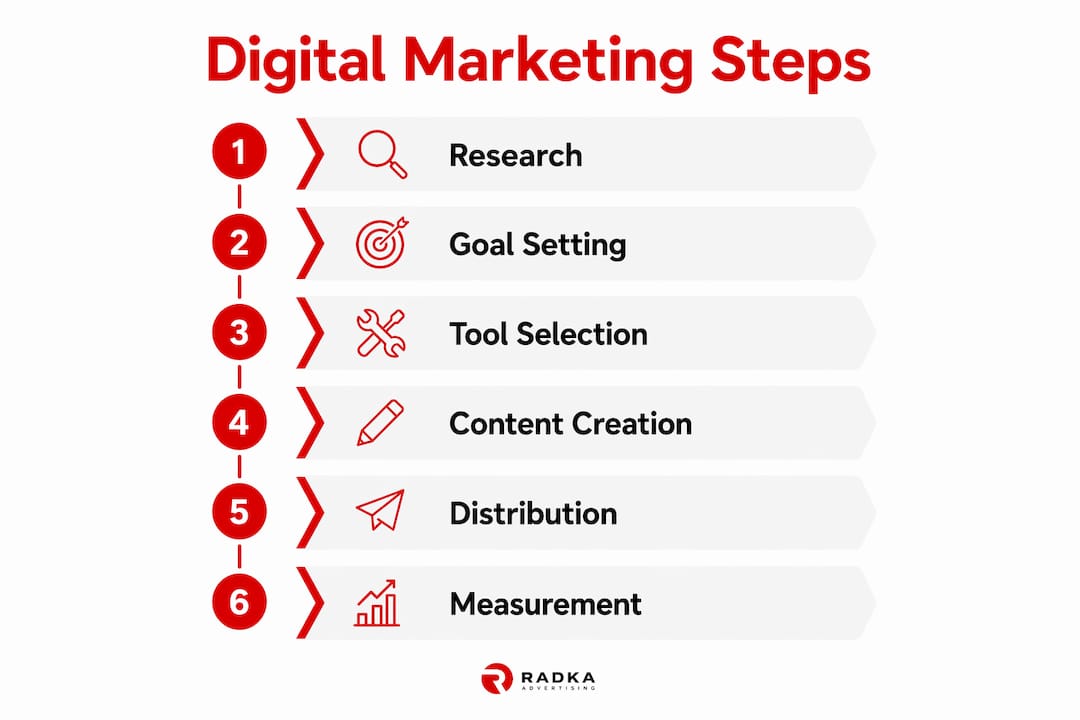
A digital marketing strategy is not a list of tactics. It is a structured plan that connects your audience, your message, and your channels to a measurable outcome. The most effective framework for small UK businesses combines the 3-3-3 rule with the RACE model.
Apply the 3-3-3 rule to avoid strategy sprawl
The 3-3-3 rule keeps your strategy focused: three core messages, three channels, and three measurable outcomes. Focusing beyond three dilutes your efforts, especially when you are working with a small team or limited budget. A London-based independent retailer, for example, might focus on brand trust, product quality, and local expertise as its three messages, delivered via Instagram, email, and Google Search, measured by conversion rate, email open rate, and organic click-through rate.
Use the RACE framework to sequence your activity
The RACE framework, developed by Smart Insights, organises digital marketing into four stages: Reach, Act, Convert, and Engage. Reach covers how you attract new audiences through SEO, paid search, and social media. Act describes how you encourage interaction on your website or landing pages. Convert is the moment a visitor becomes a customer. Engage is everything you do to retain that customer and turn them into a repeat buyer.
Allocate resources with the 50/30/20 rule
Experts recommend the 50/30/20 content split: 50% of your resources on content creation, 30% on distribution, and 20% on measurement. Most small businesses invert this accidentally, spending 80% creating and almost nothing distributing or analysing. The result is high-quality content that nobody sees and no data to explain why.
Step sequencing and time estimates
| Step | Activity | Estimated duration |
|---|---|---|
| 1 | Audience research and goal setting | 1 week |
| 2 | Channel selection and content planning | 1 week |
| 3 | Content creation and scheduling | Ongoing, batched weekly |
| 4 | Distribution and community engagement | Daily, 30 to 60 minutes |
| 5 | Performance review and strategy iteration | Bi-weekly |
Pro Tip: Commit to your three channels for at least 90 days before evaluating whether to add or swap. Switching too early is the most common cause of inconsistent results.
What are the key steps for content execution and distribution?
Creating content is only half the job. Publishing alone does not equal distribution; algorithms no longer guarantee reach without active promotion. A post published and left to perform organically in 2026 reaches a fraction of your audience compared to one that is actively shared, commented on, and repurposed.
Batch your content creation
Content batching is the most operationally sound approach for small teams. Instead of creating one post per day, you dedicate a half-day each week to producing a full week’s worth of content. This reduces decision fatigue, improves consistency, and frees up daily time for engagement and distribution.
Optimise for platform and search intent
Long-form evergreen content needs SEO and AI summary optimisation to remain visible in zero-click search environments. Use clear heading hierarchies, answer specific questions directly, and include structured data where possible. On social platforms, adapt your format: short-form video on Instagram Reels and TikTok, long-form thought leadership on LinkedIn, and conversational posts on Facebook for community-oriented UK audiences.
Here is a practical content scheduling and engagement process:
- Batch-create one week of content every Monday morning.
- Schedule posts using Buffer or a comparable tool, timed to your audience’s peak activity windows.
- Spend 20 minutes each morning responding to comments and messages across all active channels.
- Reshare your top-performing post from the previous week in a new format (e.g., turn a blog post into a carousel).
- Review engagement data every Friday and note which formats and topics generated the most interaction.
- Use those insights to inform the following week’s batch creation session.
Modern social media rewards two-way engagement and active social listening over follower counts. Responding to comments, joining relevant conversations, and monitoring brand mentions builds loyalty far more effectively than posting frequency alone. Most small marketing teams can establish a working social strategy within two to four weeks when following this structured approach.
Pro Tip: Track engagement rate, not just reach. A post seen by 500 people with 40 comments outperforms one seen by 5,000 with no interaction. Engagement signals intent and builds algorithmic momentum.
How to troubleshoot and optimise your digital marketing efforts
Even well-planned campaigns hit obstacles. The difference between businesses that grow and those that stagnate is how quickly they identify problems and adapt. Below are the most common pitfalls and how to address them.
- Neglecting audience research. If your content generates impressions but no clicks or conversions, your message is misaligned with your audience’s actual needs. Return to your behavioural profiles and adjust your messaging before changing your channel.
- Measuring only last-click attribution. Last-click attribution credits the final touchpoint before a conversion, ignoring every earlier interaction. Use Google Analytics 4’s multi-touch attribution models to understand the full customer journey and allocate budget more accurately.
- Overspending on paid acquisition too early. Google Ads customer acquisition costs can reach around £640 for B2B businesses in competitive sectors. Paid search works best when your organic content and landing pages are already converting. Launching ads before your funnel is ready wastes budget.
- Ignoring platform algorithm changes. Meta, Google, and LinkedIn update their algorithms regularly. Follow official platform blogs and marketing publications like Marketing Week to stay current.
- Spreading across too many channels. Three channels executed well outperform six channels executed poorly. If your campaign performance data shows consistently low engagement on one platform, reallocate that time and budget to your strongest channel.
Quick wins for small UK businesses include claiming and optimising your Google Business Profile, building an email list from day one using a lead magnet, and repurposing existing content into multiple formats to extend its reach without additional creation time. These three actions alone can reduce your customer acquisition cost meaningfully within the first 60 days.
Key takeaways
A structured, step-by-step digital marketing approach built on the 3-3-3 rule, the RACE framework, and the 50/30/20 content split gives UK small businesses a measurable, repeatable path to online growth.
| Point | Details |
|---|---|
| Start with goals and research | Define revenue-linked goals and build behavioural audience profiles before selecting any channel. |
| Use the 3-3-3 rule | Limit your strategy to three messages, three channels, and three measurable outcomes to maintain focus. |
| Allocate resources correctly | Spend 50% on creation, 30% on distribution, and 20% on measurement to avoid invisible content. |
| Batch content and engage daily | Create content in weekly batches and spend daily time on active engagement, not just publishing. |
| Optimise before scaling paid ads | Build a converting organic funnel before committing significant budget to Google Ads or Meta Ads. |
Why most small businesses get digital marketing backwards
I have worked with dozens of UK entrepreneurs who arrive with the same problem: they have been publishing content for months and have nothing to show for it. The issue is almost never the quality of the content. It is the sequence. They create before they research, distribute before they optimise, and measure after they have already given up.
The 3-3-3 rule sounds almost too simple when you first hear it. Three messages, three channels, three outcomes. But in practice, it is the most clarifying exercise I have seen small business owners go through. When you force yourself to name only three core messages, you realise how scattered your current communication actually is. Most businesses are trying to say seven things at once and landing none of them.
The other shift that changes everything is treating distribution as a separate discipline from creation. Data-driven distribution is not about posting more often. It is about understanding where your audience actually spends time, what format they engage with, and then putting your content directly in front of them through community participation, partnerships, and paid amplification when the organic signal is strong. The businesses I see growing consistently in the UK market are not the ones with the best content. They are the ones with the most disciplined distribution habits.
One more thing worth saying plainly: digital marketing outperforms traditional advertising not because it is cheaper, but because it is measurable. You can see exactly which message converted a customer, which channel brought them in, and what it cost. That accountability is what makes iteration possible, and iteration is what makes growth inevitable.
— Bart
How Radkaadvertising helps UK businesses build their digital strategy
Radkaadvertising works with UK entrepreneurs and small business owners who need more than a generic marketing plan. The agency’s client onboarding process begins with a structured audit of your current digital presence, identifying gaps in channel strategy, content distribution, and measurement. From there, the team builds a tailored digital marketing plan using the same frameworks covered in this guide, adapted to your specific industry, audience, and revenue targets. If you want to see how this looks in practice, the Radkaadvertising case studies include campaigns across retail, energy, and consumer goods, each showing the step-by-step process from brief to measurable outcome. The starting point is always the same: clarity before execution.
FAQ
What is step by step digital marketing?
Step by step digital marketing is a structured process of planning, executing, and measuring online marketing activities in a defined sequence. It connects audience research, channel selection, content creation, distribution, and performance analysis into a repeatable system.
How long does it take to see results from a digital marketing strategy?
Most small teams can establish a working social media strategy within two to four weeks, but meaningful business results such as lead generation and revenue impact typically emerge after 60 to 90 days of consistent execution.
Which digital marketing channels work best for UK small businesses?
The right channels depend on your audience and business type. Google Search works well for service businesses with high purchase intent, Instagram and LinkedIn suit product and B2B brands respectively, and email marketing delivers the highest return on investment across most sectors.
What is the 50/30/20 rule in digital marketing?
The 50/30/20 rule allocates 50% of your content resources to creation, 30% to distribution, and 20% to measurement. It prevents the common mistake of over-investing in content production while neglecting the promotion and analysis that drive actual results.
Do I need paid advertising to succeed in digital marketing?
Paid advertising accelerates results but is not required from the start. Build your organic content and conversion funnel first, then use paid channels like Google Ads or Meta Ads to amplify what is already working. Launching paid campaigns before your funnel converts wastes budget.