How to boost business visibility in 2026

TL;DR:
- Building a connected system across website, email, social media, and AI search enhances business visibility more effectively than isolated efforts. Prioritizing behavioral triggers, such as win-back campaigns and welcome sequences, yields high return on investment and boosts customer lifetime value. Consistent local data, ongoing content structuring, and deliberate platform focus ensure sustained online and offline brand presence.
Business visibility is defined as the degree to which your brand appears, registers, and is remembered across the channels where your customers make decisions. The most effective way to boost business visibility in 2026 is to build an interconnected system where your website, email, social media, and AI search presence reinforce one another. Siloed efforts produce diminishing returns. Connected visibility systems compound effectiveness and consistently outperform random marketing activity. Tools like Google Business Profile, behavioural trigger sequences, and AI-driven content optimisation are no longer optional extras. They are the foundation of any serious brand exposure strategy.
How to boost business visibility: core channels first
Before you layer on tactics, you need the right infrastructure. These are the channels and tools that form the base of any effective visibility system.

Your website is your most controllable asset. Fast load times and mobile-friendly design are non-negotiable. Google’s Core Web Vitals directly affect your search ranking, and a slow site loses visitors before they read a single word.
Google Business Profile is the single most important tool for local visibility. A fully completed profile with photos, updated hours, and regular posts places your business in front of customers who are actively searching nearby. Local ‘near me’ searches convert at high rates because they reach ready-to-buy customers. That means your profile is not just a listing. It is a direct revenue channel.
Social media requires selectivity. Spreading yourself across every platform wastes resource and dilutes quality. The most effective approach is to focus on 4–6 platforms where your buyers actually make decisions, whether that is LinkedIn for B2B, Instagram for product-led brands, or TikTok for consumer audiences under 35.
Email marketing remains one of the highest-ROI channels available. Unlike social posts, email lands directly in a subscriber’s inbox and is not subject to algorithm changes. Use it to nurture relationships, share new content, and re-engage dormant customers.
Here is a quick comparison of channel strengths:
| Channel | Primary Strength | Best For |
|---|---|---|
| Google Business Profile | Local search visibility | Physical locations, service businesses |
| SEO content | Long-term brand awareness | All business types |
| Email marketing | Direct customer engagement | Retention and re-engagement |
| Social media | Community and reach | Brand building and awareness |
| AI search engines | Answer engine presence | Thought leadership and authority |
Why do behavioural triggers deliver the highest ROI?
Behavioural triggers are automated messages sent in direct response to a customer’s action, or inaction. They outperform generic broadcast content because they arrive at the right moment, with the right message, for the right person.
Behavioural triggers deliver 29% of personalisation ROI and can boost customer lifetime value 2–3 times when implemented early. That figure alone justifies prioritising this approach over producing more generic content.
Here is how to build a basic behavioural trigger system:
- Welcome series. Send a sequence of 3–5 emails when someone signs up. Introduce your brand, set expectations, and guide new subscribers towards their first meaningful action.
- Activation nudges. If a user signs up but does not complete a key step (such as booking a call or making a purchase), trigger a reminder within 48 hours. Specificity matters here. Reference exactly what they did not complete.
- Win-back sequences. Target customers who have gone quiet for 60–90 days. A well-structured win-back campaign can recover 10–15% of inactive users without any additional acquisition spend. That is pure margin improvement.
- Post-purchase follow-up. After a sale, send a thank-you, a usage tip, and a review request. This builds loyalty and generates social proof simultaneously.
For a deeper breakdown of how to structure these campaigns, the guide on email campaign types covers the mechanics in practical detail.
Pro Tip: Track win-back performance by measuring revenue recovered per sequence, not just open rates. Open rates tell you who saw the email. Revenue recovered tells you whether the sequence actually works.
The data behind these sequences is what makes them powerful. Use your CRM to segment by purchase history, engagement recency, and product interest. The more precisely you match the message to the customer’s last known behaviour, the higher your conversion rate.
How do AI and social media fit into your visibility strategy?
AI search engines including ChatGPT, Gemini, and Perplexity are now a meaningful source of brand discovery. When someone asks an AI assistant for a recommendation, the brands that appear are those with structured, authoritative content and credible citations. AI tools prioritise brands with structured data and media citations for answer engine optimisation (AEO). This is a distinct discipline from traditional SEO, and it rewards a different type of content.
To improve your AI search presence, focus on:
- Writing content that directly answers specific questions, using clear headings and concise paragraphs
- Earning citations from trusted publications, industry directories, and community platforms like Reddit
- Publishing original data or research, since structured data and original statistics significantly increase the chance of being cited by AI engines
- Keeping your brand information consistent across every platform so AI systems can verify your authority
On social media, the principle is the same as with channels: depth beats breadth. Choose platforms where your audience is genuinely active, then invest in community engagement rather than broadcast posting. Social listening tools like Brandwatch or Sprout Social help you identify conversations where your brand or category is being discussed. Joining those conversations builds credibility and reach simultaneously.
Content repurposing extends the life of every asset you create. A single well-researched article can become a LinkedIn post, a short video script, an email newsletter section, and a series of social graphics. Search-based evergreen content creates long-term brand awareness in a way that social posts, with their short visibility window, simply cannot match.
Pro Tip: Before publishing any piece of content, ask: “Could an AI engine extract a clear, citable answer from this?” If the answer is no, restructure the opening paragraph until it is.
What local and offline tactics support online visibility?
Local visibility and online visibility are not separate strategies. They feed each other directly. A strong local presence drives Google Business Profile engagement, which improves your organic search ranking, which brings more website traffic.
Start with your Name, Address, and Phone Number (NAP) citations. These must be identical across every directory where your business appears, including Google, Yelp, Bing Places, and any industry-specific listings. Inconsistent NAP data confuses search engines and reduces your local ranking.
For your Google Business Profile specifically, follow these practices:
- Upload at least 10 high-quality photos, including interior, exterior, team, and product images.
- Respond to every review, positive and negative, within 48 hours.
- Post a weekly update, offer, or event to signal that the profile is actively managed.
- Use the Q&A section to pre-answer common customer questions.
Offline marketing still has a role, particularly for local businesses. Printed materials, local sponsorships, and community events build physical brand recall that reinforces your digital presence. A customer who sees your brand at a local event and then encounters your Google Business Profile the following day experiences the repeat exposure across multiple channels that compounds brand recognition over time.
The SEO audit process is a practical starting point for identifying gaps in your local and technical search presence before you invest further in content or paid channels.
Key takeaways
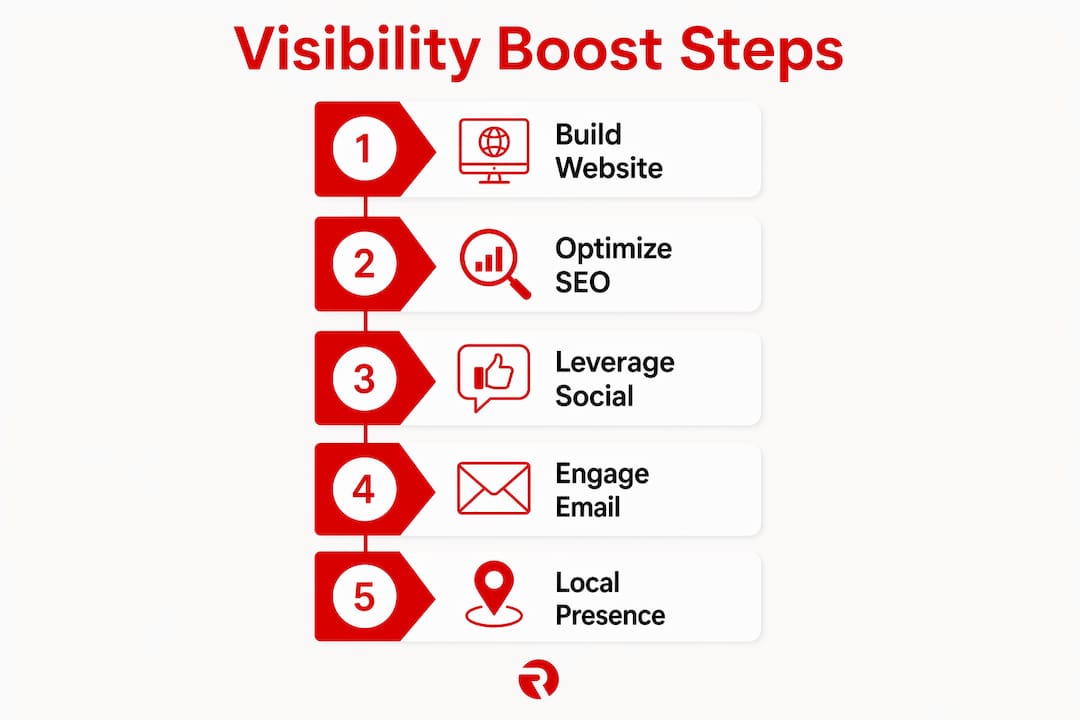
Building business visibility requires a coordinated system across website, email, social, AI search, and local channels, not a collection of isolated tactics.
| Point | Details |
|---|---|
| Build a connected system | Website, email, social, and AI channels must reinforce one another for compounding effect. |
| Prioritise behavioural triggers | Win-back sequences and welcome series deliver 29% of personalisation ROI and raise lifetime value. |
| Focus on fewer platforms | Concentrating on 4–6 relevant channels outperforms spreading effort across many. |
| Optimise for AI search | Structured content and earned media citations increase your presence in AI-generated answers. |
| Maintain consistent local data | Identical NAP citations across all directories are foundational to local search ranking. |
The visibility mistake most business owners make
After working with brands across multiple sectors, the pattern I see most often is this: business owners treat visibility as a campaign rather than a system. They run a burst of activity, see some results, then move on to the next thing. Six months later, they are back to square one.
The brands that genuinely grow their profile do the opposite. They build repeatable processes. Their Google Business Profile is updated every week without fail. Their email sequences run automatically in the background. Their content is structured to be cited by AI engines before it is published. None of this is glamorous. All of it compounds.
The second mistake is chasing vanity metrics. Follower counts and impression numbers feel good but tell you almost nothing about commercial impact. The metrics worth tracking are unaided brand recall, direct traffic growth, share of voice in your category, and revenue from re-engaged customers. These are harder to measure but they are the ones that actually reflect whether your visibility efforts are working.
My honest advice: pick three channels, build them properly, and measure them rigorously for six months before adding anything else. The case studies at Radkaadvertising consistently show that focused, well-executed strategies outperform broad, thinly spread ones every time.
— Bart
How Radkaadvertising helps you grow your brand’s reach
Radkaadvertising is a London-based full-service agency with a track record of building visibility systems for entrepreneurs, startups, and established brands. The team combines data-driven strategy with creative execution across digital, social, and earned media channels. Whether you need a full media coverage strategy to build AI search authority, or a structured audit to identify where your current visibility is leaking, Radkaadvertising delivers the kind of work that produces measurable results. If you are ready to move from scattered tactics to a connected system, the client onboarding process is the clearest starting point. It is built specifically to get your strategy right from day one.
FAQ
What does business visibility actually mean?
Business visibility is the extent to which your brand is found, recognised, and recalled across the channels where your customers search and decide. It spans search engines, social platforms, AI assistants, and local directories.
How quickly can you improve business exposure?
Local tactics like Google Business Profile optimisation and NAP citation fixes can produce measurable improvements within 4–8 weeks. Content-driven and AI search strategies typically take 3–6 months to compound into significant results.
Which channel gives the best return for raising your brand profile?
Behavioural trigger email sequences consistently deliver the highest ROI relative to cost. Win-back sequences alone recover 10–15% of inactive customers without additional acquisition spend.
How do you get your brand cited by AI search engines?
Publish structured content that directly answers specific questions, earn citations from trusted publications, and maintain consistent brand information across all platforms. Brands cited by trusted sources and community platforms like Reddit appear more frequently in AI-generated answers.
How many social media platforms should a business use?
Concentrate on 4–6 platforms where your specific buyers are active and making decisions. Attempting to maintain a presence on every platform reduces content quality and dilutes the effort that drives real engagement.