The content creation process: a practical step-by-step guide

A repeatable content creation process is a fixed set of stages you run every time: plan → research → produce → quality-check → publish → promote → measure → iterate. Get those eight stages right and you stop producing content on instinct and start producing it on purpose.
Before you read further, run this quick checklist. You can complete it in under an hour:
- Write down your next content idea and the single business goal it serves.
- Check search demand for your topic using Google Search Console or a free Semrush trial.
- Draft a one-paragraph brief: audience, format, platform, CTA, and one KPI.
- Block time in your calendar for drafting, editing, and publishing.
- Identify one existing piece of content you could repurpose alongside the new piece.
Each stage of the process has a clear job. Planning aligns your content with audience needs and business objectives. Research validates that the idea is worth your time. Production turns the brief into a publish-ready asset. Quality-checking catches errors, legal risks, and accessibility gaps before they go live. Publishing and promotion get the content in front of the right people. Measurement tells you what worked. Iteration closes the loop.
The Skills England occupational standard for content creators frames these responsibilities formally: planning, multi-platform production, legal and compliance awareness, and performance evaluation are all core duties of the role. The ICO governs data protection obligations that apply whenever you collect audience data, and the ASA sets the advertising rules that govern paid and sponsored content in the UK. Radkaadvertising applies this same eight-stage framework across client campaigns — from brand-new startups to established names like Coca-Cola and Maybelline.
Key takeaways
A repeatable content creation process, run consistently across planning, production, quality control, publishing, promotion, measurement, and iteration, is the single most reliable way to produce content that serves business goals rather than just filling a calendar.
| Point | Details |
|---|---|
| Brief before production | Every piece needs a written brief with audience, objective, KPI, platform, and CTA before drafting starts. |
| QC is non-negotiable | Editorial, legal, and accessibility checks must happen before every piece goes live, not after. |
| Repurpose before creating | Check whether an existing piece can be refreshed or repurposed before committing to net-new production. |
| Measure with decision triggers | Set refresh, repromote, and archive thresholds at the brief stage so measurement leads to action, not just data. |
| Radkaadvertising | Covers every stage from brief and production to SEO, PR distribution, and performance reporting for UK brands. |
Table of Contents
- How the content creation process works, step by step
- How to plan your content: audience, formats, and editorial calendar
- How to validate topics and map keyword intent
- Production: how to draft, record, and build assets by format
- How to edit and quality-check content before it goes live
- How to optimise content for search and platform before publishing
- How to publish, promote, and repurpose content for maximum reach
- How to measure content performance and decide what to do next
- UK compliance, accessibility, and professional standards every creator should follow
- Practical toolkit and templates for every stage of the process
- Example workflow and timeline: blog post and short social video
- An agency perspective on what the process looks like in practice
- What Radkaadvertising can do for your content programme
- Sources
- FAQ
How the content creation process works, step by step
Every piece of content moves through the same spine. The inputs and outputs change by format; the sequence does not.
Step 1: Ideation and brief (Input: business goal → Output: written brief) Define the topic, audience, format, platform, tone, CTA, and KPI before a single word is written. A brief takes 20–30 minutes solo and prevents hours of rework later.
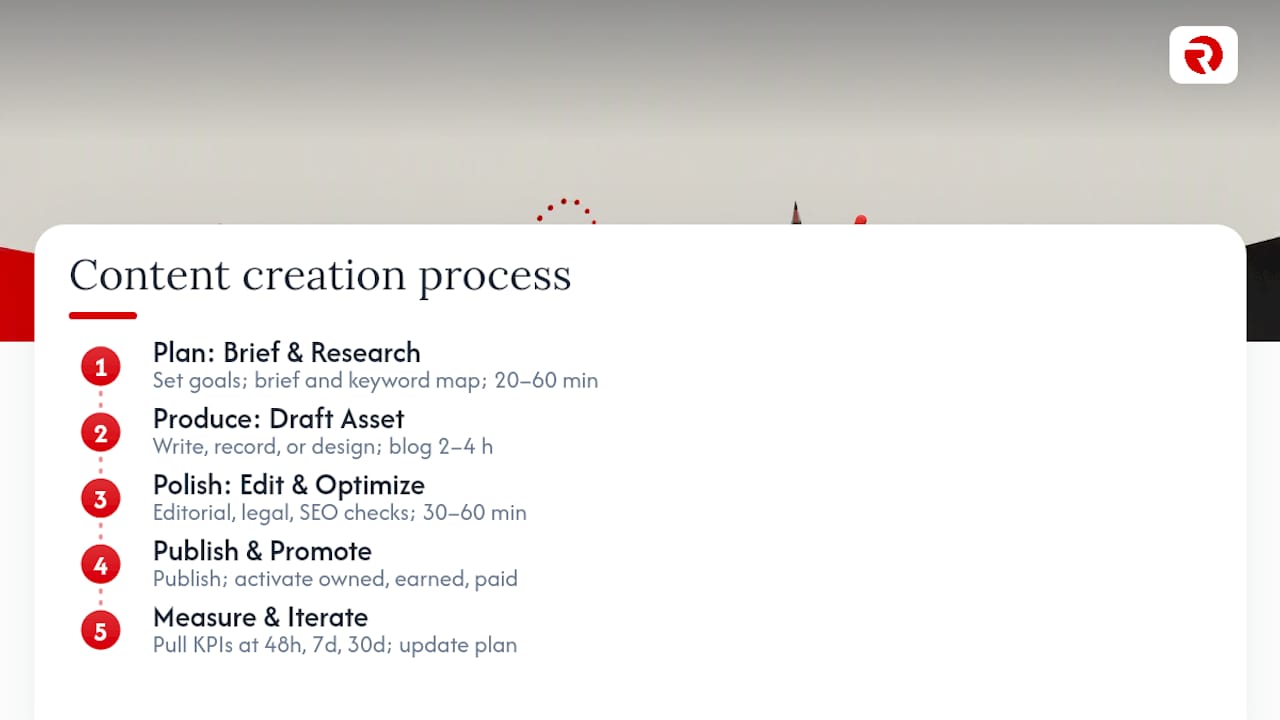
Step 2: Research and validation (Input: brief → Output: validated topic + keyword map) Confirm search demand, check audience signals, and map keyword intent to buyer journey stage. Expect 30–60 minutes for a blog post; less for a social clip where the brief is tighter.
Step 3: Production (Input: validated brief → Output: raw draft or recorded asset) Write, record, or design the asset. For a 1,000-word blog post, a solo creator typically needs 2–4 hours from outline to first draft. A 60-second social video script takes 30–60 minutes; recording and rough edit add another 1–2 hours.
Step 4: Editing and quality control (Input: raw asset → Output: approved, accessible asset) Editorial, legal, and accessibility checks. Budget 30–60 minutes for a blog post; longer for video where captions, music licences, and thumbnail rights all need sign-off.
Step 5: SEO and platform optimisation (Input: approved asset → Output: publish-ready file) Title tags, meta descriptions, alt text, schema, and platform-specific formatting. Roughly 20–30 minutes per piece.
Step 6: Publishing and distribution (Input: publish-ready file → Output: live content) Schedule or publish, then activate owned, earned, and paid promotion channels. The initial days of promotion are the most important for algorithmic reach.
Step 7: Measurement (Input: live content → Output: performance data) Pull KPIs at 48 hours, 7 days, and 30 days. Compare against targets set in the brief.
Step 8: Iteration (Input: performance data → Output: updated brief or new content plan) Refresh, repurpose, archive, or double down based on what the data shows.
For a small team, add a handover checkpoint between Steps 3 and 4 (writer to editor) and a sign-off checkpoint between Steps 4 and 5 (editor to publisher). These two checkpoints alone eliminate most last-minute scrambles.
How to plan your content: audience, formats, and editorial calendar
Good planning is the difference between content that serves a strategy and content that fills a calendar. Start with the brief.
Mandatory brief fields:
- Audience: Who is this for? Be specific. “UK SME owners aged 30–50 researching digital marketing” beats “businesses.”
- Objective: Awareness, engagement, or conversion? Pick one primary goal.
- CTA: What do you want the reader to do next?
- KPI: One measurable signal of success (e.g., organic sessions, email sign-ups, video views).
- Platform: Where does this live first? (Website, LinkedIn, YouTube, email, Instagram?)
- Tone: Match your brand guidelines. Formal, conversational, bold?
- Distribution plan: Owned channels first, then earned and paid.
Editorial calendar principles:
Build your calendar around pillar content and campaign clusters. A pillar piece (a long-form guide, a flagship video series) anchors a cluster of shorter supporting pieces: social clips, email excerpts, short-form posts, and a gated PDF. This approach multiplies reach without multiplying production effort.
Plan in quarters. Set your pillar topics for the quarter, assign formats and platforms, then fill in the weekly cadence. A content calendar built around quarterly themes keeps the team aligned and prevents the last-minute scramble that kills quality.
Prioritisation matrix:
Before committing to your next five pieces, score each idea on two axes: expected business impact (high/low) and production effort (high/low). Prioritise high-impact, low-effort pieces first. High-impact, high-effort pieces go into the next sprint once resources are confirmed. Low-impact pieces get cut or deferred.
How to validate topics and map keyword intent
Producing content without validating the idea first is the single most common waste of budget in content marketing. Validation takes less than an hour and saves days of wasted production.
Validation checklist:
- Audience signals: Does your community ask this question? Check comments, DMs, sales call notes, and support tickets.
- Search demand: Use Semrush, Ahrefs, or Google Keyword Planner to confirm monthly search volume and keyword difficulty.
- Competitor gap: Are competitors ranking for this topic with thin content you can beat on depth and accuracy?
- Social listening: Is the topic trending or evergreen on LinkedIn, X, or relevant UK forums?
- Reuse potential: Can this topic generate a blog post, a short video, an email, and a social clip from one production run?
Keyword intent mapping:
Match your topic to the buyer’s journey stage before you write a word. Informational queries (“what is content marketing”) suit top-of-funnel blog posts and explainer videos. Navigational queries (“Radkaadvertising services”) suit brand and service pages. Commercial queries (“best content agency London”) suit comparison posts and case studies. Transactional queries (“hire a content agency”) suit landing pages with a direct CTA.
Repurposing decision flow:
Before creating something new, check whether an existing piece covers the topic. If it does, ask three questions: Is it more than 12 months old? Has search intent shifted? Is it ranking outside the top 20? If yes to any two, rewrite and expand it rather than starting fresh. If the piece is strong but in a different format, repurpose it. Only create net-new content when no existing asset can be refreshed to serve the brief.
Production: how to draft, record, and build assets by format
Production is where the brief becomes a real asset. The most common mistake is skipping the outline and going straight to the draft. Don’t. An outline takes 15 minutes and cuts drafting time in half.
Blog post production checklist:
- Write a working title and H1 that matches search intent.
- Build a heading structure (H2s and H3s) before writing body copy.
- Draft in sections, not top to bottom.
- Add internal links as you write, not as an afterthought.
- Source and caption every image; write descriptive alt text for each.
- Include a clear CTA in the final paragraph.
Short social video checklist:
- Script the hook in the first 3 seconds; this determines whether viewers stay.
- Keep the script to 150–180 words for a 60-second video.
- Write a shot list before you record.
- Shoot with captions in mind: speak clearly, avoid heavy background noise.
- Prepare a thumbnail with a legible text overlay at small sizes.
Podcast episode checklist:
- Write a structured outline: intro, three to five main points, outro.
- Record intro and outro separately for easy re-editing.
- Add chapter markers to the final file for platforms that support them (Spotify, Apple Podcasts).
- Commission or generate a transcript for accessibility and SEO.
Batch working saves time. Record three to five short videos in a single session using the same background and lighting setup. Write two to three blog outlines in one sitting before switching to drafting. Batching reduces context-switching, which is where most production time disappears.
Pro Tip: Set your audio recording level to peak at a moderate level to give you headroom for editing without clipping, following standard podcast platform recommendations for clean playback.
For visual assets, common sizes used in UK digital publishing include square, landscape, and portrait formats suitable for various social platforms. Export images at web-appropriate resolution and manage file sizes to optimize page speed.
How to edit and quality-check content before it goes live
A quality-control workflow is not optional. It is the step that separates professional content from content that creates legal or reputational risk.
Editorial checklist:
- Does the structure follow a logical flow from hook to CTA?
- Is every factual claim accurate and sourced?
- Does the tone match the brand guidelines?
- Is the CTA clear and does the link work?
- Has a second reader reviewed it? Fresh eyes catch what the writer misses.
Legal and rights checklist:
- Are all images either owned, licensed, or sourced from a rights-cleared library (Getty Images, Adobe Stock, or a Creative Commons source with the correct licence)?
- Is background music licensed for commercial use? Platforms like Epidemic Sound and Artlist offer UK-accessible licences.
- Does the content include any claims that could be classified as advertising under ASA rules? If so, is it clearly labelled?
- Does the content collect, reference, or display personal data? If so, does it comply with UK GDPR as governed by the ICO?
- Does the content feature any third-party trademarks, logos, or copyrighted text? If yes, escalate to legal review before publishing.
Accessibility quick checks (WCAG basics):
- Every image has descriptive alt text.
- Videos have accurate captions or subtitles.
- Text-to-background contrast meets at least a 4.5:1 ratio for normal text (WCAG AA standard).
- Headings are used in a logical hierarchy (H1 → H2 → H3), not for visual styling.
- Links use descriptive anchor text, not “click here.”
The Level 3 Content Creator apprenticeship assessment plan (ST0105) explicitly maps accessible, platform-suitable content creation and campaign evaluation to assessed competencies. These are not aspirational standards; they are the baseline the UK industry expects.
Document your QC checks. A simple sign-off log (date, checker name, items reviewed, issues found and resolved) creates an audit trail that protects you if a rights dispute or compliance query arises later.
How to optimise content for search and platform before publishing
Publishing without optimisation is like printing a flyer and leaving it in a drawer. The pre-publish checklist below applies to every piece of content, with platform-specific notes where they differ.
SEO publish checklist:
- Title tag: 50–60 characters, primary keyword near the front.
- Meta description: 150–160 characters, includes the keyword and a clear benefit.
- H1: matches or closely mirrors the title tag; only one H1 per page.
- H2/H3 structure: uses related keywords naturally; no keyword stuffing.
- Internal links: at least two to three contextually relevant internal links per blog post.
- Image alt text: descriptive, includes keyword where natural.
- Schema markup: add Article schema for blog posts, VideoObject for video embeds.
- Canonical tag: set to the preferred URL to avoid duplicate content issues.
- Mobile preview: check the page renders correctly on a 375px viewport before publishing.
- Page speed: compress images, defer non-critical scripts, and aim for a Largest Contentful Paint under 2.5 seconds (Google’s Core Web Vitals threshold).
Platform-specific notes:
- YouTube: Front-load the primary keyword in the video title and the first two lines of the description. Add chapters using timestamps. Use all available tag slots.
- LinkedIn: The first two lines of a post appear before the “see more” break; put the hook there. Native documents (PDFs) and polls consistently outperform plain text links in organic reach.
- Instagram: Alt text is available in advanced settings; use it. Hashtags work best in the first comment rather than the caption for cleaner presentation.
- Website/blog: Run a technical SEO audit before a major content push to confirm there are no crawl errors, broken links, or redirect chains undermining your new content.
A content creation workflow aligned with SEO treats optimisation as part of production, not an afterthought. Build the checklist into your brief template so it is never skipped.
How to publish, promote, and repurpose content for maximum reach
One piece of content should never do only one job. The most efficient content teams treat every published asset as raw material for five to ten derivative pieces.

Repurposing recipes:
A 1,500-word blog post can become: three to five LinkedIn posts (one insight per post), a 60-second explainer video script, a five-email nurture sequence, a gated PDF guide with a lead capture form, and six to eight social graphics with pull quotes. The blog post is produced once; the derivative pieces extend its reach for weeks.
Promotion checklist:
- Owned channels: Email newsletter, social profiles, website homepage feature, internal linking from related posts.
- Earned channels: Pitch to relevant UK trade publications, share in LinkedIn groups and industry Slack communities, tag collaborators or sources mentioned in the piece.
- Paid channels: A small paid boost on Meta or LinkedIn (even £20–£50) can significantly extend reach for high-value pieces. Target by job title and industry for B2B content.
For PR and press distribution, Radkaadvertising’s media coverage service places content with UK and international outlets, which is particularly effective for campaign launches and thought leadership pieces.
Early signals to watch (48–72 hours post-publish):
- Click-through rate on email: below 2% suggests the subject line or preview text needs work.
- Social engagement rate: a post with strong early engagement (saves, shares, comments) is worth amplifying with a paid boost.
- Bounce rate on the blog post: above 80% in the first 48 hours suggests the content is not matching the expectation set by the headline or the traffic source.
These early signals tell you whether to amplify, adjust the headline, or let the piece run organically.
How to measure content performance and decide what to do next
Measurement without a decision framework is just data collection. The goal is to know, at a glance, whether a piece of content deserves more investment, a refresh, or retirement.
KPI mapping by goal:
| Goal | Primary KPI | Secondary KPI |
|---|---|---|
| Awareness | Impressions, reach | New sessions, share of voice |
| Engagement | Time on page, scroll depth | Comments, saves, shares |
| Lead generation | Form completions, email sign-ups | CTR from content to landing page |
| Conversion | Sales attributed, trial starts | Revenue per content piece |
| SEO | Organic sessions, keyword rankings | Backlinks earned |
Reporting routine:
- Weekly dashboard: Traffic, engagement, and conversion metrics for all live content. Flag anything that has moved more than 20% in either direction.
- Monthly review: Compare performance against the KPIs set in each brief. Identify the top three and bottom three pieces. Decide on refresh or archive for underperformers.
- Quarterly strategy check: Review the full content library against business goals. Update the editorial calendar for the next quarter. This is also the moment to run a content audit, as Mark Flanighan’s UK content strategy guide recommends: audit before creating, not after.
Action triggers:
- Refresh: Organic traffic has dropped more than 30% over 90 days, or the content is more than 12 months old and search intent has shifted.
- Repromote: The piece performed well at launch but has not been actively promoted in more than six months. A single email or social push can revive it.
- Archive: Traffic is negligible, the topic is no longer relevant, and a refresh would require a near-complete rewrite. Redirect the URL to a related, stronger page.
The Gateway Qualifications Content Creator standard specification describes EPA methods that combine a project evaluation report with a professional discussion, which is a useful model for internal reporting: pair a practical campaign output with an evaluative summary of what worked, what did not, and what you would do differently.
UK compliance, accessibility, and professional standards every creator should follow
Content creation in the UK operates within a defined regulatory and professional framework. Ignoring it is not a creative choice; it is a liability.
Essential UK references:
- Skills England occupational standard for content creators: defines the core duties, knowledge, skills, and behaviours expected of professional content creators in the UK.
- Level 3 Content Creator apprenticeship assessment plan (ST0105): maps assessed competencies to practical outputs including accessible content creation and campaign evaluation.
- UK National Occupational Standards for multi-platform editorial content: lists performance criteria covering audience identification, platform suitability, budget management, software use, and legal checks.
- ICO (Information Commissioner’s Office): governs UK GDPR compliance. Any content that involves collecting email addresses, using cookies, or processing audience data must comply.
- ASA (Advertising Standards Authority): governs advertising rules including the requirement to clearly label paid partnerships, sponsored content, and affiliate links.
Practical compliance checklist:
- Copyright: do not use images, music, or text without a licence or explicit permission.
- UK GDPR: if your content includes a lead capture form or tracks user behaviour, your privacy policy must be current and your consent mechanism must be compliant.
- ASA CAP Code: label all paid promotions with #ad or equivalent. This applies to influencer posts, sponsored articles, and affiliate content.
- Music licensing: use platforms with commercial licences (Epidemic Sound, Artlist, or Musicbed) for any content published on commercial channels.
- Image releases: if your content features identifiable individuals, obtain a signed model release before publishing.
Social network users worldwide continue to grow, which makes platform-specific compliance (each platform’s own advertising policies, community guidelines, and data terms) increasingly important alongside national regulation.
Accessibility resources:
The Web Content Accessibility Guidelines (WCAG) 2.1 at Level AA is the standard referenced in UK public sector accessibility regulations and widely adopted as best practice in commercial publishing. Key requirements: alt text on all images, captions on all video, sufficient colour contrast, and logical heading structure. The Gateway Qualifications Content Creator specification treats accessible content creation as a core assessed competency, not an optional extra.
Practical toolkit and templates for every stage of the process
The right tools reduce friction at every stage. The wrong tools create it. Choose based on your team size, budget, and the formats you produce most.
Tools mapped to stage:
- Planning: Notion (free tier available) for briefs, editorial calendars, and content libraries. Trello for visual kanban-style workflow management. Both are available and widely used by UK teams.
- Research: Semrush or Ahrefs for keyword research and competitor gap analysis. Google Search Console (free) for tracking existing content performance. AnswerThePublic for question-based content ideation.
- Production: Canva for social graphics and presentation assets. Adobe Premiere Pro or DaVinci Resolve (free) for video editing. Descript for transcript-based audio and video editing. Google Docs for collaborative writing.
- Scheduling: Buffer or Hootsuite for social scheduling. Mailchimp or Klaviyo for email. Both integrate with most CMS platforms used in the UK.
- Analytics: Google Analytics 4 (GA4) for website performance. Native platform analytics (LinkedIn Analytics, YouTube Studio, Meta Business Suite) for social. Google Search Console for organic search data.
- AI-assisted production: AI-powered content marketing automation can accelerate first-draft generation, content repurposing, and SEO brief creation, particularly useful for small teams managing high output volumes.
Copyable brief template:
Content Brief
Topic:
Audience:
Objective (awareness / engagement / conversion):
Primary KPI:
Platform(s):
Format:
Tone:
Primary keyword:
Word count / duration:
CTA:
Internal links to include:
Legal / compliance notes:
Deadline:
Approved by:
Production checklist (paste into your workflow):
- Brief approved
- Outline complete
- First draft complete
- Internal links added
- Images sourced and licensed
- Alt text written
- CTA included and link tested
- Editorial review complete
- Legal / rights check complete
- Accessibility check complete
- SEO checklist complete
- Scheduled / published
Paid vs free tools: Free tiers of Notion, Canva, GA4, and Google Search Console cover most needs for a solo creator or small team. Invest in paid tools (Semrush, Ahrefs, Adobe Creative Cloud) when you are producing more than eight to ten pieces per month and the time saved justifies the cost. Standardise file naming from day one: [YYYY-MM-DD]_[format]_[topic]_[version] keeps shared drives navigable as the team grows.
Example workflow and timeline: blog post and short social video
Two concrete timelines you can adapt immediately.
Blog post: 30–72 hour sprint
Short social video (60–90 seconds): 2–5 day micro project
To slot these into a quarterly editorial calendar, assign each pillar piece a sprint week and schedule derivative pieces (social clips, email excerpts) in the two weeks following publication. A quarterly plan of four pillar pieces, each with a five-piece derivative cluster, gives you roughly 24 pieces of content per quarter from four production sprints. That is a manageable cadence for a solo creator and a strong baseline for a small team.
An agency perspective on what the process looks like in practice
The eight-stage framework described in this guide is not theoretical. At Radkaadvertising, it is the operating structure behind every retainer and project-based engagement.

The brief is where most campaigns either succeed or fail before a single asset is produced. When a client comes to us with a vague brief (“we need more content”), the first thing we do is run a scoping session to define the audience, the business objective, and the one KPI that will tell us whether the campaign worked. That single session typically saves two to three rounds of revision later.
Handoffs are where quality drops in most content operations. We use a three-checkpoint model: writer to editor (structural and factual review), editor to publisher (SEO, accessibility, and legal check), and publisher to client (final approval before anything goes live). Each checkpoint has a sign-off log. Nothing moves forward without it.
For multi-channel campaigns, we build the pillar asset first and plan the derivative pieces in the same brief. A brand film becomes a 30-second social cut, a behind-the-scenes Instagram series, a press release, and a case study. The Radkaadvertising case studies show how this approach has worked across industries as different as energy (PowerLink Energy) and beauty (Maybelline), where the formats differ but the process is identical.
Measurement is the stage most in-house teams skip or delay. We build the reporting cadence into the contract: weekly dashboard, monthly review, quarterly strategy check. The quarterly check is where we decide what to double down on, what to refresh, and what to retire. It is also where the next quarter’s editorial calendar gets built, informed by what the data showed.
One thing worth saying plainly: the process only works if the brief is honest. If the business goal is lead generation but the brief says “brand awareness,” the KPIs will never align and the content will feel like it underperformed even when it did exactly what it was briefed to do. Align the goal, the brief, and the KPI before production starts. Everything else follows from that.
What Radkaadvertising can do for your content programme
Producing content at a professional standard across planning, production, distribution, and measurement requires either a well-resourced in-house team or an agency partner who has already built the infrastructure. Radkaadvertising is that partner for UK businesses, startups, and established brands who want results without building the operation from scratch.
The agency maps directly to every stage of the process: brand strategy and brief development at the planning stage; photography, videography, and copywriting at production; SEO, paid media (Meta and Google), and PR distribution at promotion; and GA4-based performance reporting at measurement. For businesses that want AI-driven content at scale, the AI growth service handles managed content production with built-in SEO optimisation.
A scoping call typically covers: your current content output, your primary business goal for the next quarter, the platforms you are prioritising, and your budget range. From that, the team builds a proposal within five working days.
Ready to put the process to work? Get in touch with Radkaadvertising to book a briefing call and start building a content programme that performs.
Sources
Official UK standards and guidance:
- Content creator / Skills England
- Content Creator standard specification (Gateway Qualifications)
- NOS Finder - National Occupational Standards
- Statista
Practitioner guides:
FAQ
What are the steps of the content creation process?
The core steps are: plan (brief and audience), research (validate topic and keyword intent), produce (draft, record, or design), quality-check (editorial, legal, accessibility), optimise (SEO and platform formatting), publish and promote (owned, earned, and paid channels), measure (KPIs against brief targets), and iterate (refresh, repurpose, or archive). The Skills England content creator standard maps these responsibilities formally as core professional duties.
What are the 7 steps of content creation?
A widely used seven-step version covers: ideation, research, planning, production, editing, publishing, and measurement. Different frameworks label the stages slightly differently, but the sequence from idea to performance review is consistent across professional practice, as described in guides from Benchmark Email and industry practitioners.
What are the 5 C’s of content creation?
Definitions vary across sources. A common version used in content marketing training covers: Clarity (the message is easy to understand), Consistency (tone, format, and cadence are maintained), Credibility (claims are accurate and sourced), Compelling (the content holds attention and drives action), and Conversion (the content moves the audience toward a goal). These are not a formally standardised framework but a useful editorial checklist.
How long does the content creation process take?
A 1,000-word blog post typically takes 5–10 hours from brief to published, including research, drafting, editing, and optimisation. A 60–90 second social video takes 4–8 hours across scripting, recording, editing, and QC. Timelines vary by team size, approval rounds, and content complexity.
What UK professional standards apply to content creators?
The Skills England occupational standard (OCC0105) and the UK National Occupational Standards for multi-platform editorial content (SKSJ21) set the professional baseline. Regulatory compliance sits with the ICO (data protection) and the ASA (advertising rules). Accessibility requirements follow WCAG 2.1 Level AA.