Startup branding: Position your UK business for success

TL;DR:
- Strong branding builds trust, credibility, and differentiation essential for UK startups competing in crowded markets.
- Prioritizing speed and core elements like name, logo, colors, and positioning enables early validation and consistent growth.
- Ongoing brand evolution based on customer language and market feedback sustains value and prevents costly rebranding.
You can build a brilliant product and still fail to gain traction if your brand doesn’t communicate trust the moment someone lands on your website. For UK startups operating in crowded digital markets, weak or inconsistent branding isn’t just an aesthetic problem; it’s a commercial one. Investors hesitate. Customers look elsewhere. Talent gravitates toward names that feel credible. The brands adapting to market challenges added £150 billion in combined value in 2025 alone. This guide covers preparation, execution, and verification so you can build a brand that actually performs.
Table of Contents
- Why strong branding matters for UK startups
- Core branding elements and preparation
- Step-by-step branding process for UK startups
- Verifying and evolving your startup brand
- Branding truths UK founders rarely hear
- How expert support accelerates your branding journey
- Frequently asked questions
Key Takeaways
| Point | Details |
|---|---|
| Branding drives credibility | Trust and traction in the UK digital market rely on a well-defined brand, even for new startups. |
| Start lean, iterate smart | A minimum viable brand (logo, colours, positioning) enables fast launches and later evolution. |
| Consistency beats aesthetics | It’s more important for your message and visuals to align across channels than to be perfect from day one. |
| Measure and adapt | Use feedback and analytics to evolve your startup brand for ongoing market fit. |
Why strong branding matters for UK startups
Most founders treat branding as decoration. A logo here, a colour palette there. That’s a costly misunderstanding. Branding is the architecture of trust, and in the UK’s fast-moving digital market, trust is the currency that converts visitors into customers and sceptical investors into committed backers.
“Your brand is not your logo. It’s the feeling someone gets when they hear your name. In competitive markets, that feeling is the difference between growth and stagnation.”
Strong branding does several things simultaneously for a startup:
- Builds immediate digital credibility so visitors stay on your site rather than bouncing to a competitor
- Attracts investor attention by demonstrating strategic thinking beyond the product itself
- Differentiates you in crowded UK sectors such as fintech, healthtech, and e-commerce, where dozens of similar products compete for the same audience
- Signals professionalism to talent, making it easier to recruit the people who could actually build your business
- Creates consistency across channels, from LinkedIn posts to physical pitch decks, which compounds trust over time
The UK digital market is particularly unforgiving for new entrants. Attention is scarce, scepticism is high, and consumers have been conditioned by polished brands. The Interbrand 2025 report shows that brands surging in value share one trait: they adapt while remaining recognisable. Instagram and Netflix are two prime examples. Neither abandoned their core identity during rapid growth; they evolved it deliberately.
There’s a real trade-off at the early stage, though. Pre-seed founders often face a genuine choice between speed and rigour. A full branding strategy is the right long-term investment, but a minimum viable brand gets you into market faster. Understanding how to pick a company name and the right positioning statement is often the most important decision you make before spending a penny on design.
Now that you understand why branding is so crucial, the next step is knowing exactly what you need to get started.
Core branding elements and preparation
Before you open a design tool or brief a freelancer, you need to know what you’re actually building. An MVP brand, meaning the leanest version of your identity that still communicates credibility, consists of four non-negotiable elements: a memorable name, a functional logo, a defined colour palette, and a positioning statement that captures who you are and who you serve.
The positioning statement is the piece most founders skip. It’s a single sentence that answers: what do you do, for whom, and why are you different? For UK digital audiences, your unique selling point needs to be genuinely defensible. “We make accounting easier” is not a USP. “We reduce month-end close time by 60% for UK e-commerce brands under £5 million revenue” is.
Here’s a practical checklist of the branding assets you’ll need, alongside a comparison of DIY and agency approaches:
| Branding asset | DIY/freelance option | Agency option |
|---|---|---|
| Company name | Self-directed, trademark check via UKIPO | Agency-led naming workshops |
| Logo | Freelance (£300–£800) or logo tool | Bespoke design (£1,500–£5,000+) |
| Colour palette | Adobe Color, Coolors (free) | Brand strategist-led selection |
| Typography | Google Fonts, free licensing | Licensed, unique typeface sourcing |
| Positioning statement | Founder-written with templates | Strategic brand messaging session |
| Brand guidelines doc | DIY using Canva or Notion | Professionally formatted PDF deck |
| Website design | Webflow or Squarespace templates | Custom UX and visual identity build |
When choosing between routes, the guidance from First Round’s piece on picking a company name is clear: pre-seed startups should prioritise speed and essentials, not perfection. Spend £2,000–£8,000 on the basics. Once you’ve validated your model and raised seed funding, that’s the moment to invest in a full agency-led strategy for scalability.
Choosing your colours and fonts deserves more thought than most founders give it. Colour psychology is real and culturally specific. In the UK market, deep navy blue signals authority and trustworthiness (used extensively in fintech). Green communicates sustainability and growth. Avoid overly trendy palettes that date quickly. For branding print methods, understanding how your colours translate from screen to physical materials is critical if you’re producing pitch decks, event materials, or product packaging.
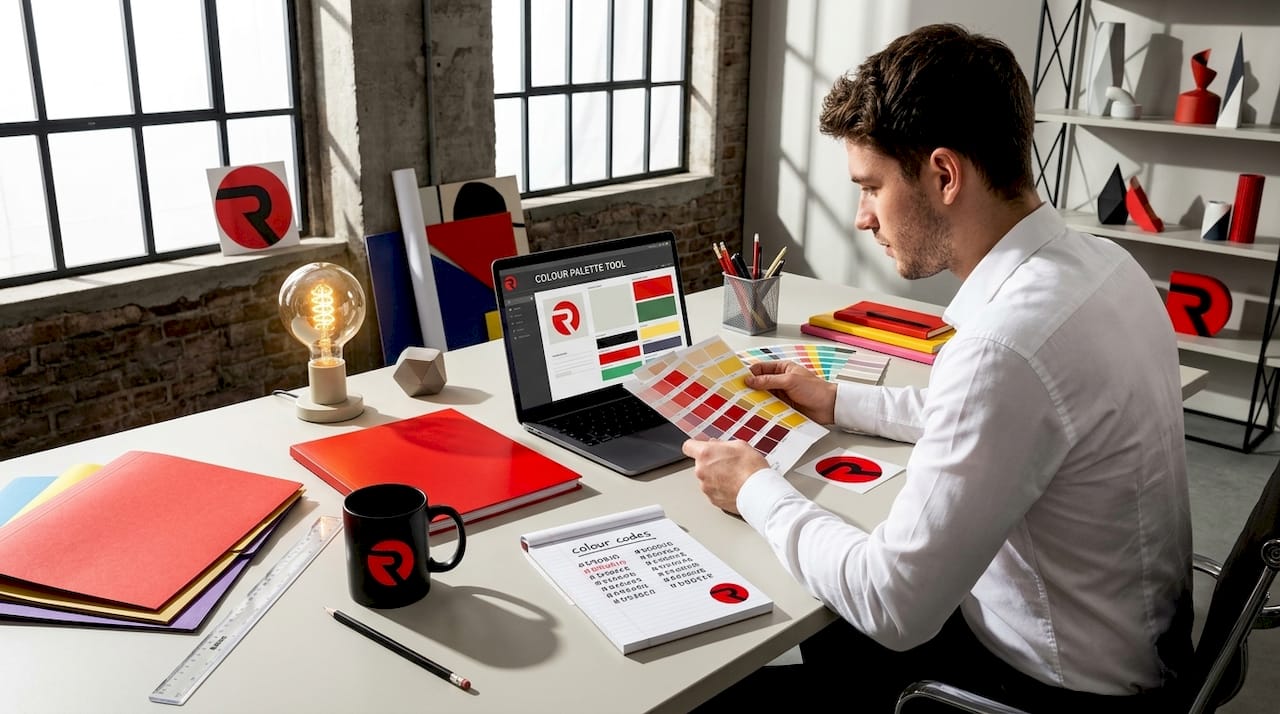
Pro Tip: Lock your primary and secondary colours in HEX, RGB, and CMYK codes from day one. It costs nothing and saves enormous frustration when you move from digital to print.
With your brand fundamentals outlined, you’re ready to follow a step-by-step process for real-world implementation.
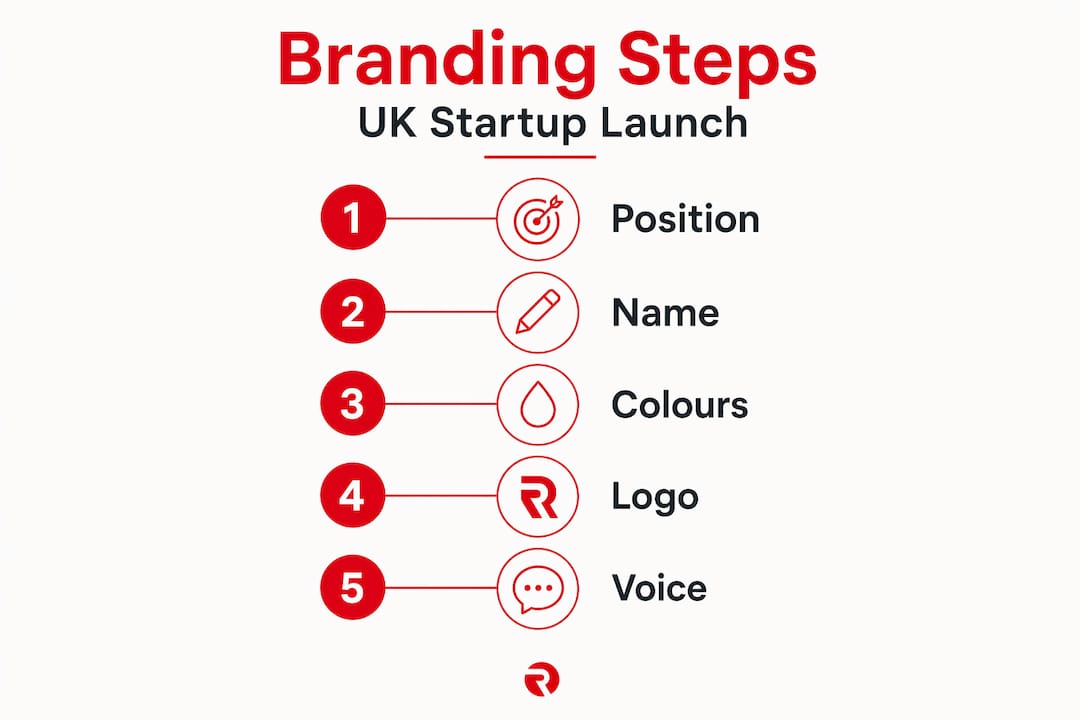
Step-by-step branding process for UK startups
Here is a practical, ordered process that works whether you’re working with a freelancer or an agency. Follow the steps in sequence. Skipping steps is how inconsistent brands are born.
- Write a design brief before you brief anyone. Document your target audience, your three main competitors, the feeling you want your brand to evoke, and two or three brands outside your sector that you admire and why. This single document will save you weeks of revision cycles.
- Choose your colour palette first, then your logo. Colours carry emotional meaning that should inform the visual identity, not the other way around. Settle on a primary colour and one accent colour. That’s enough to start.
- Create a positioning statement. Use this framework: “We help [specific audience] achieve [specific outcome] by [your distinctive method].” Test it with five people outside your industry. If they don’t immediately understand it, rewrite it.
- Commission or create your logo. Brief a designer using your palette, positioning statement, and reference brands. Request three concepts, not one. Always ask for vector formats (SVG, EPS, AI) alongside PNG and JPG.
- Write a one-page brand guidelines document. This should cover logo usage rules, approved colours, typefaces, tone of voice, and what the brand never does. One page is genuinely enough at this stage.
- Apply your brand consistently across every channel before launch. Website, LinkedIn, email signature, pitch deck, and any physical materials should all use the same palette, logo, and voice.
Here’s how MVP branding and a full branding rollout differ in practice:
| Factor | MVP branding | Full branding rollout |
|---|---|---|
| Timeline | 2–4 weeks | 8–16 weeks |
| Typical cost | £2,000–£8,000 | £15,000–£60,000+ |
| Output | Logo, colours, positioning, basic guidelines | Full identity system, messaging framework, brand strategy |
| Best for | Pre-seed validation and speed to market | Post-seed scale and investor readiness |
| Risk | May need evolution as brand matures | Significant investment before market validation |
For cross-channel consistency, your single biggest lever is a shared asset library. Store every approved logo, colour swatch, and typeface file in one place that every team member and external partner can access. Google Drive folders, Notion pages, or dedicated tools all work. The problem is never the tool; it’s the absence of one source of truth.
Understanding the right promo printing techniques matters when your brand moves into physical spaces. A logo that looks sharp on a screen can lose clarity when embossed or screen-printed. Test your assets in physical formats early, not the week before your first industry event.
The brand voice consistency demonstrated by top global brands is not accidental. It is the result of deliberate guidelines applied rigorously across every touchpoint, and the same discipline applies to UK startups operating at a fraction of the budget.
Pro Tip: The most common early failure point is inconsistency between the website and social media. Your Instagram bio and your homepage headline should feel like they come from the same voice. If they don’t, you have a brand guidelines problem, not a design problem.
Having implemented your startup brand, it’s vital to know how to verify its effectiveness and ensure ongoing traction.
Verifying and evolving your startup brand
Launching a brand is not the end of the process. It’s the beginning of a feedback loop. Too many UK founders treat brand launch as a milestone rather than a starting point, and then wonder why growth plateaus.
The metrics that matter most for early-stage brand credibility are:
- Direct traffic volume: People who type your URL or brand name into a browser are people who already know you. Growing direct traffic signals genuine brand awareness.
- Branded search impressions: Track how often your company name appears in Google Search Console. Rising branded searches mean your word-of-mouth is working.
- Social media engagement rate: Not follower count. Engagement. Low engagement on large follower numbers is a sign of audience mismatch.
- Investor and partner feedback: If you’re consistently having to explain who you are in meetings, your brand isn’t doing its job.
- Bounce rate on your homepage: High bounce rates (above 70%) often indicate a disconnect between what people expect from your brand and what they find.
Signs your branding is actively holding you back:
- Your conversion rate on landing pages is below your sector average despite adequate traffic
- Customers frequently misidentify what you do or who you’re for
- Your brand looks noticeably dated compared to competitors who launched at the same time
- Your team uses different descriptions of the business in sales calls and social posts
- Recruitment candidates express surprise at your brand after seeing your product
Stat callout: The Interbrand 2025 data is instructive here. Brands that grew their value most significantly in 2025 shared a pattern: they didn’t just maintain their identity; they actively evolved it in response to cultural and market shifts. For UK startups, that same principle scales down. Review your brand positioning every six months against real customer language, not internal assumptions.
Use qualitative data too. Customer interviews, sales call recordings, and even LinkedIn comments reveal how your audience actually describes your brand. If their language doesn’t match yours, adapt yours to match theirs. That’s not brand dilution; it’s brand intelligence.
Many founders fall into the trap of over-complicating or under-investing in branding. Here’s a frank perspective on what really matters.
Branding truths UK founders rarely hear
The uncomfortable reality is that most UK startup founders either overspend on branding before they have any market evidence, or they delay investing in consistency for so long that their brand becomes a patchwork of decisions made by different people in different contexts. Both errors are expensive, just in different ways.
The obsession with the “perfect brand from day one” is a myth worth dismantling. No brand is perfect at launch. Airbnb’s original identity was amateurish by its own co-founders’ later admission. What mattered was that they moved fast, got in front of customers, listened to what resonated, and evolved deliberately. The same pattern applies to pre-seed UK startups. Your first brand should be good enough to convey credibility and clear enough to communicate your positioning. That’s all.
Where founders consistently go wrong is conflating brand investment with brand value. Spending £40,000 on a logo does not make your brand stronger than a £2,000 one if the positioning is weak. Conversely, delaying consistency because you’re “still figuring things out” is an excuse that costs you compound credibility every week. The right approach at pre-seed is a lean, coherent identity that you actually use. Post-seed, that’s when rigorous strategy pays off.
The founders who get branding right in the UK market share one habit: they treat customer language as the primary input for brand evolution. They listen to how customers describe them, what words they use in reviews, and what objections come up in sales. Then they adjust their positioning, not their logo, to reflect reality. Branding is a living conversation with your market, not a design project with a completion date.
How expert support accelerates your branding journey
Building a brand that genuinely positions your UK startup for digital growth requires both strategic clarity and executional discipline. At Radka Advertising, we work with founders at exactly this junction: when the product is ready but the brand isn’t keeping pace. From positioning strategy and identity creation to multi-channel digital campaigns, our team translates commercial ambition into cohesive brand narratives built for the UK market and beyond. Explore our case studies and client work to see how we’ve helped startups and established brands move from unclear to unmistakable, and get in touch when you’re ready to accelerate.
Frequently asked questions
What is the minimum branding a UK startup needs to launch?
A clear name, a functional logo, consistent brand colours, and a one-sentence positioning statement are genuinely enough to launch. The MVP brand approach prioritises coherence and speed over perfection at the pre-seed stage.
How much should UK startups budget for early branding?
Freelance and DIY solutions typically range from £1,500 to £8,000 and are appropriate for early validation. According to First Round’s guidance, agency-level investment makes more strategic sense post-seed when scalability becomes the priority.
How do you know when it’s time to rebrand?
When your brand no longer attracts your target audience, feels visually inconsistent across channels, or fails to reflect your current positioning, it’s time to reassess. Brand evolution patterns show that the most successful brands update deliberately rather than reactively.
What pitfalls do most UK startups face with branding?
The most common trap is chasing perfection over progress, spending excessive time on visual details before testing positioning with real customers. Early-stage branding advice consistently points to iteration speed as more valuable than initial polish.