Online reputation management: what it is and why it matters

TL;DR:
- Online reputation management involves monitoring and shaping how a brand is perceived across digital platforms. UK businesses often overlook ORM despite high consumer reliance on reviews, risking lost trust and market share. Proactive strategies, including content creation and review engagement, build resilience and enhance local SEO, while legal and operational considerations safeguard reputation.
Online reputation management (ORM) is the practice of monitoring, shaping, and influencing how a brand or individual is perceived across digital platforms. It covers everything from Google search results and review sites to social media profiles and news coverage. Done well, ORM turns your digital footprint into a trust asset rather than a liability.
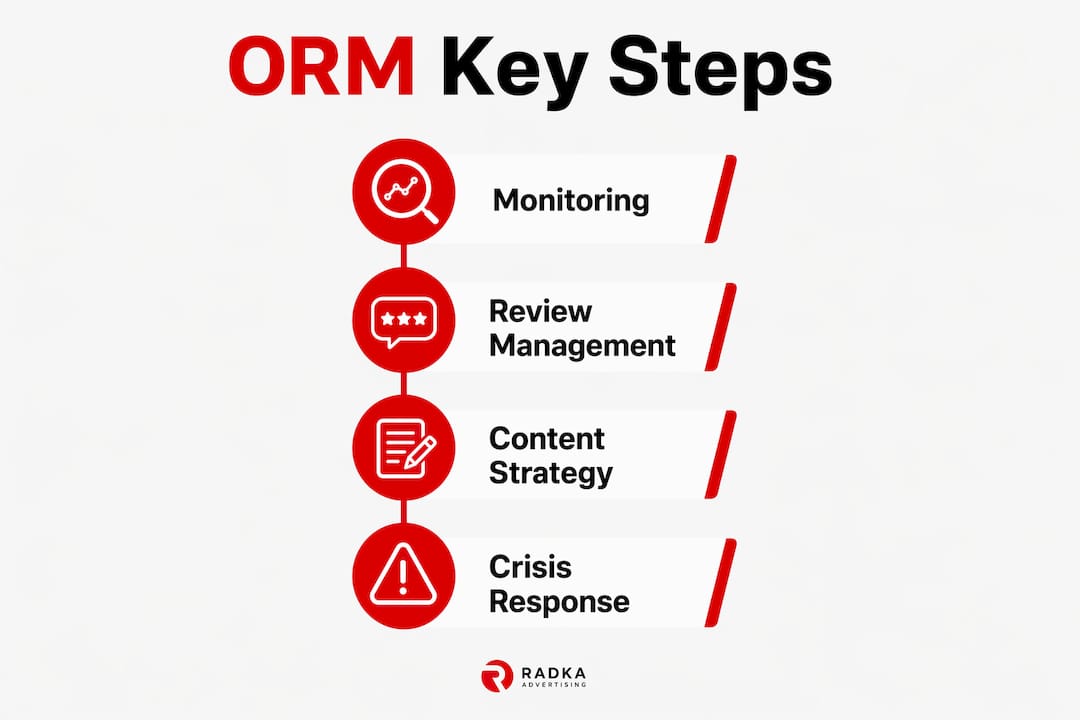
At its core, ORM involves four interconnected activities:
- Monitoring brand mentions, reviews, and sentiment across search engines, social media, and third-party sites
- Review management across platforms such as Google Business Profile, Trustpilot, and Facebook
- Content strategy to promote positive narratives and push down damaging results in branded search
- Crisis communication to respond quickly and credibly when reputation threats emerge
These activities span owned channels (your website, social profiles), earned channels (press coverage, third-party reviews), and the search results that tie them all together.
Why online reputation management matters for UK businesses right now
The numbers are stark. Between 89% and 93% of UK consumers consult online ratings and reviews before making a purchase. Yet only 17% of UK companies maintain a formal ORM plan. That gap is where reputations are won and lost.

For UK businesses, the importance of online presence has never been higher. Consumers research before they buy, compare before they commit, and share their experiences publicly whether you invite them to or not. A single cluster of unaddressed negative reviews can redirect potential customers to a competitor before you even know there is a problem.
ORM is no longer a defensive measure. UK brands that treat it as a growth function see tangible returns: stronger local search visibility, higher conversion rates from trust signals, and a customer feedback loop that actually improves the product or service. The benefits of reputation management compound over time because trust, once built publicly, keeps working.
Key benefits for UK businesses:
- Increased consumer confidence through visible, verified reviews
- Improved local SEO performance via consistent, accurate listings
- Faster identification of service problems before they escalate
- Stronger brand differentiation in crowded UK market sectors
- Greater resilience when negative press or reviews do appear
How search engines and online platforms shape what people think of you
When someone searches your brand name, the first page of Google results is your reputation, full stop. That page might include your website, your Google Business Profile, a knowledge panel, AI-generated overviews, news articles, and review site listings. Each element either builds or erodes trust.

ORM and SEO share some tools but pursue different goals. SEO focuses on ranking for traffic-generating keywords. ORM, by contrast, optimises the entire branded search ecosystem — knowledge panels, AI overviews, news boxes, and review aggregators — to control trust signals rather than visitor volume. The metrics differ too: ORM tracks review ratings, sentiment scores, and branded SERP composition rather than keyword positions.
The platforms that matter most in the UK context:
- Google Business Profile: the single most visible reputation asset for local businesses
- Trustpilot: widely trusted by UK consumers and prominently indexed by Google
- Facebook: relevant for community-facing brands and service businesses
- TripAdvisor: critical for hospitality, travel, and leisure sectors
- LinkedIn: reputation battleground for B2B brands and professional services
- Industry-specific directories: from Checkatrade to Yell, depending on your sector
Social media adds another layer. Untagged mentions, viral complaints, and influencer commentary all affect perception without appearing in your notifications. Monitoring must go beyond owned channels to catch what people say about you when they are not talking directly to you.
How to manage your online reputation effectively
Effective ORM runs on four pillars: monitoring, review management, content strategy, and crisis response. Each requires both the right tools and consistent execution.
Monitoring starts with setting up alerts for your brand name, key personnel, and product names. Google Alerts covers basic web mentions at no cost. More thorough monitoring tools scan social media, forums, news sites, and review platforms in near real time, flagging sentiment shifts before they become crises. ORM also means scanning for untagged mentions across the wider web, not just direct references on owned channels.
Review management is where most UK businesses underinvest. Responding to every review, positive and negative, signals to both customers and search algorithms that you are engaged. For negative reviews, acknowledge the issue, apologise where appropriate, and offer a resolution path. Never argue publicly. A well-handled complaint often converts a dissatisfied customer into a loyal one, and prospective buyers read your responses as closely as the original review.
Content strategy means creating and distributing material that occupies branded search results with positive, accurate information. Blog posts, press releases, case studies, and social content all compete for those first-page slots. The goal is not to hide problems but to ensure that the dominant narrative reflects your actual strengths.
Crisis response requires a protocol written before the crisis happens. Identify who speaks for the brand, what the sign-off process is, and which platforms need priority responses. Speed matters: a delayed response to a viral complaint reads as indifference.
Practical steps to implement ORM:
- Set up Google Alerts and a social listening tool for your brand and key personnel
- Audit your existing reviews across all relevant platforms monthly
- Create a review response template library for common scenarios
- Publish fresh, positive content on a regular schedule to maintain SERP presence
- Document a crisis response protocol with clear ownership and timelines
- Conduct an SEO audit to understand your current branded search footprint
Pro Tip: Build your trust buffer before you need it. Brands that accumulate a strong base of genuine positive reviews and consistent content are far more resilient when a negative story breaks. Reactive crisis management costs far more, in time and money, than proactive reputation building.
Persistent negative reviews often point to real operational problems that content alone cannot fix. If the same complaint appears repeatedly, the fix is in the service, not the messaging. Addressing root causes is what separates lasting ORM success from cosmetic reputation repair.
What are your online reputation assets and how do you manage them?
Your online reputation is not a single thing. It is a collection of digital assets, each sending signals to search engines and potential customers. Knowing what those assets are is the first step to managing them.
High-impact reputation assets include:
- Google Business Profile: name, address, phone number, photos, posts, and Q&A all affect local search visibility
- Review platform profiles: Trustpilot, Google, Facebook, TripAdvisor, and sector-specific sites
- Social media accounts: LinkedIn, Instagram, X (formerly Twitter), and Facebook pages
- Business directories: Yell, Bing Places, Apple Maps, and industry directories
- Media mentions and press coverage: articles, interviews, and features that appear in branded search
- Your own website: the content, About page, and blog all shape first impressions
Consistency across listings is critical. Mismatched addresses, outdated phone numbers, or conflicting business hours across directories confuse both customers and search algorithms. A quarterly audit of all listings catches drift before it damages local SEO performance.
Sentiment tracking beyond obvious channels matters too. Tools that monitor forums, Reddit threads, and niche communities surface reputation signals that never appear in your Google notifications. Understanding the full picture of what people say, and where they say it, gives you the intelligence to act rather than react. For brands serious about building trust online, this wider monitoring is where the real insight lives.
UK market insights: the ORM opportunity in 2026
The UK ORM market in 2026 presents a clear opportunity for businesses willing to act. Consumer reliance on reviews is at its highest recorded level, with 89–93% of UK shoppers consulting ratings before buying. At the same time, only 17% of UK companies have a structured plan to manage those perceptions.
“Proactive reputation management is not about controlling the narrative — it is about building enough genuine trust that the occasional negative voice does not define you. Brands that invest consistently in their reputation before a crisis hits spend a fraction of what reactive brands spend when things go wrong.”
— Forbes Business Council, Proactive Reputation Management
ORM in 2026 integrates marketing, customer service, local SEO, and operational improvement into a single function. It is not a campaign you run once. It is a discipline that runs alongside your business continuously. UK brands that treat it this way are already seeing it reflected in search visibility, customer retention, and conversion rates.
The gap between consumer reliance on reviews and the low rate of formal ORM adoption among UK companies is not just a risk. It is a competitive advantage waiting to be claimed. Radkaadvertising works with UK brands to close that gap through data-driven brand strategy, media coverage, and integrated digital marketing that treats reputation as a growth lever, not an afterthought.
Legal and ethical considerations for ORM in the UK
ORM in the UK operates within a clear legal framework, and ignoring it creates risks that dwarf any reputational benefit.
The UK General Data Protection Regulation (UK GDPR) governs how you collect, store, and use personal data gathered through monitoring tools. If your ORM process involves tracking individuals or storing customer data from reviews, you need a lawful basis for doing so and must comply with data subject rights including the right to erasure.
Defamation law is equally relevant. Publishing false statements of fact about a competitor, or encouraging fake positive reviews about your own brand, exposes you to claims under the Defamation Act 2013. The Competition and Markets Authority (CMA) has taken enforcement action against businesses that post or commission fake reviews, and the Digital Markets, Competition and Consumers Act 2024 strengthens those powers further.
Ethically, the line is straightforward. Encouraging genuine customers to leave honest reviews is legitimate ORM. Incentivising positive reviews without disclosure, suppressing legitimate negative feedback, or creating fake personas to post reviews crosses into deceptive practice. UK consumers are increasingly savvy about spotting manufactured sentiment, and the reputational cost of being caught fabricating reviews far exceeds any short-term gain.
ORM in practice: UK campaign examples
Real-world ORM campaigns in the UK share a common pattern: they combine operational improvement with visible, consistent engagement.
A regional hospitality group facing a cluster of negative TripAdvisor reviews about slow service did not respond with a PR campaign. They audited their kitchen workflow, reduced table turn times, and then actively invited satisfied guests to share their updated experiences. Within six months, their average rating recovered and their booking conversion rate improved alongside it. The reputation fix followed the operational fix, not the other way around.
A professional services firm in London noticed that branded searches were surfacing a years-old negative news article on the first page of Google. Rather than attempting to suppress it directly, they invested in a consistent programme of thought leadership content, press releases distributed through a media coverage strategy, and LinkedIn publishing. Over time, fresh authoritative content displaced the old article from the visible SERP positions.
A UK e-commerce retailer used Trustpilot’s verified review invitation system to systematically collect post-purchase feedback. By responding publicly to every review, including critical ones, they built a visible track record of accountability. Their Trustpilot score became a conversion tool, featured prominently on product pages and in paid advertising.
How to handle negative reviews and reputation crises
Negative reviews are not the enemy. Ignored negative reviews are. The distinction shapes everything about how effective ORM handles them.
For individual negative reviews, the response framework is simple: acknowledge, empathise, and resolve. Keep responses concise and professional. Never match the tone of an angry reviewer. Offer to take the conversation offline for complex issues, but always post a public response first so that other readers can see you engaged.
For coordinated attacks or false reviews, the process differs. Document everything before responding. Report false reviews to the platform using their official dispute process. Google, Trustpilot, and Facebook all have removal procedures for reviews that violate their policies. If defamatory content appears on third-party sites, legal advice under the Defamation Act 2013 may be appropriate.
Crisis management at scale requires a pre-built protocol:
- Designate a single spokesperson or response team with clear authority
- Establish a response time target (typically within two hours for social media)
- Prepare holding statements for common crisis scenarios before they occur
- Monitor sentiment in real time during a crisis using social listening tools
- Brief internal teams so that customer-facing staff give consistent answers
- Use PR services to manage media enquiries and shape the broader narrative
The brands that recover fastest from reputation crises are those that respond with transparency and speed, then follow up with evidence of genuine change.
How do you measure whether your ORM is working?
ORM metrics differ from standard marketing KPIs, and tracking the right ones is what separates informed management from guesswork.
The core metrics to track:
| Metric | What it tells you |
|---|---|
| Average review rating | Overall sentiment across platforms at a glance |
| Review volume and velocity | Whether customers are engaging and how frequently |
| Sentiment score | Positive vs negative tone across mentions and reviews |
| Branded SERP composition | Which results dominate page one for your brand name |
| Share of voice | How your brand presence compares to others in your sector |
| Response rate and time | How consistently and quickly you engage with reviews |
Branded SERP composition deserves particular attention. Track which results occupy the top ten positions for your brand name each month: your website, review profiles, news articles, social pages, and directory listings. Shifts in that composition, especially a negative article moving up, are early warning signals that require a content response.
Sentiment scoring tools aggregate mentions across platforms and assign a positive, neutral, or negative classification. Tracking sentiment trends over time reveals whether ORM efforts are genuinely shifting perception or simply generating more noise. Combine sentiment data with review ratings and conversion analytics to build a picture of ORM’s commercial impact. For a deeper view of how your digital presence performs across all these dimensions, a structured digital growth audit gives you the baseline to measure against.
Key takeaways
Online reputation management is a continuous, data-driven discipline that directly affects consumer trust, search visibility, and revenue for UK businesses in 2026.
| Point | Details |
|---|---|
| ORM definition | Monitoring, shaping, and influencing online perceptions across search, reviews, and social media. |
| UK consumer reliance | Between 89% and 93% of UK shoppers consult reviews before buying, making ORM commercially critical. |
| Proactive beats reactive | Building a trust buffer through consistent content and review engagement costs far less than crisis management. |
| Operational fixes first | Persistent negative reviews signal real service problems; marketing alone cannot resolve them. |
| Measure what matters | Track branded SERP composition, sentiment scores, review velocity, and response rates, not just star ratings. |
FAQ
What is the meaning of online reputation management?
Online reputation management is the practice of monitoring, influencing, and shaping how a brand or individual is perceived across digital channels, including search engines, review platforms, and social media.
What is the difference between SEO and ORM?
SEO focuses on ranking for keywords to drive traffic, while ORM optimises the branded search ecosystem — reviews, knowledge panels, and news results — to build trust and control how a brand appears to people already searching for it.
How much does online reputation management cost in the UK?
Pricing varies widely depending on scope and provider. Basic monitoring and review management for a small business can be handled with low-cost tools, while full-service ORM campaigns for larger brands typically involve agency retainers; specific pricing is not publicly standardised across the UK market.
What is online reputation in simple words?
Your online reputation is what people find and believe about you when they search your name or brand online, shaped by reviews, search results, social media, and news coverage.
How do I start managing my online reputation?
Begin by auditing your current branded search results, claiming and completing all major platform profiles, setting up monitoring alerts, and responding consistently to existing reviews before building a content strategy to reinforce positive perceptions.