What is brand differentiation? A guide for entrepreneurs

TL;DR:
- Brand differentiation involves establishing unique qualities that set your brand apart from competitors and justify customer perception. It is a strategic, structural practice that reduces reliance on price competition and builds long-term loyalty. Continuous measurement and alignment across value proposition, identity, messaging, and customer experience ensure sustained market distinction.
Brand differentiation is the deliberate process of identifying and communicating the qualities that make your brand distinct from every competitor in your market. Without it, your business competes on price alone, a position that erodes margins and destroys long-term value. According to Gartner’s 2026 research, 46% of customers cannot distinguish between most brands’ digital experiences. That figure is not a warning for large corporations. It is a direct challenge to every entrepreneur building a brand today.
What is brand differentiation and why does it matter?
Brand differentiation is the practice of establishing qualities, perceptions, and experiences that make your brand the obvious choice for a specific group of customers. The industry term you will encounter in strategic branding literature is brand positioning, though differentiation and positioning are related but distinct concepts. As marketing glossaries clarify, brand positioning is the perception difference that exists in customers’ minds, while differentiation is the substance that creates that uniqueness. You cannot have credible positioning without genuine differentiation underneath it.
For business owners, this distinction matters practically. You can claim a position in the market, but unless your product, service, experience, or values genuinely differ from competitors, that claim collapses under scrutiny. Differentiation is the evidence that makes positioning believable.
The benefits of brand differentiation extend well beyond perception. Differentiated brands lower customer acquisition costs and improve retention through stronger loyalty and recognition. When customers know exactly what you stand for and why you are different, they return without needing to be persuaded again.
What are the core elements that create effective brand differentiation?
Effective differentiation is built from four interlocking components. Understanding each one prevents the common mistake of treating differentiation as a tagline exercise rather than a structural business decision.
Unique value proposition (UVP). Your UVP is the single clearest statement of what you offer, who it is for, and why no competitor delivers it the same way. It is not a slogan. It is the internal compass that guides every external communication. A weak UVP produces generic marketing. A sharp UVP produces campaigns that convert.
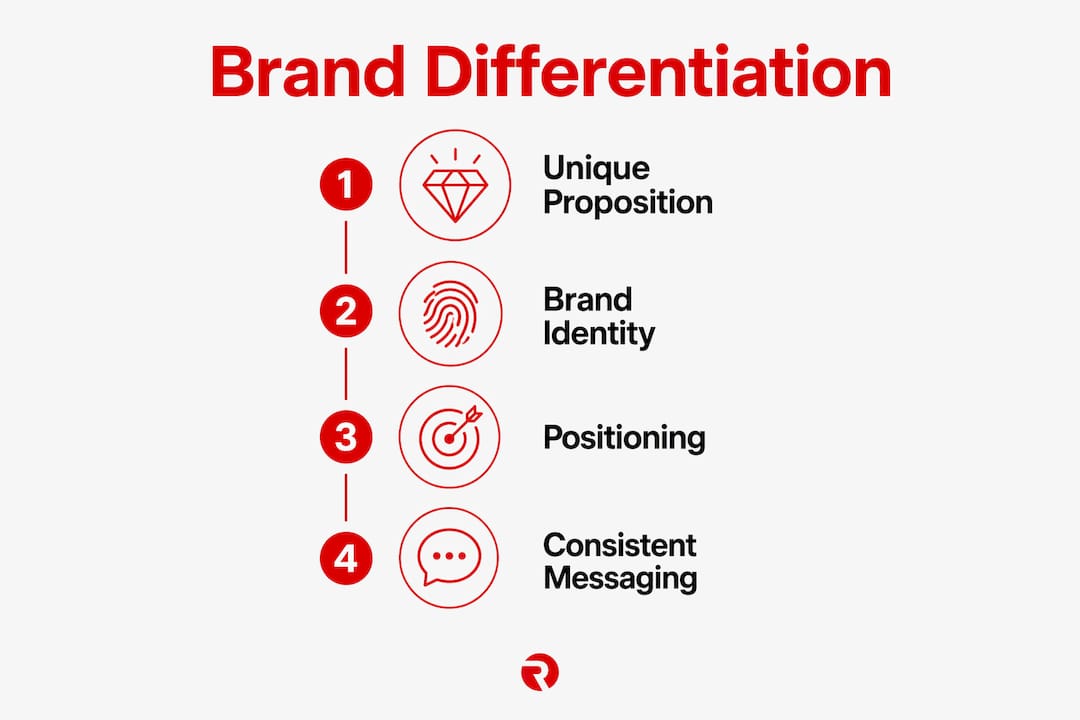
Brand identity. This covers your visual language (logo, colour palette, typography), your verbal tone (how you write and speak), and your experiential layer (how customers feel at every touchpoint). All three must be consistent and aligned. A brand with a bold visual identity but an inconsistent tone confuses customers rather than reassuring them.

Positioning relative to competitors. Differentiation does not happen in isolation. It is always relative to what else exists in the market. Knowing where competitors sit allows you to identify the gaps where your brand can own a distinct space.
Consistent messaging. Consistent brand messaging across all touchpoints is the mechanism that reinforces differentiation and builds customer recall over time. One strong message repeated clearly across your website, social media, packaging, and customer service is more powerful than five clever messages used inconsistently.
Pro Tip: Write your UVP as a single sentence that a ten-year-old could understand. If you need three sentences to explain what makes you different, your differentiation is not yet clear enough to communicate.
Why does differentiation fail so many brands?
Without clear brand differentiation, companies risk product parity, which leads directly to price-based competition and margin erosion. This is not a theoretical risk. It is the operational reality for thousands of businesses that launch with strong products but weak brand identities.
“Failing to differentiate leads brands into a damaging race to the bottom where price is the primary competitive factor, eroding profitability.” — Branding Strategy Insider
The mechanism is straightforward. When customers cannot identify a meaningful difference between your brand and a competitor’s, they default to the one variable they can measure easily: price. At that point, your marketing budget is no longer building brand equity. It is subsidising a discount war you cannot win sustainably.
The Gartner finding that 46% of customers struggle to distinguish brands digitally reveals something specific about the current environment. Digital channels have made it easier to launch a brand but harder to stand out within one. Every industry now has dozens of visually similar websites, nearly identical product descriptions, and comparable social media presences. The brands that break through this noise are not necessarily the ones with the largest budgets. They are the ones with the clearest differentiation.
Poor differentiation also damages customer retention. When a customer has no strong reason to return to you specifically, a competitor’s promotion is enough to pull them away. Differentiation is what makes switching feel like a loss rather than a neutral decision.
What are proven brand differentiation strategies?
Effective differentiation emerges from aligned decisions across your UVP, positioning, messaging, and customer experience. No single lever is sufficient on its own. The following strategies work because they address multiple dimensions simultaneously.
-
Define a UVP connected to a real customer need. Start with customer research, not internal brainstorming. The most powerful UVPs solve a problem customers already feel, not one the brand assumes they have. Patagonia’s differentiation around environmental responsibility works because its customers genuinely care about sustainability. The UVP is not invented. It is discovered through understanding the audience.
-
Build emotional connection deliberately. Emotional connection and experiential consistency create differentiation that competitors cannot replicate through features alone. Features can be copied within months. The feeling a customer associates with your brand takes years to build and is far harder to imitate. Apple’s differentiation is not primarily technical. It is the sense of belonging to a community of people who value design and simplicity.
-
Own a consistent position across every touchpoint. Your website, packaging, customer service scripts, social media tone, and even your invoice design should all communicate the same brand character. Inconsistency signals to customers that the brand is not fully formed, which undermines trust.
-
Use pricing as a differentiation signal, not just a revenue mechanism. Premium pricing, when supported by genuine quality and brand story, communicates value. Brands like Moleskine charge significantly more than generic notebook competitors because their pricing is part of the differentiation narrative, not separate from it.
-
Differentiate through customer service experience. Zappos built its entire brand identity around customer service so exceptional that it became the product. The shoes were secondary. This approach is particularly accessible for small businesses and entrepreneurs who cannot compete on product range or price but can compete on personal attention and responsiveness.
Pro Tip: Audit your brand across three competitor websites and your own simultaneously. If a customer could swap your logo for a competitor’s without noticing a difference in tone, message, or visual style, your differentiation work is not yet complete.
For entrepreneurs exploring small business marketing strategies, differentiation is the foundation that makes every other tactic more effective. Advertising a differentiated brand produces compounding returns. Advertising an undifferentiated one produces diminishing ones.
How to measure and sustain brand differentiation over time
Brand differentiation requires continuous effort. Markets shift, competitors adapt, and customer expectations evolve. A differentiation strategy that was sharp three years ago may be blunt today.
The following metrics give you a practical framework for monitoring your brand’s distinctiveness:
| Metric | What it measures |
|---|---|
| Brand recall rate | The percentage of customers who name your brand unprompted in your category |
| Net Promoter Score (NPS) | Customer likelihood to recommend, which reflects emotional differentiation |
| Price premium acceptance | Whether customers pay above the category average without significant resistance |
| Customer retention rate | Repeat purchase behaviour driven by brand loyalty rather than habit |
| Share of voice | Your brand’s presence in category conversations relative to competitors |
Tracking these metrics quarterly gives you early warning signals before differentiation erodes into parity. A falling NPS combined with declining price premium acceptance is a clear signal that your brand is drifting towards commodity status.
Sustaining differentiation also requires discipline around brand consistency. The temptation to chase trends, copy competitor campaigns, or refresh brand identity too frequently undermines the cumulative effect of consistent positioning. Brands that consistently articulate their differentiation shift customer conversations from “Which is cheaper?” to “Which fits me better?” That shift is the commercial goal of all differentiation work.
Understanding the broader branding strategy definition helps entrepreneurs see differentiation not as a one-time project but as an ongoing strategic discipline embedded in every business decision.
Key takeaways
Brand differentiation is the substance behind positioning: without it, price becomes the only competitive variable, and profitability follows.
| Point | Details |
|---|---|
| Differentiation is structural, not cosmetic | It must be embedded in your UVP, identity, and customer experience, not just your tagline. |
| 46% of customers cannot distinguish brands digitally | This Gartner finding means most markets have a clear opportunity for brands willing to differentiate deliberately. |
| Emotional connection outlasts feature advantages | Competitors can copy product features quickly; the feeling your brand creates takes years to replicate. |
| Consistent messaging compounds over time | Repeating one clear message across all touchpoints builds recall faster than rotating multiple messages. |
| Differentiation must be measured and maintained | Metrics like NPS, retention rate, and price premium acceptance signal when differentiation is eroding. |
Why I think most entrepreneurs underestimate differentiation
From working with brands across multiple industries, the pattern I see most often is this: entrepreneurs invest heavily in product development and digital advertising, then treat brand differentiation as something they will address “once the business is more established.” That sequencing is backwards.
Differentiation is not a refinement you add later. It is the strategic foundation that determines whether your advertising spend produces compounding returns or simply funds a race to the bottom. I have seen well-funded businesses with genuinely superior products lose market share to competitors with inferior offerings but sharper brand identities. The product was not the deciding factor. The clarity of differentiation was.
The other mistake I encounter regularly is confusing differentiation with novelty. Being different for its own sake does not create competitive advantage. The differentiation that works is always rooted in something customers genuinely value and that competitors cannot easily replicate. That combination, meaningful and defensible, is what makes differentiation a durable strategic asset rather than a marketing exercise.
If you are building a brand right now, start by asking one question: if your brand disappeared tomorrow, would your customers feel a specific loss, or would they simply move to the next available option? The answer tells you exactly how much differentiation work remains to be done.
— Bart
How Radkaadvertising helps you build a differentiated brand
Radkaadvertising is a London-based brand strategy agency that has worked with clients including Coca-Cola, Maybelline, and PowerLink Energy to build brands with clear, defensible differentiation. If your brand is struggling to stand out, the most direct starting point is a structured brand audit that maps your current positioning against competitors and identifies the gaps where differentiation is possible. From there, Radkaadvertising’s brand onboarding process translates strategic findings into a concrete brand identity, UVP, and messaging framework. You can also explore the agency’s brand audit service for a focused evaluation of where your current differentiation is strong and where it is leaving competitive ground unclaimed. See the full range of services to find the right starting point for your brand.
FAQ
What is brand differentiation in simple terms?
Brand differentiation is the process of making your brand clearly distinct from competitors in ways that matter to your customers. It covers your product, experience, values, and communication, not just your visual identity.
How does brand differentiation differ from brand positioning?
Brand positioning is the perception customers hold in their minds about where your brand sits relative to competitors. Brand differentiation is the actual substance, the real qualities and decisions, that creates and justifies that perception.
What are the most effective brand differentiation strategies?
The most effective strategies combine a sharp unique value proposition, emotional brand experience, consistent messaging across all touchpoints, and deliberate pricing signals. No single tactic is sufficient without the others supporting it.
Why do so many brands fail to differentiate effectively?
Most brands fail because they treat differentiation as a visual or messaging exercise rather than a structural business decision. Without genuine differences in product, service, or experience, no amount of creative branding sustains a distinct market position.
How do you measure brand differentiation?
Key metrics include brand recall rate, Net Promoter Score, price premium acceptance, customer retention rate, and share of voice. Tracking these quarterly reveals whether your differentiation is strengthening or eroding over time.