UTM naming conventions: an advanced guide with templates

Use a controlled vocabulary: lowercase values, one separator, and a documented campaign formula, enforced through a locked UTM builder rather than a blank text field. That single rule stops most tracking chaos before it starts.
The formula worth adopting today: {source} + {medium} + {yyyymm}-{program}-{tactic} inside utm_campaign, with utm_content reserved for creative or link-position variants. Here’s what that looks like on a live URL:
https://example.com/?utm_source=facebook&utm_medium=paid-social&utm_campaign=2026-q1-springlaunch-carousel&utm_content=video-ad1
- Lock the fields with a shared builder or spreadsheet template, not free text.
- Lowercase every value, always, no exceptions for brand names or product SKUs.
- Put a date token and programme name inside
utm_campaignso BigQuery or Snowflake queries can parse it without regex gymnastics.
Get that habit in place and the rest of this guide is refinement, not repair.
TL;DR:
- Using a single, locked UTM builder ensures consistent lowercase values, hyphen separators, and a fixed naming pattern, reducing tracking chaos.
- Including
utm_source,utm_medium, andutm_campaignon every link is essential, as missing any one breaks proper attribution in Google Analytics.- A key-value UTM model with explicit labels is preferable for larger teams to enhance readability and prevent errors across departments.
- Regular governance practices such as documented registries, automated dropdowns, and monthly audits prevent taxonomy drift and reporting fragmentation.
- Common UTM errors like case drift, encoding mistakes, redirect loss, and duplicate parameters can be fixed through programmatic enforcement and thorough URL testing.
Table of Contents
- What are the five UTM parameters and which ones are required?
- Why does inconsistent UTM tagging damage your reporting?
- Which UTM naming model should your team use?
- Best practices checklist for enforcing UTM consistency
- Copy-paste UTM templates for common channels
- How do you govern UTM naming across teams?
- How do you fix broken or inconsistent UTM tags?
- Key Takeaways
- Sources
- FAQ
What are the five UTM parameters and which ones are required?
Google Analytics recognises five UTM parameters, though only three carry real weight for reporting. utm_source identifies where the traffic came from (google, newsletter, facebook). utm_medium describes the channel type (cpc, email, paid-social). utm_campaign names the specific initiative (2026-q1-springlaunch). utm_term and utm_content are optional refinements, historically used for paid search keywords and for distinguishing between ad variants or link placements respectively.
Google’s own documentation is direct about this: always include utm_source, utm_medium, and utm_campaign on every tagged link, because GA4 needs all three to build a coherent attribution model. Skip one and the platform falls back to defaults that muddy your channel groupings, often lumping legitimate paid traffic into “unassigned” or “direct.”
The parsing behaviour catches more experienced marketers out than beginners. Every major analytics platform treats UTM values as case sensitive, so Newsletter and newsletter register as two distinct sources in your reports. That’s not a bug worth reporting to your analytics vendor. It’s simply how the standard works, and Terminus’s tagging guide confirms lowercase discipline is the only dependable defence against this kind of silent fragmentation.
A few technical points worth locking in early:
- Spaces in UTM values get URL-encoded as
%20or+, which looks messy in raw links and can render inconsistently across email clients. Use hyphens instead. utm_termhas largely lost relevance since Google deprecated exact-match keyword reporting in most paid search interfaces, but some teams still use it for A/B test labelling.- Reserve
utm_contentfor genuinely distinct creative or placement variants. Piling new values in here for trivial differences bloats your reporting dimensions without adding insight, a point Pimms’ scalable tagging framework makes well.
Get these five fields right and you’ve built the skeleton every other section of this guide hangs on.
Why does inconsistent UTM tagging damage your reporting?
A single rogue capital letter can quietly split one campaign into two rows in your analytics dashboard. Multiply that across a year of campaigns run by different team members, freelancers, and agency partners, and you end up with a channel report that looks nothing like reality. Email, email, and E-mail don’t just look untidy side by side. They report as three separate sources, each with its own conversion count, none of which reflects the true performance of your email programme.
The compounding cost: every inconsistent value doesn’t just create one bad data point. It creates a permanent fork in your historical reporting that requires manual reconciliation every time someone runs a quarterly review.
This isn’t a cosmetic problem. When channel-level ROI calculations depend on cleanly bucketed traffic, fragmented UTMs directly distort budget decisions. A paid social campaign that’s actually your best performer can look mediocre simply because its results are split across four naming variants instead of consolidated under one.
Consistent tagging pays off twice: once in the dashboard, and again when the data hits a warehouse. Research analytics work consistently shows that stable, structured measurement correlates with materially better marketing ROI, largely because teams stop wasting analyst hours reconciling naming drift and start spending that time on actual optimisation. A structured, dash-separated pattern also keeps campaign values parseable in tools like BigQuery or Snowflake, where a well-formed 2026-q1-program-tactic string can be split into columns with a single SQL function rather than a fragile regex.

Standardisation work is front-loaded. The audit and cleanup burden that follows a messy taxonomy, hunting down every campaign variant, deciding which is canonical, backfilling historic data, tends to shrink dramatically once a documented convention exists, because there’s nothing left to reconcile going forward.
Which UTM naming model should your team use?
Three broad approaches dominate UTM naming in practice, and picking the wrong one for your team’s size is a common source of long-term pain.
The cryptic model compresses everything into short codes: utm_campaign=sl26q1 instead of a readable string. Links stay compact, which matters in character-limited placements like SMS or some print QR codes. The trade-off is steep: cryptic codes are meaningless without a lookup registry, and if that registry lives in one person’s spreadsheet, the whole system collapses the day they leave.
The positional model relies on strict field ordering to convey meaning, something like {channel}-{date}-{campaign}-{variant} where position, not labelling, tells you what each segment represents. It’s compact and machine-parseable, which suits teams with strong warehouse tooling. It’s also unforgiving. One misplaced segment during manual entry and the whole value becomes gibberish that still passes as a “valid” UTM.
The key-value model labels each segment explicitly: campaign=springlaunch_channel=social_variant=video. It reads clearly to any human glancing at a report, which makes it far more forgiving for larger or less specialised teams, at the cost of longer, less elegant URLs.
- Cryptic: best for small, tightly coordinated teams with a strict registry and low tagging volume.
- Positional: best for teams with strong data engineering support and a genuine need for warehouse-level parsing at scale.
- Key-value: best for larger or cross-departmental teams where readability prevents errors more effectively than compactness saves characters.
A hybrid works for most organisations reading this: positional structure inside utm_campaign (so it’s automatically parseable), paired with clear, GA4-aligned values in utm_source and utm_medium (so anyone glancing at a report understands the channel instantly).
Pro Tip: Don’t choose a naming model to impress your data team. Choose the one your least technical stakeholder can still read correctly six months from now, because that’s the person most likely to introduce a typo.
Best practices checklist for enforcing UTM consistency
Give every marketer, freelancer, and agency partner this exact list before they build a single tracking link.
- Lowercase everything, always. Analytics platforms parse UTM values as case sensitive, so
Springandspringbecome two different campaigns in your reporting, with no warning and no automatic merge. - Pick one separator and never deviate. Hyphens are the safer default because some platforms and CMS URL handlers treat underscores inconsistently during encoding.
- Restrict values to letters, numbers, and hyphens only. No spaces, no ampersands, no punctuation. Anything else risks double encoding or a broken link further down the chain.
- Follow one campaign naming formula, every time. A workable structure:
{yyyymm}-{program}-{tactic}, for example2026-03-springlaunch-carousel. Field order should never change between campaigns. - Map
utm_mediumvalues directly to your GA4 channel groupings. Values likecpc,paid-social,email, andorganic-socialslot cleanly into GA4’s default channel definitions; invented mediums likepromoormktgdon’t map anywhere and land in “unassigned.” - Cap your approved
utm_sourcelist. A finite, documented list of accepted sources (google, meta, linkedin, newsletter, partner-name) prevents the slow sprawl of one-off values nobody remembers approving.
The underlying logic across Google’s guidance and independent practitioner playbooks is consistent: eight core rules, covering lowercase discipline, hyphen separators, short descriptive values, GA4-aligned mediums, embedded dates, restricted characters, documented approved values, and monthly audits, appear again and again as the baseline every functioning taxonomy needs.
- Document the approved value list somewhere every team member can reach it, not buried in a Slack thread from eighteen months ago.
- Review new campaign requests against that list before a link goes live, not after the campaign has already run for three weeks.
- Treat any UTM outside the approved vocabulary as a bug to fix, not a quirky one-off to tolerate.
Copy-paste UTM templates for common channels
Ready-made templates remove the temptation to freestyle a UTM string under deadline pressure. Adapt the placeholders and the structure holds.
Email: utm_source=newsletter&utm_medium=email&utm_campaign=2026-03-springlaunch&utm_content=header-link (use utm_content to distinguish header, body, and footer links within the same send).
Paid social: utm_source=facebook&utm_medium=paid-social&utm_campaign=2026-03-springlaunch-carousel&utm_id=fb-8842 (the utm_id value should map to a stable campaign ID from your ad platform, since campaign names alone are unreliable keys when importing cost data, as linkutm’s naming guide points out).
Paid search: utm_source=google&utm_medium=cpc&utm_campaign=2026-03-brandterms (note that Google Ads auto-tagging via gclid can conflict with manual UTMs if both are applied inconsistently across the same account, so pick one method and standardise it).
Affiliate or partner: utm_source=partnername&utm_medium=affiliate&utm_campaign=2026-03-springlaunch
QR or print: utm_source=print-flyer&utm_medium=qr&utm_campaign=2026-03-instore-promo
| Channel | Recommended medium value | Notes |
|---|---|---|
Use utm_content for link position within the send |
||
| Paid social | paid-social | Pair with utm_id for cost data import |
| Paid search | cpc | Avoid clashing with platform auto-tagging |
| Affiliate | affiliate | Source should be the specific partner name |
| QR/print | qr | Test the scanned link before printing at volume |
Every template above follows the same lowercase, hyphen-separated, GA4-aligned logic set out earlier. NextUtils’ guide to campaign tracking reinforces the same principle: keep utm_source and utm_medium tightly controlled, and give yourself more flexibility only in utm_campaign and utm_content, where descriptive nuance actually helps reporting rather than fragmenting it.
How do you govern UTM naming across teams?
A naming convention only survives contact with a real organisation if it’s backed by governance, not goodwill. Treat this as infrastructure, not a style guide people are trusted to remember.
Start with a documented source-of-truth registry, a single shared document listing every approved source, medium, and active campaign code, with a named owner responsible for updates. Without an owner, registries rot within a quarter.
Layer automation on top immediately. A locked UTM builder with dropdown menus for source and medium, rather than free-text fields, removes the human error that no amount of training fully eliminates. UTM Generator’s governance framework frames this as a four-layer system: registry, automated link creation, rollout and training, and recurring audits, each layer compensating for the weaknesses of the one before it.
- Build or adopt a locked link builder with pre-approved dropdowns for source and medium.
- Run a rollout session with every stakeholder who creates links, not just the marketing team.
- Schedule monthly audits: pull a sample of live campaign URLs and check them against the registry.
- Validate redirect chains quarterly to confirm parameters survive intermediary links and shorteners.
Pro Tip: Governance beats policing every time your team grows past five people. You cannot manually review every link a growing team publishes, but you can make it structurally difficult to publish a bad one.
Automation genuinely earns its keep here. Locked dropdowns and macros integrated directly into your CMS or ad platform substantially cut the human error rate, because the person building the link is no longer typing anything that could be misspelled.
How do you fix broken or inconsistent UTM tags?
Most UTM failures fall into four repeatable categories, and each has a fast diagnostic.
- Case drift. Run a quick query grouping traffic by lowercase-normalised source and medium values. If the normalised totals differ sharply from your raw report, you’ve got drift, and the fix is programmatic enforcement at link-creation time rather than manual correction after the fact.
- Encoding errors. Double-encoded ampersands or spaces (
%2520instead of%20) usually creep in when a link gets pasted through multiple tools before publishing. Check raw URLs before they go live, not after. - Redirect stripping. Some link shorteners and CMS redirect rules silently drop query parameters. Always test the final landing URL programmatically after any redirect hop to confirm the UTM string survives intact.
- Duplicate or conflicting parameters. A landing page with its own tracking script sometimes appends a second
utm_source, overwriting the one you set. Audit landing page tags for conflicts before a campaign goes live.
When a report suddenly looks wrong, check these four in order: case consistency, encoding, redirect survival, then landing-page conflicts. Nine times out of ten, the fault sits in one of them.
A pragmatic take on rollout
The friction in UTM governance rarely comes from the taxonomy itself. It comes from the first three weeks after launch, when old habits and new rules collide and someone inevitably ships a link with the wrong capitalisation. Automation absorbs that friction far better than a policy document ever will, because a locked dropdown physically prevents the mistake a memo only asks people to avoid.
Governance beats policing precisely because it scales. A five-person team can survive on trust and a shared spreadsheet. A fifty-person team, spread across agencies and freelancers, cannot. Radkaadvertising’s own approach to campaign measurement work treats the taxonomy as infrastructure from day one, not a document to revisit once things have already gone wrong.
— Bart
How Radkaadvertising builds and enforces your UTM taxonomy
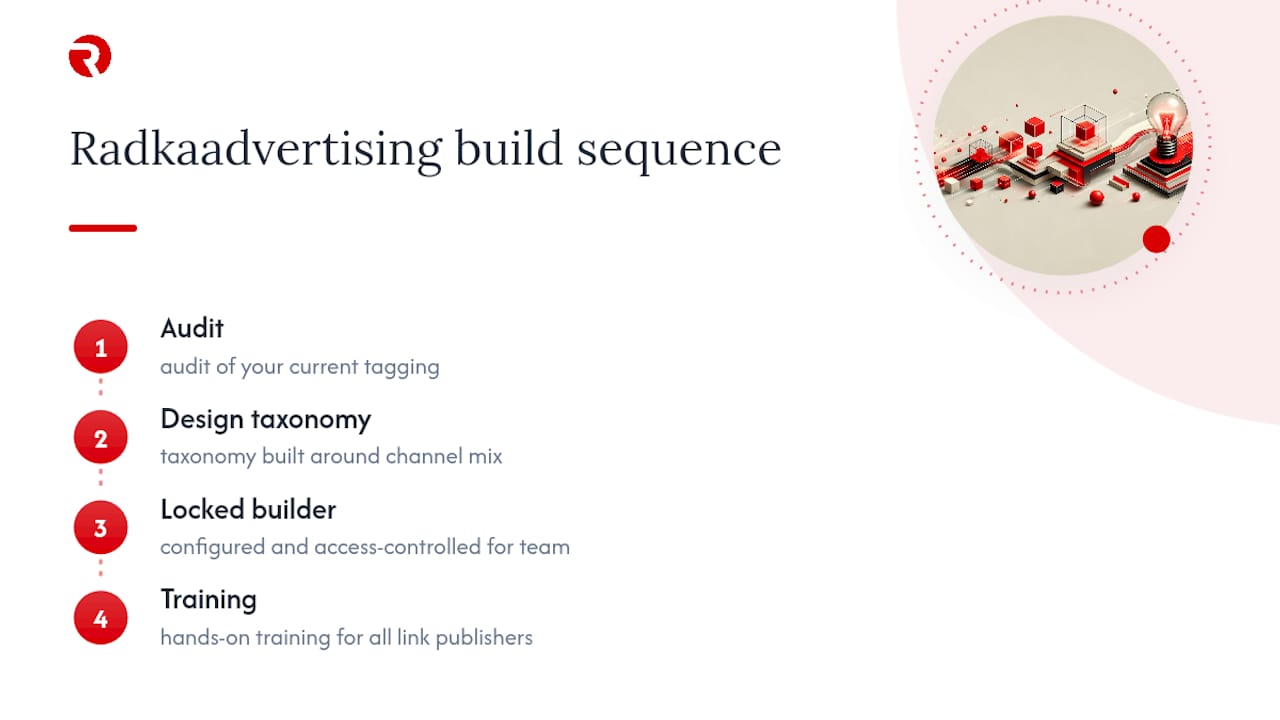
Radkaadvertising is the practical alternative to spending another quarter fighting fragmented channel data: rather than handing you a template and wishing you luck, we run the full build, an audit of your current tagging, a taxonomy designed around your actual channel mix, a locked builder configured for your team, and hands-on training for everyone who publishes links. That’s the audit, design, configuration, and training sequence covered in this guide, delivered rather than described. Our case studies show how this kind of measurement groundwork has supported campaign work for brands operating across multiple markets, including UK and Eastern European businesses managing bilingual campaigns. If your reporting currently looks like a patchwork of naming variants nobody quite remembers approving, book a taxonomy and analytics audit and get a documented, enforced convention in place before your next campaign launches.
Key Takeaways
Consistent UTM naming depends on a controlled vocabulary, enforced through automation rather than manual discipline, and backed by a documented registry with recurring audits.
| Point | Details |
|---|---|
| Three fields are mandatory | Always include utm_source, utm_medium, and utm_campaign on every tagged link. |
| Case sensitivity breaks reports | Lowercase every value, since platforms treat capitalised variants as separate entries. |
| Choose one naming model deliberately | Cryptic suits small teams, key-value suits larger cross-departmental groups, positional suits strong data teams. |
| Governance beats manual policing | A registry, locked builder, training, and monthly audits prevent taxonomy drift at scale. |
| Radkaadvertising builds the full system | Audit, taxonomy design, builder configuration, and training are delivered as one connected service. |
Vetted resources for implementation checks
For technical validation beyond this guide, Google’s URL builder documentation covers the official parameter specification, while Terminus’s dated tagging reference offers a deeper look at warehouse-friendly campaign formatting.
Sources
- Collect campaign data with custom URLs - Analytics Help
- The 2026 UTM Tagging Guide: A Complete, Dated Reference for Marketing Teams - Terminus Blog
- UTM Naming Conventions: 8 Rules + Templates for Teams
- UTM Parameters: The Complete Guide to Campaign Tracking (2026)
FAQ
What are the five UTM parameters?
The five parameters are utm_source, utm_medium, utm_campaign, utm_term, and utm_content. Only the first three are required for reliable GA4 attribution.
What are examples of good UTM naming conventions?
A dash-separated, lowercase format like 2026-03-springlaunch-carousel for utm_campaign, paired with controlled values like paid-social for utm_medium, is a workable standard most teams can adopt directly.
What are the most common UTM mistakes?
Case inconsistency, double-encoded characters, redirect chains stripping parameters, and conflicting duplicate parameters on landing pages are the four failure modes that break tracking most often.
How should I structure a UTM string?
Keep utm_source and utm_medium from a short, approved list, then build utm_campaign around a fixed field order, typically date, then programme, then tactic, so the value stays both readable and parseable in a warehouse. Radkaadvertising configures this exact structure as part of its taxonomy design work for clients running multi-channel campaigns.