UK startup marketing strategies for growth and visibility

TL;DR:
- UK startups often waste budgets by spreading spending across too many channels instead of focusing strategically. Concentrating efforts on two or three targeted channels, aligned with audience behavior and sales cycle, yields better results than scattering funds widely. Implementing disciplined frameworks like the 70-20-10 rule and ensuring compliance are essential for sustainable growth within UK regulatory boundaries.
Most UK startups waste their early budgets not because they spend too little, but because they spread too much across too many channels with too little focus. The assumption that more spend equals more growth is one of the most costly myths in British entrepreneurship. What actually separates the startups that build lasting visibility from those that burn through their runway is strategic precision, channel discipline, and an honest understanding of UK consumer culture. This guide walks you through evidence-backed frameworks, channel choices, compliance essentials, and smarter ways to grow your brand without gambling your budget.
Table of Contents
- Building a smart marketing budget for UK startups
- Choosing the right channels for your startup
- The 70-20-10 rule: balancing core and experimental campaigns
- Staying compliant: UK ad laws and startup best practice
- Marketing under restrictions: alternatives and AI opportunities
- What most startup marketers miss in the UK
- How Radka Advertising accelerates UK startup growth
- Frequently asked questions
Key Takeaways
| Point | Details |
|---|---|
| Targeted budgeting wins | Focus your marketing budget on a few high-impact channels for measurable results. |
| Channel choice matters | Choose platforms based on your audience—LinkedIn for B2B, social for B2C. |
| Compliance is critical | Labelling and contracts keep your campaigns within the law and protect your brand. |
| Adapt and experiment | Balance proven marketing channels with smart testing and AI-driven innovation. |
| Owned channels safeguard growth | Building audiences through email, partnerships, and SEO helps weather digital ad shifts. |
Building a smart marketing budget for UK startups
With budget misconceptions out of the way, it is essential to establish how much to invest and where that spend can create maximum impact.
Many founders treat marketing budgets as an afterthought, slotting in whatever is left after salaries and product costs. That approach almost always leads to inconsistent activity and poor results. The smarter path is to anchor your marketing investment to revenue projections from day one.
A useful starting benchmark: allocate 8–12% of first-year projected revenue to go-to-market activities, including paid channels, content, and testing. For a startup projecting £500,000 in year-one revenue, that translates to a marketing budget of £40,000 to £60,000. It is not a fortune, but focused correctly, it is more than enough to build meaningful traction.
What does a realistic UK marketing budget actually cover? Here is a breakdown by common line items:
| Budget line | Typical UK cost |
|---|---|
| SEO retainer | £1,500–£4,000 per month |
| Google Ads management | 10–20% of ad spend |
| Content (articles, blogs) | £300–£800 per article |
| Social media management | £800–£2,500 per month |
| Email marketing tools | £50–£300 per month |
| Creative and design | £500–£3,000 per project |
According to UK marketing cost benchmarks, B2B startups should allocate roughly 2–5% of revenue to marketing, while B2C startups typically need 5–10%, with digital channels consuming 70–80% of the overall budget.
The most common mistake early-stage founders make is splitting that budget across six or seven channels simultaneously. At seed stage, your budget is not large enough to generate meaningful data from so many fronts. Concentrated effort in two or three channels will always outperform scattered activity.
Key principles for smart budget allocation:
- Prioritise channels where your target audience is already active
- Reserve at least 10–15% of your budget for testing and iteration
- Review spend monthly rather than quarterly so you can course-correct quickly
- Use a comprehensive SEO audit before committing to organic content investment
Pro Tip: Before setting your budget, audit what your competitors are doing visibly online. If they are running consistent Google Ads and ranking for key terms, organic alone will not get you there fast enough.
Getting started does not require a massive war chest. It requires clarity. If you are still unsure where to begin, exploring UK advertising fundamentals is a practical first step before committing any spend.
Choosing the right channels for your startup
Once your budget is set, the logical next step is picking the right platforms and channels for your marketing efforts.

Not all channels are created equal, and not every platform suits every business model. The choice between LinkedIn, Google Ads, Meta, email, and organic search should be driven by your audience profile, sales cycle length, and the nature of your product.
For B2B startups, the evidence consistently points toward LinkedIn. The cost per click is higher than Google Ads, but LinkedIn delivers unmatched precision for B2B targeting, including job title, company size, industry, and seniority. When your deal size is £5,000 or more, paying a premium for the right eyeballs makes complete financial sense.
For B2C startups, Google Ads remains a powerhouse for capturing demand that already exists. If someone is searching for your product category, you want to appear. Meta platforms work well for building awareness and driving impulse purchases, especially for direct-to-consumer products with strong visual appeal.
| Channel | Best for | Average UK CPC | Conversion strength |
|---|---|---|---|
| LinkedIn Ads | B2B, SaaS, professional services | £5–£12 | High intent, longer cycle |
| Google Search Ads | B2B and B2C with search demand | £1–£6 | High intent, faster cycle |
| Meta (Facebook/Instagram) | B2C, DTC, visual products | £0.50–£2 | Medium intent, impulse |
| Email marketing | All stages, retention | Near-zero | Very high, owned channel |
| Organic SEO | Long-term authority building | N/A | High, compounding returns |
A critical strategic difference separates B2B and B2C execution. B2B content should lean into case studies, whitepapers, and trust-building assets, whereas B2C benefits far more from emotional storytelling, user-generated content, and social proof that drives fast conversions.
Practical channel selection tips:
- Pick a maximum of two paid channels in your first six months
- Match your channel to your sales cycle: short cycle means paid search; long cycle means LinkedIn and email nurture
- Invest in owned channels early so you are not perpetually dependent on paid traffic
- Explore how AI tools are reshaping channel efficiency and ad creative testing
Tools powered by artificial intelligence are increasingly relevant here. Platforms that support AI-driven creative processes can help you produce and test multiple ad variants faster than traditional methods, stretching your budget further across your chosen channels.
Pro Tip: Resist the urge to add a new channel whenever results plateau. Instead, first optimise your existing channels fully before expanding your footprint.
The 70-20-10 rule: balancing core and experimental campaigns
With platforms chosen, planning your spend across core and experimental activities keeps campaigns effective and forward-looking.
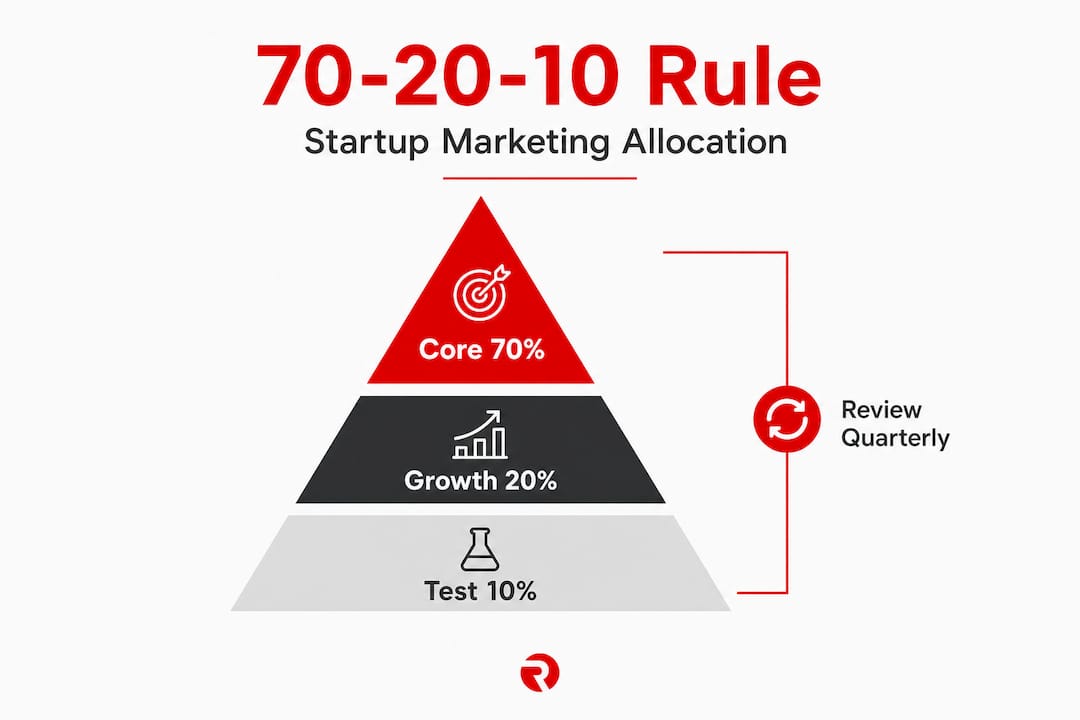
The 70-20-10 rule is a practical framework that gives your marketing plan structure without making it rigid. The principle is straightforward: put the majority of your budget into what is proven, allocate a meaningful portion to testing new approaches, and leave room for genuine experimentation.
Here is what that looks like in practice:
-
70% to core channels: This covers your proven performers. PPC, SEO, and email marketing typically sit here. These are the activities that generate predictable returns and should receive the bulk of attention and budget.
-
20% to new tests: This portion funds new audience segments, emerging platforms, or updated creative approaches. It is disciplined enough to have real data but flexible enough to explore what works beyond your core.
-
10% to experimental activity: This is where you try the genuinely untested. Podcast sponsorships, influencer partnerships, niche community advertising, or format experiments like interactive content all belong here.
According to startup marketing benchmarks for 2026, seed-stage companies typically spend £2,500–£8,000 per month on marketing, with 20–40% of ARR going to growth activities at that stage. Series A companies allocate 15–25% of ARR, with significantly larger absolute budgets.
Here is how a £100,000 annual marketing budget might be split using the 70-20-10 rule:
| Category | Allocation | Example activities |
|---|---|---|
| Core (70%) | £70,000 | Google Ads, SEO retainer, email campaigns |
| New tests (20%) | £20,000 | LinkedIn Ads, new content formats, landing page tests |
| Experimental (10%) | £10,000 | Influencer trial, podcast ads, AI creative tools |
The beauty of this framework is its discipline. Founders who skip it tend to chase every new trend at the expense of the channels actually driving results. Structured experimentation means you gather real data on new approaches without jeopardising your proven revenue channels.
SEO strategies designed for startups fit naturally into the core 70%, given that organic search delivers compounding returns over time rather than disappearing the moment you pause spend. For the experimental bucket, reviewing AI-driven ad strategy guides can give you a head start on what is working in 2026 without wasting your entire test budget on guesswork.
Pro Tip: Review the performance of your 20% and 10% buckets every quarter. Anything that outperforms your core should be promoted to the 70% in the next cycle.
Staying compliant: UK ad laws and startup best practice
Experimentation is vital, but every campaign must stay within regulatory boundaries, especially in digital and influencer marketing.
UK advertising regulations are specific and enforceable. The consequences of non-compliance range from public naming by the Advertising Standards Authority (ASA) to financial penalties. For a startup still building its reputation, a compliance breach can be far more damaging than a poor campaign result.
The core requirement is clear labelling. UK ad regulations require that any paid endorsement on social media is clearly marked as “Ad” or “Paid partnership.” This applies whether the influencer has 500 followers or 5 million.
“Brands are responsible for ensuring that the influencers they work with understand and follow the UK’s advertising rules. Contracts must include explicit compliance requirements.” — ASA and CMA joint guidance
Compliance checklist for new campaigns:
- Label all sponsored posts clearly with “Ad” at the start of the caption or content
- Include compliance clauses in every influencer or content creator contract
- Vet all endorsement claims to ensure they are substantiated and truthful
- Avoid using fake reviews or incentivised testimonials without disclosure
- Register your business properly and check sector-specific restrictions before running ads in regulated industries such as finance, healthcare, or gambling
Getting this right from day one protects your brand’s credibility. The team at Radka Advertising’s onboarding process includes a compliance review as a standard step precisely because so many startups overlook this until it becomes a problem.
Marketing under restrictions: alternatives and AI opportunities
Even the best strategies hit limits. UK startups must know how to adapt quickly when regulations or platforms shift.
Some industries face direct advertising restrictions on major platforms. Fintech products, supplements, alcohol, and various healthcare services all encounter platform-level bans or heavily restricted ad categories. When paid channels close, the strongest startups do not pause. They pivot.
Under ad bans and restrictions, the most effective approach is to shift toward story-driven messaging on owned channels such as email and SEO, combined with strategic partnerships and AI tools for generating compliant creative variants. An email list you own cannot be switched off by a platform algorithm or compliance flag.
“Owned channels are your most resilient marketing asset. Build them in parallel with paid, not as an afterthought when paid stops working.”
Practical alternatives when facing platform restrictions:
- Build and nurture an email list from your first day of trading
- Invest in long-form content and SEO-driven strategies that bring organic traffic without ad dependency
- Develop referral and affiliate programmes that turn customers into advocates
- Partner with complementary, non-competing brands to access new audiences
- Use AI tools to produce multiple compliant ad variants quickly for platforms that allow conditional advertising
AI is making TV advertising accessible for startups that would previously have found it cost-prohibitive, with geographically targeted placements and rigorous performance tracking now available at smaller budgets. This is especially relevant for startups in regions outside London looking to build local brand recognition.
A beginner-friendly AI ad guide is a sensible starting point if you are exploring how to integrate AI into your creative process without a large in-house team. Reviewing real startup case studies across different industries can also reveal how other founders have navigated exactly these constraints.
What most startup marketers miss in the UK
The UK market has its own texture, and too many startup founders ignore it entirely.
The most common mistake we see is founders lifting US marketing playbooks and applying them without adjustment. American consumer culture responds well to bold, direct, often aggressive outbound marketing. British consumers, particularly in B2B, tend to respond far better to credibility, restraint, and value-led communication. Cold outreach that works in Silicon Valley often lands poorly on a sceptical UK buyer who values context and relationship above all.
Chasing trends is the second major trap. TikTok is a genuinely powerful platform for certain audiences, but if your buyers are 45-year-old procurement managers, building a TikTok presence is a distraction, not a strategy. The same logic applies to AI-first marketing without a clear purpose. AI is a tool. If your content strategy lacks clarity, AI will simply produce more unclear content at greater speed.
The most effective UK startup marketers we have worked with share one habit: they obsess over feedback from real campaigns rather than industry reports. They read their open rates, study their bounce rates, and talk to customers who did not convert. That feedback loop is where the real learning lives. Benchmarks and best practices give you a starting point, but your own data tells you what is actually true for your specific market.
Seeing real UK campaign results across sectors gives far more applicable insight than any generic framework. The patterns that emerge from actual performance data are consistently more useful than the theoretical playbooks that dominate marketing content online.
How Radka Advertising accelerates UK startup growth
Applying these strategies is considerably easier with specialists who understand the regulatory and creative landscape. Radka Advertising works directly with UK startups to simplify the complexity of channel selection, compliance, and creative execution from day one.
Whether you need a structured approach to start your onboarding with a compliance review and channel audit, or you want to review our case studies to see how we have driven results for startups across diverse sectors, the next step is straightforward. We bring the strategic rigour, the creative capability, and the UK market knowledge that growing brands need to move faster and smarter. Discover our full services and find out how we can put these frameworks to work for your brand.
Frequently asked questions
How much should a UK SaaS startup budget for marketing in its first year?
Allocate 8–12% of your projected first-year revenue to go-to-market and marketing activities, covering paid channels, content creation, and structured testing.
What is the best digital advertising channel for B2B startups?
LinkedIn offers the most precise targeting for B2B audiences despite its higher CPC. The LinkedIn CPC is higher than Google but delivers unmatched B2B reach by job title, seniority, and company size.
What are UK ad compliance essentials for startups?
Always label sponsored content clearly as “Ad” at the start of any post or caption. UK ad regulations require brands to ensure influencer contracts explicitly mandate compliance with ASA and CMA guidelines.
How can startups advertise under strict ad platform restrictions?
Shift to story-forward messaging, owned channels such as email and SEO, and strategic partnerships, while using AI tools to generate compliant creative variants rapidly.
What is the 70-20-10 rule in startup marketing?
Dedicate 70% of your budget to core channels like PPC, SEO, and email, 20% to testing new approaches, and 10% to genuinely experimental activity with no guaranteed return.