Thought leadership on LinkedIn: your 2026 B2B playbook

Thought leadership on LinkedIn is built by consistently publishing specific, evidence-backed perspectives that solve costly problems for your audience. LinkedIn defines thought leadership marketing as content that sparks customer conversations and shapes future decisions — which means your posts need a clear point of view, not just information. Here is a 30-minute starter checklist:
- Profile: Rewrite your headline as a value proposition (who you help + what outcome you create).
- First post: Use this template: [Counterintuitive hook] + [one specific claim] + [one data point or example] + [question to invite comment].
- Distribution action 1: Send the post to five relevant connections with a personal note asking for their view.
- Distribution action 2: Comment on three posts from decision-makers in your sector within the first hour of publishing.
Every strong thought leadership post needs five things: a scroll-stopping hook, a single clear claim, specific evidence (a number, a named example, or a client outcome), a brief “so what” for the reader, and one low-friction call to action. That is the whole formula.
Pro Tip: Write your hook last. Once you know your claim and evidence, the hook almost writes itself.
Key takeaways
Building thought leadership on LinkedIn requires a specific point of view, a consistent three-pillar content plan, and measurement tied to pipeline signals from the very first post.
| Point | Details |
|---|---|
| Profile before content | Optimise your headline and About section first — every post sends traffic there. |
| Three-pillar content mix | Allocate posts across authority (40%), insight (40%), and conversion (20%) for sustained credibility. |
| First-hour engagement | Seed comments within 60 minutes of publishing to signal relevance to the LinkedIn algorithm. |
| UTM tracking from day one | Tag all external links with UTM parameters to attribute website visits and leads to specific posts. |
| Radkaadvertising | Offers full-stack thought leadership programmes covering strategy, content, paid amplification, and PR distribution for UK B2B brands. |
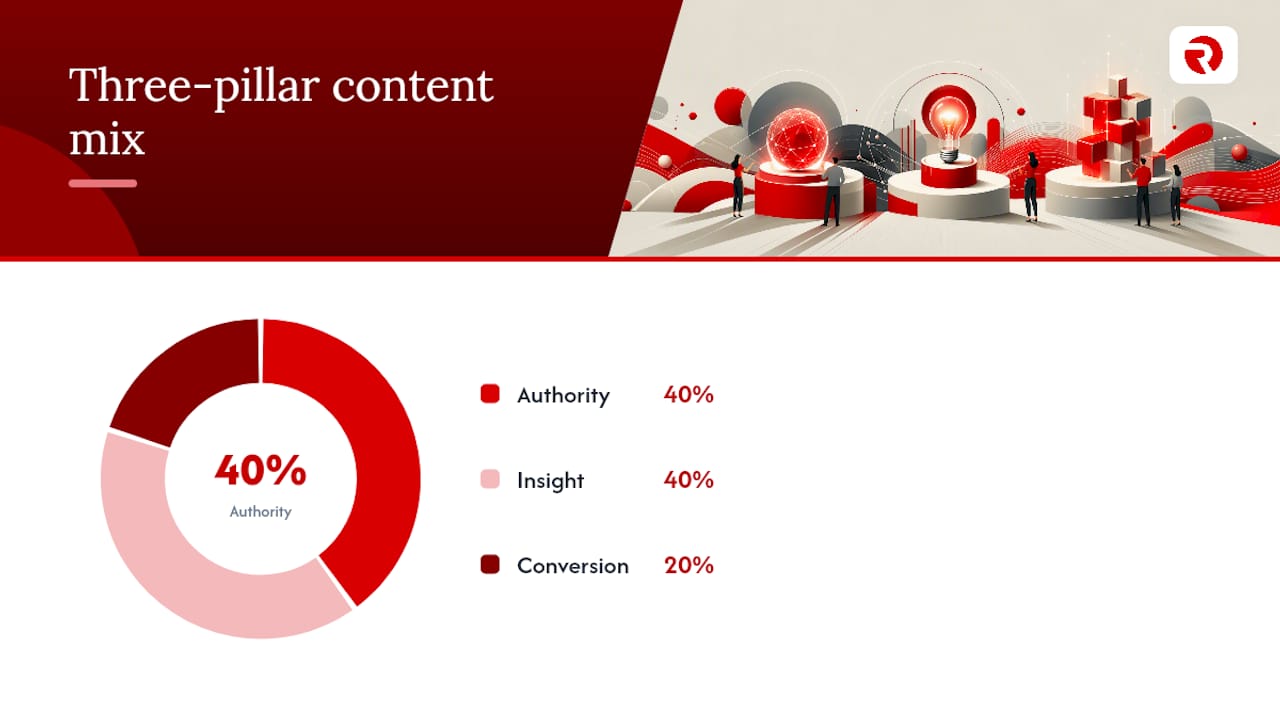
Table of Contents
- Why LinkedIn outperforms every other channel for B2B thought leadership
- What does effective thought leadership content look like on LinkedIn?
- How to plan your LinkedIn thought leadership strategy in 90 days
- How to write a high-impact LinkedIn post
- How to optimise your profile for thought leadership visibility
- Distribution and engagement tactics that actually move the needle
- How to measure whether your thought leadership is working
- When and how to use LinkedIn Ads to amplify thought leadership
- Examples, micro case studies and ready-to-use prompts
- What busy UK marketers should actually prioritise first
- Radkaadvertising builds thought leadership programmes that reach the right buyers
- Sources
- FAQ
Why LinkedIn outperforms every other channel for B2B thought leadership
No other platform concentrates buying-group decision-makers in one feed and then rewards personal voices for speaking to them directly. Sprout Social’s analysis of the LinkedIn algorithm confirms the platform actively favours content that generates early engagement, keeps users on-platform, and prioritises personal profiles over company pages — a structural advantage that no other B2B channel replicates at scale.
For UK professionals, the commercial rationale is especially sharp. B2B buying cycles in the UK regularly run six to eighteen months, and decision-makers spend that time researching, comparing, and building trust with voices they recognise. Brandformula’s summary of the Edelman-LinkedIn B2B Thought Leadership Impact Report makes the opportunity explicit: decision-makers increasingly rely on thought leadership over traditional marketing materials, yet most thought leadership content still fails to deliver genuinely high-quality insight. That gap is where disciplined, specific content wins.
Stat to anchor your strategy: The Edelman-LinkedIn research cited by Brandformula found that the majority of thought leadership content is rated as lacking in quality by the very decision-makers it targets — meaning the bar for standing out is lower than most marketers assume.
LinkedIn’s platform features reinforce the advantage:
- Creator Mode: Unlocks a “Follow” button, newsletter access, and a featured link in your profile header.
- Native newsletters: Subscriber lists you own, with push notifications to followers on publish.
- Long-form posts and articles: Indexed by Google; longer structured posts tend to hold dwell time.
- Native video: Plays in-feed without leaving the platform, which the algorithm rewards.
- LinkedIn Analytics: Impression-to-engagement breakdowns by post, audience demographics, and follower growth over time.
Social Media Today has reported a measurable increase in CEO activity on LinkedIn, signalling that senior voices are now expected to be visible — and that absence from the platform is increasingly read as disengagement by buyers.
What does effective thought leadership content look like on LinkedIn?
Format choice is a strategic decision, not an aesthetic one. Each LinkedIn format serves a different objective and reaches a different audience moment.
| Format | Primary objective | Ideal length / structure | Best use case |
|---|---|---|---|
| Short text post | Reach and opinion | 150–300 words, hook + claim + evidence + CTA | Contrarian takes, quick data points, sector observations |
| Long-form post | Credibility and dwell time | 600–1,200 words, structured with line breaks | Deep-dive frameworks, process walkthroughs, lessons learned |
| Native video | Trust acceleration | 60–120 seconds, direct to camera | Founder stories, event recaps, product demos |
| Newsletter | Audience ownership | 400–800 words, consistent format | Weekly or fortnightly insight series for subscribers |
| Poll | Engagement and research | One question, four options, 3–5 day run | Benchmarking, audience segmentation, conversation starters |
| Document / carousel | Education and saves | 6–12 slides, one idea per slide | Frameworks, checklists, step-by-step guides |
LinkedIn’s own examples of powerful thought leadership posts show that short opinion posts, native video, and repurposed brand campaign content consistently outperform generic “tips” lists.
Repurposing one idea across formats is the highest-leverage move available to a busy marketer. A single insight can become: a 200-word text post on Monday, a three-slide document post on Wednesday, a 90-second video on Friday, and a newsletter section the following week. Four pieces of content from one idea, each reaching a slightly different segment of your audience.
One important platform note: LinkedIn’s algorithm deprioritises posts that lead with an external link. Place links in the first comment, or use a “link in comments” line at the end of your post. For AI-assisted video production, tools reviewed for LinkedIn video creation can help you produce direct-to-camera clips without a full production setup.
How to plan your LinkedIn thought leadership strategy in 90 days
A clear plan is what separates sporadic posting from a programme that actually builds pipeline. LinkedIn’s marketing team recommends owning your evidence, being consistent, and matching formats to objectives — which maps directly onto the three-pillar model below.
The three content pillars
Softomates’ UK B2B content strategy guidance recommends allocating posts across three pillars:
- Authority (40% of posts): Demonstrates expertise. Sector analysis, original research, frameworks you have developed, counterintuitive positions backed by data.
- Insight (40% of posts): Builds trust. Lessons from client work (anonymised), process breakdowns, “what I got wrong” posts, curated external findings with your interpretation.
- Conversion (20% of posts): Drives action. Case study outcomes, service announcements framed as problem-solving, event invitations, direct offers.
90-day calendar template
- Weeks 1–2: Audit your profile and publish your first authority post. Aim for two posts per week.
- Weeks 3–6: Establish cadence at three posts per week (two authority/insight, one conversion). Introduce one poll per fortnight.
- Weeks 7–10: Add a newsletter. Repurpose your three best-performing posts into document carousels.
- Weeks 11–13: Review analytics. Double down on the format and topic cluster with the highest engagement rate. Test one native video.
For UK B2B specifically, a three-post-per-week cadence tuned to the three pillars typically shows measurable lead improvement within 60–90 days when content addresses specific local sector problems rather than generic advice.
Governance checklist
- Agree a simple approval flow for regulated industries (financial services, legal, healthcare).
- Brief colleagues on employee advocacy: what to share, how to personalise, and what not to say.
- Disclose paid partnerships or sponsored content clearly, per ASA guidelines.
- Align personal profile messaging with company page positioning to avoid contradictions.
Pro Tip: Map the hidden influencers in your buying group — the procurement lead, the technical evaluator, the CFO — and write at least one post per month that speaks directly to each of their specific concerns.
How to write a high-impact LinkedIn post
The formula is simple. Execution is where most posts fail.
- Hook (line 1): One sentence that stops the scroll. Counterintuitive, specific, or provocative. Never start with “I’m excited to share…”
- Claim (lines 2–3): State your position plainly. “The reason most LinkedIn strategies fail is not consistency — it’s specificity.”
- Evidence (lines 4–8): One data point, one named example, or one client outcome. Concrete beats abstract every time.
- Micro-case (lines 9–12): A two-to-three sentence story that shows the claim in action.
- CTA (final line): One low-friction question. “What has worked for you?” or “Agree or disagree?”
Before and after
Before (generic): “Consistency is key on LinkedIn. Post regularly and engage with your audience. Over time, you will see results.”
After (specific): “Three months ago, our client’s LinkedIn profile had 400 followers and zero inbound enquiries. We shifted from weekly ‘tips’ posts to fortnightly sector analysis backed by their own data. By month three: 1,200 followers, four qualified inbound calls. The difference was specificity, not frequency.”
Dos and don’ts
- Do name the specific sector, figure, or outcome. Vague claims are forgettable.
- Do take one clear position per post. Sitting on the fence reads as having nothing to say.
- Do ask a question that invites a real answer, not just a like.
- Don’t open with self-promotion. Lead with the reader’s problem, not your credentials.
- Don’t post a wall of text. Use line breaks every two to three sentences.
- Don’t use hashtag stacks of more than three tags — they signal spam to the algorithm.
Encourage early comments by messaging two or three trusted contacts before you publish, asking them to share their view once the post is live. Early engagement in the first hour is the single strongest signal to the LinkedIn algorithm that a post deserves wider distribution.
How to optimise your profile for thought leadership visibility
Your profile is your landing page. Every post you publish sends people there, and a weak profile wastes every impression you earn.
Personal profile checklist:
- Headline: Write it as a value proposition, not a job title. “Helping UK manufacturers cut procurement costs | Supply chain strategy | 15 years in the sector” outperforms “Head of Procurement at XYZ Ltd” for both search and credibility.
- About section: Open with your strongest claim in the first two lines (they show before “see more”). Use keywords your buyers search for — sector terms, job functions, problem types.
- Featured section: Pin your three best-performing posts, a newsletter sign-up link, or a case study PDF. This is prime real estate most profiles leave empty.
- Banner image: Use it to reinforce your positioning — a sector-specific visual, a key metric, or a brand tagline.
- Profile photo: Professional, recent, and high-contrast. Profiles with photos receive significantly more connection requests than those without.
For a step-by-step walkthrough of every profile field, this LinkedIn profile optimisation guide covers each section in sequence.
Company page quick wins: Feature your best-performing individual posts on the company page. Align the page’s tagline with the personal profiles of your most active voices. A company page that amplifies individuals performs better than one that publishes independently.
Pro Tip: Place your primary keyword phrase in your headline AND in the first sentence of your About section. LinkedIn’s internal search indexes both fields heavily, and Google indexes your public profile too.
Distribution and engagement tactics that actually move the needle
Distribution is the other half — and most professionals skip it entirely.
First-hour actions (do these every time you post)
- Comment on your own post immediately after publishing to add context or a link (this also seeds the comment section).
- Message five relevant connections personally: “Just published something on [topic] — would love your take.”
- Share the post to any relevant LinkedIn Groups where you are an active member (not as spam — only where it genuinely adds value).
- Ask one colleague to reshare with their own commentary, not just a plain share.
Employee advocacy
A single post reshared by ten colleagues with personalised commentary can multiply reach by a factor of five to ten without any paid spend. Brief your team with a short message they can adapt — never ask for a copy-paste reshare, as personalised commentary performs far better and feels authentic.

Newsletters and events
LinkedIn newsletters send a push notification to every subscriber when you publish, bypassing the feed algorithm entirely. Build your subscriber list by promoting the newsletter in your posts and in your profile’s Featured section. LinkedIn Events work similarly: attendees receive reminders, and the event page itself ranks in LinkedIn search.
External links and algorithm behaviour
Oktopost’s guidance on outbound links confirms that placing external links in the first comment rather than the post body preserves on-platform engagement signals. When you do use external links, tag them with UTM parameters so you can attribute website traffic back to specific posts in Google Analytics or your CRM.
LinkedIn Groups
Join two or three active Groups in your sector. Contribute genuine answers to questions before you share your own content. Groups with active moderators and real discussion are rare but valuable — they give you direct access to niche audiences outside your immediate network.
How to measure whether your thought leadership is working
Vanity metrics are easy to collect and nearly useless for business decisions. The goal is to connect LinkedIn activity to pipeline signals.
| LinkedIn metric | What it signals | Business outcome to track |
|---|---|---|
| Impressions | Content reach and algorithm favour | Brand awareness in target segment |
| Engagement rate | Relevance and resonance | Quality of audience fit |
| Profile views | Post-to-profile conversion | Buyer research intent |
| Follower growth | Audience building | Addressable audience size |
| Newsletter subscribers | Owned audience | Direct communication reach |
| Inbound connection requests | Relationship intent | Top-of-funnel pipeline signal |
| UTM-tracked website visits | Content-to-site conversion | Lead generation attribution |
Measurement flow
- Weekly: Check impressions, engagement rate, and top-performing post in LinkedIn Analytics.
- Monthly: Review profile views, follower growth, and newsletter subscriber count. Compare against the previous month.
- Quarterly: Pull UTM-tagged referral traffic from your website analytics. Count inbound enquiries that mention LinkedIn or your content. Map these to your content calendar to identify which topics and formats drove the most pipeline activity.
For UTM tagging, use a consistent naming convention: utm_source=linkedin, utm_medium=organic, utm_campaign=[pillar-name], utm_content=[post-topic]. This lets you filter LinkedIn traffic precisely in Google Analytics 4 and attribute it to specific content pillars.
Track one experiment per quarter: change one variable (format, posting time, hook style, topic cluster) and measure the effect over four weeks before drawing conclusions.
When and how to use LinkedIn Ads to amplify thought leadership
Paid amplification makes sense at two specific moments: when you have a post that is already performing organically and you want to extend its reach to a cold audience, or when you are targeting a very specific buying group that your organic network does not yet include.
Thought Leader Ads: the case for testing them
ZenABM’s analysis of 119 Thought Leader Ads found a median CTR of 2.68% in their sample, compared with 0.42% for single-image ads — and lower cost per landing-page click for Thought Leader Ads in their dataset. These are not universal benchmarks, but they are a credible signal that the format deserves a test budget.
Thought Leader Ads run from an individual’s profile rather than a company page, which means they carry the credibility of a personal voice while reaching a precisely targeted audience. They work best for awareness and trust-building at the top of the funnel, not for direct-response conversion.
Campaign basics
- Objective: Choose “Brand awareness” or “Engagement” for thought leadership amplification. Avoid “Lead generation” for a first test — it changes the creative dynamic.
- Audience: Use job title, seniority, and company size filters to reach your exact buying group. For UK B2B, layer in industry sector to tighten relevance.
- Creative: Boost your best-performing organic post. If it resonated with your existing audience, it will likely resonate with a cold one.
- Frequency cap: Set a cap of two to three impressions per member per week to avoid fatigue.
- Measurement: Track engagement rate and profile views, not just impressions. A post that drives profile views is doing its job.
Amplification checklist
- Identify your top organic post from the past 30 days by engagement rate.
- Set a test budget for a two-week campaign (start modest; scale only if CTR exceeds 1%).
- Create two audience variants: one by job title, one by company size. Run them simultaneously.
- Review results at day seven. Pause the underperforming variant and reallocate budget.
- After the campaign, check whether profile views and inbound connections increased during the run period.
Organic and paid should serve different funnel stages. Organic builds familiarity and trust over time. Paid accelerates reach to cold audiences who have never encountered your voice. Running both simultaneously, with the same content, creates a compounding effect that neither achieves alone.
Examples, micro case studies and ready-to-use prompts
Three approaches that work
From generic to specific: A UK-based financial services consultant switched from posting weekly “market update” summaries to fortnightly posts analysing one specific regulatory change and its cost implications for mid-market CFOs. Engagement rate tripled within six weeks. The insight: decision-makers do not need more news — they need someone to tell them what the news means for their specific situation.
Video for trust acceleration: A B2B SaaS founder began posting 90-second direct-to-camera videos every Friday, each answering one question from a prospect call that week. No production budget, no script — just a phone and a quiet room. Within three months, inbound demo requests began referencing the videos by name. Short direct-to-camera clips reduce psychological distance and convert awareness into trust faster than text alone.

Employee advocacy at scale: A professional services firm briefed its ten senior partners to each publish one insight post per fortnight, aligned to the firm’s three content pillars. Combined reach across the team exceeded the company page’s follower count within 60 days, with no paid spend.
Radkaadvertising in practice
When Radkaadvertising works with a client on a thought leadership programme, the workflow runs in three phases: a content audit and pillar definition in week one, a 90-day editorial calendar with post templates in week two, and a monthly measurement review tied to pipeline signals from week four onwards. The agency’s media coverage and PR distribution work extends the reach of LinkedIn content into press placements, creating a compounding visibility effect that organic posting alone cannot achieve.
12 ready-to-use writing prompts
- “The most common mistake I see [sector] professionals make with [topic] is…”
- “Three years ago I believed [X]. Here is what changed my mind.”
- “Everyone in [sector] talks about [trend]. Nobody talks about [consequence].”
- “We ran [specific experiment]. Here is what the data showed.”
- “The question I get asked most by [audience] is [question]. My honest answer:”
- “If I were starting [role/business] today, I would do [X] differently.”
- “The [sector] benchmark everyone quotes is [X]. Here is why it is misleading.”
- “I disagree with [widely held view]. Here is my reasoning.”
- “What [recent event] actually means for [specific audience].”
- “The framework we use to [solve problem]: [three-step breakdown].”
- “Before: [client situation]. After: [outcome]. What we changed.”
- “The one metric I track that most [role] professionals ignore.”
What busy UK marketers should actually prioritise first
Most LinkedIn thought leadership advice tells you to do everything at once: post daily, run ads, launch a newsletter, engage in Groups, optimise your profile, build employee advocacy. That is a reliable path to doing none of it well.
The honest ranking for a busy UK B2B marketer is this: profile first, then one pillar post per week, then measurement. Everything else is secondary until those three are working.
Profile optimisation takes two hours and pays dividends on every post you ever publish. A weak profile means every impression you earn sends people to a dead end. Fix that before you publish a single word of content.
One well-crafted pillar post per week, published consistently for twelve weeks, will outperform three mediocre posts per week every time. The LinkedIn algorithm rewards sustained engagement signals, not volume. A post that generates twenty genuine comments from relevant professionals does more for your visibility than ten posts that generate two likes each.
Measurement is where most programmes fall apart. Without a clear link between LinkedIn activity and pipeline signals, you cannot justify the time investment or make the case for a paid amplification budget. Set up UTM tracking from day one, not as an afterthought.
The frequency-versus-impact debate in UK B2B is settled, in my view: impact wins. A single post that a CFO shares with their team is worth more than a month of daily updates that nobody acts on. Write less. Mean more.
Radkaadvertising builds thought leadership programmes that reach the right buyers
If you have read this far, you know what a disciplined thought leadership programme looks like. The harder question is whether you have the time, the editorial infrastructure, and the measurement rigour to run one consistently alongside everything else on your plate.
Radkaadvertising is a London-based full-service agency that builds and manages thought leadership programmes for UK entrepreneurs, SMEs, and established brands. The work covers the full stack: content strategy and pillar definition, post writing and editorial calendars, AI-driven content growth for volume and consistency, paid amplification via LinkedIn Ads, and PR distribution that extends LinkedIn content into press placements for compounding reach.
The starting point for most clients is a content and channel audit that maps current positioning against buyer intent. From there, a 90-day programme delivers a profile overhaul, a pillar-aligned editorial calendar, and monthly measurement reviews tied to pipeline signals.
See how the approach has worked across sectors in the Radkaadvertising case studies, or get in touch via Radkaadvertising to discuss a programme scoped to your goals.
Sources
- What is Thought Leadership? - LinkedIn Business Solutions
- What to know about the LinkedIn algorithm - Sprout Social
FAQ
What is a thought leader on LinkedIn?
A thought leader on LinkedIn is a professional who consistently publishes specific, evidence-backed perspectives on a defined topic, earning recognition from peers and decision-makers as a credible voice in their field. LinkedIn defines thought leadership as content that sparks customer conversations and shapes future decisions.
What makes a good thought leadership post on LinkedIn?
A strong thought leadership post leads with a counterintuitive hook, states one clear claim, supports it with a specific data point or named example, and closes with a low-friction question that invites genuine comment. Posts that take a clear position on a costly or contested problem in a specific sector consistently outperform generic advice.
How do LinkedIn Thought Leader Ads work?
Thought Leader Ads run from an individual’s personal LinkedIn profile rather than a company page, combining the credibility of a personal voice with the targeting precision of paid advertising. ZenABM’s analysis of 119 Thought Leader Ads found a median CTR of 2.68% in their sample, compared with 0.42% for single-image ads.
Are LinkedIn Thought Leader Ads worth the budget?
They are worth testing when you have an organic post already performing well and want to extend its reach to a cold buying group. Use them for awareness and trust-building at the top of the funnel, set a frequency cap of two to three impressions per member per week, and measure profile views and engagement rate rather than impressions alone.
How often should you post for thought leadership on LinkedIn?
For UK B2B, three posts per week across the three content pillars (authority, insight, conversion) tends to show measurable lead improvement within 60–90 days, provided the content addresses specific sector problems rather than generic tips. Consistency over twelve weeks matters more than daily volume.