Strategic content creation workflow: a UK business guide

TL;DR:
- A structured content creation workflow guides content from idea to publication aligned with business goals.
- Most UK businesses publish reactively, resulting in low commercial returns due to operational inefficiencies.
A strategic content creation workflow is the structured process that takes content from raw idea to published asset, while keeping every piece aligned with your business goals. Without this structure, most UK business owners end up publishing reactively, producing content that fills a calendar but generates little commercial return. The industry term for this discipline is content operations, and it covers planning, production, approval, and measurement as a single connected system. A well-designed content operations process gives you consistent output, a clear brand voice, and content that actually moves buyers through a decision. This guide covers every stage, from foundations to measurement, with a focus on AI integration and the first-party UK insight that separates ranking content from generic noise.
What are the essential components of a strategic content creation workflow?
Strategic content planning must precede production to ensure every asset serves a clear business outcome, whether that is lead generation, brand awareness, or client retention. Mapping content to buyer journey stages improves alignment and avoids the trap of random updates that consume time without moving the needle.
Before you write a single word, you need five things in place:
- Clear content goals tied to specific business outcomes, such as generating 20 qualified enquiries per month or ranking for three target search terms
- A defined audience profile that includes the specific problems your UK buyers face, not a generic persona
- A content format plan that matches your audience’s consumption habits, whether that is short LinkedIn posts, long-form blog articles, or video scripts
- A content calendar that maps topics to buyer journey stages and publication dates at least four weeks ahead
- Defined roles covering who writes, who edits, who approves, and who publishes, with no overlap or ambiguity
Tools matter here too. For UK business owners, platforms that support British English spell-checking and team collaboration reduce friction significantly. Google Docs, Notion, and Trello each serve different workflow styles, from document-heavy editorial teams to kanban-style production boards.
Pro Tip: Build your content calendar around business events first, such as product launches, seasonal peaks, and UK public holidays, then fill the remaining slots with evergreen topics. This prevents the common mistake of planning content in isolation from commercial activity.

How do you design and implement an effective content workflow?
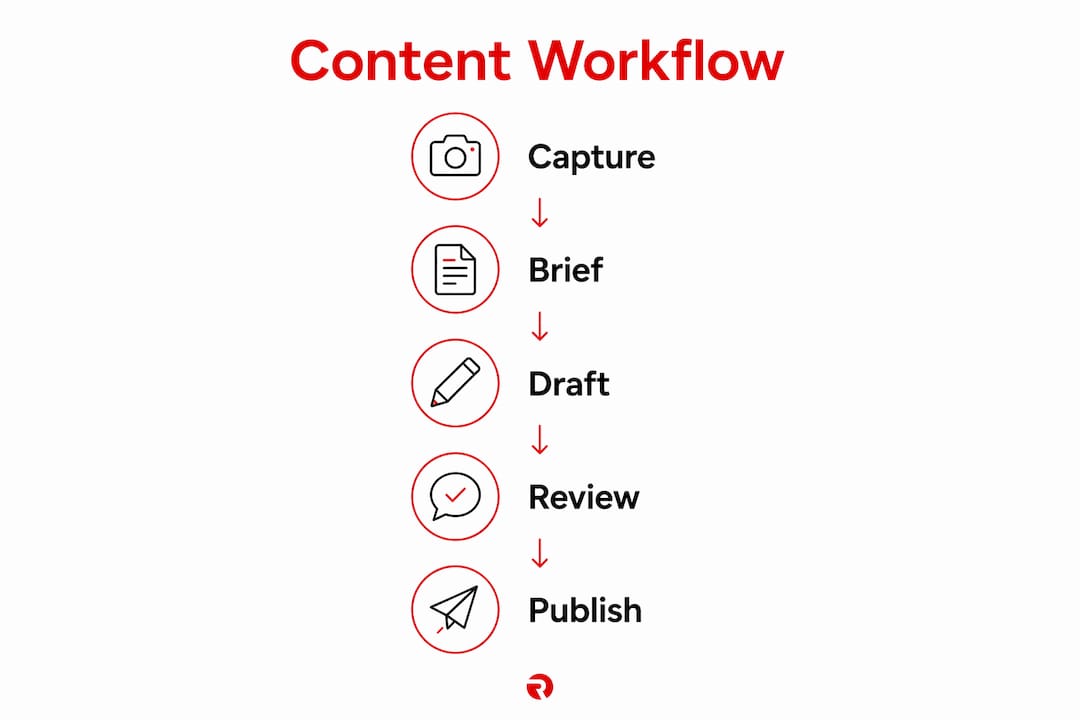
A production flow works best when it follows a clear sequence. The six phases below cover the full cycle from idea to automation.
-
Capture ideas the moment they arise. Use voice notes, a shared swipe file in Notion, or a dedicated Slack channel where your team drops references, competitor observations, and client questions. The goal is a single inbox for raw material.
-
Process raw ideas into structured briefs. Each brief should include the target keyword, the buyer journey stage, the intended format, the word count, and the key argument the piece must make. A brief takes 15 minutes to write and saves hours of aimless drafting.
-
Stress-test your angle before writing. AI tools like Claude and ChatGPT have distinct strengths: Claude excels at structural critique and strategic challenge, while ChatGPT improves with ongoing context feeding. Use them as sparring partners to pressure-test your hook and argument before committing to a full draft.
-
Draft and edit by combining an AI-generated scaffold with human review. The AI produces the structure and fills in well-documented points. Your editor then rewrites for brand voice, adds UK-specific examples, and checks factual accuracy. This division of labour produces better output than either approach alone.
-
Create visuals and schedule posts using a consistent visual template. Canva works well for social graphics; for long-form content, a simple featured image with your brand colours is sufficient. Schedule posts through your chosen publishing platform at least 48 hours ahead of the go-live date.
-
Automate admin tasks rather than creative thinking. Using tools like Zapier for task automation helps UK businesses reclaim time without compromising content quality. Automations worth building include: new brief notification to the writer, draft-complete notification to the editor, and published-post notification to the social media scheduler.
The table below shows how each phase maps to a responsible party and a typical time allocation for a two-person team.
| Phase | Responsible | Time per piece |
|---|---|---|
| Capture and brief | Founder or strategist | 15–20 minutes |
| AI draft and stress-test | Writer with AI tools | 45–60 minutes |
| Human edit and brand voice | Senior editor | 30–45 minutes |
| Visuals and scheduling | Content coordinator | 20–30 minutes |
| Automation and admin | Operations or founder | 5–10 minutes |
Pro Tip: Feed your AI tool a “brand voice document” at the start of every session. Include three examples of your best-performing content, your tone descriptors, and any phrases you never use. This cuts editing time significantly and keeps output consistent.
AI-assisted content calendars can reduce planning and drafting time by 60–70%, enabling UK businesses to publish three to five times more content efficiently. A small team using structured AI workflows saved up to £2,100 per month in time costs. That figure represents a genuine operational shift, not a marginal gain.
For a broader view of which AI tools fit different stages of this process, the marketer’s guide to AI content tools covers the current landscape clearly.
What common challenges arise in content workflow execution?
Unclear approval processes and poor version control cause “operational paralysis” that kills content workflow efficiency. The fix is simple: design your approval loop at the same time as your content brief template, not after problems appear.
The most frequent bottlenecks UK business owners report fall into four categories:
- Approval chaos: content sits in email threads waiting for sign-off, missing publication dates and creating last-minute rewrites
- Burnout from volume: committing to a publishing frequency that exceeds the team’s actual capacity, leading to declining quality or abandoned schedules
- Generic AI output: publishing AI drafts without adding UK-specific client examples, local pricing context, or market observations that make content genuinely useful
- Misaligned content: producing articles and posts that attract traffic but do not convert, because the content was never mapped to a specific buyer stage or commercial goal
The third point deserves particular attention. Injecting 15–20% of proprietary first-party UK-specific data and insights into AI-generated content is critical for ranking and maintaining uniqueness. Content without human-added UK client examples, pricing context, and market observations remains generic and underperforms in search. That is not a minor SEO consideration. It is the difference between content that builds authority and content that disappears.
“Content must be linked to clear business outcomes and buyer journey stages to avoid random, ineffective publishing. Without that link, even well-written content fails to generate commercial return.”
Only 28% of enterprise marketers find their content workflow very effective, according to Content Marketing Institute data. The gap between intention and execution almost always traces back to missing intake rules, undefined approval gates, and absent feedback loops. Fixing these structural gaps costs nothing except time and attention.
How do you measure and sustain your content workflow over time?
A content workflow without measurement is a production machine with no steering. Define your key performance indicators before you publish the first piece, not after you have three months of data.
The metrics worth tracking for UK business owners are:
- Organic search traffic by page, tracked monthly to identify which topics attract qualified visitors
- Conversion rate from content pages to enquiry or purchase, segmented by buyer journey stage
- Time to publish, measured from brief creation to live date, to identify where the workflow slows down
- Content output volume per month, compared against your planned calendar to measure execution reliability
- Engagement rate on social content, used as a signal for which formats and topics resonate with your specific audience
Schedule a monthly workflow review of 30 minutes. Review what published on time, what missed the schedule, and what performed above or below expectation. Use that data to adjust your topic plan and format mix for the following month.
AI doesn’t replace human judgement; it accelerates capturing ideas and refining content in collaboration with expert editors. As your workflow matures, the human editorial layer becomes your primary competitive advantage. Competitors can copy your tools and your publishing frequency. They cannot copy your proprietary client data, your market observations, or your brand voice.
When you are ready to scale, add tools and people in sequence rather than simultaneously. Adding a new AI tool and a new team member in the same month doubles the variables and makes it impossible to identify what changed your output quality.
Key takeaways
A content operations system built around clear goals, defined roles, and first-party UK insight consistently outperforms ad hoc publishing in both search performance and commercial return.
| Point | Details |
|---|---|
| Plan before producing | Map every content piece to a buyer journey stage and a business goal before writing begins. |
| Use AI as a collaborator | Let AI tools handle structural drafts and admin; keep human editors in control of brand voice and accuracy. |
| Add UK-specific insight | Inject 15–20% first-party UK data into AI-generated content to rank and maintain authenticity. |
| Fix approval paths first | Design your approval loop alongside your brief template to prevent operational paralysis. |
| Measure and adjust monthly | Track time to publish, conversion rate, and output volume to keep the workflow performing over time. |
Why most content workflows fail before they start
The uncomfortable truth I have observed working with UK entrepreneurs is that most content workflow problems are not content problems. They are operational design problems that show up as content problems.
A founder spends hours writing a blog post, publishes it without a brief, without a target keyword, and without a defined audience. The post gets twelve views. The conclusion drawn is that “content doesn’t work for our business.” The real conclusion should be that the production process had no structure, so the output had no direction.
The second pattern I see constantly is over-reliance on AI without editorial control. Businesses using AI to capture ideas faster and automate admin while keeping unique brand control see consistent results. The key phrase is “keeping unique brand control.” AI produces plausible, well-structured text. It does not produce your specific market knowledge, your client case studies, or your genuine point of view. Those elements require a human editor who knows the business.
The third pattern is treating measurement as optional. You cannot improve a process you are not tracking. The businesses I have seen build genuinely effective content operations all share one habit: they review what worked and what did not, every single month, without exception. That review is not glamorous. It is the work that compounds.
Radkaadvertising’s media coverage portfolio shows what this looks like in practice across different industries and campaign types. The pattern is consistent: clear brief, defined audience, human editorial control, measurable outcome.
— Bart
How Radkaadvertising supports your content operations
Building a content operations system from scratch takes time, and the gaps in an existing workflow are not always visible from the inside. Radkaadvertising works with UK entrepreneurs and business owners to design production flows that connect content to commercial outcomes. The agency’s work spans content strategy, AI-assisted production, and multi-channel campaign execution, with a track record across sectors including FMCG, energy, and beauty. You can review real-world case studies showing how structured content workflows delivered measurable results for brands at different stages of growth. For businesses ready to build or rebuild their content system, the AI growth services page outlines how Radkaadvertising integrates AI tools into production without sacrificing brand quality.
FAQ
What is a strategic content creation workflow?
A strategic content creation workflow is a structured system that guides content from idea to publication while keeping every piece aligned with specific business goals. It covers planning, production, approval, and measurement as a connected process rather than separate tasks.
How does AI fit into a content workflow for UK businesses?
AI tools work best as structural and administrative assistants, handling first drafts, scheduling, and task notifications. Human editors retain control over brand voice, factual accuracy, and the UK-specific insight that makes content rank and convert.
How much first-party data should I add to AI-generated content?
Adding 15–20% proprietary first-party data to AI-generated content is the recommended threshold for maintaining uniqueness and search performance. This includes UK client examples, local pricing, and market-specific observations.
What causes content workflow bottlenecks?
Unclear approval processes and poor version control are the primary causes of workflow bottlenecks. Designing approval gates at the same time as content brief templates prevents most delays before they occur.
How often should I review my content workflow?
A monthly review of 30 minutes is sufficient for most UK small business teams. Track time to publish, output volume, and conversion rate from content pages to identify where the process needs adjustment.