3 UGC Videos This Week: Restaurant Social Media Strategy for UK Restaurants

The most effective restaurant social media strategy prioritises short-form, authentic content on one or two platforms, aimed squarely at converting attention into bookings. Start this week: pick one platform, publish three UGC-style short videos, and set a two-hour reply target. Track social-attributed bookings and average reply time, nothing else, for the first 30 days.
TL;DR:
- Focusing on one social platform can lead to more consistent bookings than spreading efforts across multiple channels, especially during quiet nights.
- Posting three short-form, authentic videos weekly from food or people pillars, along with quick replies within two hours, optimizes social engagement for conversions.
- Using location tags, consistent profiles, and reposting tagged customer content boosts local SEO signals, enhancing search visibility and trust.
- Similar-sized micro-influencers with genuine local followings generate more booked covers than expensive celebrity collaborations, especially when given clear briefings.
- Regularly tracking social-attributed bookings, reply times, and content performance reveals what drives actual reservations and guides scalable growth.
Table of Contents
- Why social media matters for restaurants in 2026
- Choosing the right platforms for your restaurant
- Content strategy and pillars that fill tables
- Visual content and production: food photography and short-form video that converts
- Posting cadence and frameworks: when and how often to post
- Engagement and community management that keeps customers coming back
- Influencer and UGC strategy: working with creators without wasting budget
- Paid social campaigns that move the needle
- Converting followers into bookings: booking loops and friction-free CTAs
- Measuring success: the KPIs and attribution to track social ROI
- Tools and resources for restaurant social media
- Radka Advertising perspective: how we plan and run restaurant social campaigns
- Crisis management and handling negative reviews or posts
- Local SEO integration with social media strategies
- Leveraging user-generated content campaigns to boost bookings
- Staff training for social media engagement and brand voice consistency
- Author perspective: three priorities to act on this week
- Radka Advertising services: how we can help restaurants scale social-led bookings
- Sources
- FAQ
Why social media matters for restaurants in 2026
Diners now discover restaurants on social platforms before they ever open a booking app. SeverRooms’ UK trend research found that 45% of UK diners discover restaurants via social media, with AI-driven discovery tools accelerating that shift further. That single figure should reshape how owners think about their marketing spend.
Why this matters: If nearly half of new diners are finding you through a feed rather than a search bar, your Instagram grid or TikTok profile is functioning as your shopfront. Treat it accordingly.
Social media now sits inside the guest journey, not alongside it. A diner scrolls, sees a plate that looks better than anything nearby, checks your bio, and books, often within minutes. NCASS members report that using active business accounts, sharp photography, and rapid replies converts that scroll into a covered table.
The metric that matters most is not follower count. It is whether social activity fills the slots that would otherwise sit empty. A Tuesday lunch service or a wet Wednesday evening is where social-driven bookings earn their keep. Chasing likes fills your ego. Chasing bookings on quiet nights fills your restaurant.
Choosing the right platforms for your restaurant
Most restaurants waste effort spreading content across five platforms instead of mastering two. Before you open another account, run through this checklist:
- Audience match: Where does your actual customer base spend time? A late-night cocktail bar and a family carvery pub answer that question differently.
- Format fit: Can your food and setting be captured well in short video, or does it lean on still photography and menu detail?
- Team capacity: Who is actually filming, editing, and posting, and how many hours a week do they realistically have?
- Reach dynamics: Platform scale varies hugely. Statista’s global rankings show just how differently user bases are distributed by platform, which affects how far organic content can travel.
Instagram remains the strongest all-rounder for restaurants. A qualitative study of London SMEs found it the most effective platform for small and medium restaurants, improving visibility and, in some cases, sales directly. Use Reels for dish reveals, Stories for daily specials, and a tidy grid as your visual menu.
TikTok rewards raw, fast, personality-led video, staff banter, behind-the-scenes prep, the sizzle of a pan. It suits venues with a strong visual hook and a team willing to be on camera.
Facebook still matters for event promotion, group bookings, and an older demographic that checks opening hours and reviews before Instagram.
Google Business Profile is not technically social, but it behaves like one. Photos, posts, and review replies here directly influence whether someone books at all.
Deprioritise any platform where your team cannot post consistently. A neglected account with a six-month-old post does more brand damage than no account at all.
Content strategy and pillars that fill tables
Vanity metrics feel good and mean nothing. Set goals against covers filled, bookings generated, and revenue from specific promoted offers, not likes or follower growth.
Build your content around four repeatable pillars:
- Food and drink: the dish reveals, the plating, the seasonal menu changes. This is your product shelf.
- People and place: the chef, the front-of-house team, the room itself. Diners book experiences run by humans, not logos.
- Offers and events: quiet-night deals, live music, tasting menus, anything with a date and a reason to act now.
- Social proof: reposted customer videos, tagged photos, and reviews turned into shareable graphics.
A workable ratio, adapted from the broader 70/20/10 content framework, runs roughly 70% food and people content, 20% offers and events, and 10% experimental formats you are testing.
For a 30-day starter calendar, keep it simple: three short videos a week from the food and people pillars, one offer-led post pushing a specific quiet slot, and one repost of tagged customer content. Repeat weekly, adjust based on what actually drives bookings, and resist the urge to reinvent the plan every fortnight. Consistency beats novelty for the first month.
Visual content and production: food photography and short-form video that converts
You do not need a professional camera. You need consistent light and a steady hand.
For photography, shoot near a window in daylight rather than under kitchen strip lighting, which flattens colour and casts an unflattering yellow tint. Shoot from a 45-degree angle for most dishes, straight down for flat lays like pizzas or platters, and always focus on the texture, steam, or glaze that makes food look alive.
For short-form video, three formulas consistently perform:
- The sizzle: a close, slow-motion shot of something cooking, pouring, or plating, no words needed.
- The reveal: build anticipation with a build-up shot, then cut to the finished dish in under three seconds.
- The team moment: a quick, unscripted clip of staff laughing, prepping, or reacting to a busy service.
Pro Tip: Film everything vertically and slightly wider than you need. You can always crop tighter for Instagram, TikTok, or Reels later, but you can never add back footage you didn’t capture.
Editing does not require expensive software. Built-in phone editors and free apps handle trims, captions, and music licensing well enough for daily posting. Once a clip performs on one platform, repurpose it everywhere else with a caption tweak rather than reshooting. Practical content creation guidance covers repurposing workflows in more depth if your team wants a structured process.
Posting cadence and frameworks: when and how often to post
How often you post should match what your team can sustain, not what a growth hack promises. A one-person marketing effort posting five times a week and burning out after a month achieves less than a steady three posts a week for a year.
| Framework | What it means | Best suited to |
|---|---|---|
| 5-5-5 | Comment on 5 posts, follow 5 new accounts, share 5 pieces of content daily | Solo owners building initial community |
| 70/20/10 | 70% core content (food, people), 20% curated or offer-led, 10% experimental | Teams with a set content pillar structure |
| Daily story, weekly reel | One Story per day, one polished Reel per week | Small teams with limited filming time |
| Batch and schedule | Film a week’s content in one session, schedule the rest | Any team wanting consistency without daily effort |
Batching is the workflow that saves restaurant marketing from collapsing during a busy service week. Set aside 90 minutes on a quiet prep morning, capture five to seven clips, and schedule them across the week using a simple scheduling tool rather than posting live each day. This single habit change does more for consistency than any amount of enthusiasm.
Engagement and community management that keeps customers coming back
Replying quickly is not a courtesy, it is a conversion tactic. Diners perceive fast replies online as a proxy for good service at the table, according to QSR Media’s research on Gen Z dining behaviour. Set a reply standard, aim for under two hours during service hours, and hold your team to it the same way you would hold them to order accuracy.
Practical rules that work:
- Reply to every DM asking about bookings, allergens, or opening times within two hours during service, four hours overnight.
- Turn every customer tag or story mention into a repost within 24 hours, credited clearly.
- Respond to negative comments publicly and briefly, then move detailed resolution to DM.
- Join local Facebook groups and community pages to share event posts rather than only broadcasting from your own account.
Pro Tip: Save three or four reply templates for common questions (booking availability, dietary needs, parking) but always personalise the first line. A copy-pasted reply is easy to spot and undoes the goodwill instantly.
Tagged customer content is free advertising with built-in trust. A single repost of a happy table costs nothing and does more for credibility than a paid ad, because it comes from a stranger the viewer already half-trusts.
Influencer and UGC strategy: working with creators without wasting budget
Micro-influencers with a genuinely local, engaged following consistently outperform mega-influencers for hospitality, producing higher engagement rates at a fraction of the cost, according to hospitality social benchmarking data. A creator with 8,000 local followers who actually visits your area will send more covers through the door than a celebrity account with a million followers scattered across the country.
To brief creators effectively:
- Give them a specific dish or moment to feature, not a vague “come and enjoy dinner” ask.
- Agree the format upfront: one Reel, two Stories, or a TikTok, rather than leaving output open-ended.
- Offer a fixed-value exchange (a meal for two, a set fee, or both) rather than an open-ended “exposure” arrangement.
- Request the raw footage so you can repost it across your own channels afterwards.
To turn ordinary customers into creators, run a simple incentive: a free dessert or a small discount for anyone who tags you in a Story. UK operators featured in BBC coverage of small restaurants growing through social media built loyal followings largely through this kind of low-cost, staff-and-customer-led content rather than paid influencer deals.
Paid social campaigns that move the needle
Organic content builds the foundation, but paid social speeds up discovery when timed against a specific goal, not run as a vague brand-awareness spend. Structure campaigns around three objectives: awareness for new-area reach, discovery for specific dishes or offers, and conversion for direct bookings on a fixed date.
Creative that performs best in ad slots is the same short-form video that performs organically, just boosted behind a clear call to action. “Book this Friday” outperforms “check us out” every time, because it gives the viewer a single, dated action rather than an open-ended browse.
Practical guidance for budgeting:
- Start with a modest monthly spend, UK operator guidance suggests figures between £100 and £800 depending on venue size, weighted toward organic-first activity with selective paid boosts.
- Run one test at a time. Boost a single post for a specific offer rather than splitting a small budget across five ideas at once.
- Compare a discovery-objective ad against a conversion-objective ad for the same offer to see which drives more actual bookings, not just clicks.
- Reserve a small reserve budget for boosting whatever organic post already outperforms the rest that week.
Earned media coverage can amplify a paid push further. A feature or press mention alongside a paid campaign gives the ad social proof it would not otherwise have.
Converting followers into bookings: booking loops and friction-free CTAs
A follower who has to hunt for a booking link rarely becomes a diner. Fix the gap between interest and action with these three steps:
- Put the booking link in the first line of your bio, not buried under a paragraph of hashtags. Use a single link-in-bio tool that routes directly to your reservation system.
- Add a specific CTA to every post that mentions an offer or event, for example “Tap the link to book Friday’s tasting menu” rather than a generic “link in bio.”
- Capture booking source at arrival. A simple front-of-house question, “How did you hear about us?”, combined with a unique promo code or booking link for each campaign, tells you exactly which post filled which table.
Incentives help close the loop faster. A small discount code shared only through Stories, or an early-access booking window for followers, gives people a reason to act immediately rather than bookmarking your profile and forgetting about it.
Measuring success: the KPIs and attribution to track social ROI
Track four numbers, and largely ignore the rest. Social-attributed bookings, average reply time, engagement rate on your top content pillar, and cost per booking on any paid campaign.
Statistic to anchor your reporting: SevenRooms found that 45% of UK diners discover restaurants through social media, which means your discovery-to-booking conversion rate deserves as much attention as your follower growth, arguably more.
Attribution does not need to be complicated:
- Use UTM tags on any link shared in bios or ads to separate platform traffic in your booking system.
- Assign a unique promo code per campaign so redemptions map directly to the post that drove them.
- Add a dedicated “booking source” field to your reservation form or till system and review it weekly.
Review these numbers weekly, not monthly. A monthly review means a full month of underperforming content before anyone notices, whereas a weekly check lets you drop a format that is not working before it drains another week’s effort. A structured measurement approach makes this easier to sustain once volume increases.
Tools and resources for restaurant social media
You do not need an enterprise stack to run this well. For scheduling and basic editing, most micro teams manage with free or low-cost mobile apps that handle captions, cropping, and batch scheduling in one place.
For booking and reputation management, look for tools that:
- Sync directly with your table management system so booking-source data flows automatically.
- Send review alerts in real time so negative feedback gets a response within hours, not days.
- Offer simple analytics dashboards without requiring a dedicated analyst to interpret them.
Before adding any new tool, run a quick audit: does it save the team time, does it feed directly into your booking or reputation system, and can someone realistically maintain it without extra headcount? If the answer to any of those is no, skip it. Tools that create more admin than they remove are a net loss for a small team, regardless of how polished the dashboard looks.
Radka Advertising perspective: how we plan and run restaurant social campaigns
Our approach to restaurant social campaigns follows a straightforward workflow: brief, pillars, creative, test, measure. We start by agreeing which quiet slots or events the campaign needs to fill, then build content pillars around that specific goal rather than generic brand awareness.
A creative lead and an account strategist review every batch of content before it goes live, checking it against brand voice and the booking CTA before publishing.
Pro Tip: We quantify bookings uplift by comparing social-attributed reservations against the same period the previous month, then scale whichever format, video, offer post, or repost, produced the strongest lift.
Crisis management and handling negative reviews or posts
A bad review or a viral complaint will happen eventually. How you respond in the first hour matters more than the complaint itself.
Reply publicly, briefly, and without defensiveness. Acknowledge the issue, state what you are doing about it, and move detailed back-and-forth into DM or email. A public reply that argues with a customer, even a wrong one, does more damage to onlookers than the original complaint ever would.
Set a clear internal rule: any post or comment mentioning food safety, allergens, or discrimination gets escalated to a manager immediately, not left for whoever is next on the rota to notice. Speed matters here more than anywhere else in your social presence.
For a genuinely viral negative moment, such as a video of a bad experience gaining traction, resist deleting comments or disabling replies. That tends to escalate suspicion rather than calm it. Instead, post one clear, calm statement addressing what happened and what changes, if any, are being made. Silence reads as guilt online, even when there is nothing to hide.
Build a simple response protocol before you need it: who replies, within what timeframe, and who has authority to offer a resolution such as a refund or a return invitation. A protocol written in a calm moment prevents a panicked, badly worded reply written during a stressful one.
Finally, do not let one bad review dominate your feed’s presence in your own head. Respond, learn if there is something to learn, and keep publishing the food and people content that built your following in the first place.
Local SEO integration with social media strategies
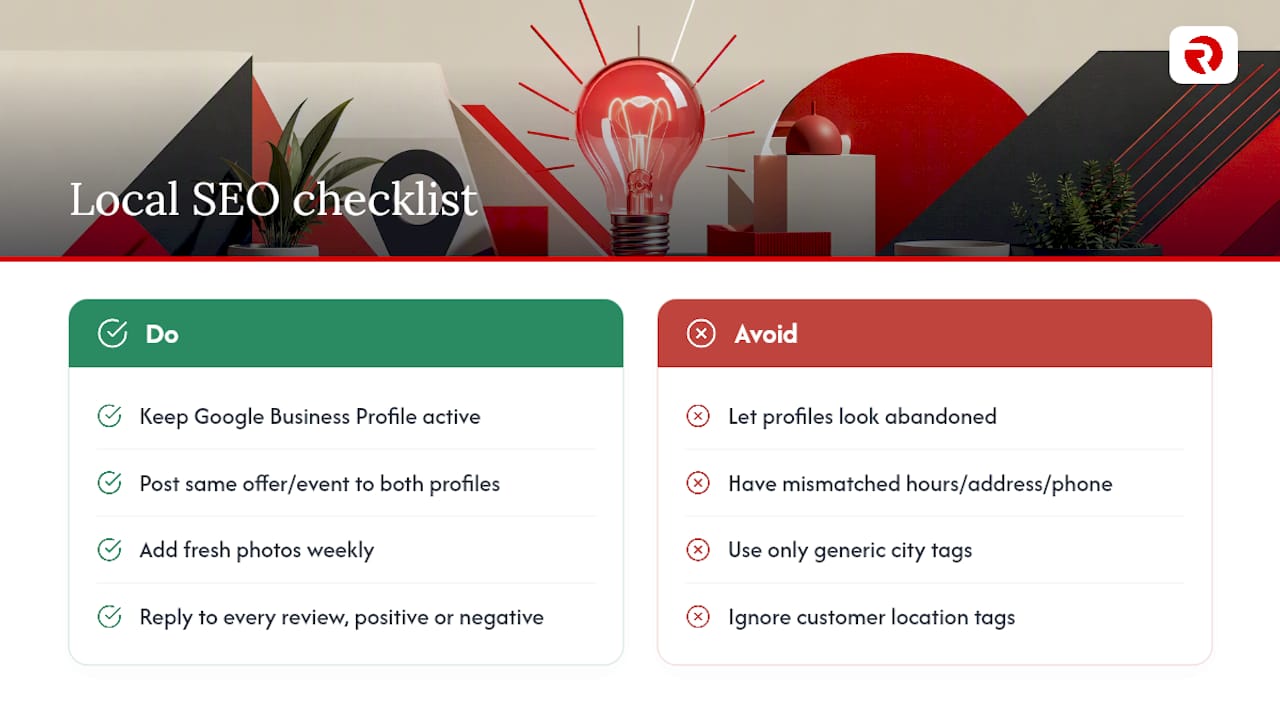
Your social profiles and your local search presence are more connected than most owners realise. Google increasingly pulls signals from active, well-reviewed social accounts when deciding which local businesses to surface for nearby searches.
Keep your Google Business Profile as active as your Instagram account. Post the same offer or event update to both, add fresh photos weekly, and reply to every review, not just the glowing ones. A profile that looks abandoned signals to both diners and search algorithms that the business itself may be inactive.
Consistency of information matters as much as activity. Your opening hours, address, and phone number should match exactly across your website, Google Business Profile, and every social bio. A mismatch, an old address on Facebook, outdated hours on Instagram, quietly erodes trust and can hurt local search rankings.
Location tags do real work here too. Tagging your actual location on every post, rather than a generic city tag, helps your content surface in local discovery feeds and location-based searches simultaneously. Encourage customers to tag your location when they post about their visit as well, since that user-generated tagging adds another local signal beyond your own account.
Reviews left on Google carry weight in both search ranking and social proof when reposted. Screenshotting a strong Google review and sharing it as a Story or post does double duty, reinforcing your search presence while giving your social feed genuine third-party validation. A broader visibility strategy can help tie these local signals together if you are managing this alongside a wider marketing push.
Leveraging user-generated content campaigns to boost bookings
Customer-created content converts better than anything a restaurant produces itself, because it carries a stranger’s trust rather than the venue’s own promotional voice. A structured UGC campaign turns this into a repeatable booking driver rather than a happy accident.
Run a simple, ongoing campaign: create a branded hashtag specific to your venue, display it on table cards or menus, and offer a small incentive, a free side, a discount on the next visit, for anyone who tags you in a post or Story. The cost is minimal and the content pipeline it creates can run for months without additional filming from your own team.
Curate rather than repost everything indiscriminately. Choose the clips and photos that show your food or room at its best, and repost them within a day while the moment is still fresh for the customer who shared it. A slow repost, three weeks later, loses most of its social proof value because the original poster’s audience has moved on.
Turn strong UGC into paid creative too. A genuine customer reaction filmed on their own phone often outperforms a polished in-house video in ad slots, because viewers recognise it as real rather than staged. Testing a UGC clip against a produced video for the same offer is one of the simplest experiments a small team can run.
Treat UGC campaigns as a specific, trackable channel rather than background noise. Note which reposted pieces correlate with a spike in bookings that week, and lean harder into whichever type of customer moment, celebration, group dinner, solo diner, produces the strongest response.
Staff training for social media engagement and brand voice consistency
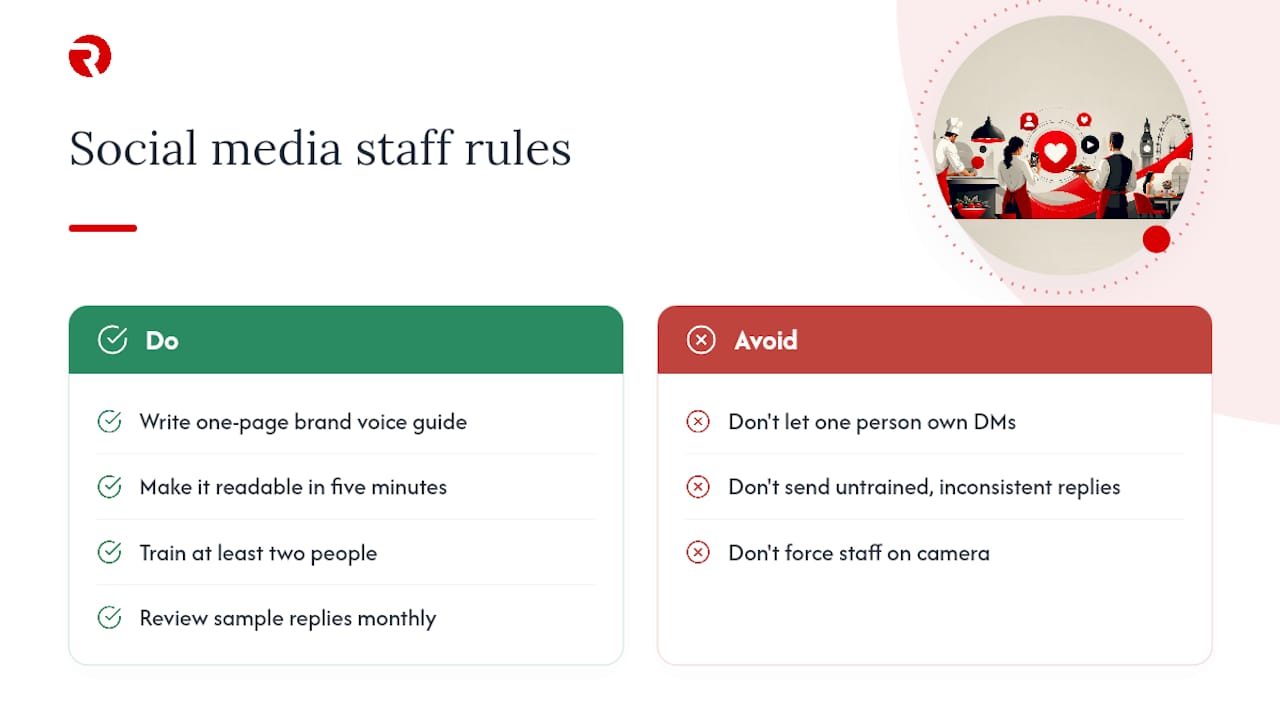
The person answering DMs at 9pm on a Saturday shapes your brand as much as any campaign you plan in advance. Untrained, inconsistent replies undo months of careful content work in a handful of careless messages.
Write a short, one-page brand voice guide covering tone (friendly but professional, playful but not flippant, whatever suits your venue), words to avoid, and two or three example replies to common questions. Keep it short enough that a new team member can read it in five minutes and actually remember it.
Rotate responsibility rather than leaving it to one person permanently. A single staff member handling all social replies becomes a single point of failure the moment they are on holiday or leave the business. Train at least two people to the same standard, and review a sample of their replies together monthly to keep tone consistent.
Encourage, rather than mandate, staff appearing on camera. The most engaging restaurant content usually features real team members, not because they are performing, but because their genuine personality reads as authentic on screen. Forced enthusiasm from a reluctant staff member is easy to spot and does not perform as well as a natural, even slightly awkward, moment from someone who wanted to be filmed.
Finally, give staff visibility into what their content actually achieves. Sharing that a particular video generated a specific number of bookings turns social media from an abstract task into a visible, motivating part of the job, and tends to produce noticeably better content from a team that understands why it matters.
Author perspective: three priorities to act on this week
Three things to do this week, in order. First, choose one platform, based on where your actual customers already spend time, and commit to it for 30 days before judging results. Second, publish three UGC-style short videos, no scripts, no expensive kit, just real moments from service. Third, set a two-hour reply SLA and hold your team to it.
The most common mistake is spreading effort across four platforms at once. Fix it by cutting to one and doing it properly. The second most common mistake is measuring followers instead of bookings. Fix it with a simple arrival question: “How did you hear about us?”
Test small, measure weekly, and scale only what actually fills seats.
— Bart
Radka Advertising services: how we can help restaurants scale social-led bookings
Our agency is an alternative to hiring separately for strategy, filming, paid media, and reporting, running all four as one connected process built around bookings rather than vanity metrics. If your team has the time and appetite to film, post, and analyse consistently, running this in-house is entirely workable, and much of this guide is designed to help you do exactly that. Where it gets harder is sustaining quality creative and paid testing alongside actually running service.
That is where a managed route earns its place. Our strategy, creative, paid media, and measurement services connect directly, so a winning organic video gets tested as a paid ad within days rather than months, and reporting ties straight back to covers filled, not impressions. Explore how this has worked for other hospitality clients in our case studies, or get in touch through our services page to talk through what a managed campaign could look like for your restaurant.
Sources
- Social media that works — NCASS
- Impact of social media marketing on small and medium-sized restaurants in London, UK (2024)
- 2025 UK restaurant trends — SevenRooms (report)
FAQ
What is the 5-5-5 rule for social media?
The 5-5-5 rule means commenting on five posts, following five new relevant accounts, and sharing five pieces of content each day, a habit-building framework for owners starting from scratch rather than a strict content formula.
What is the 5-3-2 rule on Instagram marketing?
Definitions of the 5-3-2 rule vary across sources, but a common version suggests five pieces of curated or industry content, three original posts, and two personal or behind-the-scenes posts per week.
What is the 3-3-3 rule in marketing?
The 3-3-3 rule is not a standard framework specific to restaurant social media, and definitions vary widely depending on the source, so treat any single version cautiously rather than as an industry standard.
How often should a restaurant post on social media?
Three to five posts a week on your primary platform, sustained consistently, tends to outperform a sporadic burst of daily posts followed by weeks of silence.
Which platform should restaurants prioritise first?
Instagram is generally the strongest starting point for most restaurants, given its proven effectiveness for small and medium London restaurants, though TikTok can outperform it for venues with strong visual personality and a team comfortable on camera.