Proven sales strategies to boost UK brand visibility

TL;DR:
- Most UK sales teams experienced flat or improved win and close rates despite economic turbulence, emphasizing disciplined strategy over luck. Building a systematic enablement framework and integrating sales with marketing enhances visibility, lead quality, and deal size, driving consistent growth. Measurement and tailored strategies rooted in behavioral diagnosis are essential for overcoming modern sales challenges and achieving sustainable success.
Over 90% of sales professionals report that win rates and close rates either stayed flat or improved last year, which makes the constant chatter about a “sales crisis” look rather misplaced. The reality is that win rates improved for the majority of teams even amid economic turbulence. What separates thriving UK businesses from struggling ones is not luck. It is disciplined strategy, sharp visibility, and a willingness to move beyond tactics that have long past their prime.
Table of Contents
- Understand today’s sales landscape and challenges
- Build a systematic sales enablement engine
- Combine sales and marketing: Visibility as a growth engine
- Measurement: Turning insights into action
- The uncomfortable truth: Why most sales playbooks fail in modern UK markets
- Amplify your sales and brand impact with Radka Advertising
- Frequently asked questions
Key Takeaways
| Point | Details |
|---|---|
| Win rates are up | Most UK sales teams report stable or improved outcomes, proving that strategy matters. |
| Systematic enablement wins | A unified operating model transforms sales from guesswork into repeatable success. |
| SEO powers discoverability | Blending SEO and content marketing amplifies brand reach and lead quality. |
| Measurement drives growth | Tracking key metrics enables agile learning and continual brand improvement. |
Understand today’s sales landscape and challenges
The first thing most UK business owners need to accept is that the game has shifted. It is no longer sufficient to have a decent product and a willing sales team. Your buyers are better informed, comparison-shopping harder, and quicker to dismiss outreach that feels generic or irrelevant.
Recent data paints a genuinely encouraging picture for those willing to engage with it properly. According to HubSpot’s survey findings, 91% of sales professionals say win rates and close rates stayed flat or improved, and 68% report that lead quality improved year over year. These are not flukes. They reflect teams that have invested in smarter systems and better positioning.
| Metric | 2022 benchmark | 2023 result |
|---|---|---|
| Win rate stability or improvement | 85% | 91% |
| Lead quality improvement | 59% | 68% |
| Deal size growth or stability | 88% | 93% |
| Conversion rate improvement | 61% | 67% |
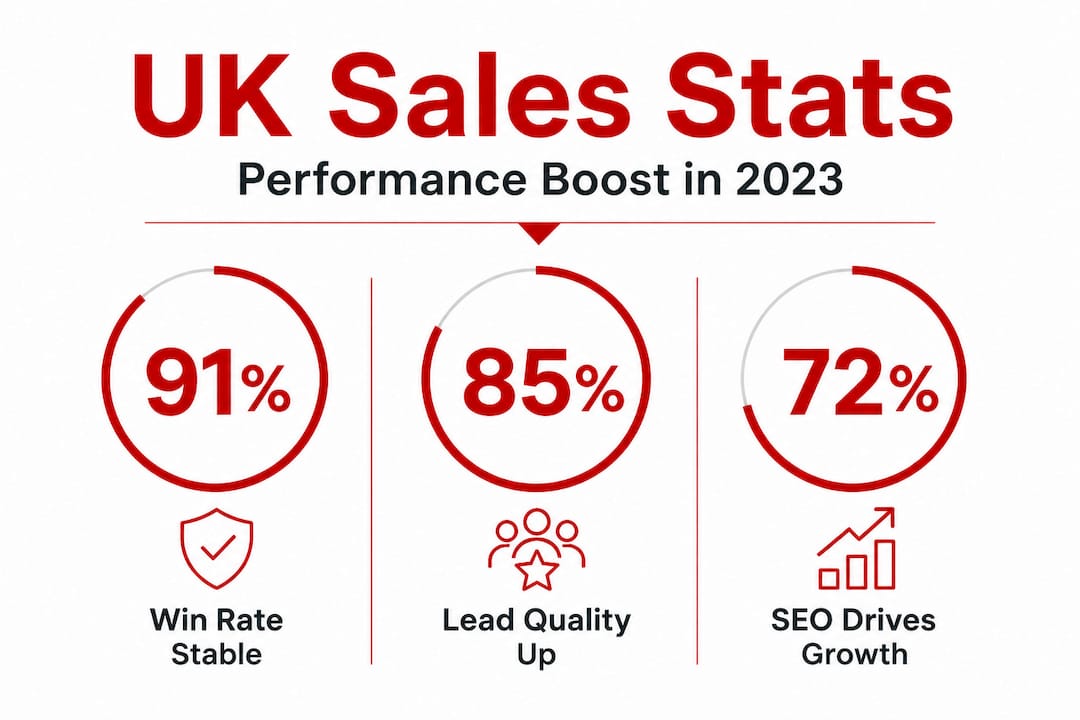
93% of sales professionals say average deal size grew or stayed consistent. That is a strong signal: when you focus on qualified, intent-driven leads rather than high volume outreach, deals get bigger and more predictable.
Still, pressure is real. Understanding where friction lives helps you allocate resources properly. The top pressures UK businesses face heading into 2026 include:
- Digital disruptors entering traditional sectors and undercutting on price or convenience
- Shrinking buyer attention spans, with decision-makers spending less time on cold emails and unsolicited calls
- Higher standards for personalisation, with buyers expecting outreach tailored to their sector, role, and specific pain points
- Complex buying committees, where decisions involve more stakeholders than ever before
- Discoverability gaps, where prospects simply cannot find your business when they search for solutions you offer
That last point deserves extra emphasis. SEO’s role in growth is no longer a marketing department concern. It is a sales imperative. If your content and brand do not appear when buyers search for what you sell, your competitors capture that demand instead. Visibility is not a vanity metric. It is a pipeline metric.
Build a systematic sales enablement engine
Most UK businesses still treat sales enablement as a periodic event rather than a permanent operating system. A quarterly training session, a new pitch deck, or a refreshed product brochure. These efforts are not without value, but they are not enough to create consistent, scalable results.

The old approach looked like this: identify a performance dip, run a training day, hope for improvement, then repeat the cycle six months later. The new approach is fundamentally different. It builds branding’s impact on growth into a systematic framework where messaging, technology, coaching, and metrics all reinforce each other continuously.
| Feature | Ad hoc enablement | Systematic enablement |
|---|---|---|
| Training frequency | Periodic, event-driven | Ongoing, embedded in workflow |
| Messaging consistency | Variable across reps | Unified “single source of truth” |
| Technology use | Disconnected tools | Integrated CRM, content, analytics |
| Performance feedback | Annual or quarterly reviews | Real-time dashboards and coaching |
| Outcome focus | Activity metrics (calls, emails) | Behavioural and revenue outcomes |
According to the Essential Sales Enablement Playbook, the most effective organisations build enablement as a systematic operating model, not a collection of training materials. This distinction matters enormously because it changes how you invest time, budget, and leadership attention.
Here is a practical step-by-step process to build this model in your own business:
- Diagnose friction points. Before adding tools or content, map where deals slow down or die. Is it at the discovery call? During the proposal? At procurement? Know your specific bottlenecks.
- Define desired behaviours. Identify precisely what your best performers do differently. What questions do they ask? How do they handle objections? Make this explicit so it can be taught and replicated.
- Build a single source of truth. Create one central repository for messaging, case studies, objection-handling scripts, and competitive intelligence. Every team member draws from the same well.
- Integrate relevant technology. Choose tools that reinforce the behaviours you have defined, whether that is a CRM with deal stage tracking, a content management system, or a conversation intelligence platform.
- Establish regular coaching cadences. Weekly or fortnightly one-to-ones focused on specific skill development, not just pipeline reviews. Coaching on behaviours, not just numbers.
- Measure and iterate. Set clear KPIs tied to outcomes, not just activities. Review performance weekly and adjust your enablement content accordingly.
Pro Tip: Create a single shared document or workspace that serves as your messaging bible. Every sales and marketing team member should be able to access the latest positioning, proof points, and competitive responses without hunting through email threads or outdated presentations. Consistency across touchpoints is a competitive advantage most teams underestimate.
Enablement is not a project with a completion date. It is an ongoing operating discipline. The businesses that treat it as such consistently outperform those that do not.
Combine sales and marketing: Visibility as a growth engine
One of the most persistent and damaging myths in UK business is that sales and marketing are separate functions with separate goals. In practice, the most successful businesses treat them as two sides of the same coin, unified by a shared obsession with discoverability and conversion.
Aligning sales and marketing around search intent and content brings measurable benefits that ripple across the entire revenue function:
- Higher-quality inbound leads who arrive already educated about your solution and more likely to convert
- Shorter sales cycles because prospects have consumed trust-building content before the first conversation
- Stronger close rates because sales teams have relevant, timely content to share at every stage of the buyer journey
- Reduced cost per acquisition as organic discoverability replaces or supplements expensive paid channels
- Greater brand authority in your sector, which makes premium pricing more defensible
According to research from BIMA, content marketing paired with SEO and search intent alignment is essential for improved rankings and conversions. Content without search alignment is essentially a broadcasting exercise. You are creating material that nobody finds unless they already know you exist.
| Metric to track | What it tells you | Improvement target |
|---|---|---|
| Organic search traffic | Brand discoverability and SEO health | Month-on-month growth |
| Engagement rate (on-page) | Content relevance and quality | Above 3 minutes average time |
| Lead conversion rate | Effectiveness of content-to-contact journey | Improve by 10% per quarter |
| Assisted conversions | Marketing’s contribution to closed deals | Increase attribution visibility |
| Content-sourced pipeline | Revenue influenced by content | Track separately from paid |
The practical starting point is deceptively simple: stop creating content about what you want to say, and start creating content around the specific problems your buyers are actively searching for. SEO basics for brands is a useful foundation here, particularly for businesses that have historically left search strategy to a side project rather than treating it as a core growth lever.
Understanding branding practices for 2026 also plays a critical role. Your brand identity, tone of voice, and visual positioning need to be consistent across every digital touchpoint, from your Google Business Profile to your LinkedIn company page to your landing pages. Inconsistency creates doubt. Doubt kills conversions.
When you are ready to orchestrate this into a fully coordinated effort, knowing how to create a marketing campaign that integrates search, social, and sales content around a coherent buyer journey is the difference between scattered activity and a growth engine.
Pro Tip: Build your content calendar around questions your buyers are searching for in Google, not around product announcements or company news. Use free tools like Google Search Console or AnswerThePublic to identify real search queries in your niche, then create content that genuinely answers them better than anyone else does.
Measurement: Turning insights into action
Here is a hard truth: most UK businesses have too much reporting and too little measurement. There is a critical difference. Reporting tells you what happened. Measurement tells you why it happened and what to do next. Without that distinction, your dashboards are decorative rather than directional.
A practical framework for real measurement looks like this:
- Set clear objectives before you start. Define what success looks like in commercial terms. Not “increase brand awareness” but “generate 40 qualified inbound enquiries per month by Q3.”
- Define the KPIs that connect activity to outcomes. Choose metrics that have a logical causal relationship with your objectives. Organic traffic, conversion rate, cost per qualified lead, sales cycle length.
- Establish a baseline. Before running campaigns or making changes, document your current performance so you have something meaningful to compare against.
- Analyse with intent. When reviewing results, ask “what behaviour or decision caused this change?” rather than simply noting that a number went up or down.
- Iterate quickly. Use what you learn to make specific, testable adjustments. Change one variable at a time where possible so you can attribute results clearly.
- Close the loop between marketing and sales. Ensure that insights from sales conversations feed back into content creation, and that marketing data informs sales talking points.
“Tracking metrics such as organic traffic, engagement, and conversions enables strategic iteration that most businesses skip entirely. The brands that improve consistently are the ones that treat measurement as a discipline, not an afterthought.”
Common slip-ups include obsessing over content volume whilst ignoring whether that content is discoverable or converting. Another frequent mistake is treating measurement as a monthly or quarterly exercise rather than a continuous feedback loop. Speed of learning is itself a competitive advantage.
Pro Tip: Use a unified reporting dashboard that pulls together your website analytics, CRM pipeline data, and campaign performance in a single view. When sales and marketing metrics live in the same dashboard, cross-functional conversations become sharper, decisions become faster, and accountability becomes clearer. Tools like Google Looker Studio can connect multiple data sources for free. You can also run a free SEO audit to identify visibility gaps that are costing you leads right now.
The uncomfortable truth: Why most sales playbooks fail in modern UK markets
After working across diverse industries and reviewing countless sales strategies, one pattern emerges repeatedly. Businesses copy tactics that worked for someone else, in a different sector, with a different audience, at a different moment in the market, and then wonder why results disappoint.
The UK market has genuine nuance. Buyer behaviour in professional services is not the same as in retail or manufacturing. London-based B2B decision-makers respond differently to outreach than businesses in the Midlands or Scotland. Cultural expectations around directness, formality, and trust-building vary considerably. Applying a framework lifted wholesale from an American SaaS company’s case study rarely translates cleanly.
The same logic applies to AI and automation tools, which have attracted enormous enthusiasm and often enormous disappointment in equal measure. Teams adopt AI-powered prospecting tools expecting transformational results, only to find that the tool amplifies the weaknesses in their process just as readily as it scales the strengths.
“Teams should start with desired behaviour and diagnose friction first. AI and tools are only valuable when used to reinforce what already works, at scale.”
AI is not an operating model. It is an accelerant. If your messaging is unclear, your buyer personas are vague, and your follow-up process is inconsistent, automation will simply deliver those flaws faster and at greater scale. The real value of any tool is unlocked only after you have done the harder, less glamorous work of diagnosing behavioural friction and defining what good looks like in your specific context.
Understanding effective UK brand strategies means starting every strategy refresh by asking two questions before touching any technology or content: where exactly does our buyer journey break down, and what specific behaviour change would fix it? Only then should tools, content, or campaigns enter the conversation.
Pro Tip: At the start of every quarterly sales and marketing review, map out your buyer journey from first awareness to closed deal and identify the single biggest drop-off point. Concentrate all enablement and content investment on solving that one friction point before diversifying effort elsewhere. This focused approach delivers faster, more attributable results than spreading resources thinly across multiple initiatives simultaneously.
Amplify your sales and brand impact with Radka Advertising
Applying these frameworks confidently takes more than reading about them. It takes experienced hands who have built and tested these systems across real markets and real buyer behaviours. At Radka Advertising, we work with UK business owners and marketing managers to design and execute brand and sales strategies that are grounded in data, aligned to search intent, and built for measurable growth. Whether you need a full brand strategy overhaul, a content and SEO programme that genuinely drives qualified leads, or integrated multi-channel campaigns, our team brings strategic rigour and creative precision to every engagement. Access our ClientPortal to explore ongoing support options and take the first concrete step towards a brand and sales function that performs consistently at the level your ambitions demand.
Frequently asked questions
How can I increase the quality of sales leads for my UK business?
Align your sales outreach with real search intent and use content to educate prospects before first contact. As lead quality data confirms, 68% of teams saw lead quality improve year over year when they combined better alignment with structured enablement tools.
What measurement metrics matter most for tracking sales-driven brand visibility?
Focus on organic traffic, engagement rates, and conversion rates to understand how your marketing actually influences revenue. Tracking these metrics enables the kind of strategic iteration that separates consistently growing businesses from those that plateau.
Is sales enablement more than training?
Yes, significantly more. Modern enablement is a systematic operating model that coordinates messaging, technology, coaching, and metrics rather than relying on periodic training events alone.
How does SEO impact sales outcomes for UK businesses?
SEO makes your brand discoverable at the precise moment a buyer is actively searching for your solution, improving both lead quality and conversion rates. Content paired with SEO alignment consistently improves rankings and commercial outcomes for UK businesses that commit to it properly.
Recommended
- How SEO drives branding and growth for UK SMEs | Radka Advertising
- How to advertise on the internet: proven UK strategies | Radka Advertising
- Build a stronger brand: Effective strategies for UK businesses
- Proven brand strategies: Real-world examples for growth | Radka Advertising
- Proven strategies to increase brand visibility for SMBs - Palmador Blog
- Proven ways to boost online sales for ambitious e-commerce brands - Nu Life Digital