7 Day Meta Ads Creative Testing Framework for Marketers in 2026

Start with a falsifiable hypothesis, then run a controlled test through Meta Experiments or an equal-budget ABO split, changing one variable only. Open Ads Manager, go to Experiments, and set up an A/B test before you touch anything else. Give it a minimum of seven days and resist every urge to peek early. That single habit separates advertisers who compound wins from those who guess forever.
TL;DR:
- Consistent weekly testing and ample budgets per variant (around £20 per day) are essential to generate statistically significant results.
- Prioritize testing visual hooks first, as they have the most impact on attention and should be evaluated with controlled, single-variable tests.
- Use Meta Experiments for randomized, defensible comparisons, and avoid editing or overlapping audiences once tests are live.
- Run tests for at least seven days and gather a minimum of 25 conversions per variant to ensure reliable data before scaling or deciding winners.
- Scale proven creatives with a separate campaign using campaign budget optimization and only graduate winners after confirming sustained, statistically significant performance.
Table of Contents
- Why structured meta ads creative testing is the competitive lever in 2026
- The testing framework: hypothesis, method, launch, interpret, scale
- How to run meta ads A/B testing in Ads Manager, step by step
- What to test first: ordering creative variables by impact
- Sizing and statistics: budgets, runtime, and confidence
- Campaign architecture: scaling winners without losing learning
- Common pitfalls and a pre-launch readout checklist
- Radka Advertising’s perspective on making creative testing operational
- Segmenting tests by audience demographics or behaviours
- Tools and software for automating creative testing and analysis
- Case studies and examples of successful creative tests
- Best practices for designing creative variations
- Key metrics and decision rules for calling a winner
- Why the algorithm-first approach beats the old testing playbook
- Get structured creative testing without building the team yourself
- Sources
- FAQ
Why structured meta ads creative testing is the competitive lever in 2026
Privacy changes gutted granular attribution, and Meta’s automation now handles targeting and bidding better than most humans can. That leaves one lever still fully in the advertiser’s hands: the creative itself. Meta’s own delivery systems reward clean, well-structured experiments, which is why designing tests to work with the algorithm rather than against it has become the defining skill in modern creative testing frameworks.
Facebook ads creative testing done properly produces repeatable winners, not one-off flukes, and it extends how long a creative performs before ad fatigue sets in. Facebook’s own fatigue curve punishes stale assets with rising frequency and falling click-through rates, so a steady pipeline of tested replacements keeps performance from decaying.
Cadence matters as much as method:
- Advertisers who test weekly build a library of proven hooks, not a graveyard of hunches.
- Consistent testing compounds: each winner becomes next month’s baseline, raising the bar every cycle.
- Teams that only test sporadically end up re-learning the same lessons every quarter.
Meta ads performance analysis in 2026 rewards structure over spontaneity. The agencies and brands pulling ahead are the ones treating creative testing strategies as infrastructure, not an occasional experiment.
The testing framework: hypothesis, method, launch, interpret, scale
Every worthwhile test starts with a sentence you could prove wrong. “A UGC-style opening hook will lift 3-second video views by more than a static product shot” is falsifiable. “This creative feels stronger” is not.
- Write the hypothesis using a simple template: “Changing [variable] will improve [metric] because [reason].”
- Choose your method. Use Meta Experiments when you need a defensible, randomised comparison with a built-in confidence score. Fall back to a manual ABO split only when Experiments isn’t available on the account. Reserve Dynamic Creative for combinatorial exploration, not clean one-variable comparisons.
- Design the test. One variable, identical targeting, equal budgets, and a runtime you commit to before launch, not one you decide midway through.
- Interpret in layers. Attention (thumbstop rate, 3-second views) tells you if the hook works. Intent (CTR, landing page views) tells you if the message lands. Conversion (CPA, ROAS) tells you if it actually sells. A creative can win on attention and lose on conversion. Read all three before declaring a winner.
- Scale deliberately, which the next section covers in detail.
Pro Tip: Write your hypothesis and your kill criteria on the same document before launch. Deciding what “failure” looks like in advance stops you from moving the goalposts once the data disappoints you.
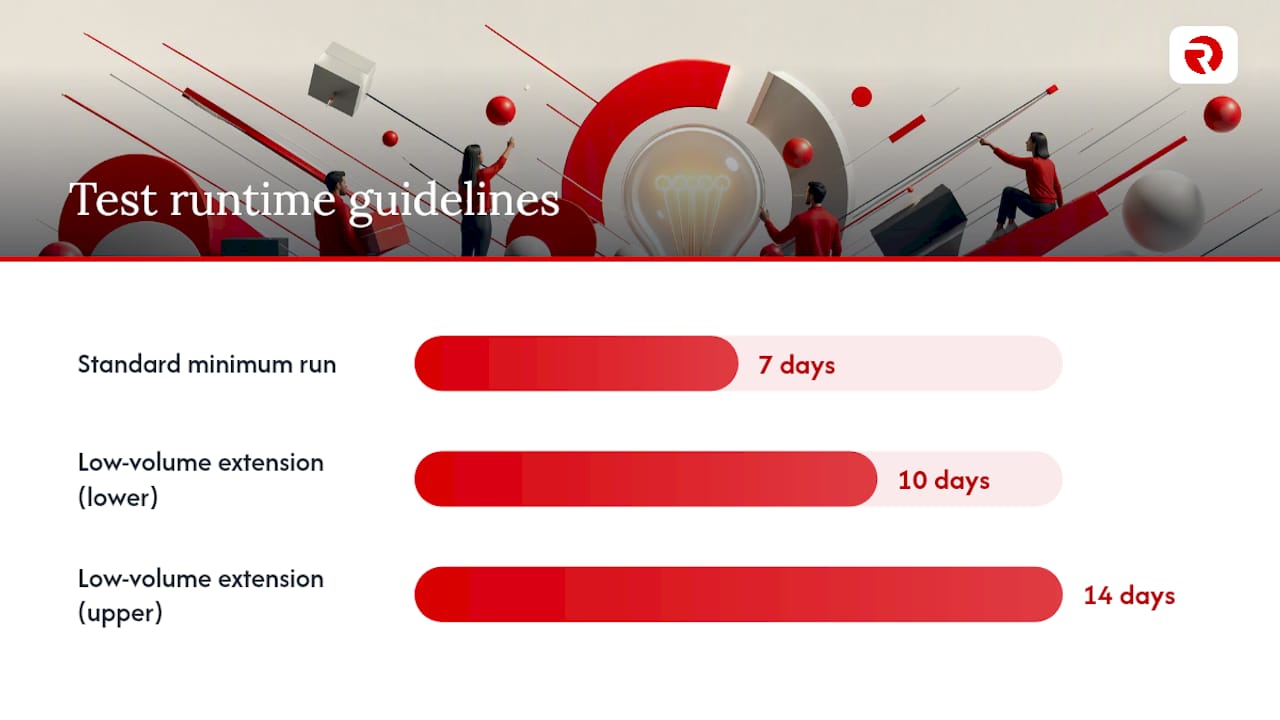
Practitioner guidance consistently backs the one-variable rule and a minimum run of seven days, extending to 10 to 14 for low-volume conversion goals. Skip this discipline and you’re not testing ads. You’re just watching numbers move.
How to run meta ads A/B testing in Ads Manager, step by step
Meta Experiments randomises your audience into non-overlapping groups automatically, which is exactly why Meta positions it as the preferred setup for creative comparisons. To launch one:
- Open Ads Manager, select Experiments, then A/B Test.
- Choose the campaign or ad set to duplicate, and change only the creative element you’re testing.
- Set an equal budget split and let Meta handle audience randomisation. Do not manually adjust either side once it’s live.
- Select your primary metric (CPA, ROAS, or cost per result) and let the test run to its pre-set end date.
If Experiments isn’t available on your account tier, a manual split works as a fallback: build two identical ad sets under one ABO campaign, split budgets evenly, and check statistical significance externally rather than trusting a gut read on the numbers.
Dynamic Creative and Advantage+ have a place, but not as a substitute for structured testing. They mix and match elements automatically, which is useful for discovering surprising combinations, but the output is a black box. You’ll see which combination won; you won’t cleanly know why, and you can’t extract a reusable hypothesis from it. Treat it as an exploration tool that feeds ideas into your next controlled test, not a replacement for one.
Pro Tip: Name every test asset with the variable it’s testing, not a generic version number. “Hook_UGC_v1” tells you something six weeks later. “Ad_47” does not.
Before you launch, run through this checklist:
- Naming convention applied consistently across all variants
- Budgets identical across ad sets or built into the Experiments split
- Placements and bid strategy locked and matching across variants
- No edits planned once the test goes live, regardless of early results
What to test first: ordering creative variables by impact
Not every creative element deserves equal testing attention. Visual hook comes first, always. The opening three seconds of a video, or the first frame of a static image, determines whether anyone sees the rest of the ad at all. Jon Loomer’s testing framework recommends testing the variable most likely to move conversion before refining anything downstream, and that variable is nearly always the visual.
A sensible testing order looks like this:
- Visual hook first — static versus video, UGC versus studio production, opening frame composition.
- Primary text and hook copy second — the first line a scroller reads before they decide to keep reading.
- Headline third — supports the hook but rarely rescues a weak one.
- Call-to-action fourth — “Shop Now” versus “Learn More” moves numbers, but modestly compared to the hook.
- Offer and placement last — worth testing, but only once the creative concept itself is proven.
Concept-level tests should always precede execution-level tweaks. Test UGC against polished studio footage before you fine-tune button colours or caption length within a concept that hasn’t been validated yet. Good visual design underpins all of this: how a frame is composed, lit, and cropped changes attention rates before a single word of copy is read, a point worth revisiting in how design shapes advertising effectiveness.
Sizing and statistics: budgets, runtime, and confidence
Undersized tests are the single biggest reason creative testing strategies fail quietly. A practical benchmark is roughly £20 or more per day per variant, and at least 25 conversions per variant before you compare results with any confidence, a figure commonly cited across creative testing benchmarks. Below that, you’re reading noise, not signal.
Runtime matters just as much as spend. Seven days is the floor for most tests; low-volume conversion goals need 10 to 14 days to gather enough events for a stable read, per the same practitioner guidance. Meta’s own confidence score inside Experiments tells you when a result is statistically meaningful. If it hasn’t reached that threshold by the end of your planned runtime, extend the test rather than call a winner on gut feel.
| Test scenario | Minimum runtime | Conversions per variant | Budget guidance |
|---|---|---|---|
| High-volume conversion goal | seven days | at least 25 | £20+/day/variant |
| Low-volume conversion goal | 10–14 days | at least 25 | £20+/day/variant, higher if CPA is high |
| Top-of-funnel (video views, engagement) | seven days | N/A (use thumbstop/CTR) | £15–20/day/variant |
Smaller total budgets should mean fewer concepts tested at once, each with enough spend to reach significance, rather than five variants sharing a budget that starves all of them, a trade-off Foxwell Digital’s 2026 guide sets out clearly. Two well-funded variants beat five underfed ones every time.
Campaign architecture: scaling winners without losing learning
Split testing from scaling into two campaigns. One campaign exists purely to find winners; the other exists purely to spend behind them. Mixing the two destabilises both jobs, because a scaling campaign’s algorithm keeps relearning every time you drop a new variant into the mix, and a testing campaign optimised for volume stops giving you a clean read.
ABO (ad set budget optimisation) suits the testing campaign because it locks equal spend per ad set, which is exactly what a fair comparison needs. CBO (campaign budget optimisation) suits the scaling campaign because Meta’s delivery system allocates budget dynamically toward whatever is performing best, which is a strength once you already know what “best” looks like.
- Run exploration and validation tests inside an ABO campaign, where every variant gets guaranteed exposure.
- Move to a CBO scaling campaign once a creative has cleared your graduation gates.
- Graduate a winner only when it hits statistical significance, meets your target CPA or ROAS, and holds that performance across multiple consecutive days rather than one lucky spike.
- Duplicate the winning ad set into the scaling campaign rather than editing the original test, which preserves the algorithm’s existing learning phase and avoids resetting delivery from scratch.
This two-campaign model is the structural backbone behind most durable Meta creative testing architectures published for 2026, and it solves the single most common complaint about creative testing: winners that perform in testing and then collapse the moment they’re scaled.
Common pitfalls and a pre-launch readout checklist
Most failed tests fall into three categories, and all three are avoidable. Underpowered tests don’t reach enough conversions to mean anything. Contaminated tests overlap audiences or change more than one variable, so you can’t tell what actually caused the shift. Premature tests get killed on day two because someone panicked at an early CPA spike that later normalised.
- Never edit a live test. Editing resets Meta’s learning phase and invalidates whatever data you’ve already collected.
- Never let audiences overlap between variants. Overlap contaminates the sample and undermines any confidence score the tool reports.
- Never kill a trailing variant before the pre-committed runtime ends. Early leaders regularly swap places once volume builds, and readout discipline that checks cross-metric alignment before graduating a winner catches this reliably.
Before calling any test finished, run this readout checklist:
- Has the test hit Meta’s confidence threshold, or the runtime you committed to, whichever is longer?
- Do attention, intent, and conversion metrics all point the same direction?
- Have you checked performance by placement? A winner on Reels can quietly lose on Feed.
- Has frequency stayed within a sane range, or is fatigue muddying the read?
- Does each variant have enough conversions to trust the result?
Pro Tip: Keep a rolling test calendar with a new hypothesis queued before the current test even finishes. Testing velocity dies the moment you’re deciding what to test next after results land, not before.
Radka Advertising’s perspective on making creative testing operational
Running one clean test is easy. Running fifty of them, in sequence, without losing discipline, is the actual challenge most in-house teams struggle with. Creative testing can be built into the production cadence itself: ideally, every asset produced, whether photography, video, or copy, gets tagged against a hypothesis before it’s ever launched, so a creative library builds up alongside the test log rather than separately from it.
That balance between production and testing is where most teams quietly fail. Producing enough fresh creative to feed a proper testing cadence takes real capacity, and testing without a production pipeline behind it just means the same three ads getting refreshed forever.
Clients running structured programmes typically see three habits pay off: regular creative audits to catch fatigue before performance drops, hit-rate tracking across every test to know which concepts consistently win, and weekly handoffs between the creative team and the media buying team so learnings from Ads Manager feed directly into the next production brief. The case studies Radkaadvertising has published show what that cadence looks like applied across different industries.
Segmenting tests by audience demographics or behaviours
A creative that wins broadly can still lose badly within a specific segment, which is why serious testing programmes layer audience segmentation on top of creative comparisons rather than treating “audience” and “creative” as separate problems.
Segment by demographic first if your product genuinely performs differently across age bands or gender, rather than as a default habit. A skincare brand, for instance, might find a UGC hook outperforms studio footage among 18 to 24 year olds while the reverse holds among 45 to 54 year olds, a split invisible in the blended top-line result.
Behavioural segmentation often matters more than demographic segmentation. Splitting a test between warm audiences (past purchasers, engaged followers) and cold prospecting audiences frequently reveals that the hook which converts warm traffic falls flat as a cold-audience introduction, because the two groups need entirely different information in the first three seconds.
Practical guidance for segmented testing:
- Keep the one-variable rule intact within each segment; don’t test creative and audience simultaneously in the same cell.
- Run segment splits as separate ad sets within the same ABO testing campaign so budgets stay controlled and comparable.
- Only segment when you have enough volume to reach significance in each slice. Splitting an already-small budget five ways guarantees underpowered results in every segment.
Segmentation adds real insight, but it multiplies your sample-size requirements. Treat it as a second-stage refinement once a creative has already won broadly, not the first test you run.
Tools and software for automating creative testing and analysis
Meta Experiments remains the foundation, since it’s built directly into Ads Manager and handles randomisation and confidence scoring natively without needing a third-party layer. For teams that want a defensible, native comparison, it’s the starting point every time.
Beyond Experiments, a handful of categories of tools handle the surrounding work. Creative analytics platforms pull performance data across dozens of live ads simultaneously, breaking results down by hook type, format, and messaging angle so patterns emerge faster than manual spreadsheet review allows. Reporting and visualisation tools then layer on top to track hit-rate over time, which matters more once you’re running tests weekly rather than occasionally.
For the analysis layer specifically, Radkaadvertising’s AI-driven growth service applies automated measurement to spot patterns across historical test data that manual review tends to miss, particularly around which creative attributes correlate with sustained performance rather than an early spike. Automation doesn’t replace the hypothesis-first discipline covered earlier. It just makes reviewing dozens of tests a week manageable instead of overwhelming. Consistent measurement practice is also the subject of The Lead Lab’s guide to campaign performance measurement, which sets out why reliable tracking has to come before any test result can be trusted.
Case studies and examples of successful creative tests
The clearest pattern across successful creative tests isn’t a specific format winning universally. It’s the discipline of testing one clear variable and giving it enough runway to produce a trustworthy signal.
A common example: an e-commerce brand tests a UGC-style testimonial video against polished studio product footage, holding targeting, budget, and placement identical. The UGC version often wins on thumbstop rate and CTR because it reads as native content rather than an obvious advertisement, but the studio version sometimes wins on conversion because it presents the product more clearly at the point of decision. Without testing both under controlled conditions, a team optimising purely for click-through would have scaled the wrong asset.
Another recurring pattern shows up in call-to-action testing. “Shop Now” frequently beats “Learn More” on direct-response campaigns, but the reverse often holds for higher-consideration purchases where a softer CTA reduces friction at the click stage without hurting downstream conversion. Neither result generalises; both only mean anything once tested inside a specific account, audience, and offer.
What separates a useful case study from an anecdote is the presence of a hypothesis stated before launch, a controlled method, and a graduation decision based on sustained performance rather than a single strong day. Radkaadvertising’s published case studies follow that structure, documenting the hypothesis and method alongside the outcome rather than presenting results in isolation.
Best practices for designing creative variations
Design variations that isolate a single, testable idea rather than bundling several small changes into one new asset. A variant that changes the hook, the CTA, and the colour palette simultaneously produces a result you can’t act on, because you don’t know which change caused the shift.
Build variations around genuine concept differences before refining execution. UGC versus studio, problem-first versus benefit-first messaging, and static versus video are concept-level splits worth testing early. Font size or button colour are execution-level refinements that only matter once a concept has already proven itself.
A few practical rules for variation design:
- Keep copy length, tone, and structure consistent across variants unless copy itself is the variable under test.
- Match video length and pacing across variants when testing visual hooks, so runtime differences don’t confound the result.
- Build variants from the same underlying asset library where possible, so production quality doesn’t accidentally become the hidden variable.
- Avoid testing more than three variants at once against a modest budget; each one needs enough spend to clear the significance threshold, and spreading budget too thin defeats the purpose.
Good variation design also respects Meta’s delivery system rather than fighting it. Feeding the algorithm clean, distinct ad sets rather than dozens of near-identical tweaks gives Meta’s own optimisation a genuine signal to work with, which is precisely the point Bir.ch’s 2026 testing framework makes about designing tests that work with automated delivery instead of against it.
Key metrics and decision rules for calling a winner
Pick one primary KPI before launch and stick to it. For most direct-response advertisers that’s cost per acquisition or ROAS; for brand or top-of-funnel campaigns it might be cost per thumbstop or cost per landing page view. Chasing a different metric depending on which number looks best that week is how teams talk themselves into scaling the wrong creative.
Secondary metrics still matter as guardrails. A creative that wins on CPA but carries an unusually high frequency might be heading for fatigue within days, and one that wins on CTR but converts poorly downstream is winning attention it can’t monetise. Reading the funnel in layers, attention through intent through conversion, catches these mismatches before they become expensive.
Decision rules should be set before the test starts, not adjusted afterwards to fit whatever result you got:
- Declare a winner only once Meta’s confidence score clears its threshold inside Experiments, not on a raw eyeballed difference.
- Require the winning margin to hold across multiple consecutive days, not a single strong 24-hour window.
- Confirm the primary KPI and at least one secondary metric agree in direction before graduating a creative to the scaling campaign.
- If confidence hasn’t been reached by the end of the planned runtime, extend the test rather than force a decision.
These rules exist because early Meta ads performance analysis is notoriously unstable in the first 48 to 72 hours, and calling a winner during that window is one of the most reliable ways to scale a loser by mistake.
Why the algorithm-first approach beats the old testing playbook
Most creative testing advice still reads like it was written before Meta’s automation took over targeting and bidding. It obsesses over manual audience exclusions and micro-segmentation, when the actual lever that moves performance now sits almost entirely in the creative itself.
The conventional advice to “test everything constantly” is where I think most teams go wrong. Volume without discipline just produces noise dressed up as data. What the evidence here actually supports is narrower and less exciting: fewer tests, properly powered, with a hypothesis written down before launch and a runtime nobody’s allowed to cut short. That’s less satisfying than running ten variants at once, but it’s the difference between a creative library that compounds and one that’s just a pile of past guesses.
If you take one thing from this framework, prioritise the visual hook test above everything else, size it properly, and let Meta’s delivery system do what it’s actually good at once you’ve fed it a clean signal. Everything downstream, copy, CTA, offer, matters less than most advertisers assume.
— Bart
Get structured creative testing without building the team yourself
Running the framework above properly takes production capacity, media buying discipline, and someone watching confidence scores daily, which is exactly where most in-house teams run out of time. Radkaadvertising is the alternative to building that capability from scratch: a full production and paid media team already structured around hypothesis-first testing, so you get tested creative rather than a queue of untested guesses waiting for budget.
Services span creative production, paid media management across Meta and Google, and the measurement layer that turns test results into a genuine hit-rate over time, all detailed on the services overview. The case study portfolio shows how that structure has played out across different industries and budgets.
If you want a clear read on where your current creative testing programme is losing budget, request a discovery audit through Radkaadvertising and get a concrete next step rather than another generic recommendation.
Sources
For setup mechanics, Meta’s own Ads Manager Experiments help centre is the primary reference. For statistical rigour and budgeting, Jon Loomer’s testing breakdown and AdAdvisor’s step-by-step guide cover sample sizes and runtime in detail. For campaign architecture, RocketShip HQ’s structure guide explains the ABO/CBO split thoroughly.
- Set Up a Creative Test in Meta Ads Manager
- Meta’s Creative Testing Tool: Setup, Strategy, and Results - Jon Loomer Digital
- Facebook Ad Creative Testing: A Step-by-Step Guide | AdAdvisor
- How to structure Meta campaigns for creative testing (2026) - RocketShip HQ
- How to Test Creatives on Meta in 2026: The Full Guide — Foxwell Digital
FAQ
Is £10 a day enough for Facebook ads testing?
£10 a day rarely reaches the 25-plus conversions per variant needed for a trustworthy result, so it works only for very cheap conversion events or top-of-funnel metrics like video views rather than full A/B creative comparisons.
Is A/B testing worth it on Facebook?
Yes. A properly powered A/B test through Meta Experiments gives a statistically defensible read on which creative actually drives results, rather than a guess based on early impressions that often reverse once volume builds.
How much do 1,000 clicks cost on Facebook?
Cost per click varies enormously by industry, audience, and creative quality, so there’s no single reliable figure. Budget guidance for testing itself is more useful: aim for roughly £20 or more per day per variant to reach significance within a standard test window.
How do I test ads in Meta Ads Manager?
Open Ads Manager, go to Experiments, and create an A/B test that changes one variable, such as the visual hook, while holding budget, targeting, and runtime constant for at least seven days before comparing results.
What’s the minimum runtime for a Meta creative test?
Seven days for most conversion goals, extending to 10 to 14 days for low-volume conversion events, gives Meta’s system enough data to calculate a reliable confidence score.