Marketing benefits for UK SMEs: what business owners need to know

TL;DR:
- Marketing, when treated as a strategic function, produces measurable benefits such as increased revenue and stronger brand awareness. Digital marketing amplifies these effects through precise targeting, measurability, and cost efficiency, especially for UK SMEs. Building a solid foundation with clear objectives, consistent messaging, and proper measurement yields the highest return on marketing investment.
Done well, marketing delivers increased revenue, predictable demand, lower customer acquisition costs, and stronger lifetime value from every buyer you win. These are not aspirational outcomes. They are measurable, repeatable results that UK businesses achieve when marketing is treated as a strategic function rather than a line item to trim.
Here are the core benefits at a glance:
- Revenue growth — consistent marketing activity drives more qualified demand into your sales pipeline
- Brand awareness — buyers who recognise your brand convert at higher rates and require less sales effort
- Customer acquisition — targeted campaigns reduce cost-per-lead by reaching the right audience at the right moment
- Customer retention — post-purchase marketing increases repeat spend and reduces churn
- Market insight — campaign data reveals what buyers want, informing product, pricing and positioning decisions
- Competitive positioning — visible, consistent brands crowd out less active competitors in buyers’ minds
- Scalable growth — digital channels let you test, learn and scale what works without proportional cost increases
TL;DR: Digital advertising alone contributed £73 billion in additional sales to the UK economy, with £26 billion of that captured by SMEs. Businesses that align marketing to clear objectives consistently report stronger ROMI, reduced CAC, and higher LTV over time.
Table of Contents
- What marketing is, and how it differs from sales
- The core business benefits marketing delivers
- Benefits that digital marketing amplifies
- How marketing creates those benefits: channels and tactics that work
- How to measure marketing benefits: KPIs that prove value
- Typical timelines and indicative costs for UK SMEs
- Common SME marketing mistakes and practical fixes
- UK-specific evidence: the economic impact of marketing
- Key takeaways
- Why most businesses underestimate what marketing actually does
- Radkaadvertising: built to deliver the benefits described here
- Useful sources
- FAQ
What marketing is, and how it differs from sales
Marketing is the process of creating demand. It shapes how your audience perceives your brand, communicates why your product or service matters, and moves potential buyers from awareness through to the point where they are ready to purchase. The Chartered Institute of Marketing defines it as the management process responsible for identifying, anticipating and satisfying customer requirements profitably.
Sales, by contrast, converts that demand into revenue. A salesperson works with buyers who are already aware of a problem and are evaluating solutions. Marketing’s job is to make sure those buyers arrive at that conversation already informed, already trusting, and already leaning towards you.
| Dimension | Marketing | Sales |
|---|---|---|
| Primary purpose | Create and nurture demand | Convert demand into revenue |
| Typical lead time | Weeks to months | Days to weeks |
| Key KPIs | Reach, CAC, brand recall, MQLs | Conversion rate, deal value, pipeline velocity |
| Buyer journey stage | Awareness through consideration | Consideration through decision |
| Who owns it | Marketing team / agency | Sales team / founder |
The practical implication: if your sales team is working too hard to convince people your product is worth considering, marketing has not done its job yet. Strong marketing makes selling easier, faster, and cheaper.
The core business benefits marketing delivers
Marketing’s advantages span every stage of the commercial cycle. The most impactful ones for UK business owners are:
- Sales growth — sustained marketing activity fills the top of the funnel with qualified prospects, which translates directly into revenue. B2C retailers see this through repeat purchase rates; B2B firms see it through shorter sales cycles and higher average deal values.
- Reduced customer acquisition cost — as brand recognition builds, organic and referral traffic increases, meaning you spend less to win each new customer over time.
- Customer retention and loyalty — email nurture, loyalty content and post-purchase communication keep buyers engaged between transactions. Retaining an existing customer costs significantly less than acquiring a new one.
- Brand equity — a recognised, trusted brand commands premium pricing and attracts better talent, partners and press coverage. Brand equity is a balance-sheet asset even when it is not formally valued as one.
- Market intelligence — every campaign generates data: what messaging resonates, which segments respond, where buyers drop off. That insight feeds better product decisions, sharper pricing and more precise positioning.
- Market expansion — digital channels remove geographic barriers. A UK SME can test demand in a new region or country with a modest paid campaign before committing to physical expansion.
UK businesses increasingly treat marketing as a strategic investment rather than a discretionary cost, and the data supports that shift. LOCALiQ’s UK digital marketing research identifies increasing sales revenue, customer engagement and brand awareness as the top three marketing priorities for UK businesses heading into 2026 — which map precisely to the benefits above.
Statistic callout: Digital advertising contributed £73 billion in additional sales to the UK economy, with £26 billion of that uplift captured by SMEs.
Benefits that digital marketing amplifies
Digital marketing does not replace the fundamentals above. It accelerates them, makes them measurable, and puts them within reach of businesses with modest budgets.
Global reach without global spend. A well-structured Google Ads or Meta campaign can put your brand in front of buyers in Manchester, Munich or Melbourne for the same cost. Traditional advertising rarely offered that scale at SME price points.
Targeting precision. Digital channels let you define your audience by job title, location, purchase behaviour, income band, or interest. You stop paying to reach people who will never buy from you.
Measurability. Every click, impression, conversion and pound of revenue can be tracked back to a specific campaign, ad, or keyword. That transparency turns marketing from a cost centre into a provable investment.
Cost efficiency. Entry-level digital campaigns cost a fraction of print, TV or outdoor advertising. LOCALiQ data shows that 59% of UK businesses report AI-driven tools increased their marketing output volume, with 52% reporting improved quality and 28% achieving cost reductions. Tools like Radkaadvertising’s AI-driven growth service apply that efficiency at scale.
Personalisation. Email platforms, CRM integrations and dynamic ad creative let you serve different messages to different segments automatically, increasing relevance and conversion rates without manual effort.
Speed to market. A new product, offer or message can be live within hours. You can test two versions of a landing page simultaneously, identify the winner in days, and scale the better-performing variant immediately.
Pro Tip: When choosing where to start digitally, match the channel to your commercial objective. If you need leads now, paid search delivers fastest. If you are building long-term authority and reducing CAC over 12 months, SEO and content are the better investment. Do not run both at half-effort; pick one primary channel, prove it, then layer in the second.
How marketing creates those benefits: channels and tactics that work
Understanding the benefits is one thing. Knowing which channels deliver which outcomes is where strategy becomes execution.
SEO builds organic visibility over 6–12 months. It reduces paid acquisition dependency and drives compounding returns: a page that ranks for a high-intent keyword keeps generating leads without ongoing spend. Start with an SEO audit to identify the fastest technical and content wins.

Content marketing (blog posts, guides, case studies, video) positions your brand as the most credible option in your category. For B2B businesses, objection-handling content and thought leadership shorten the sales cycle by answering buyer questions before a salesperson ever picks up the phone.
Email marketing is the highest-ROMI channel for most SMEs. A well-segmented list with automated nurture sequences converts prospects who were not ready to buy on first contact and re-activates dormant customers at minimal cost.
Paid social (Meta, LinkedIn) delivers fast awareness and retargeting at scale. Meta suits B2C and ecommerce; LinkedIn is the channel of choice for B2B lead generation and account-based marketing.
PPC / paid search (Google Ads) captures buyers who are already searching for what you sell. 94% of UK businesses using paid search consider it important to their business, with 71% calling it very important or essential.
PR and press distribution builds third-party credibility that paid advertising cannot replicate. A placement in a trade publication or national outlet signals authority and drives referral traffic from high-trust sources.
Typical channel combinations by goal:
- Local service business: — Google Business Profile + local SEO + Google Ads + review generation
The most effective campaigns integrate these channels into a single customer journey. A buyer might discover you through a blog post (SEO), download a guide (content), receive a nurture sequence (email), and convert after seeing a retargeted ad (paid social). Each channel does a different job; together they reduce friction and increase the probability of conversion at every stage. See Radkaadvertising’s campaign-building guide for a practical walkthrough of this process.
How to measure marketing benefits: KPIs that prove value
Measurement is what separates marketing investment from marketing spend. These are the four metrics every UK business owner should track:
Customer Acquisition Cost (CAC) — total marketing and sales spend divided by the number of new customers won in a period. Track this monthly. If CAC is rising, your targeting or conversion rate needs attention.
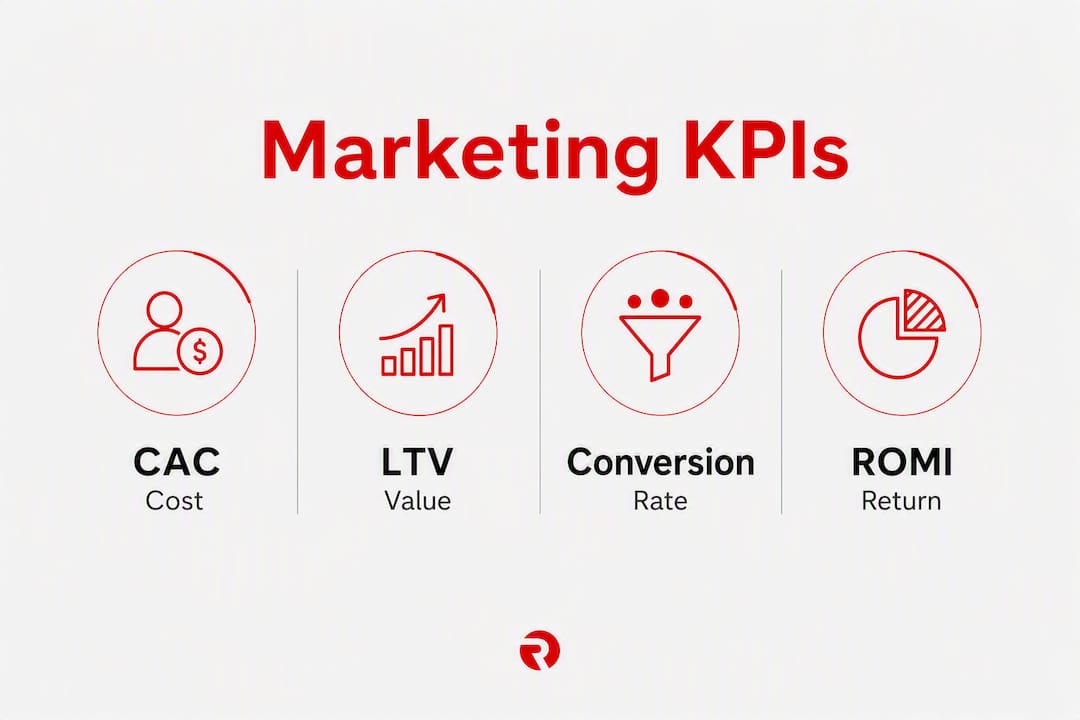
Customer Lifetime Value (LTV) — the total revenue a customer generates over their relationship with you. The LTV:CAC ratio tells you whether your acquisition economics are sustainable. A ratio of 3:1 or above is a healthy benchmark for most SMEs.
Conversion rate — the percentage of visitors, leads or prospects who take the desired next action. Small improvements here have an outsized impact on revenue without increasing spend.
Return on Marketing Investment (ROMI) — revenue attributable to marketing divided by marketing cost. For B2B, ROMI should be assessed through pipeline contribution: opportunity value created, sales cycle length, and long-term account value, not just short-term campaign costs.
| Objective | Primary KPIs | Reporting cadence |
|---|---|---|
| Brand awareness | Reach, impressions, share of voice, branded search volume | Monthly |
| Lead acquisition | CAC, MQL volume, cost-per-lead, landing page conversion rate | Weekly / monthly |
| Customer retention | Repeat purchase rate, email open/click rate, churn rate | Monthly |
| Revenue growth | ROMI, pipeline value, revenue attributed to marketing | Monthly / quarterly |
| Engagement | Social engagement rate, time on site, pages per session | Monthly |
Pro Tip: Vanity metrics (likes, followers, raw impressions) feel good but rarely correlate with revenue. Before you report on any metric, ask: “Does a change in this number move money?” If the answer is no, deprioritise it. Align your marketing dashboard with your sales pipeline and finance reporting so every number tells a commercial story.
Typical timelines and indicative costs for UK SMEs
Knowing when to expect results is as important as knowing what results to expect. Different activities operate on very different time horizons.
SEO (6–12 months to meaningful organic traffic). Technical fixes can improve crawlability within weeks, but ranking gains for competitive keywords typically take 6 months minimum. The payoff is compounding: traffic and leads grow without proportional spend increases.
Content marketing (3–6 months to measurable pipeline impact). Early content builds authority signals; results accelerate as domain authority grows and content begins ranking. B2B content that directly addresses buyer objections can shorten sales cycles within 90 days.
Paid search and paid social (days to weeks). PPC delivers results almost immediately once campaigns are live and optimised. The trade-off is that results stop when spend stops, making it a complement to organic activity rather than a replacement.
Email nurture (4–8 weeks to first measurable lift). A well-structured welcome and nurture sequence can show conversion uplift within the first campaign cycle. Ongoing optimisation compounds those gains over months.
PR and press coverage (1–3 months per campaign cycle). Media placements take time to pitch, place and publish, but the authority and referral traffic they generate can persist for years.
| Activity | Time to first results | Indicative monthly cost (UK SME) |
|---|---|---|
| SEO (managed) | 3–6 months | — |
| Content marketing | 2–4 months | — |
| Google Ads (PPC) | 1–4 weeks | — |
| Paid social (Meta/LinkedIn) | 1–4 weeks | — (inc. ad spend) |
| Email marketing | 4–8 weeks | — |
| PR and press distribution | 1–3 months | — |
These are indicative ranges for small-to-medium campaigns. Costs vary by sector, competition and scope. UK SMEs that treat marketing as a strategic asset report stronger returns and reduced cost-per-lead over time, which means the effective cost of marketing decreases as the programme matures.
Common SME marketing mistakes and practical fixes
Most marketing underperformance comes down to a handful of recurring errors. Here is what to stop, and what to do instead.
Instinct-led campaigns over strategy. Sporadic social posts and one-off promotions without a defined audience or objective waste budget. Fix: define your target customer, their problem, and the one action you want them to take before you create anything.
No measurement framework. If you cannot attribute leads or revenue to specific activities, you cannot improve. Fix: set up Google Analytics 4, connect it to your CRM, and define conversion events before any campaign goes live.
Ignoring existing customers. Most SMEs over-invest in acquisition and under-invest in retention. Fix: build a simple email nurture sequence for post-purchase customers and measure repeat purchase rate quarterly.
Inconsistent brand messaging. Different messages across channels confuse buyers and dilute brand recall. Fix: create a one-page brand messaging document (positioning, tone, key claims) and apply it across every channel.
Chasing every channel at once. Spreading thin across six platforms produces mediocre results on all of them. Fix: pick two channels that match your audience and objective, execute them well, then expand.
Quick-check list for your current marketing:
- Do you have a written marketing plan with clear objectives and KPIs?
- Can you attribute last month’s leads to specific channels?
- Is your website conversion rate tracked and benchmarked?
- Do you have an active email list with a nurture sequence in place?
- Is your brand messaging consistent across your website, social profiles and sales materials?
- Have you reviewed your CAC and LTV in the last 90 days?
- Do you have at least one piece of content that directly addresses your buyer’s main objection?
If you answered no to three or more, the fastest return on your next marketing pound is fixing the foundations, not launching new campaigns. When those foundations are in place and you need to accelerate, an agency engagement typically delivers results faster by bringing repeatable frameworks and measurement maturity that most SMEs build through costly trial and error.
UK-specific evidence: the economic impact of marketing
The scale of marketing’s contribution to the UK economy makes the case for investment more compellingly than any single case study.
Digital advertising supported £129 billion of GVA and over 2 million jobs in the UK, according to IAB UK reporting. That is not a niche sector statistic. It reflects how deeply advertising-funded commerce is woven into the UK’s economic fabric.
For SMEs specifically, the numbers are direct. Of the £73 billion in additional sales that digital advertising generated for the UK economy, £26 billion was captured by SMEs. That figure represents real incremental revenue that would not have existed without digital marketing activity.
Beyond direct sales, digital advertising funds £18 billion per year in consumer savings through ad-supported free services. The broader ecosystem that advertising sustains, from search engines to news platforms to social networks, is the same infrastructure UK businesses rely on to reach their customers.
LOCALiQ’s UK research shows that UK businesses in 2026 are prioritising sales revenue growth, customer engagement and brand awareness as their top marketing objectives. Those priorities align precisely with the channels and tactics that deliver the strongest measurable returns: paid search, email, SEO and social. Businesses that align their investment to these priorities, rather than spreading budget across low-return activities, consistently outperform those that do not.
The United Kingdom is the largest digital advertising market in Europe. For a UK SME, that means access to sophisticated targeting tools, a mature agency ecosystem, and a buyer base that is highly comfortable with digital-first purchasing decisions.
Key takeaways
Marketing delivers measurable business outcomes — increased revenue, lower acquisition costs, stronger retention, and compounding brand equity — when it is treated as a strategic function with clear objectives and consistent measurement.
| Point | Details |
|---|---|
| Digital advertising drives real SME revenue | UK SMEs captured £26 billion in incremental sales from digital advertising, per IAB UK data. |
| Measurement turns spend into investment | Track CAC, LTV, conversion rate and ROMI; align your dashboard to sales pipeline and finance. |
| Channel choice must match your objective | Paid search for fast leads; SEO and content for compounding long-term CAC reduction. |
| Foundations before campaigns | Fix audience definition, messaging consistency and analytics before launching new activity. |
| Radkaadvertising as strategic partner | Radkaadvertising delivers brand strategy, digital campaigns, SEO, AI-driven growth and PR for UK SMEs seeking measurable returns. |
Why most businesses underestimate what marketing actually does
The conventional framing of marketing as “getting the word out” undersells it by an order of magnitude. The businesses that extract the most value from marketing are not the ones with the biggest budgets. They are the ones that treat marketing as a commercial function, not a creative one.
What that means in practice: every campaign has a defined objective tied to a revenue outcome. Every channel is chosen because it reaches a specific buyer at a specific stage of their decision. Every pound spent is tracked against a metric that connects to the business’s financial performance.
The gap between that approach and what most SMEs actually do is enormous. Most run instinct-led activity: a social post here, a Google Ad there, a website that has not been touched in two years. The result is not zero return; it is unpredictable, unmeasurable return that cannot be improved because it was never properly defined.
The businesses that win consistently are the ones that build marketing into their commercial operating model. They know their CAC. They know their LTV. They know which channel is generating their best customers and which is generating noise. That knowledge compounds over time, making each successive campaign more efficient than the last.
One more thing worth saying plainly: the timeline expectations most business owners carry are too short. SEO takes months. Brand awareness takes quarters. The businesses that pull back at the three-month mark because they have not seen a return are the ones who never find out what the return would have been. Patience, paired with rigorous measurement, is the actual competitive advantage.
Radkaadvertising: built to deliver the benefits described here
Radkaadvertising is a London-based full-service agency that puts strategy before tactics and measurement before creative. For UK SMEs and growth-stage brands, the agency offers brand strategy, digital marketing, SEO, paid advertising, PR and press distribution, AI-driven content scaling, and bilingual services for UK and Eastern European markets.
A first engagement typically begins with a diagnostic: an audit of your current digital presence, channel performance and messaging consistency. From there, the team builds a prioritised plan aligned to your commercial objectives, with clear KPIs agreed before any campaign goes live. You can see the outcomes of that approach in the client case studies across sectors including FMCG, energy and beauty.
If you want to start with a focused diagnostic, the SEO audit service is a practical first step. For businesses ready to discuss a full campaign or retainer, visit radkaadvertising.com to get in touch.
Useful sources
- IAB UK digital dividend report — the primary source for UK digital advertising economic impact figures, including the £73 billion sales uplift, £26 billion SME share, £129 billion GVA contribution and £18 billion in consumer savings.
- Radkaadvertising case studies — client outcomes across brand strategy, digital marketing and campaign delivery; useful for benchmarking typical agency-delivered results.
- Radkaadvertising SEO basics for brands — practical guide to SEO fundamentals for business owners starting to build organic visibility.
FAQ
What are the main benefits of marketing for a business?
Marketing drives revenue growth, reduces customer acquisition costs, builds brand awareness, improves customer retention, and generates market insight that informs product and pricing decisions. For UK SMEs, digital marketing amplifies all of these through measurable, targeted campaigns.
How does digital marketing differ from traditional marketing in terms of benefits?
Digital marketing adds measurability, targeting precision, cost efficiency and speed that traditional channels cannot match. Every campaign can be tracked to a specific revenue outcome, and budgets can be adjusted in real time based on performance data.
What KPIs should I use to measure marketing benefits?
The four most important are Customer Acquisition Cost (CAC), Customer Lifetime Value (LTV), conversion rate, and Return on Marketing Investment (ROMI). Align these to your sales pipeline and review them monthly to track whether marketing is improving commercial performance.
How long does it take to see results from marketing?
Paid search and paid social can deliver results within weeks. SEO and content marketing typically take 6–12 months to produce meaningful organic traffic. Email nurture shows measurable conversion lift within 4–8 weeks. The strongest long-term returns come from combining fast-response paid channels with compounding organic activity.
Why do so many SMEs fail to get a strong return from marketing?
The most common causes are unclear objectives, no measurement framework, inconsistent brand messaging, and spreading budget too thinly across too many channels. Businesses that define their audience, choose two or three channels aligned to a specific commercial goal, and track results consistently report significantly stronger returns over time.