How to create a marketing campaign that grows your brand

TL;DR:
- Most UK small businesses fail to get strategic about their marketing, leading to wasted budgets.
- Focusing on foundational infrastructure, clear goals, and targeted channels improves campaign effectiveness.
- Less is more: concentrating on a few well-executed campaigns often outperforms spreading efforts thin across many channels.
Most UK small businesses waste their first marketing budget. Not because they lack creativity or commitment, but because they skip the strategic groundwork that separates campaigns which convert from those that simply cost money. 68% of UK SMEs plan to increase marketing spend in 2026, which means the competition for attention is intensifying. This guide walks you through a tested, step-by-step process built specifically for UK entrepreneurs and small business owners. From laying the right foundations to tracking real results, every section is practical, evidence-based, and designed to make your marketing budget work harder.
Table of Contents
- Laying the groundwork: key requirements before you start
- Defining goals and understanding your audience
- Selecting channels and mapping your campaign
- Launching, tracking and optimising your campaign
- A smarter approach: what most guides miss about campaign success
- Supercharge your next campaign with expert support
- Frequently asked questions
Key Takeaways
| Point | Details |
|---|---|
| Build solid foundations | Start with a strong website, SEO, and audience insight before launching marketing campaigns. |
| Set clear campaign goals | Use SMART objectives and buyer personas focused on customer pain points for strategic clarity. |
| Prioritise top channels | Choose 2-4 high-impact channels like Email and Local SEO for the best results without overextending resources. |
| Measure and optimise | Track key performance indicators and use agile, data-driven reviews to refine every campaign. |
| Focus leads to success | Ruthless prioritisation and testing outperform scattergun marketing for UK small businesses. |
Laying the groundwork: key requirements before you start
Before you write a single piece of copy or choose a channel, you need the right infrastructure in place. Think of it like building a house. No architect starts with the roof.
The non-negotiables before launch:
- A professional business website with clear calls to action
- A verified Google Business Profile, especially critical for local visibility
- Basic analytics installed (Google Analytics 4 is free and powerful)
- A defined brand identity: logo, tone of voice, and core message
- A simple CRM or email list to capture and nurture leads
Once these are in place, you can run a quick SEO audit tool check to identify any technical gaps before your campaign goes live. According to small business marketing essentials, businesses that skip this step often find their campaigns driving traffic to pages that fail to convert.
UK entrepreneurs should prioritise low-cost channels such as Local SEO, Google Business Profile, email, and content marketing, with a website and GBP treated as essential infrastructure rather than optional extras.
On budget: UK SMEs allocate 5 to 15.6% of revenue to marketing, with the majority planning increases heading into 2026. Use this as your benchmark.
| Channel | Typical cost | Effort level | Potential ROI |
|---|---|---|---|
| Local SEO / GBP | Low | Medium | Very high |
| Email marketing | Very low | Low | Exceptional |
| Content marketing | Low to medium | High | High (long-term) |
| Social media (organic) | Free | High | Medium |
| Paid social / PPC | Medium to high | Medium | Variable |
The Rule of One is worth memorising here. One campaign, one goal, one primary audience, one core message. Entrepreneurs who try to achieve five things at once typically achieve none of them well. If you feel overwhelmed choosing where to begin, a marketing consultation can help you prioritise based on your specific sector and budget.
Pro Tip: Resist the urge to be on every platform. Pick two channels you can execute brilliantly rather than five you manage poorly. Consistency beats volume every time.
Defining goals and understanding your audience
With core requirements in place, the next step is to define what success looks like and who your ideal customer truly is. This is where most campaigns either gain traction or quietly fall apart.
Setting SMART objectives
SMART objectives give your campaign a backbone. SMART stands for Specific, Measurable, Achievable, Relevant, and Time-bound. A vague goal like “get more customers” becomes “generate 50 qualified leads via email within 90 days at a cost per lead under £20.”
Here is a simple process for building your campaign objectives:
- Start with your business goal (revenue, growth, retention)
- Translate it into a marketing outcome (leads, sign-ups, purchases)
- Assign a number and a deadline
- Check it against your available budget and team capacity
- Write it down and share it with everyone involved
Building audience personas that actually work
Most persona templates ask for age, gender, and location. That is a start, but it is not enough. Define buyer personas beyond demographics by focusing on pain points, motivations, objections, and the specific language your audience uses to describe their problems.
Ask yourself: what keeps your ideal customer awake at night? What have they already tried that did not work? What would make them choose you over a competitor today?
“The best campaigns are built on customer truth, not assumptions. Speak to ten real customers before you write a single word of copy.”
You can use goal-setting tools to document your objectives and track progress throughout the campaign. For deeper brand positioning work, brand strategy services can help you align your campaign message with your long-term identity.
Pro Tip: Run five short customer interviews before finalising your persona. The language people use to describe their own problems is often the most powerful copy you will ever write.
Selecting channels and mapping your campaign
With goals and audience mapped out, you are equipped to choose the right mix of channels and structure your campaign for maximum impact.

Choosing your channel mix
Channel selection should follow three criteria: where your audience actually spends time, what type of campaign you are running (awareness, lead generation, or conversion), and what your budget realistically supports.
- Owned media: your website, email list, blog, social profiles
- Paid media: Google Ads, Meta Ads, LinkedIn Ads, display campaigns
- Earned media: press coverage, reviews, word of mouth, organic social shares
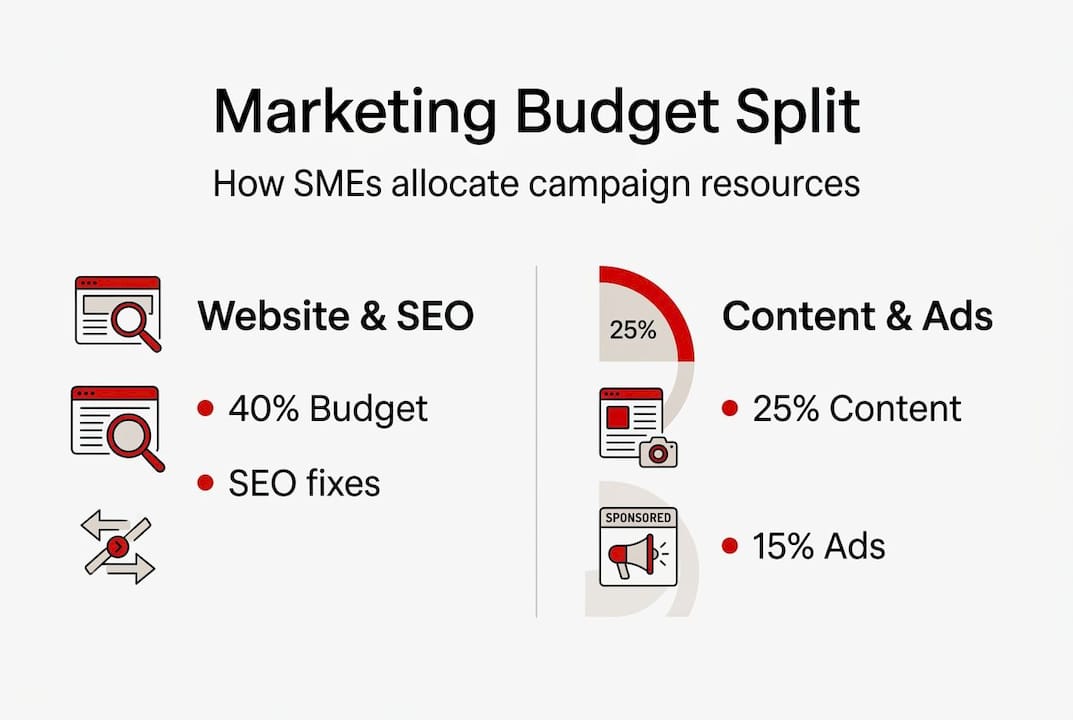
Effective UK SME marketing splits roughly 40% of budget to website and SEO, 25% to content, 15% to paid advertising, and 10% each to social media and email. This is a useful starting point, not a rigid rule.
Before committing spend, run a technical SEO report to ensure your website is ready to receive paid or organic traffic without leaking conversions.
Sample 3-month campaign schedule
| Phase | Month | Activities | Budget share |
|---|---|---|---|
| Foundation | Month 1 | SEO fixes, content creation, email setup | 30% |
| Launch | Month 2 | Paid ads go live, social push, PR outreach | 50% |
| Optimise | Month 3 | A/B testing, retargeting, review and scale | 20% |
For detailed guidance on structuring each phase, marketing campaign phases offers a practical breakdown of how to sequence activity for maximum momentum.
Limit yourself to two to four channels in your first campaign. Spreading resources across six platforms rarely produces strong results for small teams. Depth beats breadth. A Gantt chart or simple project management tool (Trello, Notion, or Asana) will help you keep activity visible and on schedule.
Launching, tracking and optimising your campaign
Once your channels and timeline are mapped, it is time to execute your campaign and ensure it genuinely performs.
Step-by-step launch process:
- Conduct a pre-launch checklist: test all links, landing pages, and tracking pixels
- Set your baseline metrics before day one so you have something to compare against
- Launch in phases if possible, starting with your lowest-risk channel
- Monitor daily for the first two weeks, then shift to weekly reviews
- Use agile sprint cycles (two to four weeks) to review, learn, and adjust
“Measure everything before scaling. Data is not a reporting exercise, it is your competitive advantage.”
Key KPIs to track:
- Leads generated and cost per lead
- Customer acquisition cost (CAC)
- Return on investment (ROI) per channel
- Conversion rate (industry average is 2 to 5%)
- Email open rates and click-through rates
- Website sessions and bounce rate
Track KPIs including leads, CAC, ROI, and conversion rates consistently throughout the campaign. 50% of UK SMBs now use AI for content creation and A/B testing, and agile sprint cycles improve efficiency by 25% compared to traditional monthly review models.
AI tools can accelerate content production, personalise email sequences, and surface insights from your data far faster than manual analysis. Use them to free up time for strategic decisions. For a deeper look at interpreting your results, analytics tracking guidance can help you move beyond surface-level metrics and understand what is actually driving growth.
For further campaign optimisation guidance, focus on the 20% of activities generating 80% of your results and cut what is not contributing.
A smarter approach: what most guides miss about campaign success
Here is the uncomfortable truth most marketing guides will not tell you. The biggest risk for UK entrepreneurs is not running a bad campaign. It is running too many average ones.
Conventional wisdom says you need to be everywhere, posting constantly, running ads on every platform, and chasing every trend. In practice, this approach exhausts small teams and produces mediocre results across the board. The brands we see grow consistently are the ones that choose fewer channels, execute them brilliantly, and build genuine audience relationships over time.
Retention is also chronically undervalued. Acquiring a new customer costs five times more than keeping an existing one, yet most campaign budgets are skewed almost entirely towards acquisition. A well-timed email to your existing customers will often outperform a paid ad to cold traffic.
Failure is also part of the process. The SMEs that grow fastest are not those who avoid mistakes; they are the ones who test quickly, learn from what does not work, and iterate without ego. Use your beyond vanity metrics framework to focus on what genuinely moves the needle rather than likes and impressions.
Fewer, better-executed campaigns beat scattergun approaches every single time. Focus is your most underrated strategic asset.
Supercharge your next campaign with expert support
If you are ready to turn your new campaign knowledge into real results, specialist support can accelerate your journey considerably. At Radka Advertising, we work with UK entrepreneurs and growing brands to build bespoke campaign strategies that are data-driven, creatively sharp, and built for measurable growth. From AI-powered content and SEO to full multi-channel campaign management, our all marketing services are designed to meet you where you are and take you further. Explore our AI growth solutions for smarter, faster campaign execution. Whether you need a free audit or a full strategy build, we offer risk-free entry points to get started without commitment.
Frequently asked questions
What is the most cost-effective marketing channel for UK small businesses?
Email marketing consistently delivers the highest ROI, with every £1 returning up to £42 in revenue, closely followed by Local SEO and a well-optimised Google Business Profile.
How much should I budget for my first marketing campaign?
Allocate between 5 and 15% of your annual revenue as a starting point, with UK SMEs increasing budgets heading into 2026. Startups may need to invest a higher proportion initially to build momentum.
How do I measure if my campaign is successful?
Focus on leads, CAC, ROI, and conversion rates as your primary indicators, and use analytics tools to review performance weekly rather than waiting until the campaign ends.
Do I need to hire an agency or can I run campaigns myself?
Start with DIY foundations to build understanding and control costs, then bring in specialist support when you are ready to scale or need expertise in areas like paid media, SEO, or brand strategy.
Recommended
- Full-Service Advertising Agency — London | Radka Advertising
- ClientPortal | RADKA ADVERTISING
- AI Growth Package — Autopilot SEO & AI Visibility | Radka Advertising
- Services — Full-Service Advertising & Marketing | Radka Advertising
- 7 Essential Steps for an Effective Ad Creatives Checklist - playablemaker.com 7 Essential Steps for an Effective Ad Creatives Checklist