Win 52% More Interaction: Reels & SEO Instagram Content Strategy UK

Adopt a Reels-first content strategy built on one measurable KPI, a repeatable weekly series, and a fortnightly measurement loop. Short-form video under 90 seconds drives up to a 52% higher interaction rate than static posts, so your first task this week is simple: pick your primary KPI, then script one Reel idea you can film and post within 15 minutes using nothing but your phone.
TL;DR:
- Using Reels for reach requires creating engaging hooks in the first three seconds, with looping designs to increase watch time and replays.
- Focus on one primary KPI each quarter, such as link clicks for conversions or saves for consideration, and tailor your content accordingly.
- Building a consistent recurring series, like a weekly Reel or monthly spotlight, outperforms sporadic posts in generating audience habit and engagement.
- Content calendars should balance planned pillars with 20% reactive content, batch production by pillar, and follow flexible industry-recommended ratios like 5-3-1 or 3-2-1.
- Prioritize measuring sends per reach, as sharing signals are the top indicator of content discovery and virality in 2026.
Table of Contents
- What is an instagram content strategy built for growth?
- How Instagram’s surfaces work and which format fits your goal
- Building a content mix and calendar that actually scales
- Creating Reels that actually stop the scroll
- Getting Instagram SEO and your profile right
- Engagement routines and creator collaborations that build community
- Measuring what matters and adjusting the plan
- Tools, workflows and who should own what
- How Radka Advertising applies this playbook
- Author’s perspective: three priorities for 30, 90 and 180 days
- How Radka Advertising can help you run this without the guesswork
- Sources
- FAQ
What is an instagram content strategy built for growth?
An instagram content strategy is the plan that connects a business goal to what you post, when you post it, and how you judge whether it worked. Too many businesses skip straight to “post more Reels” without deciding what the Reels are meant to achieve, and that’s why so many accounts post consistently for months with nothing to show for it beyond a stagnant follower count.
The strategy has three moving parts: goals and audience, format and calendar, and measurement. Get the first part wrong and everything downstream (your Instagram posting strategy, your creative choices, even your caption writing) points at the wrong target.
Turning business goals into Instagram KPIs
Every business goal maps to one primary KPI on Instagram, supported by two others that give you context. A skincare brand chasing sales should track link clicks or website conversions as the primary metric, with saves and shares as supporting signals, since saves indicate purchase intent and shares indicate word-of-mouth potential. A local trades business chasing bookings should track profile visits and DM enquiries first, follower growth second.
Resist the temptation to track everything. Pick one primary KPI per quarter and let it drive your creative decisions. If your primary KPI is reach, you make different content than if it’s saves.
- Awareness goal → primary KPI: reach or accounts reached; supporting: shares, follows
- Consideration goal → primary KPI: saves; supporting: profile visits, comment quality
- Conversion goal → primary KPI: link clicks or DMs; supporting: Story replies, sticker taps
A quick audience persona using Instagram’s own signals
You don’t need a market research agency to build a working persona. Instagram tells you who is already engaged, if you look.
Check your Insights for the demographics of your current followers (age, location, active hours), then cross-reference that against the hashtags and accounts your best customers already follow. Look at what they save, not just what they like, because saved content reveals intent rather than passive scrolling. A gym owner might discover their most engaged followers save workout-breakdown Reels but never comment on motivational quote posts, which tells you exactly what to make more of.
Build a one-paragraph persona: who they are, what problem they’re solving, which format they already respond to, and what would make them share your content with a friend. That last question matters more than most businesses realise, because shares and sends are among the strongest ranking signals on Instagram in 2026.
Prioritising goals when resources are tight
If you can only manage one content type well, choose Reels for reach and Stories for relationship-building, and treat feed posts as a slower third priority. Most small teams overcommit to a content mix they can’t sustain, then abandon the whole plan by month two. Better to do two formats consistently than five formats sporadically.
How Instagram’s surfaces work and which format fits your goal
Instagram isn’t one algorithm. It’s four separate ranking systems, one each for Feed, Reels, Stories, and Explore, and each rewards different behaviour, according to Buffer’s breakdown of how the algorithm actually works. Treating every surface the same way is the single most common mistake in an Instagram Reels strategy.
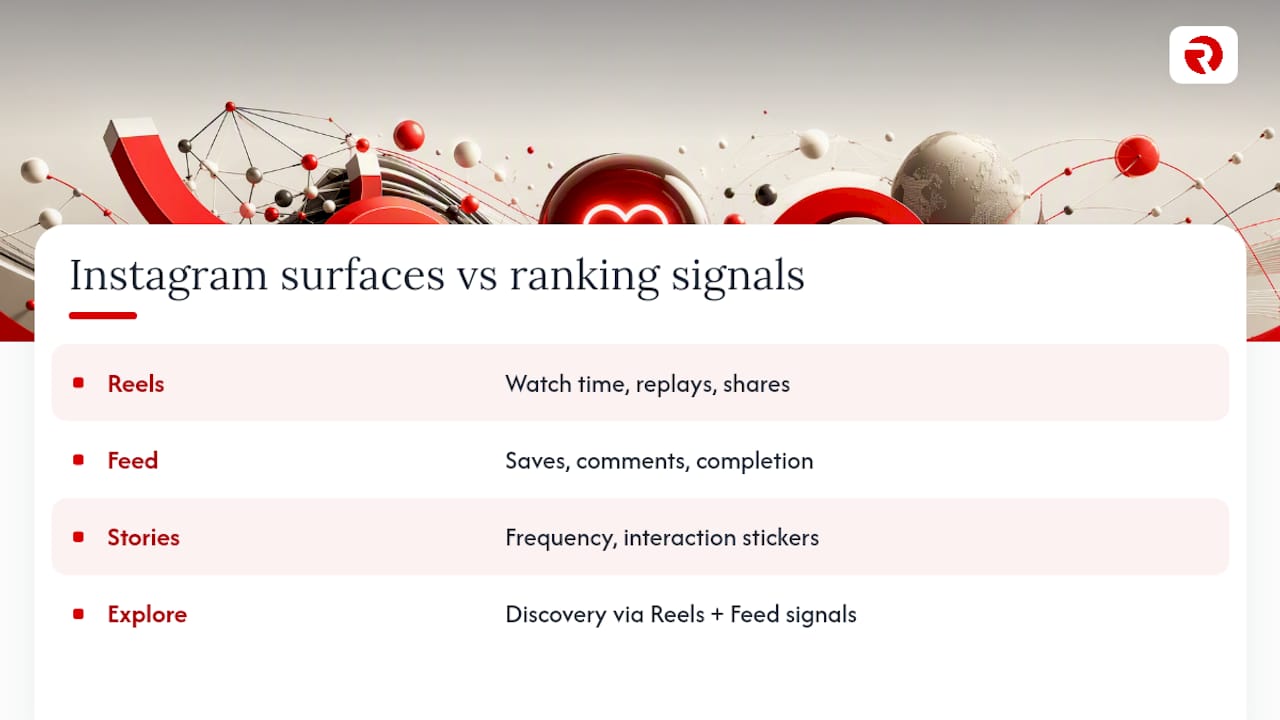
Reels rewards watch time, replays, and shares, and is built for reach beyond your existing followers. It’s the surface Instagram most wants to grow, which is why it rewards originality so heavily.
Feed posts (static images and carousels) reward saves and comments, and perform best with audiences who already follow you. Carousels in particular reward completion rate, meaning someone swiping through all the slides.
Stories reward frequency and interaction stickers (polls, questions, sliders), and are the best surface for relationship maintenance rather than discovery. They disappear after 24 hours, which lowers the pressure to make them polished.
Live and Explore function differently again. Live rewards real-time interaction and notifies your most engaged followers, while Explore surfaces content based on a mix of Reels and feed performance signals, effectively acting as a discovery layer on top of the other three.
Matching format to campaign goal
Use this as a working checklist before you plan any content:
- Want reach or new followers? Lead with Reels. Static posts rarely travel beyond people who already follow you.
- Want deeper trust with an existing audience? Use carousels with genuinely useful, saveable information.
- Want quick feedback or product validation? Use Story polls and question stickers.
- Want to convert warm interest? Use Stories with swipe-up links or DM prompts, paired with a pinned feed post that answers objections.
- Want to demonstrate expertise? Use Live sessions or long-form carousels that reward saves.
The pattern that trips up most UK marketers is treating Reels for business as a vanity metric play, then wondering why reach doesn’t convert. Reach is the top of the funnel. It needs a Story or feed follow-up to do the conversion work, which is why your format choices should never live in isolation from each other.
Building a content mix and calendar that actually scales
Content-mix frameworks like the 5-3-1 rule, the 3-2-1 variant, and the 80/20 split aren’t platform rules Instagram enforces. They’re marketing shorthand, useful defaults you adapt to your posting frequency and audience rather than follow rigidly.
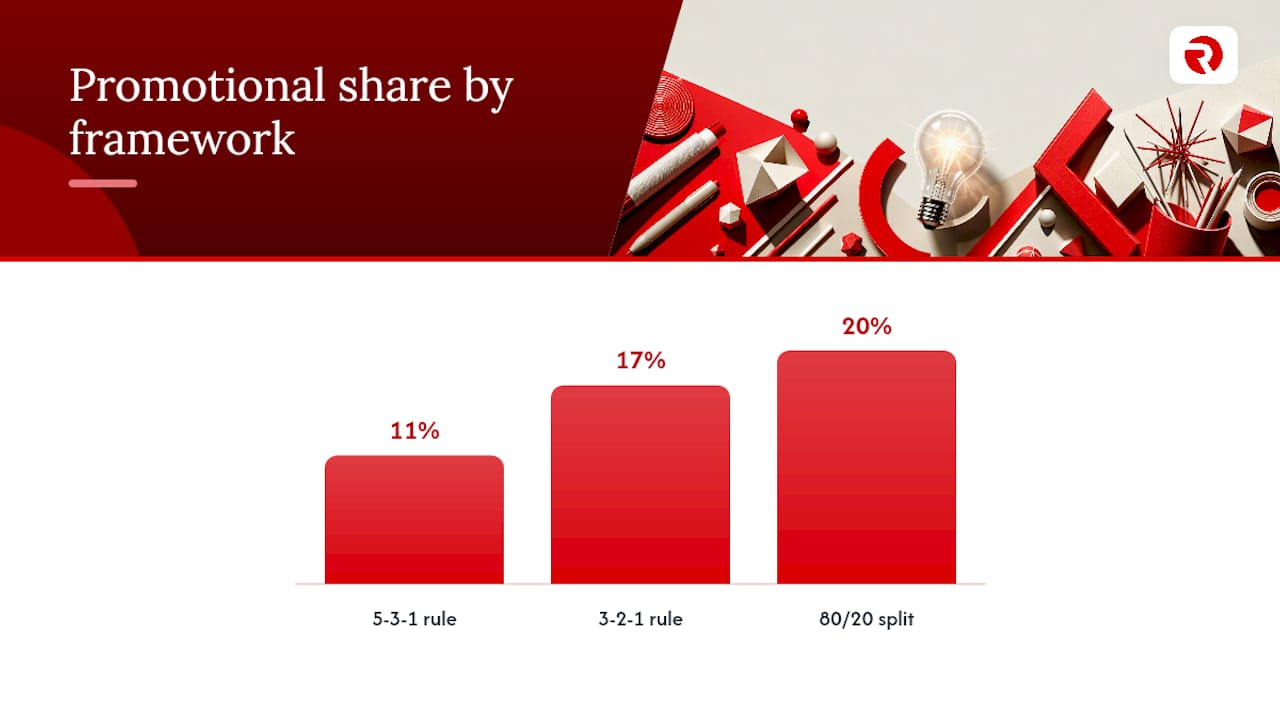
The 5-3-1 rule suggests five pieces of curated or educational content, three original pieces showing personality or process, and one direct promotional post, out of every nine posts. The 3-2-1 rule compresses that into three educational, two entertaining, one promotional. All three exist to stop businesses from turning their grid into a catalogue, which is the fastest way to lose followers.
Pick whichever ratio matches your posting cadence, then build it into themed content pillars rather than treating each post as a standalone decision.
- Choose three to four content pillars. For a bakery: process/behind-the-scenes, product showcase, customer moments, and educational tips (storage, pairing, seasonal use).
- Assign pillars to formats. Behind-the-scenes suits Reels and Stories. Product showcase suits carousels and static posts. Educational content works well as carousels that get saved.
- Build a recurring series. A weekly “how it’s made” Reel or a monthly customer spotlight gives your audience a reason to expect and return for specific content, which builds habit far faster than one-off posts.
- Batch by pillar, not by day. Film all your behind-the-scenes footage in one session, write all your captions in another. This is the single biggest time-saver for small teams.
- Leave 20% of the calendar unplanned. Trend-jacking and reactive content need space; a calendar that’s 100% pre-scripted a month out can’t respond to what’s actually working.
Instagram’s own Creator Lab guidance reinforces this: sustainable content plans balance format variety with enough structure that the audience knows what to expect from you.
A sample five-post weekly calendar
| Day | Format | Pillar | Goal |
|---|---|---|---|
| Monday | Reel | Behind-the-scenes | Reach |
| Wednesday | Carousel | Educational | Saves |
| Thursday | Story series | Customer moments | Engagement |
| Friday | Reel | Product showcase | Reach + saves |
| Sunday | Static post | Promotional | Conversion |
Five posts a week is sustainable for most small teams without an in-house creative department. Scaling up to seven or more should only happen once this rhythm feels easy, not before.
Creating Reels that actually stop the scroll
The first three seconds decide whether someone watches your Reel or swipes past it, and that window is unforgiving. Open with motion, a bold on-screen question, or a visual that contradicts expectation, never with a slow logo intro or a static “let me tell you about” setup.
Design every Reel to work with the sound off first, then treat audio as a layer on top. Most people scroll with sound muted, especially in public or at work, so captions and on-screen text need to carry the message alone. If your Reel only makes sense with narration playing, you’ve built it backwards.
Length matters less than looping. A Reel that ends on a frame or phrase that naturally returns to its opening increases replays, and Hootsuite’s analysis of the algorithm notes that small structural edits like this can noticeably shift distribution. Fifteen to thirty seconds tends to be the sweet spot for most business content: long enough to deliver value, short enough to loop cleanly.
Pro Tip: End your Reel with the exact visual or phrase you opened with. A cropped-in version of your opening shot, repeated at the final frame, tricks the eye into a seamless loop and quietly boosts watch time.
Originality rules you can’t afford to ignore
Instagram actively down-ranks recycled video carrying another platform’s watermark, according to Hootsuite’s algorithm breakdown. If you’re repurposing a TikTok, re-export it clean, crop out the logo, and re-edit the pacing for Instagram’s audience rather than reposting it as-is. This single fix recovers reach that businesses lose without realising why their numbers dropped.
Shareability is the mechanic most businesses under-invest in. A Reel earns sends when it makes the viewer think of a specific person, not just when it’s generically funny or nice to look at. Build that into your creative brief directly:
- Ask a question in your caption that only makes sense to forward to someone specific (“send this to the friend who always cancels plans”).
- Design carousels people save as reference material, not just admire once.
- Include a clear “tag someone who…” or “save this for later” prompt rather than assuming the viewer will think of it themselves.
Shares and saves carry real ranking weight in 2026, so a prompt that costs you one line of caption can be the difference between a Reel that plateaus at your follower count and one that reaches thousands beyond it.
Getting Instagram SEO and your profile right
Instagram now behaves like a search engine, and UK-focused platform analysis confirms that optimising for discoverability matters more than chasing hashtags alone. That means your bio, name field, and captions all need to work as search copy, not just branding.
- Name field: include a keyword alongside your brand name (e.g. “Marlowe & Co | London Interior Design” rather than just “Marlowe & Co”). This field is searchable text, unlike your @handle.
- Bio: state clearly who you help and how, using the actual words your audience searches for.
- Alt text: add descriptive alt text to every post via the accessibility settings, since it feeds Instagram’s understanding of what the image shows and helps screen-reader users too.
- Captions: open with a direct answer to a likely question, then expand. Someone searching “best coffee shop for working, London” is more likely to find a caption that states the answer plainly than one that opens with a story.
Captions that answer, Highlights that funnel
Structure captions like a mini-FAQ: state the point in the first line, because Instagram truncates captions after roughly two lines and most people never tap “more”. Save the storytelling for the second half, once you’ve already delivered the value that earns the save.
Highlights should function as a menu, not a scrapbook. Group them by customer intent (FAQs, Reviews, How We Work, Book Now) rather than by date or event, so a new visitor can navigate your profile the way they would navigate a website. Pin your best-converting post to the top of your grid, and treat your single bio link as prime real estate. A link-in-bio tool that routes to specific pages performs better than a flat homepage link, particularly if you’re running multiple campaigns at once.
Engagement routines and creator collaborations that build community
Fifteen minutes of genuinely targeted engagement each day beats an hour of generic activity. Reply to every comment on your last three posts, comment meaningfully on five accounts in your niche, and respond to every Story mention within the hour. Instagram’s ranking systems weigh sincere, specific engagement far more heavily than blanket like-and-run activity, and sincerity is also what turns a casual follower into an advocate.
- Reply to comments with a question back, not just a thank you, to keep the thread alive and signal genuine interaction.
- Engage with accounts that follow you before you post something new, since recent interaction increases the odds they see it.
- Use Story polls and quizzes weekly purely to keep your account in the “frequently interacted with” bracket for your existing audience.
Briefing micro-influencer collaborations properly
Micro-influencers (typically 5,000 to 50,000 followers) tend to deliver stronger engagement rates than larger accounts, because their audience trusts them like a friend rather than a broadcaster. A working brief needs three things: the specific outcome you’re measuring (saves, link clicks, or promo code redemptions), creative freedom within brand guardrails, and a clear usage-rights agreement covering how long and where you can repost their content.
Measure the collaboration against the same KPI you’d use for your own content, not against follower count. A creator with 8,000 followers who generates fifty saves has outperformed one with 80,000 followers who generates the same fifty saves, because reach without action doesn’t move your business forward.
For user-generated content, always request explicit written permission before reposting, even when someone tags you. A simple DM asking “can we share this to our grid, credited to you?” protects you and usually flatters the customer enough that they say yes immediately.
Measuring what matters and adjusting the plan
The metric with the highest ranking weight for discovery in 2026 is sends per reach: the proportion of people who see your content and then send it to someone else. It matters more than likes, more than comments, and arguably more than saves, because it’s the clearest signal that content is genuinely worth someone else’s time.
Every creative experiment should carry a shareability hypothesis before you post it, not after. Ask “why would someone send this?” at the brief stage, then check whether the sends-per-reach data actually confirms your guess.
- Set your KPI hierarchy before the month starts. One primary metric, two supporting ones, agreed in advance so you’re not moving the goalposts after a post underperforms.
- Run two-week A/B tests, not single-post guesses. Post three variations of a format (different hooks, different lengths, different captions) across two weeks, then compare sends-per-reach and saves across the set, not individual posts.
- Report on a fortnightly cadence. Weekly is too noisy for small accounts; monthly is too slow to catch a format that’s underperforming.
- Keep an experiment log. A simple spreadsheet with hypothesis, format, result, and next action turns scattered posting into a compounding body of evidence about what your specific audience responds to.
Statistic to anchor your benchmarks: Short-form video under 90 seconds drives up to a 52% higher interaction rate than static content. If your Reels aren’t clearing that kind of uplift against your own static posts, the format isn’t the problem: the hook, the pacing, or the sound-off design usually is.
Tools, workflows and who should own what
You don’t need enterprise software to run a serious Instagram content plan, but you do need five functions covered somewhere: planning, editing, analytics, social listening, and creator management. A solo business owner can cover all five manually with a shared calendar, a mobile editing app, and native Insights. A small team usually splits planning and analytics under one person and editing under another, while an agency model assigns a dedicated lead to each function.
- Planning: a shared content calendar (even a spreadsheet works) mapped to your content pillars.
- Editing: mobile-first editing apps designed for vertical video, since desktop-edited content often looks visibly out of place on Reels.
- Analytics: native Instagram Insights for the basics, layered with a third-party analytics tool once you’re posting across multiple accounts or need historical comparison beyond Instagram’s own 90-day window.
- Listening: manual hashtag and competitor tracking at small scale; dedicated social listening tools once volume grows.
- Creator management: a simple spreadsheet tracking briefs, deliverables, and usage rights is enough until you’re running more than a handful of collaborations a month.
AI earns its place in social intelligence, meaning pattern analysis, audience insight synthesis, and performance reporting, rather than as a wholesale replacement for human-made short-form content, since UK audiences consistently respond better to authentic, creator-led formats than polished, obviously automated ones. A platform like reflects this shift: using AI to surface what’s actually working in your data, so your team spends its creative energy on the Reels themselves rather than the reporting around them.
How Radka Advertising applies this playbook
Radka Advertising builds Instagram content strategy around the same sequence covered in this guide: define the KPI, choose the surface, build the calendar, then measure sends and saves rather than vanity metrics. That structure runs through the agency’s broader case study portfolio, where brand and social work sit inside a single strategic plan rather than as disconnected deliverables.
The pattern holds across sectors: a content mix built around three to four pillars, a Reels-first posting rhythm, and a fortnightly reporting loop that adjusts creative direction based on what sends-per-reach data actually shows, not what the team assumed would perform.
Three takeaways worth implementing this week, regardless of who runs your account:
- Pick one KPI before you plan a single post. Everything else in the strategy should serve that number.
- Script your hook before you script the rest of the Reel. If the first three seconds don’t earn attention, nothing after it matters.
- Build one recurring series. A weekly format your audience learns to expect outperforms a feed of unrelated one-off posts, almost every time.
Author’s perspective: three priorities for 30, 90 and 180 days
Most Instagram strategies fail from overreach, not underinvestment. In the first 30 days, your only job is picking one KPI and posting one consistent Reel series, nothing more. Businesses that try to nail Reels, Stories, carousels, and influencer outreach simultaneously in month one usually abandon all four by month two.
By 90 days, shift focus to your content mix and calendar discipline: batch-produce, assign pillars to formats, and start running proper two-week experiments rather than judging single posts. This is also when Instagram SEO work (bio, alt text, caption structure) starts compounding, because search-style discovery takes longer to show results than viral reach does.
By 180 days, the priority becomes creator collaborations and a genuine measurement rhythm, because you’ll finally have enough data to brief influencers against real benchmarks rather than guesses.
The biggest pitfall I’d flag: businesses chase reach metrics long after they’ve proven the format works, instead of redirecting budget toward conversion and retention once awareness is established. Reach is a means, not the goal itself.
— Bart
How Radka Advertising can help you run this without the guesswork
Some agencies offer an alternative to hiring a full in-house social team for businesses that want a strategic Instagram content plan without carrying the overhead of dedicated staff. Where a DIY approach means one person juggling planning, filming, editing, and reporting alone, Radka’s Social Media Management service covers the full workflow, from KPI setting through to fortnightly performance reviews, at £350 per month.
For businesses that also need original photography, videography, or scripted Reel content rather than relying on in-house filming, Content Creation sits at £400 per month, and pairs naturally with the Social Media Management service for teams that want both strategy and production handled together. If your priority is faster, AI-informed audience analysis layered on top of organic content, the AI Growth Package is worth a look, with pricing available on request.
A sensible first step is an audit: a short review of your current profile, format mix, and KPI setup against what’s actually working in your data. From there, clients often move into a small pilot series before scaling. Explore Radka Advertising’s full service list to see where a managed approach fits your business.
Sources
- Instagram algorithm tips for 2026: Everything you need to know — Sprout Social
- How the Instagram algorithm works (Hootsuite)
- How the Instagram algorithm works — Later
- Build your content creator strategy — Instagram Creators
FAQ
What Is the 5-3-1 Rule on Instagram?
The 5-3-1 rule suggests posting five curated or educational pieces, three original personality-driven pieces, and one promotional post out of every nine, as a rough content-mix guideline rather than a platform-enforced rule. It works best as a starting ratio you adjust once you see which pillar actually drives your primary KPI.
What Is the 3-2-1 Rule in Instagram Marketing?
The 3-2-1 rule compresses the same idea into three educational posts, two entertaining posts, and one promotional post per cycle. It suits businesses posting less frequently, since it needs fewer total posts to complete a full rotation than the 5-3-1 version.
What Is the 4-1-1 Rule on Instagram?
The 4-1-1 rule (borrowed from broader social media marketing rather than Instagram specifically) recommends four value-driven or entertaining posts for every one soft promotion and one hard promotion. Like the other ratios, treat it as a flexible default rather than a fixed formula, and adapt it to how your specific audience responds over time.
What Is the 5-5-5 Rule for Social Media?
Definitions of the 5-5-5 rule vary across marketing sources, and there isn’t one settled version. Some use it to describe spending five minutes engaging, five minutes creating, and five minutes analysing each day; treat any version you encounter as a rough discipline habit rather than an Instagram-specific standard.
How Do I Know if My Instagram Content Strategy Is Working?
Track your primary KPI against a fortnightly benchmark, not a single post’s performance, since one viral Reel can distort a weekly view. Sends-per-reach and saves are the strongest early indicators that your content is earning distribution beyond your existing followers.
Does Radka Advertising Offer Instagram Content Strategy Services?
Yes. Radka Advertising’s Social Media Management service covers Instagram content strategy, including goal setting, content planning, and reporting, priced at £350 per month. Content Creation support is available separately at £400 per month for businesses needing original photography or video production.