IMC in marketing: a 2026 strategy guide

TL;DR:
- Integrated marketing communications (IMC) unifies brand messaging across channels to improve campaign performance. Success depends on message consistency, channel synergy, leadership, and unified data infrastructure. Organizations that adopt IMC principles outperform siloed marketing through higher ROI and stronger brand trust.
Integrated marketing communications (IMC) is defined as the strategic coordination of all marketing messages, channels, and tools to deliver a single, unified brand experience to every customer. Where traditional marketing treats advertising, PR, social media, and direct mail as separate disciplines, IMC in marketing treats them as one interconnected system. Companies using IMC strategies report 20 to 35% higher campaign performance, a figure that reflects what happens when message consistency, channel synergy, and timing coordination work together rather than against each other. For any business serious about brand equity and measurable ROI, understanding integrated marketing communication is no longer optional.
What are the core components and benefits of IMC in marketing?
IMC integrated marketing rests on three interdependent pillars: message consistency, channel synergy, and timing coordination. The effectiveness of any campaign can be understood through a simple formula: (Message Consistency × Channel Synergy × Timing Coordination) ÷ Budget Allocation. When any one of those variables drops, the whole equation suffers.

Message consistency means your audience receives the same core brand promise whether they encounter you on a billboard, a Google Search ad, or an Instagram Story. The most consistent brands increase trust and conversion rates by maintaining a unified brand voice, visuals, and value proposition across every touchpoint. This matters because a consumer who sees a confident, premium message on LinkedIn and then lands on a discount-heavy email campaign experiences cognitive dissonance. That dissonance erodes trust faster than any competitor can.
Channel synergy is where the financial case for IMC becomes undeniable. Integrated campaigns generate up to 30% higher ROI than siloed marketing, with each additional coordinated channel amplifying the returns of those already in play. Think of it as a flywheel: the fifth pound spent on a coordinated IMC campaign yields more return than the first, because each channel reinforces the others rather than competing for attention.
The table below illustrates the performance gap between integrated and traditional siloed approaches.
| Metric | Integrated marketing (IMC) | Traditional siloed marketing |
|---|---|---|
| Campaign ROI | Up to 30% higher | Baseline |
| Brand recognition | Significantly improved | Inconsistent |
| Message alignment | Unified across channels | Varies by department |
| Attribution clarity | Multi-touch, measurable | Single-channel, limited |
| Customer experience | Coherent across touchpoints | Fragmented |
Pro Tip: Map every customer touchpoint before launching any campaign. If your paid social creative, email subject line, and landing page headline do not share the same core message, you are running three separate campaigns with one budget.
How does IMC differ from multichannel and omnichannel marketing?
These three terms are used interchangeably in most boardrooms, but they describe fundamentally different approaches. Getting the distinction right shapes how you allocate budget and structure your teams.
Multichannel marketing means a brand is present on multiple platforms, such as email, social media, and paid search, but each channel operates with its own strategy, creative, and KPIs. There is little coordination between them. A customer might receive a promotional offer via email on the same day your paid search ad positions the brand as a premium provider. The channels exist in parallel, not in dialogue.
Omnichannel marketing goes further by prioritising a seamless customer experience across all channels. The focus is on removing friction from the customer journey so that switching from a mobile app to a physical store feels effortless. However, omnichannel does not necessarily demand message alignment. A retailer can offer a frictionless purchase experience while still running inconsistent brand narratives across channels.
IMC communications sit in a distinct position. The primary focus is on unified messaging and strategic integration, not just channel presence or journey smoothness. The comparison below clarifies where each approach places its emphasis.
| Approach | Primary focus | Message alignment | Channel coordination |
|---|---|---|---|
| Multichannel | Channel presence | Low | Minimal |
| Omnichannel | Customer experience | Medium | High (experience-led) |
| IMC | Unified messaging | High | Strategic and deliberate |
IMC does not replace omnichannel thinking. The strongest marketing operations combine both: the message discipline of IMC with the experience architecture of omnichannel.
What are the main challenges when implementing an IMC strategy?
The biggest obstacle to IMC is not technology. It is organisational structure. Most marketing departments are built around channels, with separate teams for paid media, content, social, and email. Each team has its own budget, its own metrics, and its own definition of success. Siloed budgets and departmental conflicts require top-down mandates that prioritise brand equity over individual channel metrics. Without that mandate from leadership, IMC remains a slide in a strategy deck rather than a functioning system.
Data fragmentation compounds the structural problem. Analysts spend 60% of their time manually reconciling data from tools like GA4 and Meta due to inconsistent attribution windows and mismatched customer IDs. That is time not spent on optimisation or insight generation. A unified data architecture, where all channel data flows into a single source of truth, is a prerequisite for real-time IMC performance management.
AI adoption introduces a newer challenge. Agentic platforms like Salesforce Agentforce and HubSpot Breeze can now execute campaigns autonomously, generating content and making bidding decisions without human approval at every step. The risk is that AI platforms increase content volume while undermining message consistency. Human oversight within IMC frameworks keeps consistency scores above 90%, but that oversight requires governance structures most organisations have not yet built.
The practical steps to address these challenges include:
- Appoint a senior leader with cross-departmental authority as the IMC owner, not a channel manager
- Establish shared KPIs that measure business outcomes such as ROAS and customer lifetime value, not channel-specific vanity metrics
- Invest in a unified data infrastructure before scaling AI-generated content
- Create a brand governance document that defines tone, visual standards, and message hierarchy for every channel
- Run quarterly cross-functional reviews where paid, organic, PR, and product teams align on upcoming campaigns
Pro Tip: Before adopting any AI content tool, test its output against your brand governance document. If the tool cannot reliably produce on-brand copy without manual editing, the time saved in generation is lost in review.
How can technology and AI enhance IMC in the 2026 marketing landscape?
Technology does not create IMC. It scales it. The distinction matters because many organisations invest in marketing technology stacks before they have a coherent message architecture, and the result is faster production of inconsistent content.
Modern consumers expect hyper-personalisation across eight or more touchpoints, which makes manual coordination of every message impossible at scale. This is where platforms like Improvado, HubSpot, and Salesforce earn their place in an IMC framework. Improvado aggregates cross-channel performance data into a single dashboard, removing the manual reconciliation burden. HubSpot Breeze and Salesforce Agentforce automate campaign execution, but both require brand guardrails to function within an IMC framework rather than outside it.
The technology priorities for IMC in 2026 are:
- A unified customer data platform (CDP) that resolves identity across channels and devices
- Marketing automation tools configured to enforce message consistency, not just trigger sequences
- AI content generation tools operating within defined brand guidelines, reviewed by a human editor before publication
- Multi-touch attribution modelling to measure the contribution of each channel to a conversion, replacing last-click thinking
- Integrated analytics tools that connect paid, owned, and earned media performance in one view
The balance between AI acceleration and human oversight is the defining IMC challenge of 2026. AI handles volume and personalisation at scale. Human strategists handle brand coherence and creative judgement. Neither replaces the other. Radkaadvertising’s approach to AI-driven growth reflects this balance, using technology to amplify strategy rather than substitute for it.
What practical steps should businesses take to develop an IMC strategy?
A functional IMC strategy follows a clear sequence. Skipping stages, particularly the research and message architecture phases, is the most common reason campaigns underperform despite significant investment.
-
Conduct a communications audit. Review every active channel and piece of content. Identify where messages conflict, where brand voice is inconsistent, and where channel teams are working at cross-purposes. This audit becomes the baseline against which you measure improvement.
-
Build a three-tier message architecture. A three-tier architecture balances core brand pillars with channel-specific creative execution. Tier one is the non-negotiable brand promise. Tier two is the campaign narrative that supports it. Tier three is the channel-specific execution, where tone and format adapt to the platform while the core message remains constant.
-
Define integrated KPIs before launch. Unified cross-channel KPIs and leadership accountability are what shift focus from channel performance to business outcomes. Metrics should include customer journey completion rates, message consistency scores, and ROAS across the full campaign, not per channel.
-
Assign cross-functional ownership. Each campaign needs a lead who has authority over all contributing teams. Without this, the default is for each channel team to optimise for its own metric, which fragments the campaign.
-
Plan channel sequencing deliberately. IMC synergy works because advertising raises awareness, PR adds credibility, and direct marketing drives conversions. These functions are most powerful when sequenced, not run simultaneously without coordination.
-
Measure, attribute, and refine. Use multi-touch attribution to understand which channel combinations drive the highest-value conversions. Review performance reports at the campaign level, not the channel level. Adjust budget allocation based on synergistic performance, not individual channel ROI.
The brand consistency research supporting IMC is clear: organisations that maintain unified brand voice and visuals across touchpoints outperform those that do not on both trust and revenue metrics. The practical steps above are how that consistency is built and sustained.
Key takeaways
IMC in marketing succeeds when message consistency, channel synergy, and leadership accountability operate as a single system, not as separate initiatives.
| Point | Details |
|---|---|
| IMC outperforms siloed marketing | Integrated campaigns deliver up to 30% higher ROI through channel reinforcement. |
| Message architecture is foundational | A three-tier structure keeps brand pillars constant while allowing channel-specific adaptation. |
| Leadership drives adoption | A senior IMC owner with cross-departmental authority is the single most important structural decision. |
| Data unification precedes AI scaling | Unified data infrastructure must exist before AI tools can support consistent IMC execution. |
| Measurement must be campaign-level | Multi-touch attribution and integrated KPIs replace channel-specific metrics for accurate performance analysis. |
Why IMC is the discipline most marketing teams are not actually practising
I have reviewed marketing strategies for brands across retail, energy, and consumer goods, and the pattern is consistent. Every team claims to do integrated marketing. Almost none of them do. What they actually run is coordinated scheduling: the same campaign assets pushed out across channels on the same week, with each channel team still optimising for its own metric.
Real IMC requires something most organisations find genuinely uncomfortable, which is giving up channel ownership in favour of campaign ownership. The paid media manager does not want to be told that their channel’s ROAS looks weak because it is doing awareness work for a conversion campaign running in email. But that is exactly the trade-off IMC demands.
The skills gap is also real. Fragmented marketing skills no longer suffice; success requires blending data analytics and creativity in ways that most specialists have not been trained to do. The best IMC practitioners I have worked with are not the deepest channel experts. They are the people who can read a data dashboard and write a creative brief in the same afternoon.
My honest view is that AI will accelerate this problem before it solves it. Agentic platforms will make it easier to produce more content across more channels faster than ever. Without a strong IMC framework in place first, that means more inconsistency at greater speed. The organisations that invest in message architecture and governance now will be the ones who can actually use AI as a multiplier rather than a liability.
— Bart
How Radkaadvertising supports your IMC strategy
Radkaadvertising works with businesses and marketing teams that are ready to move from channel-by-channel execution to genuinely integrated campaigns. The agency’s client onboarding process is structured around building a unified message architecture before any creative work begins, so every channel operates from the same strategic foundation. For teams that need to understand where their current communications are fragmenting, a marketing audit identifies the gaps between what your brand says and what your audience actually receives. Explore the Radkaadvertising case studies to see how this approach has delivered measurable results for clients across diverse sectors.
FAQ
What is IMC in marketing?
IMC in marketing is the strategic coordination of all marketing channels and messages to deliver a consistent brand experience. Companies using integrated marketing communications report 20 to 35% higher campaign performance compared to siloed approaches.
How does IMC differ from traditional marketing?
Traditional marketing treats channels independently, with separate strategies and metrics for each. IMC integrated marketing coordinates all channels under a unified message architecture, producing synergistic returns rather than isolated results.
What are the main benefits of integrated marketing communication?
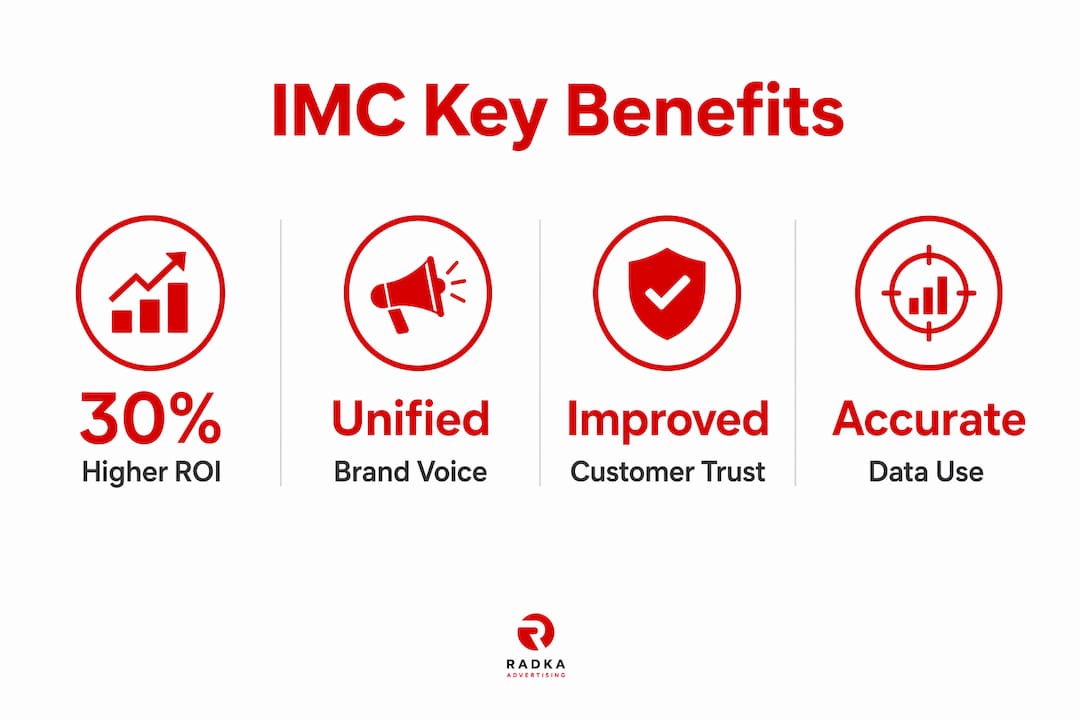
The primary benefits include up to 30% higher ROI, stronger brand recognition, improved customer trust, and more accurate performance attribution across the full campaign rather than individual channels.
Which tools support IMC strategy implementation?
Platforms like Improvado, HubSpot, and Salesforce support IMC execution by unifying data, automating campaign delivery, and enabling multi-touch attribution. A unified customer data platform is the foundational requirement before any of these tools can function effectively within an IMC framework.
How do you measure IMC effectiveness?
Effective measurement combines message consistency scores, customer journey completion rates, and ROAS at the campaign level. Multi-touch attribution modelling replaces last-click analysis to reflect the contribution of each channel to overall business outcomes.