How to build global campaigns that actually scale

TL;DR:
- Successful global campaigns maintain a consistent brand core while adapting to local markets through governance, localization, and workflow design. Prioritizing markets, assigning clear ownership, and choosing centralized digital tools enable coordinated local execution without sacrificing brand integrity. Regular audits and measurement ensure ongoing improvement and alignment across regions.
Global campaigns are defined by their ability to maintain a consistent brand core while adapting creatively and operationally to local markets. The difference between a campaign that resonates in Tokyo and one that falls flat in São Paulo is rarely budget. It is governance, localisation, and workflow design. Knowing how to build global campaigns means constructing a scalable system, not just translating an advert. Brands like Coca-Cola and Maybelline succeed internationally because they treat localisation as a structural discipline, not a last-minute task. This guide gives marketing professionals and business owners the frameworks to do the same.
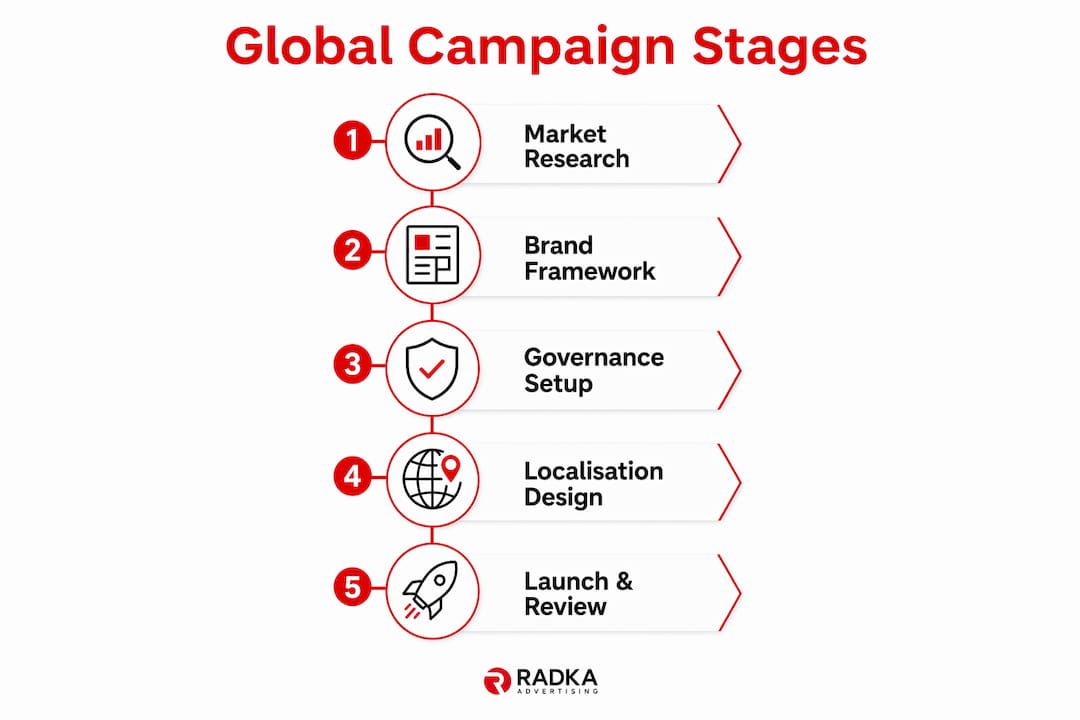
How to build global campaigns: strategic planning first
Every successful international campaign begins with a decision about where to compete. Prioritise markets based on three criteria: addressable market size, growth trajectory, and brand fit. Entering five markets simultaneously with thin resources produces mediocre results in all five. Entering two markets with depth produces results you can replicate.
Once you have selected your markets, map your brand elements into three categories. Global brand frameworks define which elements are globally fixed, regionally customisable within limits, or locally owned outright. Your logo, core colour palette, and brand voice are fixed. Tagline tone and channel mix are regionally customisable. Promotional timing and cultural references are locally owned.
Governance mapping follows directly from this. Assign ownership and decision rights at each level before a single asset is created. Without this, regional teams make inconsistent calls, and brand standards erode quietly over months.
Technology selection is the final planning step. You need a platform that centralises asset access, tracks version control, and enforces compliance. Tools like Marq for brand management and monday.com for workflow coordination are built for this purpose. Choose your stack before your campaign brief, not after.
- Identify 2–3 priority markets before allocating creative budget
- Map brand elements into fixed, flexible, and local categories
- Assign governance ownership at global, regional, and local levels
- Select a centralised digital asset management platform
- Build asynchronous handoff protocols into your workflow model from day one
Pro Tip: Create a one-page governance map that shows every team member who approves what and at which stage. Distribute it before the campaign brief lands. Ambiguity at the planning stage costs ten times more to fix during execution.
How do you design campaigns that localise without losing brand integrity?
Template design is where most global campaigns either succeed or fail structurally. A template engineered for localisation accounts for language direction (right-to-left for Arabic, left-to-right for Latin scripts), character count expansion in German or Finnish, and date format conventions. Build these variables into your master templates before any regional team touches them.

Marketing localisation involves adapting not just language but tone, timing, channel use, and cultural messaging to fit local market expectations. This distinction matters enormously. A campaign translated word-for-word from English to Japanese will read as foreign and cold. A campaign transcreated for Japanese audiences, with adjusted formality levels and visual hierarchy, will perform differently in every measurable way.
Integrate translation and transcreation workflows at the brief stage, not post-production. Campaigns built with localisation integrated from the start scale more smoothly and avoid last-minute issues. Retrofitting localisation onto a finished campaign costs more in time, money, and brand consistency than building it in from the outset.
Compliance requirements follow the same logic. Compliance must be treated as a design variable, not an afterthought, to prevent costly regulatory risks in global campaigns. In the EU, financial services advertising carries specific disclosure requirements. In the UAE, imagery and messaging standards differ from Western norms. Encode these as conditional variables in your templates so regional teams cannot accidentally publish non-compliant content.
| Approach | Outcome |
|---|---|
| Translation only | Literal accuracy, cultural mismatch, lower engagement |
| Transcreation | Cultural resonance, higher engagement, stronger brand recall |
| Template with localisation variables | Consistent brand, faster regional rollout, fewer compliance errors |
| Post-production localisation | Delays, higher cost, inconsistent brand application |
Centralised digital asset management enables all markets to find approved files quickly and maintain version control, reducing brand risk. Platforms that combine asset libraries with approval workflows mean regional teams always work from the correct, approved version. This removes the single most common source of brand drift in global campaigns.
Pro Tip: Build a localisation brief template that sits alongside your creative brief. It should specify approved tone variants, restricted imagery, compliance requirements, and preferred transcreation partners for each market. Teams that receive this document produce better work faster.
What operational frameworks keep global teams coordinated?
Execution at scale requires structure that does not depend on everyone being awake at the same time. Asynchronous workflows with automated handoff tools significantly improve global campaign efficiency and reduce employee burnout compared to synchronous meetings. A team in London finishing their day should be able to hand off to a team in Singapore without a live call.
Build your operational model around these five principles:
- Define regional versus global responsibilities in writing. Every task should have a named owner at the global or regional level. Shared ownership is no ownership.
- Automate approval workflows with compliance gates. Legal and regulatory sign-off should be a system step, not a calendar request. Platforms like monday.com allow you to build conditional approval chains that route content to the correct reviewer automatically.
- Set asynchronous communication standards. Agree on response windows, update formats, and escalation paths. A regional team in Sydney should not be waiting on a London sign-off that could have been pre-approved through a workflow rule.
- Audit middle management layers quarterly. Brand standards degrade most often in the regional management layer. Quarterly audits of this layer catch inconsistencies before they compound into campaign-wide brand drift.
- Balance autonomy with oversight. Governance frameworks empower regional teams to make local adaptations within brand parameters, balancing control and creativity. Over-controlling regional teams kills local relevance. Under-controlling them produces brand chaos.
The most effective global teams treat their workflow platform as a single source of truth. Every brief, asset, approval, and deadline lives in one place. This removes the email chains, version confusion, and missed handoffs that derail campaigns across time zones.
How do you measure and improve global campaigns over time?
Measurement in global campaigns requires two layers: global KPIs that track brand consistency and campaign reach, and local KPIs that track market-specific performance. Tracking only global metrics misses the localisation failures that drag down regional results. Tracking only local metrics makes it impossible to see brand drift at scale.
Start with these monitoring priorities:
- Track asset adoption rates across regions to identify which markets are using approved materials and which are creating their own
- Monitor brand consistency scores through quarterly audits, focusing specifically on the middle management layer where drift most commonly occurs
- Use analytics to detect localisation bottlenecks, such as markets that consistently miss launch windows due to translation delays
- Adjust campaign timing to local cultural calendars, not just global launch schedules. Ramadan, Chinese New Year, and Diwali each require different messaging and timing strategies
- Review compliance metrics after every campaign cycle, not just when a regulatory issue surfaces
“The brands that win globally are not the ones with the biggest budgets. They are the ones that treat measurement as a continuous feedback loop, not a post-campaign report.”
Common pitfalls in cross-border marketing include inadequate localisation (treating translation as sufficient), poor coordination between global and regional teams, and underutilisation of the technology stack selected during planning. Each has a direct remedy. Inadequate localisation is solved by integrating transcreation at the brief stage. Poor coordination is solved by asynchronous workflow models with clear ownership. Tool underutilisation is solved by training regional teams on the platform before the campaign launches, not during it.
For teams looking to address digital marketing challenges in 2026, the measurement layer is where most improvements are available. Data already exists in most organisations. The gap is in how systematically it is reviewed and acted upon.
Key takeaways
Successful global campaigns require a governance framework, localisation built into the brief, and asynchronous workflows that keep distributed teams coordinated without burnout.
| Point | Details |
|---|---|
| Plan governance before creative | Assign ownership at global, regional, and local levels before any brief is written. |
| Localise at the brief stage | Integrate transcreation and compliance requirements into templates from the start, not post-production. |
| Use asynchronous workflows | Build handoff protocols that maintain campaign momentum across time zones without live meetings. |
| Audit the middle layer quarterly | Brand drift most often occurs in regional management; quarterly audits catch it before it compounds. |
| Measure at both global and local levels | Track brand consistency globally and market performance locally to catch drift and localisation failures early. |
Why most global campaigns fail at the middle layer
After working across international campaigns with brands operating in multiple regions, the pattern I see most consistently is this: the strategy is sound, the creative is strong, and the technology is in place. The failure happens in the middle. Regional managers who are neither fully briefed on brand standards nor empowered with clear decision rights make small, well-intentioned adaptations that accumulate into brand inconsistency over a campaign cycle.
The quarterly audit recommendation from Marq is not bureaucratic caution. It is the most practical intervention available. I have seen campaigns where the global brand team believed their standards were being followed, while regional markets were running visuals that had drifted significantly from the approved palette and tone. No one was acting in bad faith. The governance structure simply had not made the boundaries clear enough.
The other insight I would press on is the value of investing in culture-specific campaign elements beyond language. Transcreation is not a luxury for large budgets. It is the difference between a campaign that performs and one that is merely present in a market. Brands that treat localisation as a translation exercise consistently underperform against those that treat it as a creative discipline.
For teams building their first international framework, I would recommend starting with an organic growth strategy as the foundation before scaling paid global activity. The discipline required to grow organically across markets builds the localisation and governance muscles that paid campaigns then amplify.
The continuous optimisation mindset is not optional in global marketing. Markets shift, regulations change, and cultural contexts evolve. The teams that build review cycles into their operational model from the start outperform those that treat a campaign launch as a finish line.
— Bart
How Radkaadvertising helps you execute global campaigns
Radkaadvertising is a London-based full-service agency with direct experience managing multi-market campaigns for clients including Coca-Cola, Maybelline, and PowerLink Energy. The agency builds governance frameworks, localisation workflows, and asset management systems that allow brands to scale across regions without losing brand integrity. From the initial brief through to regional execution, Radkaadvertising structures every campaign for compliance, cultural relevance, and measurable performance. If you are ready to move from a single-market approach to a coordinated global programme, the client onboarding process at Radkaadvertising is designed to get your framework in place quickly. You can also review proven campaign results across industries before committing.
FAQ
What is the first step in building a global campaign?
The first step is market prioritisation. Select 2–3 markets based on size, growth, and brand fit, then map your brand elements into fixed, flexible, and locally owned categories before any creative work begins.
How does localisation differ from translation?
Localisation adapts tone, timing, channel use, and cultural messaging to fit local expectations, not just language. Translation converts words; localisation converts meaning and relevance for a specific audience.
Why do global campaigns lose brand consistency?
Brand standards most commonly degrade in the regional management layer, where governance boundaries are unclear. Quarterly audits of this layer are the most effective way to catch and correct drift before it compounds.
What tools support global campaign coordination?
Platforms like monday.com for asynchronous workflow management and Marq for brand asset control are built for distributed global teams. A centralised digital asset management system reduces version errors and speeds up regional approvals.
How often should global campaigns be reviewed?
Review compliance and brand consistency metrics after every campaign cycle. Audit the middle management layer quarterly. Adjust localisation and timing strategies based on market-specific performance data, not global averages alone.