Grow e-commerce sales with smart branding strategies

TL;DR:
- Building organic presence and investing in brand storytelling lead to sustainable e-commerce growth beyond quick paid ads.
- Long-term SEO efforts generate lasting traffic, higher conversion rates, and stronger brand credibility compared to fleeting paid campaigns.
Many e-commerce business owners believe that scaling online sales requires pouring money into paid advertising. It is a seductive idea because paid ads deliver traffic fast, and fast traffic feels like progress. Yet SEO owns traffic long-term whilst paid acquisition is quicker but carries far greater risk. The brands quietly outpacing their competitors are not necessarily the ones with the biggest ad budgets. They are the ones building organic presence, investing in brand identity, and crafting digital experiences that convert visitors into loyal repeat customers. This article lays out exactly how to do that.
Table of Contents
- Understanding the e-commerce landscape in 2026
- SEO versus paid ads: Which drives sustainable e-commerce growth?
- Building brand presence for repeat customers
- Digital marketing strategies to boost sales
- Why long-term organic strategies outshine quick paid wins
- Enhance your e-commerce growth with expert support
- Frequently asked questions
Key Takeaways
| Point | Details |
|---|---|
| SEO drives sustainable sales | Investing in SEO offers lasting growth and higher conversion rates for e-commerce brands. |
| Paid ads offer instant results | Paid campaigns create immediate traffic but the effect only lasts as long as the spend continues. |
| Branding builds loyalty | A strong, consistent brand message increases trust and repeat purchases among customers. |
| Combine channels for success | The best-performing e-commerce brands integrate organic, paid, and branding strategies for maximum impact. |
| Expert guidance accelerates growth | Working with digital marketing specialists helps you apply proven strategies to scale your online business. |
Understanding the e-commerce landscape in 2026
E-commerce is no longer a niche sales channel. It is the primary arena where brands compete, lose relevance, and occasionally dominate their category. In 2026, the landscape has shifted dramatically from even three years ago, and the strategies that produced results in 2021 are now producing diminishing returns.
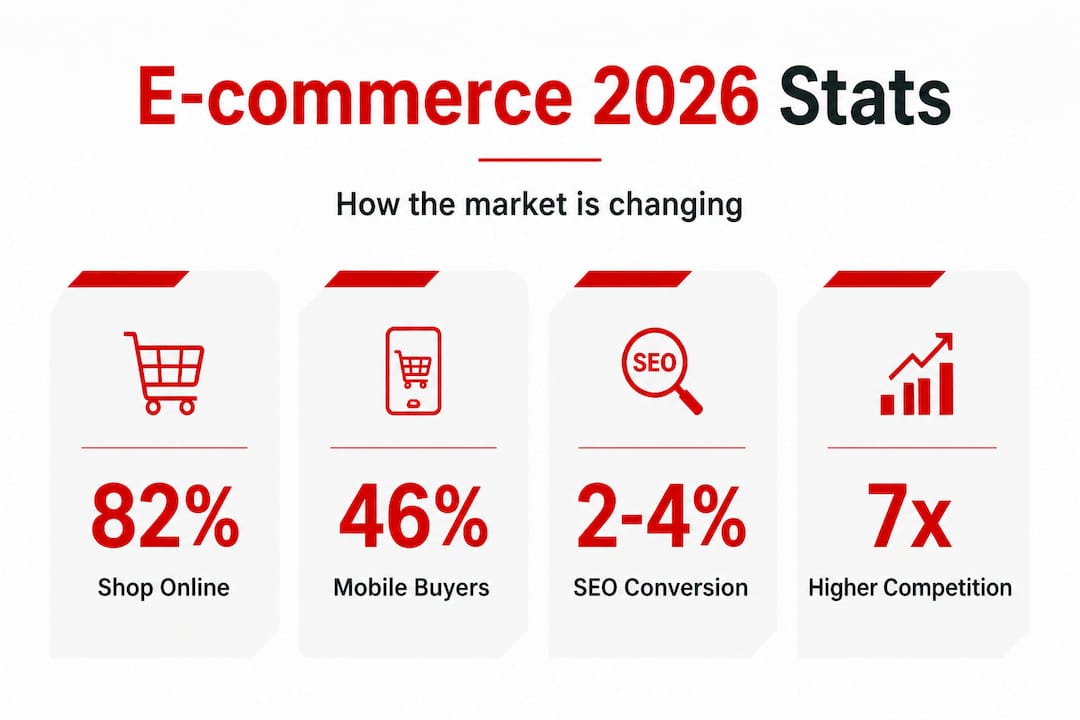
The most significant shift is the explosion in competition. More businesses entered e-commerce during and after the pandemic, saturating categories that were once profitable with modest investment. At the same time, digital advertising costs have risen sharply, meaning the cost to acquire a customer through paid channels is considerably higher than it was just a few years ago. Brands that built their entire model around paid social or Google Shopping are now finding margins tighter and results less predictable.
Alongside this, consumer behaviour has changed. Shoppers are more informed, more sceptical, and far more likely to research a brand before purchasing. They read reviews, browse social media profiles, check for blog content, and form opinions about your credibility before they ever reach your product page. This means your brand presence across organic channels matters far more than it once did.
Here is a snapshot of how key metrics compare across acquisition strategies in 2026:
| Channel | Average conversion rate | Average order value | Sustainability |
|---|---|---|---|
| Organic SEO | 2 to 4% | Higher | Long-term |
| Paid search (PPC) | 1 to 2% | Moderate | Short-term |
| Paid social | 0.5 to 1.5% | Lower | Short-term |
| Email marketing | 3 to 5% | High | Long-term |
As the data above illustrates, SEO delivers a 2 to 4% conversion rate alongside higher average order values compared to paid alternatives. This is not accidental. Organic search visitors arrive with a higher degree of intent. They have actively searched for something, found your brand naturally, and arrived with curiosity rather than because an algorithm pushed an ad in front of them.
Key trends reshaping e-commerce strategy right now include:
- Voice and AI search changing how product queries are structured
- Social commerce blurring the boundary between content and purchase
- First-party data becoming essential as third-party cookies disappear
- Brand storytelling driving higher engagement across all digital channels
- Sustainable and ethical positioning influencing purchase decisions more than ever
Understanding these shifts is not just useful context. It directly informs which strategies deserve your time, budget, and creative energy.
SEO versus paid ads: Which drives sustainable e-commerce growth?
This debate sits at the centre of most e-commerce marketing discussions, and it is worth examining honestly rather than defaulting to a “do both” non-answer.
Paid advertising is genuinely useful. If you launch a new product, run a seasonal campaign, or need to test a market quickly, paid ads give you speed and precision. You can reach a specific demographic, in a specific location, at a specific moment. For short bursts, that is hard to beat. The problem is what happens when the budget stops.
“Over-reliance on paid risks rented visibility that disappears the moment you stop paying. SEO builds an asset. Paid builds a tap.”
That quote captures the core issue. When you invest in SEO, you build something that compounds. A well-optimised product page, a genuinely useful blog post, a set of authoritative backlinks, these things continue delivering traffic months and years after the initial investment. Paid ads deliver traffic precisely as long as you fund them, and not a day longer.
Here is a practical comparison to guide your thinking:
| Factor | SEO | Paid ads |
|---|---|---|
| Time to results | 3 to 6 months | Immediate |
| Cost over time | Decreases | Consistent or rising |
| Traffic when budget stops | Continues | Stops immediately |
| Trust signals built | Yes | No |
| Average order value | Higher | Moderate |
| Brand credibility | Builds over time | Minimal impact |
For e-commerce brands serious about sustainable growth, SEO basics for brands should be a foundational investment, not an afterthought. This does not mean abandoning paid channels entirely. It means rebalancing so that organic growth is your engine and paid advertising is your accelerant on top of a solid base.
If you are exploring marketing alternatives to costly paid campaigns, content-led SEO combined with email nurture sequences and strong brand positioning can replace a significant proportion of your paid spend over 12 to 18 months.
Pro Tip: Run paid ads to your highest-converting landing pages while simultaneously building organic content targeting the same keywords. This dual approach shortens the time before SEO traffic begins to replace paid spend.
Building brand presence for repeat customers
Acquiring a new customer costs five to seven times more than retaining an existing one. Yet most e-commerce marketing budgets are disproportionately weighted towards acquisition. Building a brand that earns repeat purchases is not just good ethics, it is smart economics.
Brand presence is not simply a logo or a colour palette. It is the entire experience a customer has with your business, from the first ad they see to the packaging that arrives at their door to the follow-up email they receive three days later. Every touchpoint either reinforces or undermines trust.
Consistent messaging is the foundation. When your product pages, social media profiles, email communications, and customer service team all speak in the same voice and reflect the same values, customers feel they know who you are. That familiarity drives loyalty. You can explore brand strategy examples from real campaigns to see how leading brands translate strategic thinking into tangible loyalty.
Storytelling is underutilised in e-commerce. Most product pages focus exclusively on features and price. The brands that build strong communities around their products do something different. They explain why the product exists, who created it, what problem it solves in real life, and how it fits into a customer’s identity. This is not fluff. It is the detail that transforms a commodity into a brand, and a one-time buyer into an advocate.
Practical branding steps every e-commerce manager should act on:
- Define your brand voice and apply it consistently across every channel, including automated emails and product descriptions
- Build a visual identity that works equally well on mobile, desktop, and printed packaging
- Create a post-purchase journey that reinforces the buyer’s decision and opens a dialogue
- Leverage user-generated content by encouraging and showcasing customer photos, reviews, and stories
- Publish educational content that positions your brand as an authority in your niche, not just a seller
Understanding how branding drives growth at a strategic level helps marketing managers align their daily creative decisions with longer-term business objectives. And for those operating in the UK market specifically, SEO branding for SMEs offers a practical lens on combining search visibility with brand-building in a cost-effective way.
Pro Tip: Track your repeat purchase rate monthly. If fewer than 25% of customers make a second purchase within 90 days, your post-purchase experience needs significant attention before you scale acquisition spending.
Digital marketing strategies to boost sales
Knowing that SEO and branding matter is one thing. Knowing precisely how to implement campaigns that convert is another. Here is a step-by-step approach that consistently produces measurable results for e-commerce brands.
-
Audit your current traffic sources. Before spending a penny more on marketing, understand where your existing sales are coming from. Use analytics to identify which channels, pages, and campaigns are already generating revenue. Scale those first.
-
Identify your highest-value customer segment. Not all customers are equal. Identify your top 20% by lifetime value and study their behaviour. Where did they come from? What did they search for? What content did they consume before purchasing? Build campaigns that attract more people who look like them.
-
Create content that answers real purchase questions. Product comparison pages, buying guides, and “best of” articles consistently rank well in organic search and convert at high rates. These are known as bottom-of-funnel content assets, meaning they reach people who are ready to buy rather than those still in early research stages.
-
Launch targeted campaigns with creative that reflects your brand. Generic banner ads and stock photography no longer perform. Invest in creative that is visually distinctive and tells a story. For practical guidance, creating effective marketing campaigns walks through the process from brief to execution.
-
Integrate SEO into every campaign. Before launching any paid campaign, ensure the landing page it points to is fully optimised for organic search too. This prevents you from building traffic on a page that delivers no long-term return once the paid budget stops.
-
Test, measure, and iterate. Commit to a 30 day testing cycle for any new campaign element, whether that is a subject line, a hero image, or a call-to-action phrase. Make decisions based on data, not instinct.
Exploring sales strategies for UK brands gives you a market-specific perspective on what works in the current UK consumer environment. UK shoppers, in particular, tend to respond well to value-led messaging, social proof from recognisable review platforms, and brands that communicate clearly about delivery and returns.
Targeted advertising for SMEs can punch above your weight when creative is sharp and audience segmentation is precise. You do not need a massive budget to compete. You need smarter targeting and better creative. Likewise, creative campaigns for SMEs consistently show that creativity is often the single most cost-effective lever an e-commerce brand can pull.
Pro Tip: Repurpose your highest-performing organic content into paid ad creative. If a blog post or product guide already ranks well and converts, use its key messages in your ad copy and landing page design. You are validating your paid investment with organic proof of concept.
Why long-term organic strategies outshine quick paid wins
There is a pattern we see repeatedly across e-commerce brands: they invest heavily in paid ads, achieve a short burst of sales, then either increase spend to maintain results or pull back and watch revenue fall. The cycle is exhausting and expensive, yet many teams return to it quarter after quarter because the speed of paid results feels reassuring.
The uncomfortable truth is that paid ads are not building your business. They are renting it. Every pound you spend on paid acquisition belongs to Google, Meta, or TikTok the moment you spend it. No equity is built. No audience is truly yours. No asset sits on your books.
SEO delivers lasting traffic and higher order value whilst paid ads remain fast but fleeting. This is not an argument against paid advertising. It is an argument for treating SEO and branding as investments with long-term returns rather than costs to minimise.
The brands that understand this think differently about time. They accept that a well-executed content strategy might take six months to produce meaningful organic traffic. They invest in that strategy anyway because they understand that month seven, eight, and nine will deliver traffic at near-zero marginal cost. Meanwhile, competitors who relied solely on paid ads are still spending the same amount every month with no compounding benefit.
There is also a trust dimension that paid advertising simply cannot replicate. When a customer finds your brand organically, through a search result, a well-placed article, or a recommendation from a trusted source, the relationship starts from a position of credibility. You earned their attention rather than buying it. That distinction matters enormously in how they engage, how much they spend, and whether they return.
SEO-driven branding for SMEs is particularly compelling for e-commerce businesses operating with tighter budgets, because it simultaneously builds search visibility and brand authority. That dual return is something paid advertising never delivers.
The most successful e-commerce brands we work with have made a deliberate commitment to patience. They run paid campaigns strategically, to launch products or fill seasonal gaps, but they never allow paid spend to substitute for the slower, sturdier work of building an organic presence that customers trust.
Enhance your e-commerce growth with expert support
If this article has clarified your thinking about organic growth, brand strategy, and campaign integration, the next step is putting it into practice with the right support behind you. At Radka Advertising, we work with e-commerce brands that are serious about sustainable growth rather than short-term spikes. Our team brings together strategic brand development, data-driven digital marketing, and creative content that converts. Whether you are starting from scratch or refining an existing strategy, we can help you build something that compounds. Log into the ClientPortal to manage your projects or, if you are ready to see where your organic presence currently stands, claim your free SEO audit and get a clear picture of the opportunity in front of you.
Frequently asked questions
Which digital marketing channel delivers the highest ROI for e-commerce?
SEO typically offers the highest long-term return on investment because it builds sustainable organic traffic with a 2 to 4% conversion rate alongside higher average order value than paid alternatives.
How can e-commerce brands reduce reliance on paid ads?
Brands can replace a significant portion of paid spend by building content-led SEO programmes, since SEO owns traffic long-term in a way that paid campaigns fundamentally cannot.
What is the main risk of only investing in paid ads?
Over-reliance on paid creates rented visibility where all traffic stops the moment your budget does, leaving no lasting brand asset or organic presence behind.
How do branding strategies affect repeat purchases?
Consistent brand messaging and memorable customer experiences build trust and familiarity, which directly increases the likelihood of repeat purchases and improves customer lifetime value over time.
What actionable steps help boost online sales quickly?
Launch targeted digital campaigns against your highest-converting audience segments, optimise your top landing pages for both paid and organic traffic simultaneously, and reinforce brand credibility through social proof and post-purchase follow-up sequences.
Recommended
- How branding strategies drive real business growth
- Elevate your brand: Best branding practices for 2026
- Build a stronger brand: Effective strategies for UK businesses
- Proven brand strategies: Real-world examples for growth | Radka Advertising
- Proven ways to boost online sales for ambitious e-commerce brands - Nu Life Digital
- Digital branding drives 23% sales growth for SMBs in 2026 | Ibrandmedia