Book Jobs With Google Ads for Contractors: Trades First, CPL £60–£120

Yes, Google Ads works for contractors when the account is built around service lines rather than generic trade terms. Prioritise Search campaigns and Local Services Ads together, send every click to a single-purpose landing page, and treat call tracking as non-negotiable. Do those three things first: split budget by job type, install call tracking before launch, and answer every lead within five minutes.
TL;DR:
- Campaigns should be split by service line and focused on specific regions to improve ad relevance and reduce wasted spend.
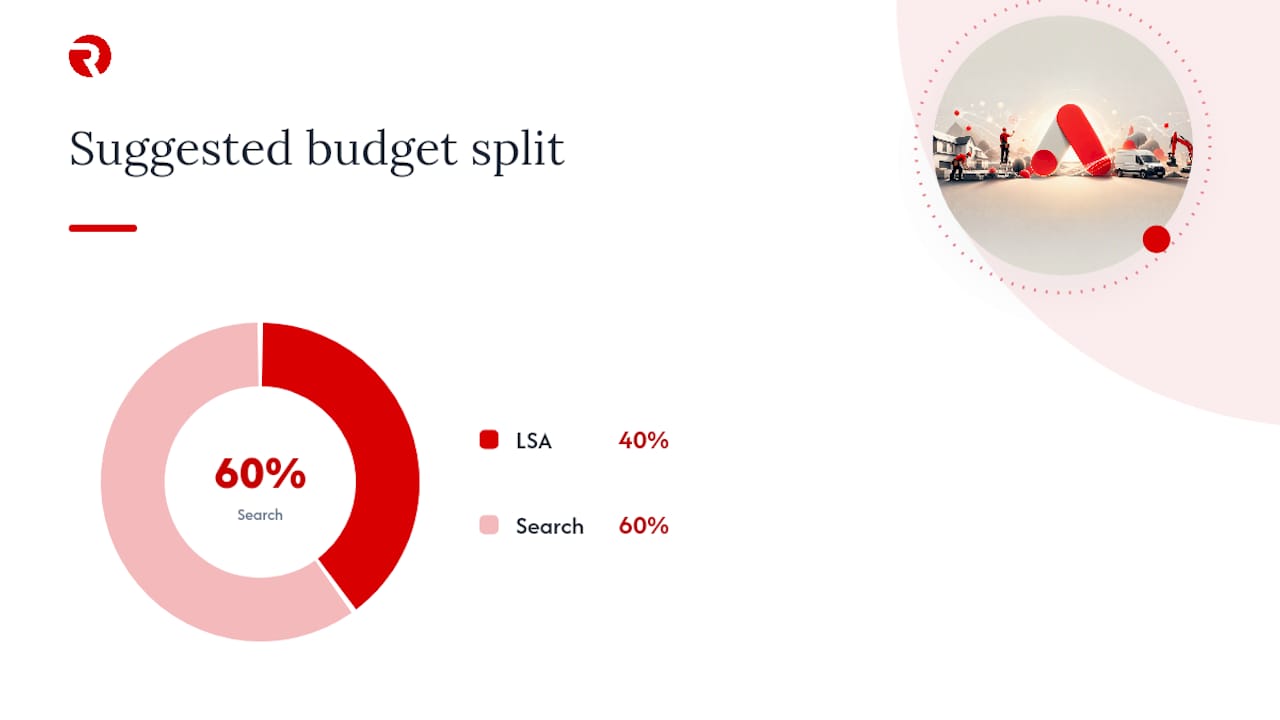
- Local Services Ads are ideal for emergency or same-week jobs, while Search campaigns best target planned, higher-value projects, with a recommended budget split of about 40% to LSA and 60% to Search.
- Effective landing pages must mirror ad language, include trust signals, and enable quick contact, with response times under five minutes vastly improving lead conversion.
- UK lead costs generally range from £60 to £120, with higher budgets needed for larger, higher-value projects or commercial work, and tracking offline conversions enhances optimization.
- Regular negative keyword management, ad testing, and refining campaign structure are crucial to prevent overspending and maximize ROI for contractor advertising efforts.
Table of Contents
- Campaign structure: how to organise accounts for contractors
- Budgets and UK benchmarks: what a realistic CPL looks like
- Local Services Ads vs standard Search ads: which to run and when
- Landing pages and lead handling: convert clicks into booked jobs
- Keywords, match types and negative keywords: stop wasting spend
- Measurement and optimisation: tracking calls, offline conversions and attribution
- Common mistakes and a quick optimisation checklist
- Agency perspective: how a pilot campaign should actually run
- Why we still tell contractors to pair Ads with local SEO
- How Radkaadvertising can get your Ads account working harder
- Sources
- FAQ
Campaign structure: how to organise accounts for contractors
Most wasted budget traces back to one root cause: a single campaign trying to sell everything from boiler repairs to loft conversions. Google’s algorithm can’t optimise for a job it can’t distinguish, so the fix starts with structure, not spend.
Contractors should split campaigns by service line and use tight, focused ad groups per job type, which improves Quality Score and reduces wasted spend compared with one sprawling account. Here’s the build order that works:
- Separate campaigns by service line. Roofing, kitchen extensions, rewiring and emergency call outs each get their own campaign, because they have different search intent and different values per job.
- Split emergency from planned work. A burst pipe searcher wants a phone number in the next ten seconds; a homeowner researching a £40,000 extension wants proof of past projects. Different ad copy, different landing pages.
- Build ad groups around town or postcode plus service. “Bathroom fitter Leeds” and “bathroom fitter Wakefield” belong in separate ad groups, even if the copy is 90% identical, because it lets you control bids by area.
- Write copy that pre-qualifies. State project minimums, accreditations (Gas Safe, NICEIC, FMB membership) and typical turnaround directly in the headline. It filters out browsers before they click.
- Use Search for intent capture, Performance Max for remarketing. Search catches people actively typing what they need; Performance Max works better once you have enough site visitors and past customers to build audiences from, rather than as a cold-traffic launch tool.
Builders chasing high-value projects can justify a heavier cost per click here, since one won job often covers several months of ad spend.
Budgets and UK benchmarks: what a realistic CPL looks like
UK home services Search campaigns typically land a cost per lead somewhere between £60 and £120, with plenty of variation by trade and region.
Statistic callout: Local Services Ads often push per-lead cost below that range because Google only charges for verified, Google Guaranteed leads, filtering out tyre kickers before you pay.
Test budgets need to reflect the size of the job you’re chasing, not a flat rule of thumb:
- Small trades (plumbers, electricians, locksmiths): £600–£1,000/month minimum to gather enough data for meaningful optimisation.
- General builders and extensions: £1,000–£2,000/month, since fewer, higher-value conversions need a longer testing window.
- Commercial contractors: £1,500–£3,000/month, reflecting longer sales cycles and higher-value contracts.
To translate CPL into an acceptable cost per acquisition, divide your average job value by your close rate.
Local Services Ads vs standard Search ads: which to run and when
Local Services Ads and Search solve different problems, and the mistake most contractors make is picking one when they should be running both.
LSA charges per verified lead and carries the Google Guaranteed badge, which builds instant trust for someone who needs a plumber today. Search gives you full control over keywords, ad copy and landing pages, making it the better tool for planned, higher-value work where the buyer is comparing several contractors over days or weeks.
- Run LSA when: the job is emergency or same-week, your trade is eligible in your postcode, and you want leads with minimal setup.
- Run Search when: you’re targeting specific project types (extensions, rewires, commercial fit-outs) and want to control the message and destination page.
- Run both when: you want to own more of the results page for high-value search terms, since LSA and Search ads can appear alongside each other.
- Suggested split for a mixed trade: roughly 40% of budget to LSA for emergency capture, 60% to Search for planned, higher-ticket jobs, adjusted once you see which channel actually books jobs.
Eligibility for LSA varies by trade and postcode, so check availability before building a budget split around it, and never assume approval in one town means approval everywhere.
Landing pages and lead handling: convert clicks into booked jobs
A brilliant ad sending traffic to a homepage is one of the fastest ways to burn a budget. Every campaign needs its own single-purpose landing page that mirrors the ad’s exact language, with a phone number that’s tappable on mobile and a form no longer than four fields.
- Build one landing page per campaign, matching the headline, service and location mentioned in the ad.
- Add trust signals above the fold: accreditation logos, real project photos, and one or two short testimonials with a typical project value attached.
- Set a five-minute response SLA. Contacting a lead within five minutes rather than an hour can multiply your conversion rate many times over, according to research cited by Made For Builders, so route calls and form fills into a simple CRM or shared inbox that alerts whoever’s free.
- Route by lead type, not just by who’s nearest the phone. Emergency calls go to whoever’s on the road; quote requests go to whoever’s building estimates that day.
Pro Tip: Record every call automatically and listen to your worst-converting week. Nine times out of ten, the problem isn’t the ad. It’s someone taking forty seconds to answer or forgetting to ask for the booking.
Keywords, match types and negative keywords: stop wasting spend
Keyword choice decides whether your budget buys booked jobs or curious browsers. Target job-plus-location phrases such as “kitchen extension Bristol” rather than generic trade terms like “builder,” which attract everyone from DIY researchers to job seekers.
- Use phrase and exact match for your highest-intent phrases, where you know exactly what the searcher wants.
- Use broad match cautiously, and only if you’re checking the search terms report at least weekly, because broad match can drift into irrelevant queries fast.
- Seed your negative keyword list before launch with terms like “jobs,” “salary,” “DIY,” “how to,” “course,” “free,” plus any national chain names and trades you don’t offer.
- Review search terms twice weekly for the first month. A strong negative list combined with close monitoring during the first 30 to 60 days is one of the highest-leverage things a contractor can do without hiring anyone.
Measurement and optimisation: tracking calls, offline conversions and attribution
You can’t optimise what you don’t measure, and phone-heavy trades lose most of their real conversion data by default. Install call tracking and track form fills as a separate conversion action, then import signed contracts as offline conversions once a job closes.
- Set your attribution window to match your actual sales cycle, typically 30 to 90 days for planned work, so late-closing leads aren’t undercounted.
- Watch CPL, CPA, close rate, response time and search terms weekly; watch trends monthly rather than reacting to daily noise.
- Feed offline conversion data back into Google Ads consistently. Importing signed contracts helps Smart Bidding learn which clicks actually turn into paid work, not just phone calls.
Common mistakes and a quick optimisation checklist
The same handful of errors show up in almost every underperforming contractor account: sending paid clicks to the homepage, skipping negative keywords, mixing emergency and planned intent in one campaign, and slow lead response.
- Weekly: prune your search terms report, removing anything irrelevant before it burns more spend.
- Weekly: test two or three ad variants per ad group and pause the weakest after a fair sample size.
- Weekly: check landing page conversion rate by campaign, not just click volume.
- Scale budget once CPL is stable and close rate holds steady for two to three weeks.
- Optimise instead of scale if CPL is climbing or close rate is dropping. Adding budget to a leaking account just leaks faster.
Construction-focused targeting and tighter negative lists can cut wasted clicks by 40 to 60% for commercial contractor campaigns specifically, which is often the single biggest lever available before touching bids at all.
Agency perspective: how a pilot campaign should actually run
A properly run pilot follows a fixed sequence: audit the existing account or market, build separate campaigns per service line, attach a dedicated landing page to each, install call tracking, then import offline conversions once jobs close.
- Radkaadvertising documents outcomes and conversion improvements from past campaigns in its case study library. It’s useful reading before setting expectations for your own pilot.
- Pairing paid campaigns with a technical SEO audit tends to shorten the runway before organic leads start arriving.
- Performance analytics and AI-driven optimisation, covered in Radkaadvertising’s growth work, feed directly into the Smart Bidding improvements offline conversion import makes possible.
Why we still tell contractors to pair Ads with local SEO
Google Ads is the fastest way to get the phone ringing, but it’s a rented channel. Local SEO takes three to twelve months to mature, yet it steadily lowers your cost per lead once it does. The pitfall we see most often is owners never rebalancing: they keep the same Ads budget indefinitely instead of shifting spend toward organic once rankings hold. Fix that, and Ads becomes the bridge it was always meant to be, not a permanent tax on every job you win. For a deeper look at combining paid and organic channels, see why digital presence matters for UK businesses.
— Bart
How Radkaadvertising can get your Ads account working harder
A practical alternative to running this alone or handing it to a generalist agency is working with a team that builds campaign structure, dedicated landing pages, call tracking and offline conversion import as one connected system, rather than treating each as a separate job. If your budget has crept past £1,000 a month or you’re now juggling more than two service lines, that’s usually the point where a managed setup pays for itself faster than DIY trial and error. Contractors serious about insulation-specific local visibility alongside paid campaigns can also review Honey Badger SEO’s insulation-focused local search tactics as a complementary read. Start by reviewing recent campaign results in the case study library, then book an audit to see exactly where your account is currently leaking budget.
Sources
- Local SEO vs Google Ads for Tradespeople · Made For Builders
- Google Ads for Builders — SwiftLead
- Google Ads ROI for general contracting | ClicksGeek
- Google Ads for UK Contractors: Stop Burning Budget | Market Maestro
FAQ
Do Google Ads work for contractors?
Yes, provided campaigns are split by service line, sent to matching landing pages, and paired with fast lead response. Poorly structured accounts underperform regardless of the channel.
How much do Google Ads cost for construction?
UK home services campaigns typically run a cost per lead of £60 to £120, though builders targeting high-value projects can justify a higher cost per click since one won job offsets months of spend.
How much does Google Ads pay per 1,000 views?
Google Ads doesn’t pay contractors per view; that model applies to content creators on other platforms. Contractors pay per click or per verified lead, not the reverse.
Is £500 a month enough for Google Ads?
It’s tight for most trades and rarely enough for builders chasing high-value projects, since it may only generate four to eight leads at typical UK CPLs. Small trades in lower-competition areas can sometimes test meaningfully at that level, but £600 to £1,000 gives cleaner data.