Film advertising: a UK commissioner’s guide for SMEs

TL;DR:
- Branded film advertising delivers measurable business results when planned with clear KPIs and multi-format content. Radkaadvertising provides strategic, multi-platform content suites for UK brands, guiding projects from discovery through analytics. Proper pre-production, written rights agreements, and early Clearcast review are essential for efficient, impactful campaigns.
Film advertising, in the context of this guide, means branded video commercials and multi-format campaign assets produced for companies to drive measurable business outcomes. Not film publicity. Not cinema screen networks. Branded video built to perform on YouTube, Meta platforms, TikTok, and broadcast TV.
The verdict: commission a multi-format content suite when you need high-impact brand storytelling tied to specific KPIs. Brief a strategic production partner on your distribution channels and usage rights from day one, and if broadcast TV is in scope, factor in Clearcast and ASA clearance before you set a go-live date.
Table of Contents
- Why does film advertising deliver real business outcomes for UK SMEs?
- What does a UK film advertising project actually look like, stage by stage?
- What should you budget for branded video in the UK?
- Which deliverables and formats should you request up front?
- How do you choose the right production partner in the UK?
- How do you protect budget and maximise ROI during production?
- How does Radkaadvertising approach film advertising projects?
- Key takeaways
- Why the brief is the most underrated part of the whole process
- Radkaadvertising: strategic film advertising for UK and Eastern European brands
- Useful sources
- FAQ
Why does film advertising deliver real business outcomes for UK SMEs?
Branded video lifts brand salience and drives conversion when distribution and measurement are planned before the camera rolls. The KPIs that matter most are not raw views.
Track these from the outset:
- View completion rate — the percentage of viewers who watch to the end; a direct signal of creative relevance
- Click-through rate — how many viewers take the next step after watching
- Conversion rate — demo sign-ups, purchases, or enquiries attributable to the film
- Cost per acquisition — total campaign spend divided by conversions generated
- Assisted-conversion contribution — how the film influences conversions that close on another channel
YouTube, Meta (Facebook and Instagram), and TikTok are the primary distribution channels for UK SMEs. Each rewards different formats and viewing behaviours, which is exactly why campaign planning must precede production, not follow it.
Pro Tip: Plan your film as a content suite from the start: one hero film plus social cutdowns and stills from a single shoot. You get more assets, better ad relevance across platforms, and a significantly lower cost per deliverable than running separate productions.
What does a UK film advertising project actually look like, stage by stage?
A properly scoped TV or online commercial follows a clear sequence. UK broadcast productions typically run several weeks from concept to delivery when all stages are included, with regulatory clearance adding time at both ends.
| Stage | Typical duration | Key tasks and notes |
|---|---|---|
| Discovery and briefing | 1–2 weeks | KPI definition, audience mapping, channel planning, usage rights discussion |
| Creative development | 1–2 weeks | Script, storyboard, concept sign-off |
| Pre-production | 1–2 weeks | Casting, locations, crew, schedule, Clearcast script submission if broadcast |
| Shoot | 1–3 days | Principal photography, B-roll, performance capture |
| Post-production | 2–4 weeks | Edit, colour grade, sound design, motion graphics, music licensing |
| Clearance and delivery | 1–3 weeks | Clearcast rough-cut and final TVC review for broadcast; technical delivery to platforms |
For broadcast TV, Clearcast reviews scripts, rough cuts and final TVCs; a script submission takes a few working days, but complex claims or regulated wording take longer. Submit early. A finished spot that fails a Clearcast check is unbroadcastable until changes are made, and that costs both time and money.
What should you budget for branded video in the UK?
Budgets vary considerably. Industry pricing guides show common UK project bands: entry-level projects in the low thousands, mid-range brand films in the £5,000–£25,000 area, and high-end or broadcast-quality productions from £25,000 upwards.
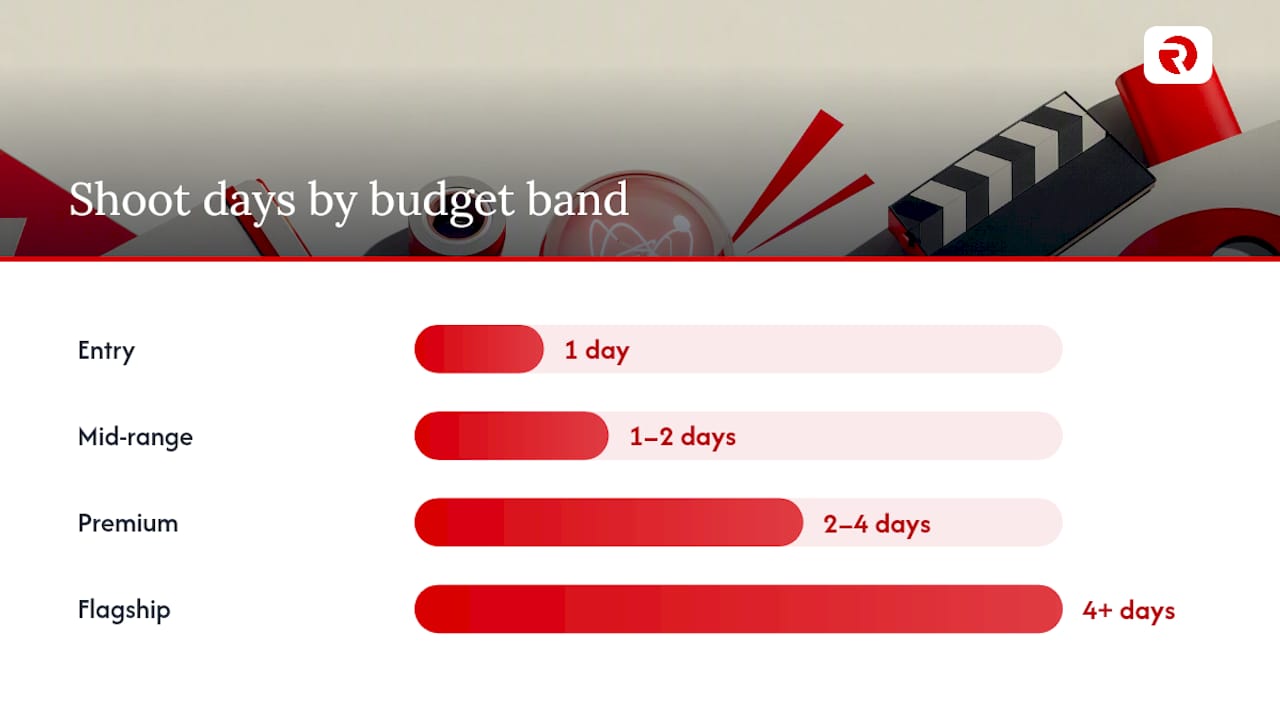
| Band | Typical budget | Outputs | Shoot days |
|---|---|---|---|
| Entry | low thousands | Single online film, basic edit | 1 |
| Mid-range | £5,000–£25,000 | Brand film + 2–3 social cutdowns | 1–2 |
| Premium | £25,000+ | Multi-format content suite, broadcast-ready | 2–4 |
| Flagship | £25,000+ | Full TV commercial, VFX, talent, multi-location | 4+ |
London shoots typically cost noticeably more than comparable regional UK locations, driven by crew day rates, location hire, and logistics. The main cost drivers across all bands are: days of filming, location complexity, on-screen talent and casting fees, specialist equipment or VFX, music licensing, and the number of deliverables requiring versioning.
Pro Tip: Post-production commonly accounts for a significant portion of a brand film budget. Allocate it explicitly in your brief rather than treating it as a residual. Underestimating post is the fastest route to a rushed grade and a weak final cut.
Which deliverables and formats should you request up front?
Demand a content suite from a single shoot. One production should yield a master film plus multiple social cutdowns and supporting formats.
| Deliverable | Duration | Format | Platform |
|---|---|---|---|
| Master film | around one minute to one and a half minutes | — | TV, YouTube, web |
| Social hero | about thirty seconds | — | YouTube pre-roll, Meta feed |
| Vertical cutdown | short, around fifteen seconds | — | TikTok, Instagram Reels, Stories |
| Square version | short, around fifteen seconds | 1:1 | Meta feed, LinkedIn |
| Bumper | very short, about six seconds | — | YouTube bumper ads |
| Subtitled web version | Matches master | —, SRT/burned-in captions | Web, organic social |
Beyond the files themselves, request: ProRes or H.264 masters at the agreed codec and colour space, audio mixed to -14 LUFS for streaming platforms, a clock slate for broadcast delivery, subtitle and caption files in SRT format, and clearly labelled project masters so future edits do not require a full re-grade. Integrating video assets with your web content also improves discoverability and on-page conversion.
How do you choose the right production partner in the UK?
Choose partners who lead with strategic outcomes, not kit lists. The right agency asks about your KPIs and distribution plan before discussing cameras.
- Review their discovery process. Do they ask about audience behaviour, channels, and measurement before creative? If not, walk away.
- Check sector-relevant case studies. Portfolio breadth matters; sector fit matters more for regulated or technical brands.
- Confirm multi-format delivery experience. Ask to see examples of content suites, not just hero films.
- Assess measurement capability. Can they advise on UTM tagging, platform pixel setup, and reporting?
- Verify project management structure. Who is your day-to-day contact? What does the sign-off process look like?
- Confirm ownership and licensing in writing. Industry bodies including Pact recommend confirming scope of usage in writing at the start of the project to prevent licensing disputes later.
Questions to ask in a first meeting: What KPIs have you optimised for on similar projects? How do you handle platform-specific versioning? What does your Clearcast experience look like? Who owns the raw footage after delivery? What is your cancellation and reshoot policy?
Red flags: vague scope with no sample budgets, no written usage-rights policy, a portfolio of hero films with no social cutdowns, or a briefing process that involves five stakeholders with no single sign-off owner.
Pro Tip: Confirm contract terms covering territory, duration, and media type for usage rights. Also nail down the payment schedule (typically 30–50% upfront, balance on delivery), cancellation terms, and liability for reshoots caused by production error.
How do you protect budget and maximise ROI during production?
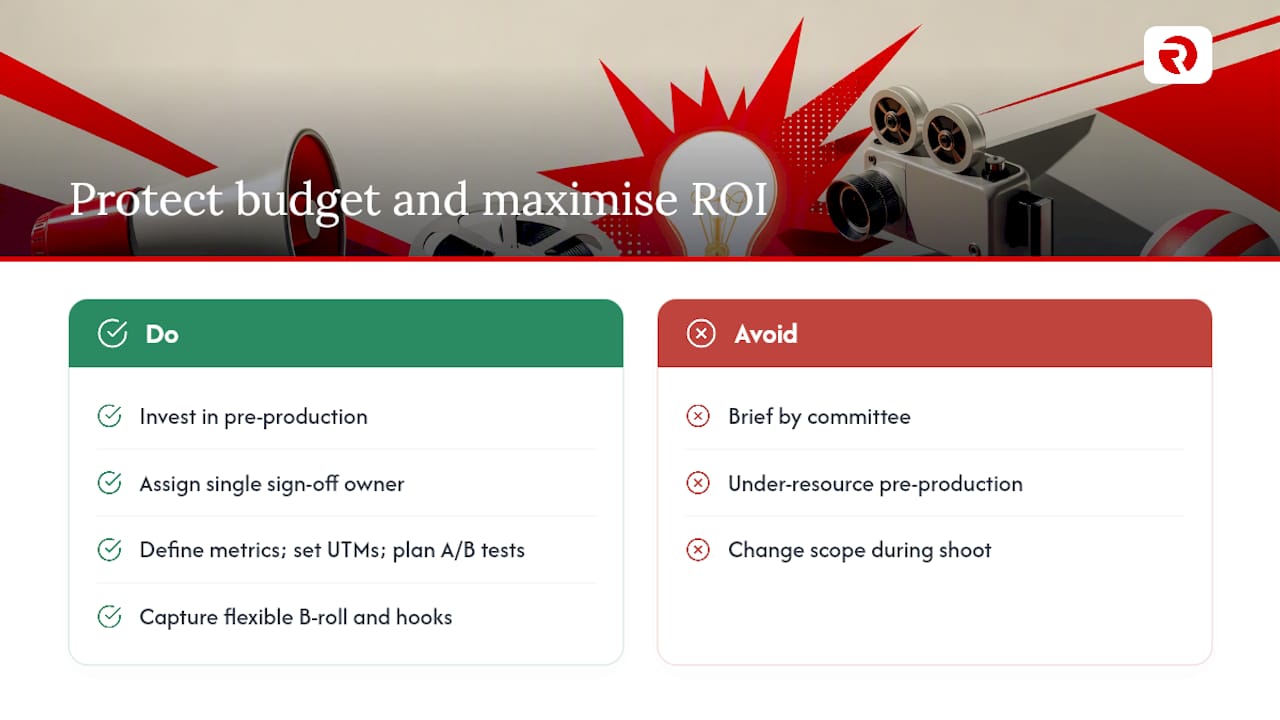
Invest in pre-production. Under-resourcing it is the single largest cause of budget overruns; experienced producers treat it as the phase that protects the shoot.
A solid pre-production phase covers: a locked script and storyboard, a detailed shot list, confirmed locations and permits, cast and crew contracted, a day-by-day schedule with contingency time built in, and a clear brief signed off by one internal decision-maker.
Briefing by committee kills projects. Consolidate stakeholders into a single sign-off owner before production starts. Scope changes during a shoot trigger reshoots; reshoots cost money that was not in the budget.
Before post-production begins, define your success metrics and set up UTM parameters and platform pixels. Plan A/B tests for cutdowns and thumbnails at this stage, not after delivery. On shoot day, capture flexible B-roll and multiple performance hooks so the edit team can optimise for platform-specific viewing behaviour without going back to camera.
Pro Tip: A well-written video brief is the most valuable document in any production. It keeps everyone aligned, prevents costly miscommunication, and gives your production partner the context to make genuinely good creative decisions.
How does Radkaadvertising approach film advertising projects?
Radkaadvertising delivers strategic, multi-format content suites with measurable outcomes for SMEs and scaleups across the UK and Eastern Europe. Every project starts with a structured discovery phase: mapping KPIs, audience behaviour, and distribution channels before a single frame is scripted.
From there, projects move through content-suite scripting, consolidated shoot days designed to capture the full deliverables list in one production, multi-format post-production, and an analytics handover covering tagging, reporting setup, and optimisation guidance.
Clients working with Radkaadvertising typically receive: a hero film, three to five social cutdowns in multiple aspect ratios, subtitled web versions, production masters, and a campaign analytics framework. The agency has produced work for clients including Coca-Cola, Maybelline, and PowerLink Energy, with case studies available across sectors.
Pro Tip: Ask your agency for a brand and campaign audit before briefing production. Knowing where your current assets underperform tells you exactly what the new film needs to do.
Key takeaways
A branded video commercial only drives measurable ROI when distribution, format, and usage rights are locked before production begins.
| Point | Details |
|---|---|
| Commission a content suite | One shoot should yield a master film, social cutdowns, and stills for all channels. |
| Budget realistically | Entry-level UK projects start in the low thousands, with mid-range brand films running £5,000–£25,000; post-production takes 30–40% of the total. |
| Allow 8–12 weeks | UK TV commercials need 8–12 weeks end-to-end; add time for Clearcast if broadcast is in scope. |
| Lock rights in writing | Confirm territory, duration, media type, and raw footage access before signing any contract. |
| Work with Radkaadvertising | Radkaadvertising structures every project around KPIs, multi-format delivery, and analytics handover. |
Why the brief is the most underrated part of the whole process
Most brands spend their energy evaluating production reels and day rates. The brief gets ten minutes. That imbalance is where most branded video projects go wrong.
A production partner can only make a film as good as the brief they receive. Vague objectives produce technically competent work that nobody can prove drove anything. The brands that consistently get strong returns from branded video are the ones who arrive with a clear KPI, a named distribution plan, and a single internal decision-maker. Everything else, including the creative, the format, and the budget, flows from that foundation.
The content-suite approach is not just a production efficiency argument. It is a strategic one. A brand that runs a 90-second hero film on YouTube, a 15-second vertical on TikTok, and a 6-second bumper in pre-roll is telling a consistent story across three different attention contexts. That consistency compounds over time in ways that a single-format production simply cannot.
Radkaadvertising: strategic film advertising for UK and Eastern European brands
For SMEs and startups that need branded video to perform across multiple channels, Radkaadvertising offers a sharper alternative to commissioning production and strategy separately. The agency handles strategic discovery, content-suite scripting, shoot management, multi-format post-production, and campaign analytics in a single engagement, so you are not coordinating between a creative agency, a production house, and a media buyer.
The typical path: a discovery call to map KPIs and channels, a scoped proposal with a clear budget band, a production schedule with milestones, and a contract that covers usage rights, payment schedule, and deliverables in full. No vague scope. No surprise licensing fees.
View the case studies to see the formats and outcomes delivered for brands across sectors, or get in touch with the team to request a proposal for your next campaign.
Useful sources
- Clearcast — the UK broadcast pre-clearance body; submit scripts and rough cuts here before finalising any TV commercial.
- Advertising Standards Authority (ASA) — the UK’s independent advertising regulator; sets the BCAP rules that govern broadcast content.
- Pact — the UK trade body for independent production companies; publishes guidance on production agreements and rights.
- How Much Does Corporate Video Production Cost in the UK? | Bearjam — budget bands and post-production cost breakdowns from a UK producer.
FAQ
What is film advertising in a business context?
Film advertising refers to branded video commercials and multi-format campaign assets produced for companies to drive measurable outcomes such as conversions, brand awareness, and click-throughs. It covers online ads, social video, and broadcast TV commercials.
How long does a UK branded video project take?
UK TV commercials typically take 8–12 weeks from concept to delivery. Online-only projects without broadcast clearance can move faster, often in 4–6 weeks depending on scope and sign-off speed.
Does a UK TV commercial need Clearcast approval?
Yes. Any advert intended for UK broadcast television must be cleared by Clearcast before it airs. Submit your script early in pre-production; complex claims or regulated wording extend the review period.
What budget should a UK SME set for a brand film?
Mid-range brand films in the UK typically run £5,000–£25,000 for one to two shoot days with social cutdowns. Entry-level projects start in the low thousands. Post-production accounts for 30–40% of the total budget, so factor that in from the start rather than treating it as an afterthought.
How does Radkaadvertising structure a film advertising project?
Radkaadvertising begins with a strategic discovery phase to map KPIs and distribution channels, then moves through content-suite scripting, consolidated shoot days, multi-format post-production, and an analytics handover. Full project examples are available in the case studies.