Strategic marketing: boost your brand & digital reach

TL;DR:
- Strategic marketing aligns activities with long-term business objectives to drive growth.
- Frameworks like SWOT, STP, and SOSTAC help create effective marketing plans.
- Successful implementation requires continuous testing, measurement, and realignment, not just planning.
Most business owners think marketing means running ads or posting on social media. It doesn’t. Strategic marketing is the systematic process of aligning your marketing activities with long-term business objectives, and it’s a discipline that separates growing brands from stagnant ones. If you’ve ever felt like your marketing efforts aren’t adding up to much, the problem usually isn’t budget or creativity. It’s the absence of a coherent strategy. This guide breaks down what strategic marketing actually involves, which frameworks matter most, and how UK entrepreneurs can apply it to sharpen brand positioning and build a stronger digital presence.
Table of Contents
- Defining strategic marketing: beyond tactics and campaigns
- Core frameworks and tools every marketer should know
- The strategic marketing process: key stages for UK businesses
- Evidence and impact: why strategic marketing drives business results
- Perspective: what most experts overlook about strategic marketing
- Connect with experts to elevate your strategy
- Frequently asked questions
Key Takeaways
| Point | Details |
|---|---|
| Strategy over tactics | Long-term success requires marketing that aligns with business goals, not just one-off campaigns. |
| Use proven frameworks | British marketers rely on tools like SWOT, STP, and SOSTAC to plan and measure success. |
| Evidence matters | Organised and data-driven strategies boost brand visibility and business outcomes dramatically. |
| Execution is everything | Even the best plans fail without proper implementation and ongoing optimisation. |
Defining strategic marketing: beyond tactics and campaigns
To understand strategic marketing, we must separate broad strategies from the day-to-day activities businesses often focus on. A campaign is a tactic. A promotion is a tactic. Strategic marketing is the architecture that decides which tactics are worth using in the first place.
Our advertising and marketing services are built on this distinction, because we’ve seen what happens when businesses skip the strategy layer and jump straight to execution. They spend money. They get noise. They rarely get results.
Strategic marketing rests on five core elements:
- Market research: Understanding your competitive landscape, customer behaviour, and emerging trends before you spend a penny.
- Audience segmentation: Dividing your market into distinct groups so your messaging lands with precision.
- Value proposition: Articulating clearly why your brand is the right choice for a specific audience.
- Integrated channels: Choosing the right mix of online and offline touchpoints to reach your audience consistently.
- Performance measurement: Tracking outcomes against defined objectives so you can improve over time.
Think of it this way. Tactics are what you do on a Tuesday. Strategy is why you’re doing it at all.
“Strategic marketing is the systematic process of aligning marketing strategies with long-term business objectives, ensuring every activity contributes to measurable business growth.”
The difference between strategy and tactics isn’t just academic. Strategy determines your positioning in the market over months and years. Tactics are the specific actions you take this week. Most businesses are brilliant at tactics and terrible at strategy. They run a great Instagram campaign but have no idea whether it’s attracting the right customers or contributing to revenue. Strategic marketing fixes that by ensuring every activity connects back to a clear business goal. It underpins every successful brand-building effort, from product launches to long-term customer retention.
Core frameworks and tools every marketer should know
Understanding what strategic marketing is, let’s explore the trusted frameworks that bring it to life. The CIM strategy planning frameworks confirm that core methodologies include SWOT/TOWS, STP, Porter’s Five Forces, Ansoff Matrix, and planning frameworks like SOSTAC. These aren’t just academic tools. They’re practical lenses that help you make better decisions.

| Framework | Best used for | Key benefit |
|---|---|---|
| SWOT/TOWS | Internal and external analysis | Identifies strengths, gaps, threats, and opportunities |
| STP | Audience strategy | Focuses resources on the most valuable segments |
| Porter’s Five Forces | Competitive analysis | Reveals where power sits in your market |
| Ansoff Matrix | Growth planning | Maps risk against market and product decisions |
| SOSTAC | Campaign planning | Provides a clear end-to-end planning structure |
| PESTEL | Environmental scanning | Spots macro-level risks and opportunities |
| BCG Matrix | Portfolio management | Prioritises where to invest or divest |
Here’s how these frameworks typically fit together in a strategic planning process:
- Scan your environment using PESTEL to understand the macro context your business operates in.
- Analyse your position with SWOT/TOWS and Porter’s Five Forces to understand where you stand competitively.
- Define your audience using STP: segment your market, choose your target, and clarify your positioning.
- Plan your growth path with the Ansoff Matrix to decide whether to penetrate existing markets or explore new ones.
- Build your plan using SOSTAC: Situation, Objectives, Strategy, Tactics, Actions, Control.
- Manage your portfolio with the BCG Matrix if you offer multiple products or services.
Pro Tip: Use STP and SOSTAC as the backbone for any integrated online and offline plan. STP tells you who you’re talking to and why. SOSTAC tells you how to reach them and measure the results. Together, they give you a structure that’s both rigorous and flexible enough to adapt as your market shifts. Access strategic planning resources to put these frameworks into practice for your own business.
The strategic marketing process: key stages for UK businesses
Now that you know the tools, let’s see how they come together in a step-by-step marketing process. This is where theory meets the real world, and where most entrepreneurs either gain clarity or get lost.
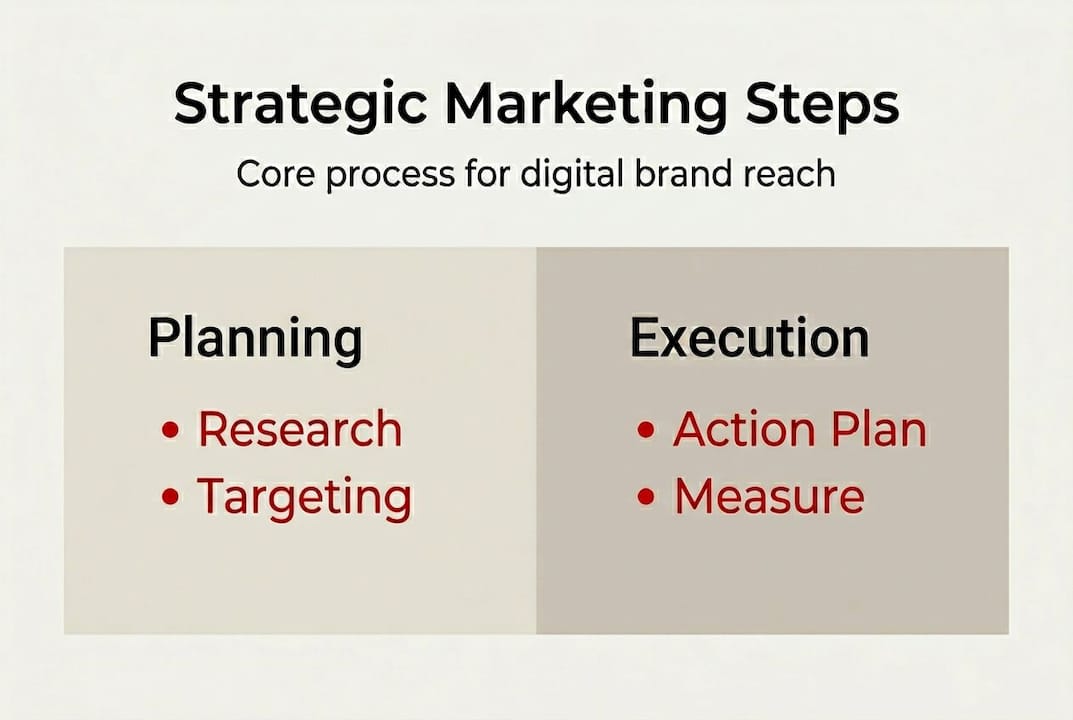
- Market research: Start by gathering data on your customers, competitors, and market conditions. This isn’t optional. It’s the foundation everything else is built on.
- Segmentation: Break your audience into meaningful groups based on demographics, behaviour, needs, or geography.
- Targeting: Choose which segments offer the best return based on size, accessibility, and alignment with your offer.
- Value proposition: Define precisely what you offer, to whom, and why it’s better than the alternatives.
- Marketing mix: Decide on your product, pricing, distribution, and promotional approach for each target segment.
- Execution: Deploy your campaigns across chosen channels with clear timelines, budgets, and responsibilities.
- Measurement: Track performance against your KPIs (key performance indicators) and adjust your approach based on what the data tells you.
The most common pitfalls UK businesses fall into include skipping the research stage, targeting audiences that are too broad, and failing to set measurable KPIs before a campaign launches. Without KPIs, you can’t tell whether your strategy is working or simply burning money.
Pro Tip: Organised marketers are 397% more likely to report success. The difference isn’t talent. It’s structure. Build your process before you build your campaign, and you’ll make better decisions at every stage. The strategic marketing experts who get consistent results aren’t necessarily the most creative. They’re the most disciplined.
Evidence and impact: why strategic marketing drives business results
Let’s examine what the data reveals about real-world impact and how to approach strategy critically. The numbers are striking. Organised marketers are 397% more likely to report success, and in the UK B2B space, 44% of businesses are increasing brand spend while 73% report longer sales cycles. That last figure matters. Longer sales cycles mean you need to stay visible and credible for longer, which is exactly what strategic marketing enables.
| Metric | Benchmark |
|---|---|
| Organised marketers reporting success | 397% more likely |
| UK B2B businesses increasing brand spend | 44% |
| UK B2B businesses reporting longer sales cycles | 73% |
| Improvement in conversion rates with data-driven approach | Significantly higher |
Here’s what strategic marketing actually changes in practice:
- Customer retention: Clear positioning and consistent messaging build trust, which keeps customers coming back.
- Brand recognition: Integrated campaigns across multiple channels reinforce your brand identity over time.
- Return on investment: Targeted, data-driven activity reduces wasted spend and improves efficiency.
- Sales pipeline quality: Better segmentation and targeting means you attract prospects who are more likely to convert.
- Competitive positioning: A clear strategy makes it harder for competitors to undercut you on price alone.
However, it’s worth being honest about the limits of the evidence. Research gaps in implementation remain a genuine concern in marketing strategy literature. Not every framework translates cleanly from theory to practice, and there’s a real risk of efficiency bias, where businesses mistake cost-cutting for strategic progress. Data-driven doesn’t automatically mean optimal. It means informed. The interpretation still requires judgement.
Perspective: what most experts overlook about strategic marketing
Here’s an uncomfortable truth. Most entrepreneurs who invest in strategic marketing frameworks still don’t see results. Not because the frameworks are wrong, but because they confuse having a plan with executing one.
We see this constantly. A business owner completes a thorough SWOT analysis, builds a detailed SOSTAC plan, and then defaults to the same three tactics they’ve always used. The framework becomes a document rather than a discipline.
The other trap is efficiency bias. Mistaking efficiency for effectiveness is one of the most dangerous patterns in marketing strategy. Cutting your agency budget, consolidating channels, and automating everything might look like progress on a spreadsheet. But if it reduces your brand’s presence and relevance, it’s actually regression dressed up as optimisation.
True strategic power comes from testing, measuring, and realigning regularly. Not once a year during a planning retreat. Monthly. Quarterly at minimum. Markets shift. Audiences evolve. The strategy that worked in January may be irrelevant by September. Working smarter means staying curious about what’s actually happening in your market, not just defending the plan you wrote six months ago.
Connect with experts to elevate your strategy
If you’re ready to move from theory to practical results, here’s where expert help can make the difference. At Radka Advertising, we work with UK entrepreneurs and established brands to build strategic marketing frameworks that are grounded in data, shaped by genuine market insight, and designed to deliver measurable outcomes. We don’t hand you a template and wish you luck.
Explore our see all services to understand how brand strategy, digital marketing, and creative content can work together for your business. Or browse our client case studies to see how we’ve helped brands across diverse industries sharpen their positioning and grow their digital presence. Strategy without execution is just theory. Let’s build something that works.
Frequently asked questions
What are the most widely used strategic marketing frameworks in the UK?
The most widely used frameworks include SWOT, STP, Porter’s Five Forces, Ansoff Matrix, and SOSTAC, as recommended by the Chartered Institute of Marketing for strategic planning at both SME and enterprise level.
How does strategic marketing impact my brand’s digital presence?
Strategic marketing integrates digital with offline activities, using STP and integrated channel frameworks to ensure your brand is consistently positioned and visible across every touchpoint your audience uses.
Why do so many marketing strategies fail in implementation?
Most fail because businesses focus on building frameworks rather than executing them, and gaps in implementation remain one of the most documented weaknesses in marketing strategy research.
What’s the difference between strategic and tactical marketing?
Strategic marketing is long-term planning aligned with overall business goals, while tactical marketing covers the specific short-term campaigns and actions that deliver on those goals week to week.
Recommended
- ClientPortal | RADKA ADVERTISING
- Full-Service Advertising Agency — London | Radka Advertising
- Services — Full-Service Advertising & Marketing | Radka Advertising
- Case Studies — Our Work | Radka Advertising
- Mastering digital strategy for luxury brand growth
- Top marketing strategies that drive rapid business growth