Design thinking in marketing: 5 phases for innovation

TL;DR:
- Design thinking shifts marketing focus from messaging to understanding customer experiences.
- It involves five phases: Empathise, Define, Ideate, Prototype, and Test, emphasizing iteration.
- Adopting empathy-driven, iterative methods improves campaign outcomes and customer loyalty.
Some of the most effective marketing breakthroughs begin not with a brainstorming session, but with a single, uncomfortable question: do we actually know what our customers need? Most campaigns fall short not because of poor creative execution, but because the underlying problem was never properly understood. Design thinking offers a structured, empathy-led approach to solving that problem. Borrowed from product and service development, it gives marketing professionals a repeatable framework to move from vague assumptions to sharp, validated strategies. This guide breaks down what design thinking means for marketers, how each phase works in practice, and what real-world evidence tells us about its impact on campaign performance and consumer loyalty.
Table of Contents
- What is design thinking in marketing?
- The five phases of design thinking: A marketer’s guide
- Real-world examples: Design thinking in action
- Barriers and adaptations: Design thinking in the real marketing world
- A fresh perspective: Where most marketers go wrong with design thinking
- Supercharge your marketing with design thinking experts
- Frequently asked questions
Key Takeaways
| Point | Details |
|---|---|
| Empathy first | Understanding real customer needs is the foundation of effective marketing innovation. |
| Practical framework | The five-phase design thinking model makes marketing more adaptive and user-focused. |
| Proven results | Brands using design thinking report measurable gains in loyalty and campaign performance. |
| Adapt for scale | Small teams can flexibly adopt core design thinking tools for fast, impactful improvements. |
What is design thinking in marketing?
Design thinking is a human-centred problem-solving methodology. It was originally developed in engineering and product design contexts, but it has since proved its worth far beyond those fields. In marketing, it shifts the starting point from “what do we want to say?” to “what does our customer actually experience?”
This distinction matters enormously. Traditional marketing often begins with a brand message and works outward. Design thinking reverses that. It starts with the customer’s world, their frustrations, habits, and unspoken desires, and builds the campaign around genuine insight rather than assumption.
As a full-service advertising agency, we see this gap constantly. Brands invest heavily in creative production while skipping the research phase that would tell them whether the creative direction even resonates with the right audience.
Design thinking in marketing follows a structured methodology typically consisting of five key phases: Empathise, Define, Ideate, Prototype, and Test. Each phase builds on the last, creating a cycle of continuous learning rather than a one-shot campaign launch.
Some common misconceptions are worth addressing directly:
- Design thinking is not just another word for “being creative.”
- It is not exclusively for large agencies with big research budgets.
- It does not replace marketing strategy; it sharpens it.
- It is not a linear checklist but an iterative, flexible process.
Several forces are pushing more brands toward this approach right now. Consumer expectations are rising sharply. Audiences are more sceptical of advertising than ever, and generic messaging is increasingly ignored. Meanwhile, the explosion of digital data means marketers have more raw material than ever to understand behaviour, if they know how to use it.
“Design thinking is not about thinking outside the box. It is about understanding the box your customer lives in.”
Brands that have adopted this mindset, from global consumer goods companies to ambitious startups, are consistently outperforming those that rely on intuition alone. The client portal overview at Radka Advertising reflects this philosophy, giving clients visibility into the research and strategy phases that underpin every campaign we build.
The five phases of design thinking: A marketer’s guide
Design thinking follows five key phases: Empathise, Define, Ideate, Prototype, and Test. Understanding each one in a marketing context transforms how you plan and execute campaigns.
-
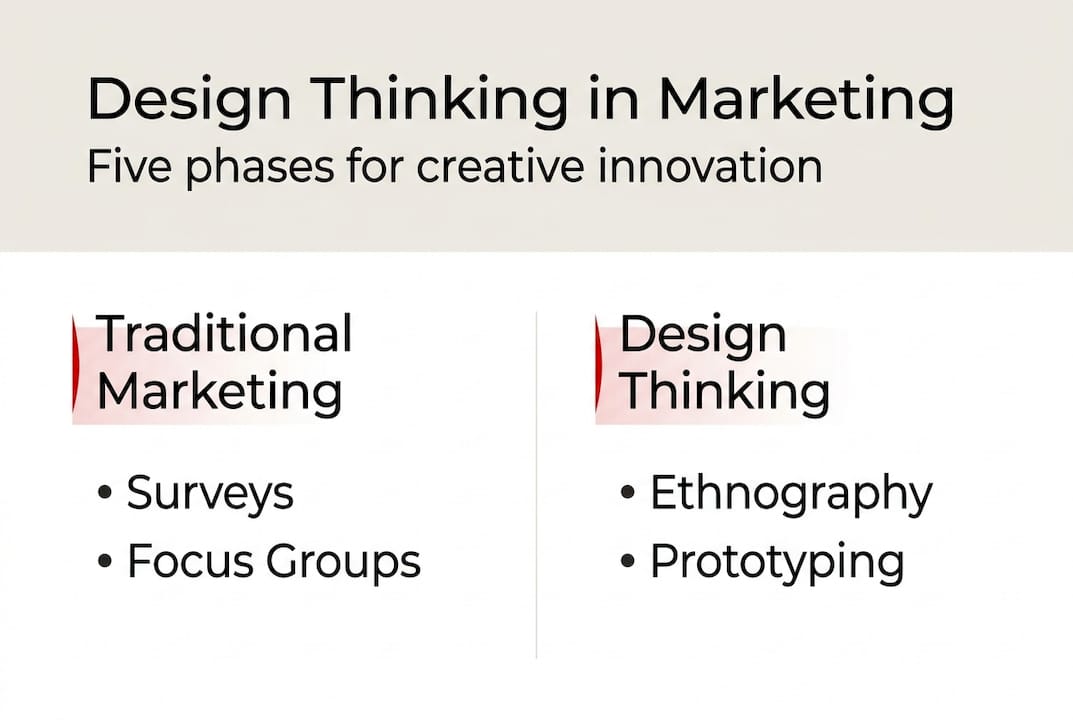
Empathise. This is where genuine insight begins. Rather than relying on surveys alone, marketers conduct interviews, observe customer behaviour in context, or use digital ethnography to understand how people actually interact with a product or service. The goal is to surface needs that customers themselves may not be able to articulate.
-
Define. Once you have gathered raw insight, you synthesise it into a clear problem statement. This is not a vague brief like “increase brand awareness.” It is a specific framing: “Young professionals in urban areas feel overwhelmed by financial product choices and distrust traditional bank advertising.”
-
Ideate. With a sharp problem definition in hand, the team brainstorms freely. Campaign concepts, messaging angles, channel combinations, and creative formats are all fair game. The emphasis here is on volume and variety before evaluation.
-
Prototype. Ideas become tangible quickly. In marketing, this might mean a draft social media campaign, a landing page mock-up, or a short video concept. The prototype does not need to be polished; it needs to be testable.
-
Test. Real audiences engage with the prototype and provide feedback. This data shapes the next iteration, long before full budget is committed to a rollout.
| Phase | Traditional marketing | Design thinking approach |
|---|---|---|
| Research | Surveys and focus groups | Ethnography and observation |
| Planning | Strategy set upfront | Problem defined from insight |
| Creative | One big campaign idea | Multiple rapid prototypes |
| Launch | Full rollout | Iterative testing first |
| Measurement | Post-campaign review | Continuous feedback loop |
Pro Tip: When running the Empathise phase, resist the urge to validate what you already believe. The most valuable insights often come from the moments when customers behave in ways that surprise you. Review marketing case studies to see how this plays out across different sectors.
Real-world examples: Design thinking in action
Theory is useful. Evidence is better. Several well-documented cases show exactly what happens when design thinking is applied to marketing challenges with rigour and commitment.
The Herta case is particularly instructive. Herta, a processed meat brand, was struggling with customer retention despite reasonable product quality. Rather than launching another advertising push, the team used in-home ethnography, observing how consumers actually stored, prepared, and consumed their products at home. The research identified 3 failure points that surveys had completely missed: awkward packaging, confusing portion guidance, and a disconnect between the product’s positioning and how it was actually used in family meals. Addressing those specific friction points improved loyalty measurably.

The lesson here is sharp. Surveys tell you what people think they do. Observation tells you what they actually do. Those two things are often very different.
| Approach | Method used | Outcome |
|---|---|---|
| Herta (ethnography) | In-home observation | 3 failure points identified, loyalty improved |
| SME with AI integration | DT combined with AI tools | Improved campaign effectiveness |
| Traditional campaign | Survey-led research | Missed behavioural insights |
For smaller businesses, the picture is equally compelling. SMEs integrating design thinking with AI marketing tools reported sharper campaign targeting and better returns on modest budgets. The combination works because AI accelerates the data analysis that the Empathise and Test phases depend on, while design thinking ensures the human context is never lost in the numbers.
Key takeaways for brands of any size:
- Behavioural observation beats self-reported data almost every time.
- Small, well-targeted tests outperform large, untested campaigns.
- Combining empathy with data tools compounds the benefit of both.
- Loyalty improvements tend to follow when friction points are genuinely resolved.
Explore marketing success stories from our own portfolio to see how these principles translate across industries, from energy brands to beauty and consumer goods.
Barriers and adaptations: Design thinking in the real marketing world
Design thinking sounds compelling on paper. In practice, many marketing teams hit real obstacles when they try to implement it. Understanding those barriers is the first step to working around them.
The most common challenge is time. A full design thinking process, done properly, takes weeks. Most marketing teams are working to quarterly deadlines with campaigns already in flight. The gap between the ideal process and the available runway is often significant.
Cost is the second barrier. Ethnographic research, usability testing, and iterative prototyping all require investment. For lean teams and SMEs, full implementation faces resource challenges that are genuinely difficult to overcome without compromising elsewhere.
Pro Tip: You do not need to run all five phases on every project. Even applying just the Empathise and Define phases before briefing your creative team will produce sharper, more targeted work than jumping straight to ideation.
Practical adaptations for resource-limited settings:
- Run five customer interviews instead of a full ethnographic study. Even a small sample surfaces patterns.
- Use existing customer service data, reviews, and social listening as low-cost empathy inputs.
- Prototype with simple tools: a Canva mock-up or a short script is enough to test a concept.
- Timebox your ideation sessions. Sixty focused minutes beats three hours of unfocused brainstorming.
- Use AI-powered marketing tools to compress the research and analysis phases without losing depth.
For teams that want to go deeper on the prototyping side, a rapid prototyping guide offers a useful framework that translates well into marketing asset development. The core principle, build fast, learn faster, applies just as much to a campaign concept as it does to a physical product.
Design thinking is not an all-or-nothing commitment. Even partial adoption, applied consistently, improves the quality of marketing decisions over time.
A fresh perspective: Where most marketers go wrong with design thinking
Here is the uncomfortable truth we have observed working with brands across multiple sectors: most teams treat design thinking as a process to complete rather than a mindset to adopt. They run through the five phases, tick the boxes, and then revert to their usual instincts at the moment of decision.
The phases are not the point. Genuine curiosity about your customer is the point. The best marketers we have worked with do not follow design thinking because it is on a framework diagram. They follow it because they are genuinely unsatisfied with assumptions. They push for one more interview, one more test, one more iteration, not because a process tells them to, but because they know there is always something they have not yet understood.
Top-performing campaigns in our practical case studies share one trait: the team behind them stayed curious longer than felt comfortable. They resisted the pressure to move to production before the insight was solid.
The brands that struggle with design thinking are often the ones looking for a shortcut to innovation. There is no shortcut. The methodology gives you structure, but the results come from the quality of attention you bring to your customer’s real experience.
Supercharge your marketing with design thinking experts
At Radka Advertising, we apply design thinking principles across every stage of campaign development, from initial customer research through to creative execution and performance testing. We do not start with a brief and end with a launch. We start with questions and iterate until the answers are clear.
If your campaigns are not generating the engagement or loyalty you expect, the problem is rarely the creative. It is usually the insight behind it. Our marketing services are built to close that gap, combining strategic empathy-led research with AI growth solutions that accelerate learning and sharpen targeting. Let us help you build campaigns that actually connect.
Frequently asked questions
How does design thinking differ from traditional marketing approaches?
Design thinking prioritises empathy and iterative testing, while traditional approaches typically set strategy upfront and launch without flexible adaptation. The five-phase process builds in continuous learning rather than a single campaign cycle.
Can small teams or SMEs use design thinking effectively in marketing?
Yes, SMEs can adapt the process to their scale by focusing on rapid customer interviews and quick prototypes rather than full formal research programmes. SMEs face resource challenges but consistently benefit from even partial adoption of the methodology.
What evidence is there that design thinking actually improves marketing outcomes?
Studies show that companies like Herta and numerous SMEs report improved campaign performance and stronger customer loyalty when applying design thinking. Case studies confirm that behavioural insight consistently outperforms assumption-led planning.
How does AI fit into design thinking for marketing?
AI enhances design thinking by accelerating research analysis and enabling faster testing cycles, particularly in the Empathise and Test phases. SMEs combining AI with design thinking report measurably improved campaign effectiveness compared to using either approach alone.