Creative advertising for UK SMBs: grow your brand in 2026

TL;DR:
- Regularly refreshing creatives boosts ROAS by 1.5x and increases conversions by 19%.
- Creative advertising, combining originality and emotional storytelling, outperforms generic ads across budgets.
- Balancing long-term brand building with short-term activation using testing and data-driven strategies drives sustainable growth.
Refreshing five to seven creatives weekly can boost ROAS by 1.5x and lift conversions by 19%. That figure surprises most marketing managers in small and medium-sized businesses, because the assumption has long been that standout advertising belongs to brands with enormous budgets. It does not. Creativity is a force multiplier, and it works regardless of spend level. This guide unpacks what creative advertising actually means, why the evidence behind it is compelling, and how UK SMBs can apply practical frameworks to generate real, measurable brand growth without waiting for a bigger budget.
Table of Contents
- What is creative advertising and why does it matter?
- How creative advertising drives measurable business outcomes
- The power of creative optimisation and testing
- Best practice frameworks for UK SMBs
- Our perspective: rethinking creative spend for sustainable brand growth
- Enhance your brand with expert creative strategy
- Frequently asked questions
Key Takeaways
| Point | Details |
|---|---|
| Creativity delivers ROI | Investing in creative advertising consistently boosts sales, conversions, and long-term brand value for UK SMBs. |
| Testing beats guesswork | Frequent creative refreshes and optimisation turn wasted spend into measurable gains, even on modest budgets. |
| Emotional campaigns build trust | Emotional, trust-led creative strategies outperform standard approaches in earning loyalty and driving sustainable growth. |
| Frameworks enable scale | Smart frameworks—balancing brand and activation—help SMBs scale visibility without overspending or sacrificing quality. |
What is creative advertising and why does it matter?
Creative advertising is not simply making things look attractive. It is the deliberate combination of originality, emotional storytelling, and strategic messaging to capture attention and shift how an audience feels about a brand. The distinction matters because most advertising fails not from poor placement but from a lack of genuine creative ambition.
For UK SMBs, this is both a challenge and an opportunity. Large brands spend millions on reach, but reach without creative impact is noise. A smaller brand that tells a sharper, more emotionally resonant story can consistently outperform a competitor spending ten times more. The playing field is not level, but creativity tilts it in your favour.
Why does creativity cut through? Because human attention is selective. People ignore what feels generic and remember what surprises or moves them. Advertising that triggers an emotional response, whether curiosity, warmth, humour, or aspiration, earns a disproportionate share of mental space. That mental space translates directly into purchase intent and brand recall.
The evidence supports this strongly. Highly creative campaigns are twice as likely to win effectiveness awards, with a 44% win rate compared to 21% for standard campaigns. That is not a marginal difference. It reflects a structural advantage that creativity provides across industries and budget levels.
Here is what effective creative advertising typically involves:
- Emotional storytelling that connects the brand to a feeling or aspiration the audience already holds
- Distinctive visual identity that makes the brand instantly recognisable across channels
- Consistent messaging that reinforces a single, clear brand promise over time
- Audience-specific relevance that makes the viewer feel the message was made for them
- Originality that earns attention rather than buying it through sheer volume
“Creativity is not a luxury for brands with large budgets. It is the most cost-efficient tool available to any brand willing to invest in ideas.”
You can explore how these principles translate into real-world results through creative campaign case studies across a range of industries and brand sizes.
How creative advertising drives measurable business outcomes
Knowing what creative advertising is matters less than understanding what it actually delivers. The good news is that the data here is unusually clear.
Trust-building creative campaigns deliver 65% more large business effects than standard campaigns, and 93% of brands using emotional, trust-led approaches report major business gains compared to 66% for average campaigns. These are not marginal improvements. They represent a fundamentally different growth trajectory.
The mechanism behind this is well understood. Emotional campaigns build memory structures, which is the mental shorthand people use when making purchasing decisions. When a brand has invested in emotional creative over time, it becomes the instinctive choice rather than a considered one. That is enormously valuable, particularly for SMBs competing against established names.
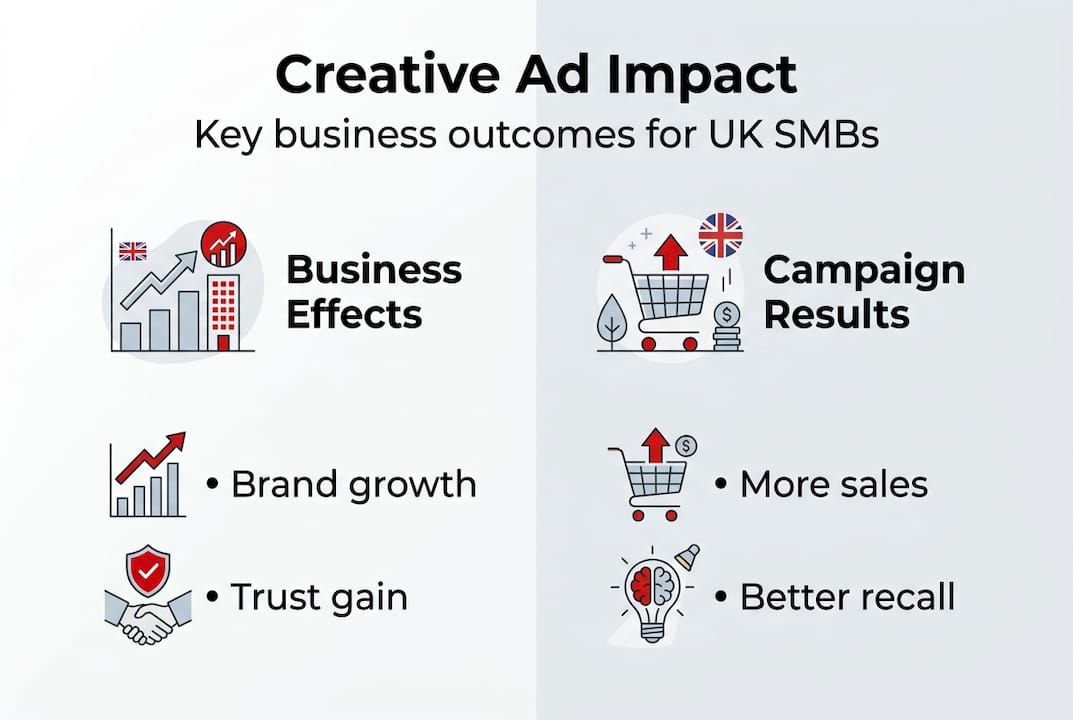
Here is a comparison of how creative and standard campaigns typically perform across key metrics:
| Metric | Standard campaign | Highly creative campaign |
|---|---|---|
| Effectiveness award win rate | 21% | 44% |
| Major business effects reported | 66% | 93% |
| Long-term brand equity growth | Moderate | Significantly higher |
| Emotional recall after 30 days | Low | High |
| Trust and loyalty uplift | Incremental | Sustained |
The long-term effects deserve particular attention. Activation campaigns, those focused on immediate sales or clicks, produce short bursts of performance. Creative brand-building campaigns compound over time. Each piece of content reinforces the last, building a cumulative equity that makes future campaigns more efficient.
For UK SMBs, this means that emotional campaigns for lasting results are not a soft, feel-good investment. They are a hard commercial strategy with a measurable return that grows the longer you commit to it.
Key outcomes that creative advertising consistently delivers include:
- Higher conversion rates driven by stronger emotional engagement at the point of decision
- Improved customer retention because emotionally connected customers are less price-sensitive
- Greater brand differentiation in crowded markets where product parity is common
- Reduced cost per acquisition over time as brand familiarity lowers the barrier to purchase
The power of creative optimisation and testing
Understanding creative impact is one thing. Systematically improving it is another. This is where creative optimisation and testing become essential tools for any SMB serious about advertising performance.

Creative optimisation means continuously refining your advertising assets based on real performance data. Rather than launching a single campaign and hoping for results, you test multiple versions, learn what works, and iterate quickly. The methodology is straightforward but the discipline required is significant.
A basic A/B testing process for creative advertising looks like this:
- Define a single variable to test, such as headline, image, or call to action
- Create two versions of the ad that differ only in that variable
- Run both simultaneously to a comparable audience segment
- Measure the key metric relevant to your goal, whether click-through, conversion, or engagement
- Declare a winner after reaching statistical significance, then test the next variable
- Refresh creatives regularly, aiming for five to seven variants weekly to maintain performance
Varied creative formats yield 19% more conversions, which makes the case for testing across formats, not just within a single one. Video, static image, carousel, and short-form content each reach different audience states and deserve individual testing.
Here is how manual and AI-driven optimisation compare:
| Approach | Speed | Scale | Cost | Best for |
|---|---|---|---|---|
| Manual A/B testing | Slow | Limited | Low upfront | Early-stage SMBs |
| AI-driven optimisation | Fast | High | Moderate investment | Growth-stage brands |
| Hybrid approach | Moderate | Scalable | Flexible | Most UK SMBs |
The creative intelligence market is projected to grow 22.6% to $11.5 billion by 2028, driven by AI tools that personalise creative at scale and eliminate the 40 to 50% of creative assets that currently go to waste. That waste figure is striking. Nearly half of what most brands produce never performs. Smarter testing eliminates this.
You can track your creative performance using creative refresh analytics and explore AI-powered creative optimisation tools suited to SMB budgets. For teams without in-house design capacity, outsourced creative talent provides a scalable route to maintaining creative volume without overspending.
Pro Tip: Start with two or three creative variants rather than one polished execution. The learning you gain from early testing is worth more than the perfection of a single asset.
Best practice frameworks for UK SMBs
With testing tools and data in hand, the question becomes how to structure your creative investment for sustainable results. Several frameworks have proven particularly effective for UK SMBs operating with constrained resources.
The most widely validated is the 60:40 brand-to-activation split. Sixty percent of your creative budget should build long-term brand equity through emotional, trust-led content. Forty percent should drive short-term activation through direct response and conversion-focused ads. This balance prevents the common SMB mistake of spending everything on immediate sales while starving the brand of the awareness it needs to grow.
High-volume testing is another cornerstone. Rather than producing one campaign per quarter, produce multiple lightweight creative variants continuously. This keeps your advertising fresh, feeds the algorithm with performance data, and prevents creative fatigue in your audience.
A multi-channel approach is equally important. Different platforms serve different audience mindsets. Social media is where emotional storytelling lands best. Search captures intent. Display reinforces awareness. Each channel deserves creative tailored to its context rather than a single asset repurposed everywhere.
Here are the key practices worth building into your creative process:
- Prioritise emotional resonance over informational density in brand-building content
- Maintain creative consistency across channels so each touchpoint reinforces the same brand identity
- Test regularly and refresh often to avoid audience fatigue and maintain engagement rates
- Use data to guide decisions rather than relying on internal preferences or assumptions
- Allocate budget deliberately using the 60:40 principle as a starting point, then adjust based on results
You can manage these workflows through the SMB creative optimisation portal, which gives you visibility across campaigns and creative performance in one place. For teams looking to scale without hiring, remote team strategies offer a practical route to creative capacity on demand.
Pro Tip: Tap into specialist creative partners for specific executions rather than building a full in-house team. You get expertise where it counts without the overhead.
Our perspective: rethinking creative spend for sustainable brand growth
After working across UK markets and reviewing the evidence, we hold a view that most guides avoid: the biggest creative mistake UK SMBs make is not underspending on creativity. It is overspending on volume while underinvesting in quality.
Many brands produce a high volume of mediocre content because it feels productive. It rarely is. One emotionally resonant campaign, properly tested and refreshed, will consistently outperform ten average ones. The brands we see achieving real creative success are not those with the largest outputs. They are those with the clearest point of view and the discipline to test it rigorously.
Small budgets are not the barrier most marketers believe them to be. Agility is the real advantage. A smaller brand can test, learn, and pivot in days. A large brand takes months. That speed is a genuine competitive edge, but only if you are structured to use it. Prioritise trust, emotional connection, and creative consistency over sheer volume, and the returns will follow.
Enhance your brand with expert creative strategy
The frameworks and data in this guide point to one clear conclusion: creative advertising, when executed with discipline and tested rigorously, delivers outsized returns for UK SMBs. The question is not whether to invest in creativity but how to do it efficiently.
As a full-service creative agency, we help UK brands build and execute creative strategies that are grounded in data and designed for sustained growth. Whether you need a complete brand overhaul or targeted campaign support, our creative marketing services are built around your business objectives. Start by exploring the creative client portal to see how we manage and optimise creative performance for brands at every stage.
Frequently asked questions
Does creative advertising really work for small budgets?
Yes. Weekly creative refreshes boost ROAS by 1.5x and lift conversions by 19%, demonstrating that frequency and variety matter more than budget size. Smart iteration consistently outperforms big spend on static campaigns.
What methods help SMBs maximise creative impact?
High-volume testing and dynamic optimisation, combined with a balanced emotional and informative approach across multiple channels, give UK SMBs the tools to compete effectively and scale visibility without proportionally increasing spend.
How does emotional creative advertising affect business results?
Trust-building campaigns deliver 65% more large business effects and 93% of brands using them report major gains, significantly outperforming activation-only approaches that focus purely on short-term conversion.
Is outsourcing creative design a viable strategy for SMBs?
Absolutely. The creative intelligence market is growing rapidly, and outsourcing gives SMBs access to specialist talent and scalable creative capacity without the fixed costs of an in-house team.