Why measure marketing ROI: a practical guide for 2026

TL;DR:
- Measuring marketing ROI connects marketing spending to business profit and justifies budget requests. Accurate ROI relies on reliable data, linking revenue to campaigns, and tracking core metrics like revenue, ROAS, and CAC. Building a trustworthy system requires aligning finance and marketing, standardizing data practices, and fixing tracking flaws first.
Marketing ROI is defined as the net profit attributable to marketing activities divided by the total marketing spend, expressed as a percentage. It is the clearest measure of whether your marketing budget generates real business value or simply produces activity. Marketing ROI compares net profit from marketing against the cost of that marketing to assess campaign profitability. Understanding why measure marketing ROI matters is not an academic exercise. It is the difference between a marketing function that earns its seat at the board table and one that fights every budget cycle to justify its existence.

Why measure marketing ROI at all?
The answer is straightforward: without measuring return on investment, marketing spend is an act of faith rather than a business decision. Marketing ROI connects every pound spent on campaigns, content, and advertising to a financial outcome. That connection is what separates marketing that drives profit from marketing that merely drives activity.
Business owners and marketing professionals who track ROI gain three concrete advantages. First, they can justify budget requests with financial evidence rather than impressions and click-through rates. Second, they can reallocate spend away from underperforming channels before losses compound. Third, they build credibility with CFOs and boards who speak the language of margins, not metrics.
The importance of marketing ROI also extends to long-term strategy. When you know which channels produce the highest return, you can model future growth with confidence. That modelling informs hiring decisions, product launches, and market expansion. Without it, growth planning rests on assumptions that unravel under scrutiny.
How is marketing ROI calculated and interpreted?
The core formula is: (Revenue attributable to marketing minus marketing cost) divided by marketing cost. The result tells you how much profit each pound of marketing spend generates. A result of 2.0 means every £1 spent returns £3 in revenue, covering cost and generating £2 in profit.
Three metrics sit at the heart of any credible ROI calculation.
- Marketing-attributed revenue is the direct revenue generated by specific campaigns. Tracking this revenue enables clear justification of marketing spend and positions it as the clearest indicator of ROI.
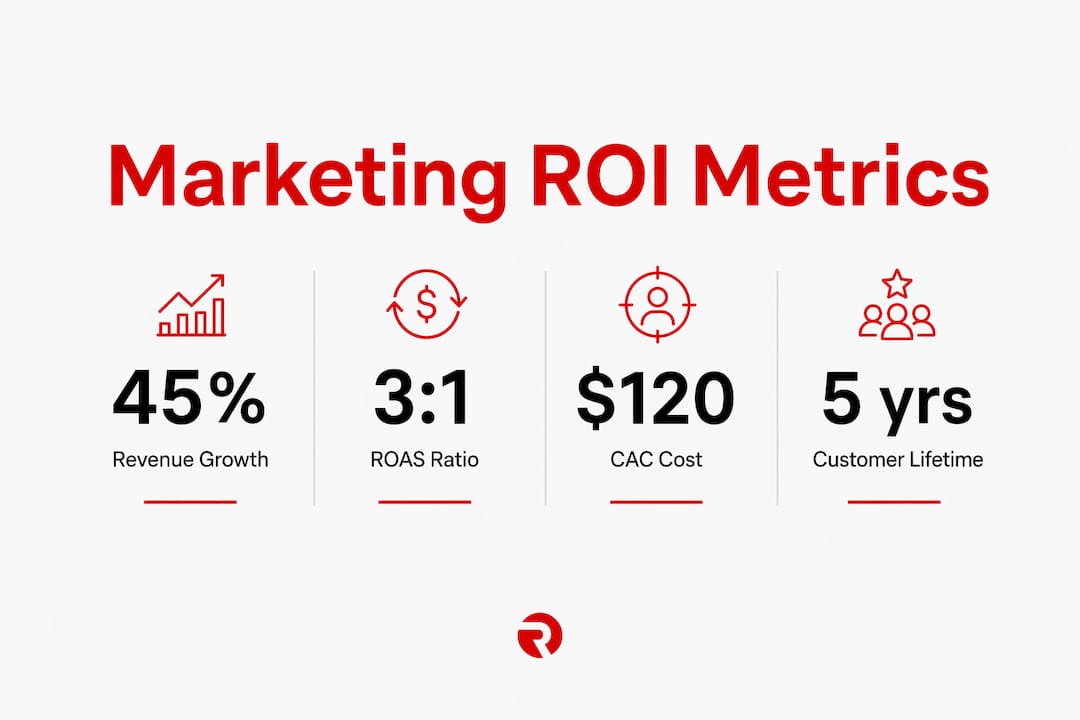
- Return on Ad Spend (ROAS) measures how much revenue is earned for each pound spent on advertising. ROAS profitability thresholds depend on business margins, so a 4:1 ROAS may be excellent for a high-margin software product but inadequate for a low-margin retailer.
- Customer Acquisition Cost (CAC) must include agency fees, software licences, and staff time, not just ad spend. Total CAC including all expenses gives a far more accurate picture of profitability than ad spend alone.
Interpreting these figures requires context. A positive ROI figure means nothing if it ignores product margins or customer lifetime value. A campaign that acquires customers at £50 CAC looks profitable until you discover those customers spend £40 on average and churn within 90 days.
Pro Tip: Focus on the three Tier 1 metrics above rather than building dashboards with 30 data points. These three metrics provide 80% of the insight needed to assess marketing profitability and efficiency.
What are the main challenges in measuring marketing ROI?
Most measurement failures are architectural, not analytical. The problem is not that marketers lack the intelligence to interpret data. The problem is that the data itself is broken before anyone looks at it.
The most common structural failures include:
- Disconnected CRM data: When marketing spend data and sales outcome data live in separate systems with no shared identifier, attribution becomes guesswork. You cannot calculate marketing-attributed revenue if your CRM does not record which campaign sourced each closed deal.
- Inconsistent UTM tagging: UTM fragmentation and lack of CRM linkage cause discrepancies between spend and attributed outcomes. A single inconsistency in UTM conventions corrupts months of channel data.
- Dashboard bloat: Reporting on 40 metrics creates the illusion of rigour while obscuring the three numbers that actually matter. Boards and CFOs do not want more data. They want clearer answers.
- Activity metrics masquerading as outcomes: Clicks, impressions, and leads are activity metrics. Signed contracts, revenue, and gross profit are outcome metrics. Reporting the former as evidence of ROI destroys credibility with finance teams.
Dashboards designed for campaign management often fail under board scrutiny for financial accountability. The mismatch between what marketing reports and what commercial finance requires is the root cause of board-level distrust in marketing ROI reporting.
The consequence of these architectural flaws is budget misallocation. When cost-per-outcome figures are skewed by broken tracking, marketing teams double down on channels that appear to perform well but actually do not. That misallocation compounds over quarters and erodes the marketing function’s commercial credibility.
Which core financial metrics reveal true marketing impact?
Three metrics provide the clearest picture of marketing effectiveness. Understanding each one, and using them together, is the foundation of credible ROI reporting.
| Metric | Definition | Purpose | How to interpret |
|---|---|---|---|
| Marketing-attributed revenue | Proves marketing’s contribution to top-line growth | Higher is better; compare across channels and periods | |
| ROAS (Return on Ad Spend) | Revenue earned per £1 of advertising spend | Measures ad efficiency relative to margins | Benchmark against your gross margin, not a universal target |
| CAC (Customer Acquisition Cost) | Total marketing cost divided by new customers acquired | Reveals true cost of growth | Compare against customer lifetime value to assess sustainability |
Marketing-attributed revenue is the most direct link between marketing activity and business growth. It answers the question every CEO asks: “What did we get for that spend?” Tracking it by channel, campaign, and audience segment reveals which investments produce the most commercial value.
ROAS works best as a relative measure rather than an absolute target. A 3:1 ROAS in a business with 70% gross margins is highly profitable. The same ratio in a business with 20% margins means the campaign loses money after costs. Always calibrate ROAS targets against your own unit economics.
CAC is where most businesses undercount. Including only media spend and ignoring agency fees, marketing technology costs, and the proportion of staff time dedicated to acquisition produces a figure that flatters performance. Accurate CAC requires a full accounting of every resource consumed to win a new customer.
Pro Tip: Pair CAC with customer lifetime value (CLV) to assess whether your acquisition economics are sustainable. If CAC exceeds CLV within 12 months, the channel is destroying value regardless of what the ROAS figure suggests. Analytics-focused approaches that drive better ROI consistently prioritise this pairing.
How can businesses build trustworthy ROI reporting systems?
Trustworthy reporting starts with architecture, not analysis. Before you build dashboards or commission reports, the underlying data infrastructure must connect marketing spend to financial outcomes reliably.
- Connect CRM outcome data to marketing spend. Assign a shared identifier, such as a lead source code or campaign ID, to every prospect from first touch to closed deal. This single step eliminates the attribution gap that undermines most ROI reports.
- Standardise UTM tagging conventions. Create a documented tagging protocol and enforce it across every team and agency. Inconsistent UTMs are the single most common cause of channel data corruption.
- Design multi-layered reporting. Separate activity metrics (clicks, sessions), progression metrics (leads, qualified opportunities), outcome metrics (revenue, contracts), and efficiency metrics (CAC, ROAS) into distinct reporting layers. Each layer answers a different question for a different audience.
- Involve finance in metric definitions. When marketing and finance agree on how marketing-attributed revenue is defined and calculated, board-level trust follows. Unified measurement frameworks that connect activity data, financial outcomes, and organisational collaboration restore confidence in marketing reporting.
- Use AI models to complement, not replace, sound architecture. AI connects brand sentiment and revenue impact over time, revealing ROI insights that last-click attribution misses entirely. However, AI models built on broken tracking data produce confident-sounding nonsense. Fix the architecture first.
The goal is a reporting system that a CFO can interrogate without finding gaps. That means every revenue figure traces back to a campaign, every campaign traces back to a spend line, and every spend line connects to a financial outcome.
Pro Tip: Conduct a quarterly audit of your measurement architecture. Check UTM consistency, CRM linkage, and whether your reported metrics match your finance team’s revenue figures. Catching discrepancies early prevents months of misallocated budget.
Key takeaways
Measuring marketing ROI is the only way to connect marketing spend directly to business profit, and the three metrics that matter most are marketing-attributed revenue, ROAS, and CAC.
| Point | Details |
|---|---|
| Define ROI with precision | Calculate net profit from marketing divided by marketing cost, not just revenue versus spend. |
| Prioritise three core metrics | Marketing-attributed revenue, ROAS, and CAC provide 80% of the insight needed for sound budget decisions. |
| Fix architecture before analysis | Disconnected CRM data and inconsistent UTM tagging corrupt ROI figures before anyone interprets them. |
| Align with finance teams | Shared metric definitions between marketing and finance build board-level trust in ROI reporting. |
| Use AI as a complement | AI-driven models enhance ROI insight but only when built on reliable, connected data infrastructure. |
What I have learned from years of watching ROI reports fail
The most common mistake I see is not a calculation error. It is a confidence error. Marketing teams produce dashboards full of numbers and present them as evidence of ROI when they are actually evidence of activity. Clicks went up. Impressions grew. Cost per click fell. None of that tells a CFO whether marketing made the business more profitable.
The shift that changes everything is moving from volume-based proxies to outcomes-based measurement. That shift is harder than it sounds because it requires marketing to accept accountability for revenue, not just reach. It also requires finance to engage with marketing data rather than dismissing it as unverifiable. When both sides meet in the middle, the reporting becomes genuinely useful.
I have also seen businesses invest heavily in AI-driven attribution models before fixing their basic tracking. The result is sophisticated analysis of corrupted data. The lesson is always the same: architecture first, analysis second. A well-structured marketing strategy that integrates financial ROI from the outset avoids this trap entirely.
The role of ROI reporting in 2026 is evolving. AI tools now connect brand health metrics to commercial outcomes in ways that last-click models never could. That is genuinely useful progress. But the businesses that benefit most are those that already have clean, connected data. The ones that skip the architecture step will find that better tools simply produce faster wrong answers.
Marketing that cannot prove its financial contribution will always be treated as a cost centre. Marketing that can prove it becomes a profit driver. That distinction determines whether marketing gets more budget or less at every planning cycle.
— Bart
How Radkaadvertising approaches marketing ROI for its clients
Radkaadvertising works with business owners and marketing professionals who need more than campaign reports. The agency builds finance-aligned measurement frameworks that connect marketing spend directly to revenue and margin outcomes. Every engagement starts with an audit of the existing measurement architecture to identify where tracking breaks down and where budget is being misallocated as a result.
The Radkaadvertising case studies show measurable ROI improvements across sectors including energy, beauty, and consumer goods, with clients including Coca-Cola, Maybelline, and PowerLink Energy. For businesses ready to move beyond vanity metrics, the AI-powered growth programme integrates brand health data with commercial outcomes to produce reporting that satisfies both marketing teams and finance directors. The result is a marketing function that earns its budget rather than defending it.
FAQ
What is marketing ROI in simple terms?
Marketing ROI measures how much profit a business earns for every pound spent on marketing. It is calculated by subtracting marketing cost from marketing-attributed revenue, dividing by marketing cost, and expressing the result as a percentage.
Why do boards distrust marketing ROI reports?
Boards distrust ROI reports when they are built on activity metrics rather than financial outcomes. Dashboards designed for campaign management often fail under board scrutiny because they cannot trace revenue figures back to specific spend lines.
What is the difference between ROAS and marketing ROI?
ROAS measures revenue generated per pound of ad spend, while marketing ROI measures net profit relative to total marketing cost. ROAS is a useful efficiency metric, but it does not account for margins or the full cost of marketing, which ROI does.
How do I fix broken marketing ROI measurement?
Start by connecting your CRM outcome data to your marketing spend using a shared identifier such as a campaign ID. Then standardise UTM tagging conventions across all channels and agencies to prevent data fragmentation.
Which metrics matter most for measuring marketing ROI?
Marketing-attributed revenue, Return on Ad Spend (ROAS), and Customer Acquisition Cost (CAC) are the three metrics that provide the clearest picture of marketing profitability. Together, they account for the majority of insight needed to make sound budget decisions.