Why is content marketing important for brand growth?

TL;DR:
- Content marketing involves creating valuable content to attract, engage, and convert customers without interrupting their experience. It builds trust faster than advertising and influences all buyer journey stages, resulting in higher-quality leads. Cost-effective and capable of delivering 3–5 times return over 24 months, it requires a deliberate distribution and measurement strategy to succeed long-term.
Content marketing is the strategic creation and distribution of valuable, relevant content to attract, engage, and convert customers, making it one of the most powerful drivers of brand growth available to businesses today. Unlike paid advertising, which interrupts audiences, content marketing earns attention by solving real problems and answering genuine questions. Content marketing increases brand awareness for 87% of marketers and helps generate more leads for 76%. Those numbers explain why understanding why is content marketing important has moved from a marketing debate to a boardroom priority. Radkaadvertising works with brands from startups to established names like Coca-Cola and Maybelline, and the pattern is consistent: brands that publish with purpose grow faster than those that advertise alone.
Why is content marketing important for building trust?
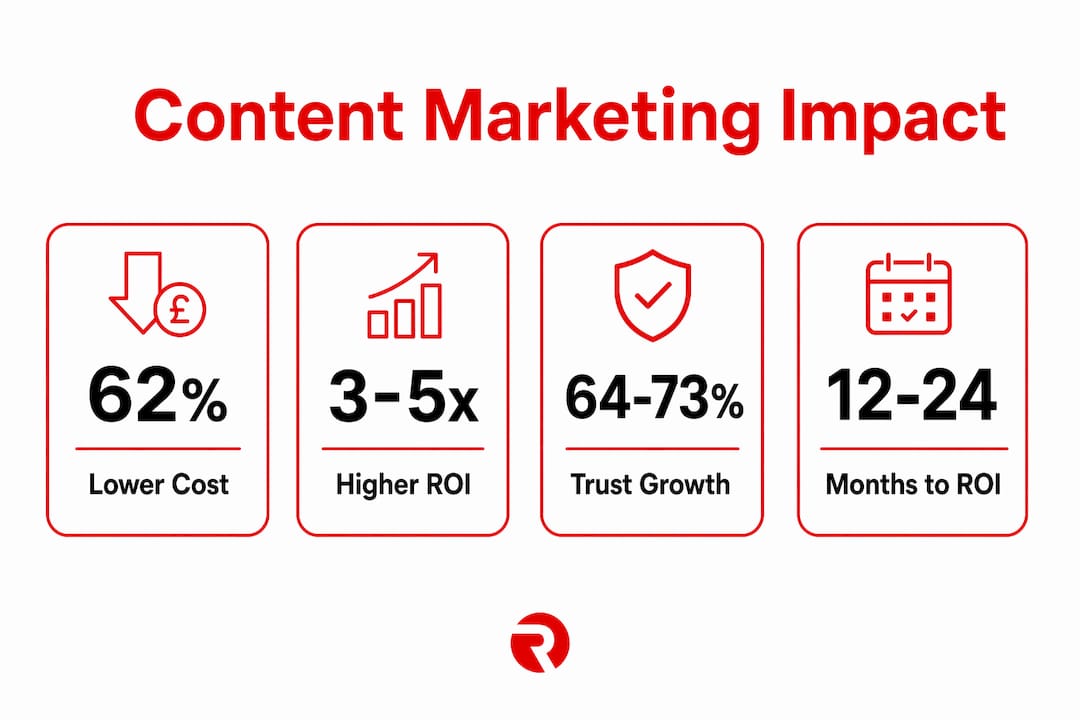
Trust is the single biggest commercial asset a brand can own, and content marketing builds it faster than any advertisement. 96% of people do not trust advertising, while 64% trust brands that create educational content. That trust figure rises to 73% just one week after a consumer engages with a brand’s content. The gap between those two numbers is the entire business case for content marketing.
Traditional advertising tells people what to buy. Content marketing shows people how to solve a problem, which positions the brand as a credible authority rather than a vendor. A software company publishing a detailed guide on data security earns more credibility with a procurement manager than a banner ad ever could. That credibility shortens sales cycles because buyers arrive already convinced of the brand’s expertise.
“People don’t want to be sold to. They want to be helped. Content marketing is the mechanism that makes helping people profitable.”
The trust advantage also compounds over time. A library of genuinely useful articles, videos, and guides becomes a permanent asset that continues working long after the initial publishing cost. Paid ads stop the moment the budget runs out. Content does not.
Pro Tip: Prioritise depth over volume. One genuinely useful 1,500-word guide outperforms ten thin posts every time, both for reader trust and for search engine authority.

How does content marketing drive lead generation?
Content marketing influences multiple buyer journey stages with tailored content, from early awareness through to final evaluation. This is what makes it structurally different from most other marketing channels. A paid search ad captures demand that already exists. Content marketing creates demand by educating buyers who did not yet know they had a problem.
The buyer journey breaks down into three practical content opportunities:
- Awareness stage. Blog posts, explainer videos, and social content attract buyers who are problem-aware but not yet solution-aware. A financial services firm publishing guides on cash flow management reaches business owners before they start comparing accounting software.
- Consideration stage. Comparison articles, case studies, and webinars help buyers evaluate options. Lead nurturing through content at this stage keeps your brand in the shortlist while competitors go quiet.
- Decision stage. Testimonials, detailed product guides, and ROI calculators give buyers the final confidence to act. This content self-qualifies leads, meaning the prospects who reach your sales team are already educated and motivated.
The practical result is better lead quality, not just more leads. A buyer who has read three of your articles before contacting you is a fundamentally different conversation from a cold prospect. 76% of marketers report increased lead generation from content marketing, which reflects this structural advantage across industries and business sizes.
AI-powered search tools like ChatGPT and Perplexity now surface content directly in answers, adding a new discovery layer on top of traditional Google search. Brands with established content authority appear in these AI-generated responses, which creates a distribution advantage that did not exist three years ago.
Is content marketing cost-effective compared to paid advertising?
Content marketing costs 62% less to launch and maintain than comparable paid campaigns. That cost advantage is significant on its own, but the more important financial argument is the return profile over time.
| Metric | Paid search | Content marketing |
|---|---|---|
| Cost per lead | Higher, ongoing spend required | Lower after initial investment |
| Traffic after budget pause | Stops immediately | Continues from organic rankings |
| ROI timeline | Fast but short-lived | Slower to build, compounds over 24+ months |
| Brand authority built | Minimal | Significant and defensible |
Content marketing delivers 3–5x ROI over 24 months compared to paid search for service businesses. The reason is simple: a well-ranked article keeps attracting visitors without additional spend, while a paid ad requires continuous budget to maintain the same traffic.
The measurement conversation has also shifted. C-suite leaders now expect marketing teams to link content impact to revenue, customer outcomes, and AI-driven visibility rather than purely to traffic or click metrics. Effect (engagement) and impact (revenue influence) are distinct measures. Marketing teams that report only on page views are speaking a language their leadership no longer finds convincing.
Pro Tip: Set KPIs that connect content to pipeline contribution and revenue influence. Track which articles generate demo requests or trial sign-ups, not just which ones get the most traffic.
What does effective content marketing execution actually look like?
Publishing good content is necessary but not sufficient. Content marketing only works when content genuinely earns attention and reaches the right audience through active distribution. The most common failure mode is producing content and then waiting for it to be discovered.
Effective execution requires a distribution plan built before the first piece of content is published. The core distribution channels are:
- Email. A subscriber list is the only distribution channel a brand fully owns. Email delivers content directly to people who have already expressed interest, making it the highest-conversion distribution method available.
- Social media. Platforms like LinkedIn, Instagram, and YouTube amplify content to new audiences. The format must match the platform. A 2,000-word article works on LinkedIn as a summarised carousel. The same content fails as a raw link on Instagram.
- Partnerships and earned media. Guest posts, podcast appearances, and co-created content with complementary brands extend reach into audiences you do not yet own. Radkaadvertising’s media coverage services are built around exactly this principle.
- SEO and AI search. Structuring content to answer specific questions earns organic rankings and AI citations. Both require consistent publishing over time, not one-off efforts.
Publishing consistently quality content creates a defensible competitive advantage that accumulates authority over time. A competitor can copy your ad spend overnight. They cannot replicate three years of published expertise, audience trust, and search authority in the same timeframe. That asymmetry is the long-term case for content marketing as a core business investment rather than a campaign tactic.
Key takeaways
Content marketing builds brand authority, generates qualified leads, and delivers measurable ROI at lower cost than paid advertising, making it a non-negotiable investment for brands serious about growth.
| Point | Details |
|---|---|
| Trust over advertising | 96% of people distrust ads; educational content raises brand trust to 73% within a week. |
| Lead quality advantage | Content serves all buyer journey stages, delivering self-qualified leads to your sales team. |
| Cost and ROI | Content marketing costs 62% less than paid campaigns and delivers 3–5x ROI over 24 months. |
| Distribution is non-negotiable | Publishing without a distribution plan wastes the content investment; email, social, and SEO are all required. |
| Measure business impact | Align content KPIs to revenue and pipeline contribution, not just traffic or engagement metrics. |
Content marketing in 2026: what I actually think
The brands I see struggling with content marketing share one trait: they treat it as a production task rather than a communication strategy. They hire writers, publish articles, and then wonder why nothing moves. The content exists. The audience does not know it exists.
The shift I find most significant right now is the rise of AI-generated search responses. When a business owner asks ChatGPT for advice on choosing a CRM, the answer draws from published content. Brands with deep, well-structured content libraries get cited. Brands without them are invisible. That is a structural change to how content creates commercial value, and most marketing teams have not yet adjusted their measurement or their publishing strategy to reflect it.
What I advocate for is a content programme built around three things: genuine expertise, consistent publishing, and deliberate distribution. AI tools like Claude and ChatGPT can accelerate research and drafting, but they cannot replace the human judgement that makes content trustworthy. Readers and AI systems alike reward specificity, accuracy, and a clear point of view. Generic content, regardless of how well it is produced, does not build authority.
The importance of content strategy also lies in patience. The compounding returns from a well-executed content programme take 12–24 months to fully materialise. Brands that abandon the approach at month six because they have not seen a revenue spike are making a measurement error, not a strategic one. The data is clear: content marketing rewards consistency more than it rewards brilliance.
— Bart
How Radkaadvertising approaches content marketing for clients
Radkaadvertising works with entrepreneurs, startups, and established brands to build content programmes that connect directly to business outcomes. The agency’s work spans brand strategy, digital marketing, and multi-channel content, with a track record that includes campaigns for Coca-Cola, Maybelline, and PowerLink Energy. If you are at the stage of building a content strategy from scratch or auditing what you already have, the services overview covers the full range of content and digital marketing support available. For brands that want to see what results-driven content looks like in practice, the client case studies show the approach across diverse industries and markets.
FAQ
What is content marketing in simple terms?
Content marketing is the practice of creating and sharing useful, relevant content to attract and retain customers, rather than paying to interrupt them with advertisements. The goal is to build trust and generate leads through genuine value.
Why does content marketing work better than traditional advertising?
96% of consumers distrust advertising, while educational content builds trust with 64–73% of audiences. Content earns attention rather than buying it, which produces higher-quality leads and longer-lasting brand relationships.
How long does it take to see results from content marketing?
Content marketing typically takes 12–24 months to deliver its strongest returns, because authority and search rankings accumulate over time. ROI over 24 months is 3–5x higher than paid search for service businesses.
What metrics should I use to measure content marketing success?
Measurement should link content to revenue influence, pipeline contribution, and customer outcomes rather than traffic alone. C-suite leaders expect content performance to connect directly to business results.
Do I need a content strategy before I start publishing?
A content strategy is the foundation of any effective content programme. Without one, distribution, audience targeting, and measurement all lack direction, which is the primary reason most content efforts underperform.