Why choose a full-service agency for your brand

TL;DR:
- A full-service agency offers integrated marketing services, reducing coordination and execution risks for complex campaigns. It provides consistency, scalability, and cost efficiencies by managing multiple disciplines under one roof. Businesses with high campaign complexity or spend above the break-even point benefit most from partnering with such agencies.
A full-service agency is defined as an integrated marketing partner that delivers strategy, creative, media, digital, and analytics under one roof, removing the need to coordinate multiple suppliers. Business owners who choose this model gain consistent brand messaging, faster execution, and access to specialist teams without the overhead of building them internally. The question of why choose a full-service agency comes down to one core truth: fragmented marketing produces fragmented results. Radkaadvertising, for example, brings brand strategy, digital marketing, social media content, and product innovation together in a single, coordinated operation, which is precisely the model this article examines.
What are the key benefits of choosing a full-service agency?
The primary benefit of a full-service agency is integrated campaign execution. When your SEO, paid media, social content, and PR all originate from one team, the messaging stays consistent across every channel. Integrated campaign execution reduces project delays by 23%, according to Forrester. That figure reflects the time lost when separate agencies brief each other, reconcile conflicting strategies, and wait on approvals from different account managers.

Scalability is the second major advantage. Full-service agencies carry bench depth, meaning they can rapidly staff up for a product launch, a rebrand, or a simultaneous multi-market campaign without you recruiting freelancers or extending internal headcount. That flexibility is difficult to replicate with boutique providers, who are typically sized for steady-state work rather than surge demand.
Cost efficiency through vendor consolidation is a less-discussed but significant benefit. Full-service agencies hold media buying power that mid-market brands cannot access directly, securing premium inventory and better technology licensing rates. The savings on media and production often offset a meaningful portion of the retainer fee.
The core advantages of a full-service model include:
- Unified brand voice across paid, owned, and earned channels
- Single point of accountability for campaign performance and delivery
- Access to specialists in SEO, PR, creative, data, and media without separate contracts
- Established quality controls refined over years of complex campaign delivery
- Buying power on media, production, and software licensing
Pro Tip: Before signing a retainer, ask the agency to map exactly which disciplines sit in-house and which are subcontracted. A genuine full-service operation keeps the core disciplines internal.
How does a full-service agency reduce execution risk?
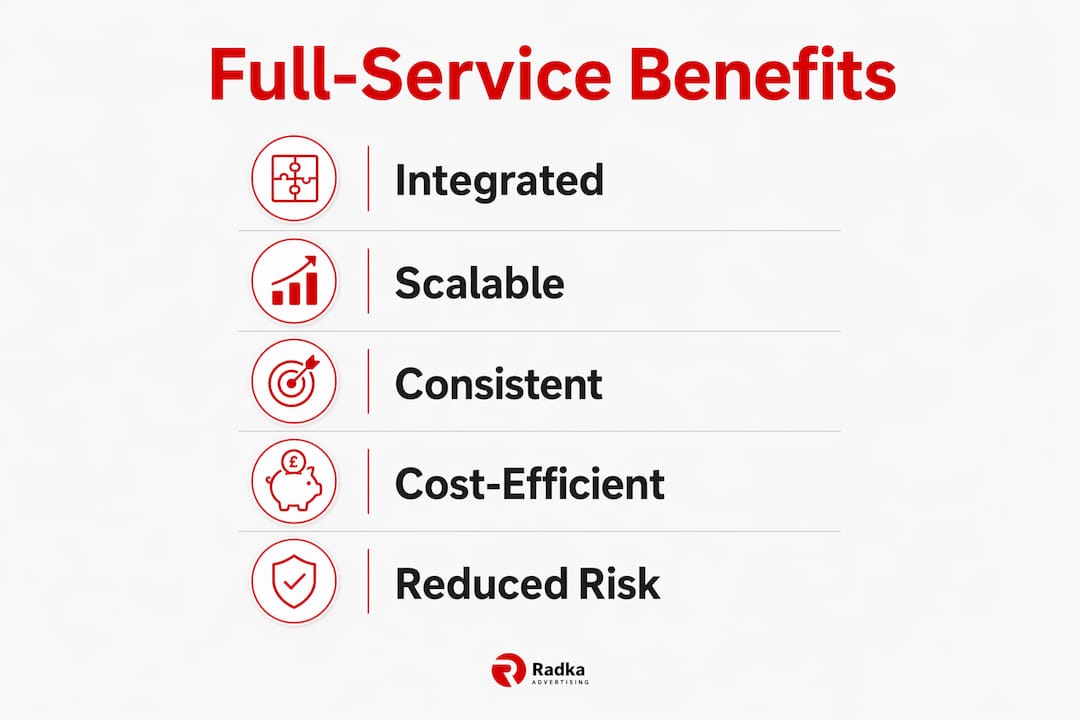
Execution risk is the probability that a campaign launches late, off-message, or over budget. Full-service agencies reduce this risk through process discipline and institutional knowledge. Enterprise brands report fewer delays and higher quality outcomes when working with agencies that have established project management frameworks, because those frameworks catch errors before they reach the client.
The coordination benefit is particularly visible in multichannel marketing, where a single campaign might span paid search, display, email, social, and out-of-home simultaneously. Managing five separate boutique agencies across those channels creates version-control problems, briefing gaps, and conflicting creative directions. A full-service team eliminates those friction points because the strategist, the creative director, and the media planner sit in the same operation.
“Businesses with complex, multi-channel campaigns involving more than three integrated disciplines are advised to prefer full-service agencies to reduce coordination overhead. Managing multiple boutique agencies for such campaigns often incurs higher costs and execution risk.”
Consistent brand voice is another measurable outcome. When one agency owns the brand guidelines and applies them across every deliverable, the risk of off-brand content appearing in a paid ad or a press release drops considerably. Radkaadvertising’s work with clients across sectors like energy and consumer goods demonstrates how a single creative team maintaining brand identity produces more coherent campaigns than a patchwork of specialists.
What are the cost considerations of hiring a full-service agency?
Cost is the most common objection to full-service agency engagement, and it deserves an honest analysis. The headline retainer is rarely the total cost. Scope creep adds 15–25% to effective monthly costs within the first year, driven by additional briefs, revision rounds, and expanded deliverables that fall outside the original agreement.
Onboarding, internal management overhead, and tool duplication add further indirect costs. A business owner who spends four hours per week managing an agency relationship is spending real money, even if it does not appear on an invoice. Tool redundancy is a related issue: if your agency uses its own project management, reporting, and analytics platforms, you may end up paying for overlapping subscriptions.
| Cost category | Typical impact |
|---|---|
| Retainer fee | Core quoted cost; varies by scope and agency tier |
| Scope creep | Adds 15–25% to monthly spend within year one |
| Onboarding overhead | Internal time cost; often underestimated |
| Tool duplication | Redundant software subscriptions across client and agency |
| Total cost uplift | 20–35% above quoted retainer in first year |
The break-even point for building an in-house team rather than using an agency sits at approximately £120,000–£150,000 in annual marketing spend. Below that threshold, a full-service agency or a hybrid model almost always delivers better value than recruiting, training, and retaining an internal team.
Pro Tip: Request a detailed scope-of-work document before the contract is signed. Define what constitutes an “additional brief” and agree on a process for handling out-of-scope requests. This single step prevents the majority of scope creep disputes.
When is a full-service agency the right strategic choice?
Not every business needs a full-service agency. The model delivers its strongest return in specific circumstances, and recognising those circumstances saves both time and money.
-
You are running campaigns across more than three disciplines simultaneously. Coordinating SEO, paid media, social, PR, and email through separate providers creates overhead that erodes both budget and quality. A single agency removes that overhead.
-
You are launching a new product or entering a new market. These moments require rapid, coordinated output across creative, media, and communications. Full-service agencies carry the bench depth to execute at speed without a ramp-up period.
-
Your brand is undergoing a rebrand or repositioning. Brand consistency during a transition depends on one team owning every touchpoint. Splitting that work across boutique providers increases the risk of inconsistent execution.
-
Your annual marketing spend is below the in-house break-even threshold. At spend levels under £120,000–£150,000 per year, an agency partnership is more cost-efficient than building internal capability.
-
You need compliance and process rigour. Regulated industries, including financial services and healthcare, benefit from agencies with established approval workflows and documented quality controls.
-
You want access to AI-driven marketing tools at scale. Full-service agencies currently lead in AI tool adoption due to economies of scale, giving clients access to capabilities that would be prohibitively expensive to licence independently. Radkaadvertising’s AI-driven marketing services reflect this advantage directly.
The common thread across all six scenarios is complexity. The more moving parts a campaign has, the more a full-service model outperforms the alternatives.
Key takeaways
A full-service agency delivers the strongest return when campaign complexity, brand consistency, and spend efficiency matter more than specialist depth in a single channel.
| Point | Details |
|---|---|
| Integrated execution reduces delays | Coordinated campaigns cut project delays by 23%, according to Forrester research. |
| Scope creep is a real cost | Budget for 15–25% above the quoted retainer to cover first-year scope expansion. |
| Break-even threshold is clear | Businesses spending below £120,000–£150,000 annually get better value from an agency than an in-house team. |
| Complexity is the deciding factor | Campaigns spanning more than three disciplines benefit most from full-service coordination. |
| AI access favours agencies | Full-service agencies lead in AI tool adoption, giving clients capabilities beyond typical in-house reach. |
What I have learned from watching brands choose the wrong model
Most business owners I have spoken with make the same mistake. They hire a boutique agency for one discipline, then add another boutique for a second, then a third, and suddenly they are managing three separate retainers, three sets of brand guidelines, and three account managers who have never spoken to each other. The campaign that results is technically competent in each channel and incoherent as a whole.
The efficiency argument for full-service agencies is real, but it comes with a caveat. Hybrid models, which combine an in-house core team with specialist agency support, achieve a campaign quality score of 8.1 out of 10 and reduce cost per lead by 12% compared to agency-only arrangements. That tells me the optimal answer is not always “full-service agency for everything.” It is “full-service agency for the integrated core, with in-house ownership of brand strategy.”
The brands I have seen get the most from a full-service partnership are the ones who treat the agency as an extension of their leadership team, not a supplier. They share business objectives, not just briefs. They give the agency access to sales data, customer feedback, and product roadmaps. That level of integration is what separates a campaign that performs from one that merely launches.
My advice to any business owner evaluating this decision: map your current marketing complexity honestly. If you are managing more than two external suppliers and still not getting consistent output, a full-service agency is not a luxury. It is the more efficient choice. You can review client case studies to see how that integration plays out in practice across different industries and growth stages.
— Bart
How Radkaadvertising delivers full-service marketing for growing brands
Radkaadvertising is a London-based full-service agency covering brand strategy, digital marketing, social media content, PR, and product innovation within a single integrated team. The agency has delivered campaigns for clients including Coca-Cola, Maybelline, and PowerLink Energy, demonstrating the range of sectors where coordinated, multi-channel execution produces measurable results. For business owners who need consistent brand messaging across multiple channels without the overhead of managing separate suppliers, Radkaadvertising’s full range of services is built to reduce execution risk from the first brief. Explore the agency’s PR and communications capability as one example of how specialist disciplines integrate within the broader offering.
FAQ
What is a full-service agency?
A full-service agency is a marketing partner that provides strategy, creative, media, digital, and analytics under one contract. It removes the need to manage multiple specialist suppliers for an integrated campaign.
Why choose a full-service agency over a boutique specialist?
Full-service agencies reduce coordination overhead and execution risk, particularly for campaigns spanning more than three disciplines. Boutique agencies offer deeper specialist focus but require more client-side management to integrate effectively.
How much does a full-service agency typically cost in the UK?
Costs vary by scope, but total spend in the first year commonly runs 20–35% above the quoted retainer once scope creep and onboarding overhead are included. The in-house break-even threshold sits at approximately £120,000–£150,000 in annual marketing spend.
When does a hybrid model outperform a full-service agency?
Hybrid models, combining an in-house core team with agency specialists, achieve higher campaign quality scores and lower cost per lead than agency-only arrangements. They suit businesses with sufficient internal capability to own brand strategy while outsourcing execution.
How do I evaluate whether a full-service agency is genuinely integrated?
Ask which disciplines are managed in-house versus subcontracted, and request examples of campaigns where multiple disciplines worked from a single brief. Genuine integration shows up in consistent creative direction and unified reporting across channels.