Why brand consistency matters for business growth

TL;DR:
- Brand consistency involves presenting a unified identity and message across all touchpoints, increasing recognition and trust. It directly impacts revenue, visibility, and reduces operational risks, especially in regulated sectors. Regular audits and centralized asset management maintain coherence and enhance AI search visibility over time.
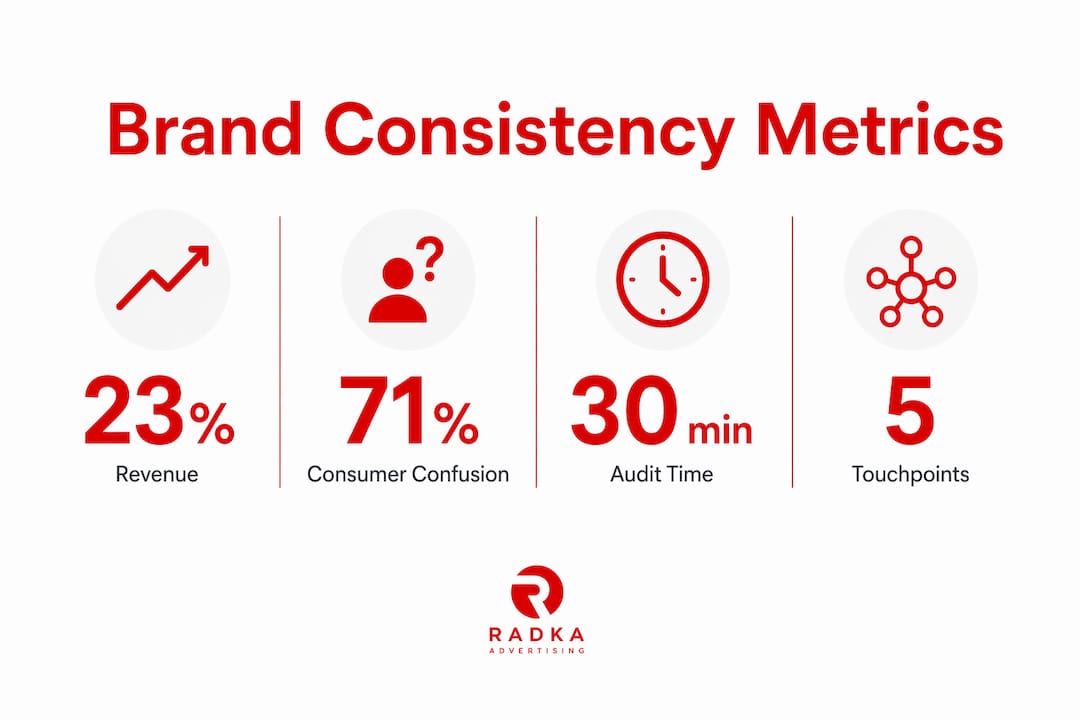
Brand consistency is the practice of presenting a unified identity, message, and visual language across every customer touchpoint, from your website and social media to packaging and sales calls. Consistent brand presentation can increase revenue by up to 23%, with two-thirds of companies surveyed reporting at least a 10% lift. That figure alone explains why brand identity significance sits at the centre of every serious growth strategy. Business owners and marketers who understand why brand consistency matters gain a measurable commercial advantage over those who treat it as a design afterthought.
Why brand consistency matters for visibility and trust
Uniform brand presentation is the single most reliable way to build consumer recognition at scale. Brands with consistent messaging are 3.5 times more visible to consumers. That multiplier compounds over time, meaning every consistent touchpoint adds to a growing recognition asset rather than starting from zero.

The psychology behind this is straightforward. Human brains use familiarity as a shortcut when making purchase decisions. When a prospect encounters your brand across multiple channels and sees the same colours, tone, and promise, their brain registers it as trustworthy and low-risk. When the signals conflict, the brain registers uncertainty instead.
71% of consumers report that inconsistent branding causes significant market confusion. That confusion does not just create a bad impression. It actively pushes buyers towards competitors whose messaging feels clearer and more reliable.
Visual identity carries particular weight in this process. 55% of a brand’s first impression comes from visuals alone, and consistent visual elements can lift brand recognition by up to 80%. Those numbers explain why brand recognition strategies built around visual coherence, such as a locked colour palette, consistent typography, and a single logo treatment, deliver outsized returns relative to their cost.
Key factors that drive recognition through consistency:
- A defined colour palette applied identically across digital and print
- A single brand voice and tone guide used by every content creator
- Consistent logo placement and sizing rules across all formats
- Aligned messaging hierarchy so every channel tells the same story
- Standardised imagery style that signals the same brand world at a glance
Pro Tip: Audit your brand’s five most visited digital touchpoints in one sitting. If a stranger could not identify them as belonging to the same brand, you have a consistency problem worth fixing this week.
Operational risks when brand consistency breaks down
Brand inconsistency does not just confuse customers. It slows your business down internally and creates real financial risk. Inconsistent branding creates confusion for buyers and internal teams alike, slows execution, and shifts revenue to competitors. The cost is not hypothetical. It shows up in longer sales cycles, higher creative rework costs, and lost deals.
The mechanism is what practitioners call micro-friction. Conflicting messaging and visual signals generate hesitation in prospects, undermining their perception of your operational competence. A buyer who sees a polished website and then receives a poorly formatted proposal with different fonts and a different tone will question whether your business is as capable as it appeared.
In regulated industries, the stakes are higher still. Inconsistent brand messaging in sectors such as healthcare and insurance is a compliance liability, not merely a marketing problem. Centralised governance is the standard mitigation approach. Without it, distributed teams produce off-brand content that can breach regulatory requirements and expose the business to legal risk.
Governance structures that prevent these problems include:
- A centralised brand asset library with version-controlled templates
- Approval workflows for external-facing content
- A brand usage policy distributed to every team that creates content
- Quarterly brand audits to catch inconsistency before it compounds
- Clear escalation paths when teams are unsure about brand application
Pro Tip: Assign one person in your organisation as the brand guardian. Their job is not to police creativity but to maintain the guardrails that keep all creative output recognisably yours.
How AI-driven search rewards brand consistency
AI answer engines such as ChatGPT, Perplexity, and Google’s AI Overviews do not cite brands at random. They cite sources they can identify as coherent, authoritative entities. Disjointed brand narratives reduce citation confidence in AI systems, meaning inconsistent brands are systematically underrepresented in AI-generated answers.
This is a new and significant commercial risk. As AI-driven search captures a growing share of discovery traffic, brands that present a fragmented identity across channels will lose visibility in the channels that matter most. The brands that win citations are those with aligned tone, consistent messaging, and high-frequency content that reinforces the same core claims.
Digital brands that invest in sustained brand consistency gain greater AI search visibility and long-term organic recognition. That investment does not require a large budget. It requires discipline: publishing content that reflects the same brand voice, answering the same core questions your audience asks, and maintaining a coherent presence across your website, social channels, and earned media.
The connection between brand consistency and SEO performance is direct. Search engines and AI systems both reward topical authority, and topical authority is built through consistent, on-brand content published over time. A brand that shifts its messaging every quarter confuses algorithms as much as it confuses people.
Pro Tip: Create a single-page brand brief that covers your core message, tone, and three key claims. Share it with every agency, freelancer, and internal team member who creates content on your behalf. This one document prevents the majority of consistency failures.
How to maintain brand consistency across every channel
Maintaining brand consistency at scale requires a system, not just good intentions. The 30-minute brand audit is a standard practitioner technique for identifying inconsistency leaks along the customer journey. The process maps every touchpoint a prospect encounters and scores each one against your brand standards.
Running a touchpoint audit
Start by listing every channel where your brand appears: website, social media profiles, email templates, proposals, presentations, invoices, packaging, and any advertising. Visit each one as a new customer would. Score each touchpoint on three criteria: visual alignment, message alignment, and tone alignment. Any touchpoint scoring below your threshold becomes a priority fix.
Systematic touchpoint auditing is the key method for identifying and mitigating inconsistency leaks. The audit works because it forces you to see your brand the way a stranger does, not the way an insider does.
Centralising brand assets
Centralised brand asset governance with controlled workflows allows distributed teams to produce on-brand content without requiring constant oversight. A shared asset library containing approved logos, colour codes, fonts, photography, and copy templates removes the guesswork from day-to-day content creation.
The table below outlines the core metrics business owners and marketers should track to measure brand adherence over time.
| Metric | What it measures | Review frequency |
|---|---|---|
| Visual consistency score | Percentage of touchpoints using approved visual assets | Monthly |
| Message alignment rate | Proportion of content reflecting core brand claims | Quarterly |
| Brand audit pass rate | Touchpoints passing full brand standard review | Quarterly |
| Content tone consistency | Deviation from defined brand voice across channels | Monthly |
| AI citation frequency | How often brand appears in AI-generated answers | Monthly |
Tracking these metrics turns brand consistency from a subjective feeling into a measurable discipline. When scores drop, you have an early warning signal before the commercial damage becomes visible. For a broader view of how omnichannel consistency strengthens marketing effectiveness, the principles apply directly to this measurement framework.
Key takeaways
Brand consistency is a measurable commercial discipline that directly links uniform identity and messaging to revenue growth, consumer trust, and AI search visibility.
| Point | Details |
|---|---|
| Revenue impact | Consistent brand presentation can increase revenue by up to 23% across surveyed companies. |
| Visibility multiplier | Brands with consistent messaging are 3.5 times more visible to consumers than inconsistent ones. |
| Operational risk | Inconsistency slows internal execution and creates compliance liability in regulated industries. |
| AI search advantage | Coherent brand entities receive more citations from AI answer engines than fragmented ones. |
| Audit discipline | A 30-minute touchpoint audit is the standard method for identifying and fixing consistency leaks. |
Brand consistency compounds: what I have learned working with real businesses
The brands that struggle most with consistency are not the ones that lack guidelines. They are the ones that wrote guidelines once, filed them away, and assumed the job was done. Brand consistency is not a document. It is a daily operational habit that compounds its value the longer you maintain it.
The most common pitfall I see business owners fall into when scaling is treating brand governance as a marketing department problem. The moment your sales team starts customising pitch decks with their own fonts, or your customer service team starts writing emails in a completely different tone, you have a consistency failure that no brand guideline document will fix on its own. Consistency requires buy-in from every function, not just the people who make the assets.
The second pitfall is confusing consistency with rigidity. A brand can evolve and still remain consistent. The key is that changes are deliberate, documented, and rolled out across all channels simultaneously. Gradual, uncoordinated drift is what kills brand recognition. Planned evolution, communicated clearly, does not.
The brands I have seen grow fastest are the ones that treat their brand as an asset with a compounding return. Every consistent touchpoint adds a small deposit to a recognition account. Over months and years, that account pays dividends in the form of shorter sales cycles, higher conversion rates, and customers who refer others because they can describe what you do in a single sentence. That clarity does not happen by accident. It is the direct result of sustained brand discipline applied consistently over time.
— Bart
How Radkaadvertising helps brands build lasting consistency
Radkaadvertising works with entrepreneurs, startups, and established brands to build the kind of brand consistency that produces measurable commercial results. The agency’s approach covers brand strategy, identity creation, and multi-channel content, all aligned to a single brand framework designed for global reach. Clients including Coca-Cola, Maybelline, and PowerLink Energy have worked with Radkaadvertising to create brand systems that hold together across markets and channels. If your brand is producing inconsistent signals across touchpoints, the Radkaadvertising case studies show exactly how that problem gets solved. For a full view of available brand and marketing services, the agency’s service pages outline every area of support.
FAQ
What is brand consistency?
Brand consistency is the practice of presenting the same visual identity, messaging, and tone across every customer touchpoint. It builds familiarity, which drives trust and purchase confidence over time.
How does brand consistency affect revenue?
Consistent brand presentation can increase revenue by up to 23%, with two-thirds of surveyed companies reporting at least a 10% lift linked directly to brand consistency.
Why does inconsistent branding cause confusion?
71% of consumers report that inconsistent branding creates significant market confusion. Conflicting visual and messaging signals generate hesitation in buyers and reduce their confidence in a brand’s reliability.
How often should a brand consistency audit be run?
A 30-minute touchpoint audit is a standard practitioner technique and works well on a quarterly basis. Monthly checks on visual and tone metrics help catch drift before it compounds into a larger problem.
Does brand consistency affect AI search visibility?
AI answer engines favour coherent brand entities when generating citations. Brands with disjointed narratives across channels receive fewer citations, reducing their visibility in AI-driven search results.