What is product innovation: a practical guide for leaders

TL;DR:
- Product innovation involves introducing significantly improved goods or services that create meaningful market or user benefits. It helps firms grow revenue, defend margins, and stay competitive by focusing on solving customer problems with new functionality or delivery models.
Product innovation is the introduction of a new or significantly improved good or service that delivers a meaningful difference to users or the market. For business leaders, it is the primary mechanism for growing revenue, defending margins, and staying ahead of competitors who are not standing still. TL;DR: Identify one customer problem worth solving, commit a ring-fenced budget, and run a structured process from discovery to launch.
- Product innovation covers both tangible goods and digital services.
- It must deliver a significant difference, not just a cosmetic update.
- It can be new to your business, new to your market, or genuinely new to the world.
- The UK tracks it formally through the UK Innovation Survey, aligned to the OECD Oslo Manual.
Table of Contents
- What is product innovation, exactly?
- What are the main types of product innovation?
- How does product innovation differ from process innovation?
- Why does product innovation matter for your business?
- How does the product innovation process work?
- How should leaders organise teams and budgets for sustained innovation?
- What pitfalls derail product innovation projects?
- How do you measure product innovation success?
- UK support, official definitions, and where to get help
- UK product innovation in practice: three case sketches
- Key takeaways
- What actually separates the firms that innovate well from those that just talk about it
- How Radkaadvertising helps you get products to market faster
- Useful sources
- FAQ
What is product innovation, exactly?
The UK definition, drawn directly from the OECD Oslo Manual, is precise and worth knowing if you plan to claim R&D tax relief or apply for a grant:
That “significant difference” threshold is the gatekeeper. A new colour option or a repackaged product does not qualify. What does qualify:
- A new functional capability that customers could not access before.
- A service redesigned around a different delivery model (for example, moving from in-person to digital-first).
- A good with measurably improved performance, durability, or usability.
- A digital product that combines existing technologies in a way that creates a new user benefit.
Simple resale of another firm’s product is explicitly excluded, as are purely aesthetic changes. The UK Innovation Survey questionnaire asks firms to confirm that their new or improved goods and services “differ significantly from previous” offerings. That phrasing matters when you are documenting a claim.
What are the main types of product innovation?
Not all product innovation carries the same risk or reward. Understanding the categories helps you match your approach to your strategic objectives.
Incremental (sustaining) innovation is the most common type. You improve what already exists: better battery life, a faster checkout flow, a new flavour variant. The risk is low, the timeline is short, and it protects current revenue. Most businesses do this continuously, even when they do not call it innovation.

Disruptive innovation targets a different customer segment or a different price point, often with a simpler product that the mainstream market initially ignores. Over time, it moves upmarket and displaces incumbents. This type demands a different business model and a longer runway before returns appear.
Radical (breakthrough) innovation creates something genuinely new to the world: a technology, material, or capability that did not exist before. High risk, high potential return, and typically only viable for firms with deep R&D capability or strong external funding.
Architectural innovation recombines existing components in a new configuration. The individual parts are familiar; the system they create is not. Think of how smartphones combined a phone, camera, GPS, and internet browser into a single device.
Feature-level updates sit below the threshold of formal product innovation for statistical purposes but matter commercially. A new filter in a SaaS dashboard or a revised onboarding flow can move retention metrics meaningfully without requiring a full product launch.
How does product innovation differ from process innovation?
The distinction matters for budgeting, reporting, and grant applications. Product innovation changes what you sell. Process innovation changes how you make or deliver it.
- Product innovation outcome: a new or improved good or service that customers experience directly.
- Process innovation outcome: a more efficient, faster, or lower-cost way of producing or delivering your existing offer.
In practice, the two are linked. A new product often requires a new production process. A process improvement can unlock a product capability that was previously too expensive to offer. The UK Innovation Survey treats them as separate categories precisely because firms often pursue both simultaneously and need to report them correctly for tax and grant purposes.
Pro Tip: When budgeting, keep product and process innovation spend in separate cost codes from the outset. Mixing them creates headaches at year-end when you are trying to calculate qualifying R&D expenditure for HMRC.
Why does product innovation matter for your business?
60% of UK businesses reported product or service changes in 2025, up from 56% in 2024. That shift is not coincidental: firms that innovate consistently outperform those that do not on revenue growth, customer retention, and market share.
The concrete business benefits:
- Revenue growth: new products open new customer segments and price points.
- Margin protection: a differentiated product is harder to commoditise and supports premium pricing.
- Customer retention: customers who adopt a new feature or product version are harder to lose to a competitor.
- Market entry: a genuinely new product can create a category rather than compete in one.
- Resilience: a portfolio of products at different lifecycle stages reduces dependence on any single revenue stream.
The long-term picture is compelling, but individual projects carry real uncertainty. R&D returns vary significantly by sector: high-tech and knowledge-intensive services see higher productivity gains from R&D investment than lower-tech sectors. That means strategic alignment, not just activity, drives results.
How does the product innovation process work?
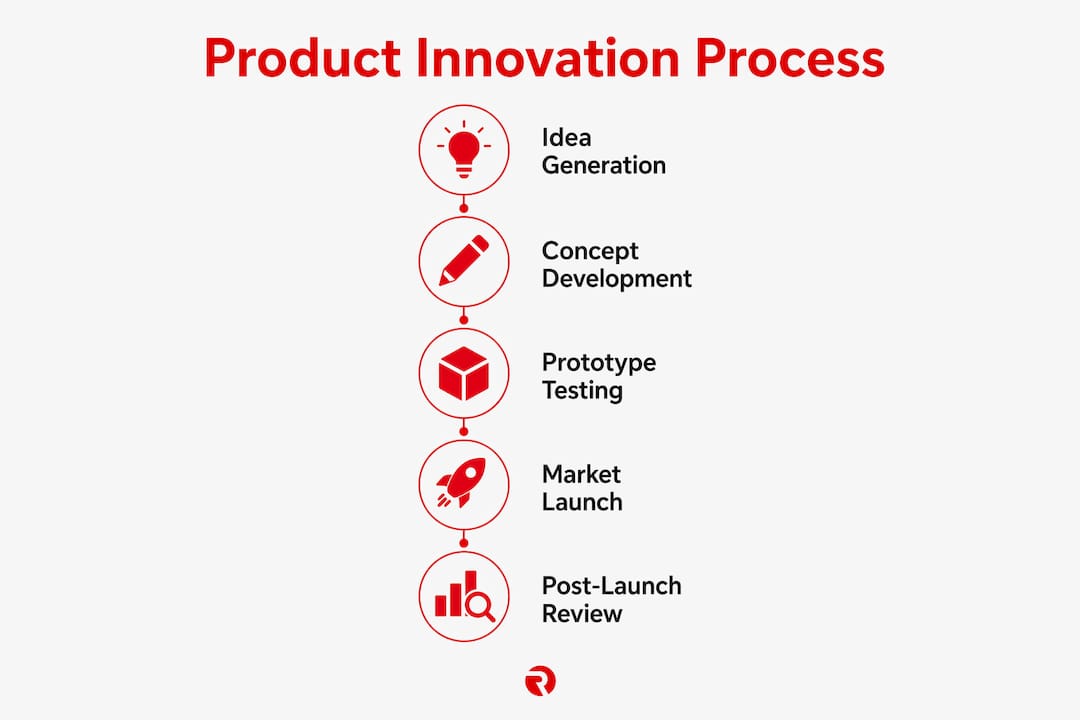
A repeatable process reduces waste and improves the odds of a successful launch. Here is a six-stage framework that works for both product teams and leadership sponsors.
-
Discovery and research. Define the customer problem, map the competitive context, and size the opportunity. Typical duration: two to six weeks. Primary cost: researcher time and customer interview incentives.
-
Ideation. Generate candidate solutions through structured workshops, cross-functional input, and external scanning. Do not filter too early. Duration: one to three weeks.
-
Concept selection and business case. Score ideas against strategic fit, technical feasibility, and commercial potential. Build a lightweight business case with go/no-go criteria. Duration: one to two weeks.
-
Prototyping. Build the minimum version needed to test the core assumption. For physical products, this means tooling and materials costs. For digital products, it means design and engineering time. Duration: four to twelve weeks depending on complexity.
-
Testing and validation. Put the prototype in front of real users. Measure against the go/no-go criteria set in stage three. This is where most projects should be killed or pivoted, not after launch. Duration: two to eight weeks.
-
Launch and scale. Prepare go-to-market, train sales and support, and plan media coverage for the launch. Monitor adoption and retention in the first 90 days. Scale spend only after the unit economics are confirmed.
Pro Tip: Run two or three small-batch pilots in parallel during the testing phase rather than betting on a single prototype. The cost difference is modest; the learning is disproportionately higher.
Key cost drivers across the process: R&D staff time, external user research, tooling and certification (for physical goods), IP filing fees, and go-to-market spend. Smaller firms can reduce the gap by using open innovation partnerships and staged funding, combining internal effort with external knowledge rather than trying to fund everything internally.

How should leaders organise teams and budgets for sustained innovation?
Structure determines speed. Three organisational models work in practice, each suited to different firm sizes and risk appetites.
- Centralised innovation team: a dedicated unit with its own budget and mandate. Works well for large firms with complex product portfolios. Risk: isolation from the business units that need to adopt the output.
- Federated squads: small cross-functional teams embedded in each business unit, coordinated by a central innovation lead. Faster learning loops, closer to the customer. Works well for mid-size firms.
- Skunkworks: a small, separate team given freedom to work outside normal processes on a high-risk project. Useful for genuinely disruptive bets, but requires clear governance to avoid becoming a vanity project.
On budgeting, the most effective approach is a balanced innovation portfolio: ring-fence a portion of the budget for incremental work that protects current margins, and a smaller portion for experimental projects with longer horizons. Leaders who concentrate all discretionary spend on headline disruptive projects tend to underinvest in the sustaining work that keeps current customers loyal.
Before committing resources, ask:
- What is the specific customer problem this solves?
- What evidence do we have that customers will pay for the solution?
- Who owns this project end-to-end, and what is their decision authority?
- What does success look like at 90 days, 12 months, and three years?
Aligning marketing, product, engineering, and operations from the start, rather than handing off sequentially, cuts time to market and reduces costly late-stage rework. Smaller firms face real capacity constraints here; open innovation and external partnerships are a practical way to extend capability without hiring.
What pitfalls derail product innovation projects?
Most product innovation failures are predictable. The warning signs appear early; the problem is that teams under pressure ignore them.
- Vanity metrics: tracking downloads, sign-ups, or press mentions instead of retention and revenue. A product with strong launch numbers and poor 90-day retention is failing, not succeeding.
- Insufficient customer validation: building based on internal assumptions rather than observed customer behaviour. The fix is structured user research before prototyping, not after.
- Scope creep: adding features during development that were not in the validated concept. Each addition extends the timeline, inflates cost, and dilutes the core value proposition.
- Poor go-to-market planning: treating launch as an afterthought. A technically strong product with weak positioning and no channel strategy will underperform.
- Unclear ownership: when no single person is accountable for the outcome, decisions slow down and problems get escalated rather than resolved.
- Sector misalignment in R&D spend: investing in breakthrough R&D in a low-tech sector where returns are structurally lower than in high-tech or knowledge-intensive services.
The corrective action for most of these is the same: set explicit go/no-go criteria before each stage, review them honestly, and be willing to kill a project that is not meeting them. Sunk cost is not a reason to continue.
How do you measure product innovation success?
Measurement starts before launch. Define your KPIs at the concept stage so you are not retrofitting metrics to outcomes.
| KPI | What it measures | Example formula |
|---|---|---|
| Adoption rate | How quickly users take up the new product | Active users at 30 days ÷ total eligible users |
| Retention rate | Whether users keep using it | Users active at day 90 ÷ users active at day 30 |
| Revenue lift | Incremental revenue from the new product | New product revenue ÷ total revenue |
| R&D efficiency | Return on innovation spend | Revenue from new products ÷ total R&D £ spent |
| Time to market | Speed from concept to launch | Calendar days from brief sign-off to first sale |
Leading indicators (tell you where you are heading): prototype test scores, user interview sentiment, pilot conversion rates, and NPS from early adopters.
Lagging indicators (confirm what happened): revenue contribution, churn rate, and market share change at 12 months.
Use cohort analysis to compare fairly: a product launched in January and one launched in October are at different maturity points. Comparing their absolute revenue figures is misleading; comparing their 90-day retention curves is not. For products where quantitative data is thin early on, usability scores and structured qualitative feedback from a small user panel are legitimate proxies. Optimising your product pages for search also feeds measurable organic traction into your go-to-market metrics from day one.
UK support, official definitions, and where to get help
The UK’s formal definition of product innovation is grounded in the Oslo Manual 2018 and administered through the UK Innovation Survey. Understanding this framework matters practically: it determines whether your activity qualifies for public support.
| Support route | What it covers | When to use it |
|---|---|---|
| R&D tax relief (HMRC) | Corporation tax relief on qualifying R&D expenditure | When you have documented R&D spend on a project that seeks to advance science or technology |
| Innovate UK grants | Co-funded grants for business-led innovation projects | When you have a project with commercial potential and can match-fund |
| Knowledge Transfer Partnerships | Funded collaboration between a business and a UK university | When you need specialist knowledge your team does not have |
| Enterprise Research Centre | Research and data on UK innovation trends and firm performance | When you need evidence to build an internal business case |
“Innovation investment is an investment in a firm’s stock of knowledge — and the productivity returns, while real, vary by sector and depend on how well that investment is aligned to the firm’s capabilities.” — NIESR
For documentation, the principle is straightforward: record the problem you were trying to solve, the uncertainty you faced, the experiments you ran, and the outcome. That narrative is what HMRC and grant assessors look for when they evaluate whether your work meets the “significant difference” threshold. AI-driven approaches to marketing and product optimisation are increasingly relevant here too, particularly for firms building digital products where data is the primary R&D asset.
UK product innovation in practice: three case sketches
Incremental innovation: a UK fintech improving its mobile app. A mid-size payments firm identified that users were abandoning the checkout flow at the authentication step. Over 12 weeks, the team redesigned the biometric login experience, reducing friction without changing the underlying technology. The result was a measurable improvement in transaction completion. Cost scale: low to mid five figures. Innovation type: incremental, new to the business.
Disruptive innovation: a UK health-tech startup. A small firm built a remote monitoring device for chronic condition management, targeting patients who previously had no between-appointment visibility of their own data. The product did not compete with hospital equipment; it served a segment that existing products ignored. Timeline from concept to CE marking: approximately 18 months. Cost scale: mid six figures including regulatory certification. Innovation type: disruptive, new to the market.
Feature-led innovation: a UK SaaS platform. A project management tool added an AI-assisted task prioritisation feature based on user behaviour data. The feature was not new to the market, but its integration into the existing workflow was new to the business and drove a measurable uplift in daily active use among enterprise accounts. Timeline: eight weeks from brief to release. Cost scale: engineering time plus user research. Innovation type: feature-level, new to the business.
Each sketch maps to a different resource commitment and risk profile. The right choice depends on your strategic position, not on which type sounds most impressive.
Key takeaways
Product innovation succeeds when leaders combine a clear definition of “significant difference,” a structured process, and a balanced portfolio of incremental and experimental bets.
| Point | Details |
|---|---|
| Definition anchors everything | The UK/OECD “significant difference” threshold determines what qualifies for grants, tax relief, and formal classification. |
| Portfolio balance matters | Ring-fence budget for both incremental work (margin protection) and experimental projects (long-term growth). |
| Process reduces waste | A six-stage process from discovery to scale, with explicit go/no-go criteria, cuts costly late-stage failures. |
| Measure from the start | Set adoption rate, retention, revenue lift, and R&D efficiency KPIs before launch, not after. |
| Radkaadvertising accelerates go-to-market | The agency’s strategy, creative, and AI-enabled growth services help leaders move from validated concept to market faster. |
What actually separates the firms that innovate well from those that just talk about it
The gap between firms that sustain product innovation and those that produce one-off launches is almost never about ideas. It is about governance. The firms that consistently bring new products to market have made two unglamorous decisions: they have assigned a named owner to every project, and they have agreed in advance what “failure” looks like so they can act on it without a political battle.
The conventional wisdom says innovation requires a special culture, a visionary leader, or a dedicated lab. Sometimes those things help. More often, what they actually need is a clear brief, a realistic budget, and a team that is allowed to kill a project before it becomes a sunk-cost trap. The Oslo Manual definition is not just bureaucratic framing; it is a useful discipline. If you cannot articulate the “significant difference” your product delivers, you probably have not validated it with enough rigour yet.
One more thing worth saying plainly: the firms that over-invest in headline disruptive projects at the expense of incremental work tend to lose customers to competitors who kept improving the basics. Disruptive innovation is not more virtuous than sustaining innovation. It is just riskier. A portfolio that holds both, with honest metrics for each, is what actually compounds over time.
How Radkaadvertising helps you get products to market faster
Bringing a validated product concept to market is where many firms stall. The strategy is clear; the execution is not. Radkaadvertising is a London-based full-service agency that works with entrepreneurs, startups, and established brands to close that gap, specifically through brand positioning, product marketing, and data-driven multi-channel campaigns built for measurable growth.
Where most agencies hand you a brand deck and step back, Radkaadvertising stays in the process: from sharpening your product’s positioning against the competitive set, to building the go-to-market campaign that drives first-mover awareness, to tracking the metrics that tell you whether the launch is working. The agency’s case studies include product-related campaigns for clients across consumer goods, energy, and beauty, with results tied to real commercial outcomes. If you have a product ready to launch or a concept that needs sharper positioning, get in touch with the team to discuss your project.
Useful sources
- UK Innovation Survey 2025 report (GOV.UK): the primary source for the UK definition of product innovation, aligned to the Oslo Manual 2018. Use this for definitions, classification guidance, and current UK innovation statistics.
- UK Innovation Survey questionnaire (ONS): the actual survey questions firms are asked, useful for understanding how to document your own innovation activity for grant and tax purposes.
- Innovation State of the Nation 2025 (Enterprise Research Centre): current data on UK business innovation rates, including the 60% figure for 2025 and the SME innovation gap.
- NIESR report on R&D and productivity: economic analysis of R&D returns by sector; essential reading before committing a large R&D budget.
- UK CPI: disruptive vs incremental innovation: a clear practitioner-facing explanation of innovation types and portfolio strategy.
- Innovate UK (UKRI): the primary public funding body for business-led innovation in the UK; start here for grant opportunities and Knowledge Transfer Partnerships.
FAQ
What is the meaning of product innovation?
Product innovation is the introduction of a new or significantly improved good or service, as defined by the OECD Oslo Manual and used in the UK Innovation Survey. It must deliver a meaningful functional, performance, or user-benefit difference, not merely a cosmetic change.
What is a clear example of product innovation?
A UK health-tech startup building a remote chronic-condition monitoring device for patients who previously had no between-appointment data access is a strong example: it is new to the market, solves a documented problem, and required genuine technical development to achieve.
What are the main types of product innovation?
The four principal types are incremental (sustaining), disruptive, radical (breakthrough), and architectural innovation. Feature-level updates sit below the formal threshold but matter commercially. Each type carries a different risk profile, timeline, and resource requirement.
What are the four types of innovation more broadly?
Beyond product innovation, the Oslo Manual recognises process innovation (how you make or deliver), marketing innovation (how you position and sell), and organisational innovation (how the business is structured). Product and process innovation are the most commonly tracked in UK official statistics.
How do I know if my product qualifies as an innovation for UK grant or tax purposes?
The key test is whether your product is “significantly different” from what existed before, either for your business or for the market. Document the customer problem, the technical uncertainty you faced, the experiments you ran, and the measurable improvement achieved. That evidence trail is what HMRC and Innovate UK assessors look for.