What is paid media? A clear guide for UK businesses

TL;DR:
- Paid media involves purchasing advertising space to reach specific audiences immediately, using auction-based platforms like Google Ads and Meta. It offers precise targeting, real-time performance data, and rapid scalability, but stops generating traffic when spending ceases, requiring integration with organic efforts for long-term success. Most campaigns struggle because they treat paid media as a standalone solution instead of a tool to accelerate existing marketing strategies.
Paid media is defined as any advertising space a business purchases to promote content or products to a specific audience. Within the PESO framework (paid, earned, shared, owned), paid media sits at the top of the traffic-generation stack. It delivers immediate visibility through auction-based platforms like Google Ads and Meta, where advertisers bid for placement in front of precisely defined audiences. Unlike organic channels, which build reach gradually, paid media produces results from the moment a campaign goes live. For UK business owners and marketing professionals, understanding what paid media is and how it fits into a broader strategy is the foundation of any serious advertising plan.
What is paid media and how does it work?
Paid media platforms operate through auction-based bidding, where advertisers set a budget, define an audience, and compete for ad placements in real time. Every time a user loads a page or opens an app, an automated auction determines which ad appears and at what cost. The advertiser who wins is not always the highest bidder. Platform algorithms weigh bid amount against ad quality and relevance, so a well-crafted ad can outperform a larger budget.
Targeting is where paid media earns its reputation for precision. Advertisers can filter audiences by age, location, income bracket, interests, online behaviour, and even purchase intent. A London-based retailer can target women aged 25–44 in the South East who have recently searched for a specific product category. That level of specificity is simply not available through organic search or social media posts.
Pricing models vary by objective:
- Cost-per-click (CPC): You pay only when someone clicks your ad. Common in search engine marketing.
- Cost-per-thousand-impressions (CPM): You pay per 1,000 views. Used widely in display and video campaigns.
- Cost-per-conversion (CPA): You pay when a user completes a defined action, such as a purchase or form submission.
Real-time dashboards show performance as it happens. Marketers monitor key metrics like CPC and return on ad spend (ROAS) and can shift budget mid-campaign toward whichever ad set is performing best.
Pro Tip: Set a daily budget cap from day one. Paid platforms will spend your full budget if you let them. A cap protects you while you gather data in the first two weeks.
Benefits of paid media vs organic marketing
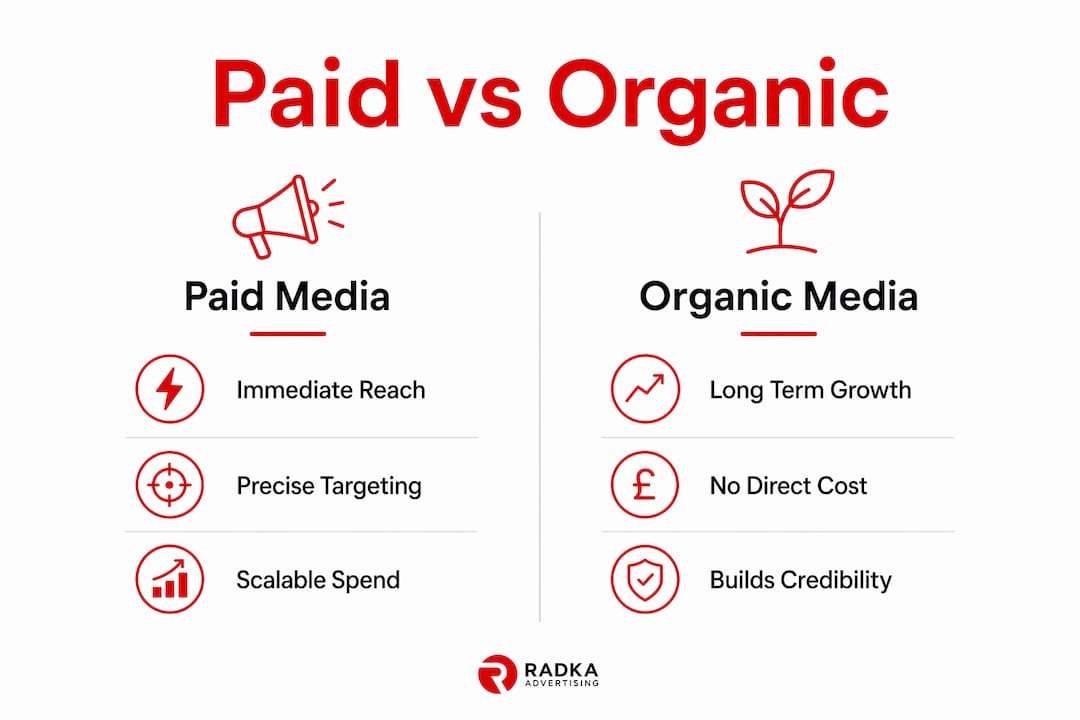
The primary benefit of paid media is rapid scalability and precise reach. A campaign can go from zero to thousands of impressions within hours of launch. Organic content, by contrast, builds reach over months through search engine optimisation and audience growth.
| Factor | Paid media | Organic media |
|---|---|---|
| Speed to visibility | Immediate | Weeks to months |
| Audience control | Precise targeting | Broad, algorithm-dependent |
| Cost structure | Ongoing spend required | Time investment, lower direct cost |
| Scalability | Scales with budget | Scales with content volume |
| Longevity | Stops when spend stops | Compounds over time |
Paid media gives you full control over the message, the audience, and the timing. You can test ten different headlines in a week and know within days which one converts. Organic content rarely offers that feedback speed.
The limitations are real, though. Costs rise as more advertisers compete for the same audiences. Facebook CPM averaged approximately $13.75 in 2024 benchmarks, and that figure fluctuates with competition and seasonality. Spending more on paid media increases impressions but does not automatically increase profitability. Targeting precision and creative quality determine whether the spend returns value.
The other structural weakness is dependency. Paid media stops delivering traffic the moment you stop spending. Organic content, once ranked or shared, continues to attract visitors without ongoing cost. This is why the most effective marketing approaches combine both.
Pro Tip: Use paid media to test which messages resonate, then build those messages into your organic content strategy. The two channels inform each other far better than most marketers realise.
Examples of paid media channels for UK businesses
Paid media includes a wide set of channels, each suited to different objectives and audience types. UK businesses typically use a combination depending on their sector, budget, and customer profile.
- Search engine marketing (SEM): Paid search ads appear at the top of Google results when users type specific queries. They capture high-intent audiences who are actively looking for a product or service. For a plumber in Manchester or a solicitor in Edinburgh, SEM is often the highest-converting paid channel.
- Social media advertising: Sponsored posts and paid placements on Facebook, Instagram, and LinkedIn put your brand in front of defined audience segments. LinkedIn works particularly well for B2B campaigns targeting decision-makers by job title or industry.
- Display and programmatic advertising: Banner and image ads served across publisher websites through automated buying platforms. Programmatic systems use data to place ads in front of the right person at the right moment, across thousands of sites simultaneously.
- Video advertising: Pre-roll and mid-roll ads on YouTube and connected TV (CTV) platforms reach audiences during high-attention moments. Video ads are especially effective for brand awareness and product demonstration.
- Influencer sponsorships: Paid partnerships with content creators whose audiences match your customer profile. This format sits at the intersection of paid and earned media, combining the reach of paid placement with the credibility of a trusted voice.
- Traditional paid media: Television, radio, and print advertising remain relevant for certain UK sectors, particularly those targeting older demographics or local markets. Digital channels now dominate budget allocation, but offline formats still deliver reach that digital cannot replicate in every context.
Businesses that perform best with paid media rarely rely on a single channel. They match the format to the stage of the customer journey, using awareness channels at the top and direct-response formats closer to the point of purchase.
How to measure success in paid media campaigns
Measurement starts with choosing the right metrics for your objective. The four most important are:
- CPC (cost-per-click): Tells you how efficiently your ad drives traffic. A falling CPC with stable conversion rates signals improving campaign health.
- CPM (cost-per-thousand-impressions): Relevant for awareness campaigns where reach matters more than immediate action.
- ROAS (return on ad spend): The revenue generated for every pound spent. A ROAS of 4:1 means £4 returned for every £1 invested.
- Conversion rate: The percentage of ad clicks that result in a desired action. Low conversion rates often point to a landing page problem rather than an ad problem.
A/B testing is the standard method for improving creative performance. Run two versions of an ad simultaneously, changing one variable at a time: headline, image, call to action, or audience segment. Shift budget toward the winner. Repeat. This process compounds improvements over time.
Measurement has become more complex due to privacy changes. Evolving tracking policies from browsers and platforms have reduced the reliability of third-party cookies. Marketers now blend first-party data collected directly from customers with modelled attribution techniques to fill the gaps. Pixel-based tracking, CRM data, and platform-native analytics each contribute to a fuller picture.
Funnel architecture matters enormously in paid campaigns. Top-of-funnel ads should focus on awareness and engagement, not sales. Bottom-of-funnel ads should target audiences who have already shown purchase intent, whether through a website visit, a product page view, or an abandoned basket. Mixing these up wastes budget and confuses potential customers.
| Funnel stage | Ad objective | Example format |
|---|---|---|
| Awareness | Reach, video views | YouTube pre-roll, display |
| Consideration | Traffic, engagement | Social sponsored posts, SEM |
| Conversion | Purchases, leads | Retargeting, search ads |
Integrating paid media with your owned assets, such as your website, email list, and blog, improves overall return. Paid ads that drive traffic to a well-built landing page with a clear offer convert at a higher rate than ads pointing to a generic homepage. For guidance on managing these digital marketing challenges, the principles of funnel alignment and first-party data collection apply across every channel.
Key takeaways
Paid media delivers immediate, measurable reach, but only produces sustainable results when integrated with owned and earned media channels.
| Point | Details |
|---|---|
| Paid media definition | Any advertising space a business purchases to reach a defined audience through digital or traditional channels. |
| How it works | Auction-based bidding on platforms like Google Ads and Meta determines ad placement, cost, and reach. |
| Core benefits | Immediate visibility, precise audience targeting, and real-time performance data set paid media apart from organic channels. |
| Key limitation | Traffic stops when spend stops, making a hybrid paid and organic approach necessary for long-term growth. |
| Measurement priority | Track ROAS, CPC, and conversion rates, and align ad creatives with the correct funnel stage to maximise efficiency. |
Paid media in practice: what most guides get wrong
Most articles on paid media treat it as a standalone solution. Spend money, get traffic, make sales. That framing misses the point entirely. The businesses I see struggle most with paid media are those that treat it as a tap they can turn on and off without building anything underneath it.
The real function of paid media is to accelerate what you already have. If your landing page converts poorly, paid traffic will expose that weakness at scale and at cost. If your organic content has no authority, paid ads will drive visitors who bounce because there is nothing to hold them. Paid media should direct visitors to owned channels where trust is built over time, not just to a product page and a checkout button.
The privacy shift is also underestimated. Many UK businesses are still running campaigns as if third-party cookie tracking works the way it did in 2019. It does not. First-party data and modelled attribution are not optional extras. They are the baseline for accurate measurement in 2026. If you have not audited your tracking setup recently, your performance data is likely less reliable than you think.
My honest view is that paid media rewards patience and iteration more than budget size. The brands that win are those that test relentlessly, match their creative to the customer journey stage, and use paid spend to learn as much as to sell. For conversion rate improvements that compound over time, the discipline of testing one variable at a time is more valuable than any single campaign idea.
— Bart
How Radkaadvertising helps UK businesses get more from paid media
Radkaadvertising is a London-based full-service agency with direct experience running paid media campaigns for brands across competitive sectors. The team combines data-driven targeting with creative built for specific funnel stages, so every pound of ad spend works harder. Whether you are launching a first campaign or auditing an existing one, Radkaadvertising brings the strategic depth that separates profitable campaigns from expensive experiments. You can review client campaign results across industries, or visit the Radkaadvertising services page to see the full range of paid media and digital marketing support available to UK businesses.
FAQ
What is the paid media definition in simple terms?
Paid media is any advertising placement a business pays for to reach a defined audience. It includes search ads, social media ads, display banners, and video placements.
How does paid media work on platforms like Google and Meta?
Both platforms use auction-based bidding. Advertisers set a budget and target audience, then compete for placement. Ad quality and relevance influence the outcome alongside bid amount.
What are the main examples of paid media for UK businesses?
The most common formats are search engine marketing, social media advertising on Facebook, Instagram, and LinkedIn, programmatic display ads, YouTube video ads, and influencer sponsorships.
What is the difference between paid media and organic media?
Paid media delivers immediate, targeted reach in exchange for ongoing spend. Organic media builds reach over time through content and SEO, without direct cost per placement, but stops growing if content production stops.
What metrics should I track to measure paid media performance?
Track ROAS, CPC, CPM, and conversion rate. Align each metric to your campaign objective and use A/B testing to improve creative performance over time.