What is marketing automation: a practical guide for 2026

TL;DR:
- Marketing automation uses software to execute repetitive marketing tasks automatically and manage customer journeys. It improves efficiency, reduces costs, and increases conversions by personalizing communication at scale. Success depends on disciplined data hygiene, clear customer lifecycle mapping, and ongoing weekly review.
Marketing automation is defined as software that executes repetitive marketing tasks automatically, managing customer communications across email, social media, paid ads, and more without manual effort for each action. The discipline is formally known as marketing automation or, in more advanced implementations, customer journey orchestration. For business owners and marketing professionals, understanding what is marketing automation means understanding how to replace manual, time-consuming processes with systems that work around the clock. UK SMEs using AI-powered automation reclaim 30–60 hours weekly and achieve a return of £5.44 for every £1 invested. That figure alone explains why adoption has accelerated sharply across British businesses of every size.
How does marketing automation work?
Marketing automation operates through three core mechanics: triggers, workflows, and segmentation. Each one plays a distinct role in turning a contact database into an active, responsive marketing system.

Triggers are the starting points. A trigger fires when a contact takes a specific action or meets a defined condition. Examples include filling in a contact form, clicking a link in an email, visiting a pricing page, or reaching a lead score threshold. The trigger tells the system: “Something has happened. Now do something about it.”
Workflows define what happens next. A workflow is a pre-built sequence of automated steps. Those steps might include sending a welcome email, waiting 48 hours, sending a follow-up with a case study, alerting a sales representative, or updating a contact record. Workflows remove the need for a human to manually manage each step.
Segmentation ensures the right message reaches the right person. Contacts are grouped by behaviour, demographics, purchase history, or lifecycle stage. A first-time website visitor receives different content from a returning customer who has already purchased.
CRM integration is the connective tissue that makes all three mechanics work together. The CRM holds customer records and sales data. The automation platform reads those records, fires triggers, and writes back updated information after each interaction. Without CRM integration, automation operates in a silo and misses critical context.
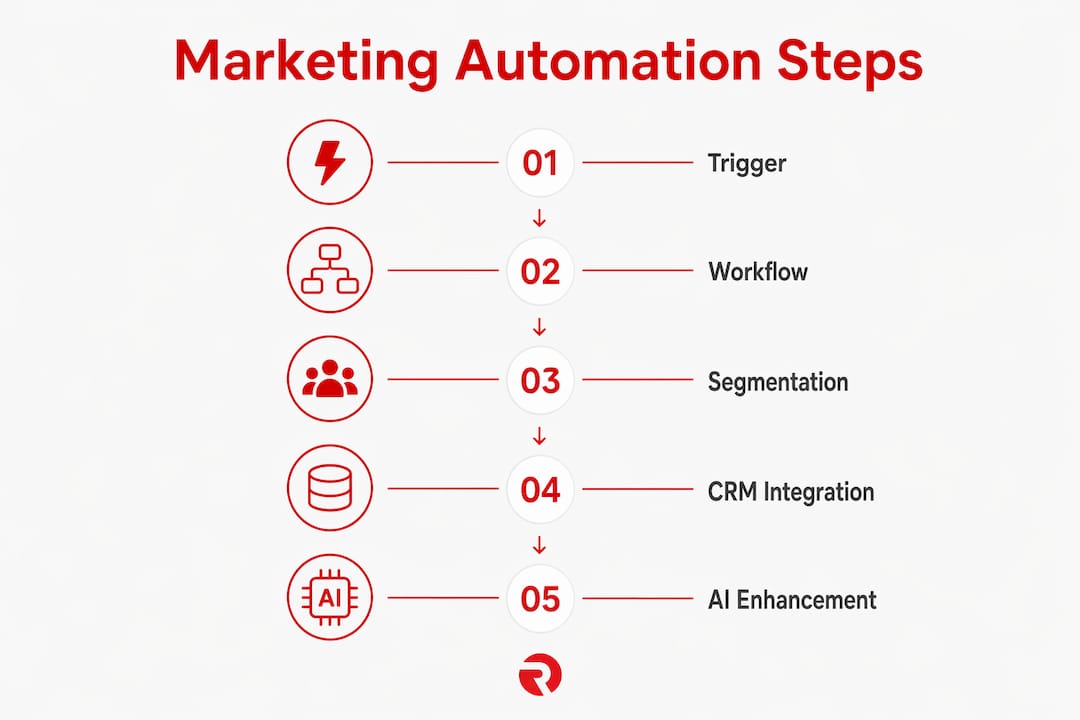
The difference between traditional and AI-powered automation is significant. Traditional rule-based automation follows fixed if-then logic: if a contact opens an email, then send a follow-up. AI-powered automation adapts in real time, predicting the best send time, subject line, or content variant for each individual contact. AI handles the complexity that manual rules cannot manage at scale.
Pro Tip: Clean your CRM data before building a single workflow. Automation amplifies whatever is in your database. Dirty data means wrong messages sent at scale, which damages trust faster than no automation at all.
What are the benefits of marketing automation?
Marketing automation delivers measurable advantages across time, cost, and revenue. The benefits are not theoretical. They show up in weekly hours recovered and annual budget lines.
Time savings and capacity
Reclaiming 30–60 hours weekly is the most immediate benefit for lean marketing teams. Those hours previously went to manual email sends, follow-up reminders, social scheduling, and list management. Automation handles all of it, freeing your team to focus on strategy and creative work.
Cost reduction
Marketing tool stacks can be reduced from 6–8 platforms to 2–3 by consolidating functions inside a single automation platform. That consolidation cuts costs by £14,000–£30,000 annually for many UK SMEs. The saving comes from cancelled subscriptions and reduced time spent switching between disconnected tools.
Lead nurturing and conversion
Automated lead nurturing delivers personalised content based on each contact’s behaviour, replacing one-size-fits-all email blasts. Leads receive consistent, relevant follow-up without a human manually tracking each conversation. The result is higher engagement and more conversions at the bottom of the funnel.
Personalisation at scale
AI-powered automation enables personalisation across thousands of contacts simultaneously without increasing headcount. A lean team of two or three marketers can deliver the kind of tailored communication that previously required a much larger operation.
“The biggest mistake businesses make with marketing automation is trying to automate everything at once. Start with one customer journey where leads currently stall. Fix that first. Then build from there.” — Expert insight from UK SME marketing automation practitioners
Pro Tip: Measure your automation performance weekly for the first three months. Early data tells you whether your triggers and messaging are working before bad habits compound.
What marketing automation tools are available?
Marketing automation tools fall into distinct categories, each addressing a different part of the customer journey. Choosing the right category matters more than choosing the most feature-rich platform.
| Category | What it does | Best suited for |
|---|---|---|
| Email lifecycle automation | Sends triggered sequences based on contact behaviour | Welcome series, nurture campaigns, re-engagement |
| Lead scoring | Assigns points to contacts based on actions and attributes | Prioritising sales outreach |
| Social media scheduling | Publishes content across platforms automatically | Consistent brand presence without manual posting |
| Retargeting tools | Serves ads to contacts who visited your site | Recovering warm leads who did not convert |
| Customer journey orchestration | Coordinates multi-channel sequences across email, SMS, and ads | Full-funnel campaigns for growing businesses |
The distinction between rule-based and AI-powered platforms matters when you are choosing. Rule-based tools work well for straightforward sequences with predictable contact behaviour. AI-powered platforms handle complex scenarios, such as predicting which contacts are most likely to churn or identifying the optimal moment to send a pricing email. For most UK SMEs starting out, a mid-tier platform with solid email automation and CRM integration covers the majority of use cases.
The role of AI in marketing has shifted from a premium add-on to a practical necessity for teams managing multiple channels with limited resource. AI does not replace the marketer. It removes the repetitive decisions so the marketer can focus on the ones that require judgement.
Pro Tip: Do not buy a platform based on its full feature list. Identify the three customer journey points where you lose the most leads, and choose a tool that handles those three points well.
How to implement marketing automation step by step
Implementation is a sequencing challenge. Skipping any step risks building a system that decays quickly or sends the wrong messages to the wrong people.
-
Build a clean data foundation. Audit your CRM before touching any automation settings. Remove duplicate records, standardise field formats, and confirm that your contact lifecycle stages are clearly defined. Automation amplifies data quality in both directions.
-
Map your customer lifecycle. Define the stages a contact moves through from first awareness to closed customer. Identify the triggers that should move a contact from one stage to the next. This map becomes the blueprint for every workflow you build.
-
Build your core workflows first. Start with a welcome sequence for new subscribers, a lead nurturing sequence for contacts who have shown interest but not purchased, and a sales handover alert for contacts who reach a qualifying lead score. These three workflows address the highest-value moments in most customer journeys.
-
Integrate your channels. Connect your website forms, paid media campaigns, and any webinar or event platforms to your automation system. Each channel should feed contacts into the right workflow automatically, without manual imports.
-
Create reporting dashboards. Connect your automation data to pipeline and revenue metrics. You need to see which workflows generate qualified leads and which ones produce engagement without conversion. Revenue attribution at the workflow level is the goal.
-
Establish a weekly operating cadence. Without ongoing management, automation systems degrade as data grows stale and triggers lose meaning. A weekly review of workflow health, data hygiene, and engagement metrics keeps the system effective.
A practical step-by-step automation checklist helps teams avoid the most common implementation mistakes, particularly the tendency to build too many workflows before the foundational ones are proven.
Pro Tip: Automate one customer journey completely before starting a second. A single well-built workflow that converts reliably is worth more than ten half-finished sequences.
The most common implementation failure is skipping the data hygiene step because it feels slow and unglamorous. Clean, well-structured data is the single factor that most determines whether automation helps or harms your customer relationships. Build the foundation properly and the rest follows logically.
Key takeaways
Marketing automation delivers measurable ROI only when built on clean data, clearly mapped customer journeys, and a disciplined weekly review process.
| Point | Details |
|---|---|
| Definition of marketing automation | Software that automates repetitive marketing tasks and manages customer journeys across multiple channels. |
| Start with data hygiene | Clean your CRM before building any workflow to prevent wrong messages reaching the wrong contacts. |
| Core workflows first | Build welcome, nurture, and sales handover sequences before adding complexity. |
| AI versus rule-based tools | AI-powered platforms adapt in real time; rule-based tools follow fixed logic. Choose based on your journey complexity. |
| Weekly operating cadence | Review workflow health and data quality every week to prevent system decay and maintain effectiveness. |
Why discipline matters more than technology
Most businesses that struggle with marketing automation have a process problem, not a technology problem. I have seen teams invest in sophisticated platforms and then spend months trying to automate chaos. The platform does not fix a poorly defined customer journey. It just automates the confusion faster.
The businesses that get genuine results from automation share one habit: they treat it as a marketing discipline, not a software project. They define their customer lifecycle stages before touching a workflow builder. They review their data weekly. They resist the temptation to add complexity before the basics are proven.
The operating cadence point is the one most teams skip. A weekly 30-minute review of your active workflows, your lead scores, and your email engagement rates is what separates a system that compounds results over time from one that quietly degrades. Automation is not a set-and-forget tool. It is a living system that reflects the quality of your attention.
The other thing worth saying plainly: automation does not replace the relationship. It creates the conditions for a better one. When your system handles the routine follow-up, your team has the time and mental space to have the conversations that actually close deals and build loyalty. That is the real return on the investment.
— Bart
How Radkaadvertising supports your marketing efficiency
Radkaadvertising works with entrepreneurs, startups, and established brands to build marketing systems that produce measurable results. The agency’s approach combines brand strategy with data-driven campaign execution, covering the full journey from positioning to pipeline. For businesses ready to move beyond manual marketing, Radkaadvertising’s AI growth solutions connect automation strategy with creative execution across multiple channels. The agency’s client case studies demonstrate the kind of outcomes that come from treating automation as a strategic discipline rather than a technical project. If your marketing is producing effort without proportionate results, that is the conversation worth having.
FAQ
What is the definition of marketing automation?
Marketing automation is software that automatically executes repetitive marketing tasks, such as sending emails, scoring leads, and scheduling social posts, based on predefined triggers and workflows.
Is marketing automation worth it for small businesses?
UK SMEs using marketing automation reclaim 30–60 hours weekly and achieve returns of £5.44 for every £1 invested, making it one of the highest-ROI investments available to lean marketing teams.
What are the most common examples of marketing automation?
The most common examples include welcome email sequences, lead nurturing campaigns, lead scoring, social media scheduling, and retargeting ad campaigns triggered by website behaviour.
How long does it take to implement marketing automation?
A basic implementation covering data hygiene, lifecycle mapping, and three core workflows typically takes four to eight weeks. Rushing the data foundation stage is the most common cause of delays and poor results.
What is the difference between rule-based and AI-powered marketing automation?
Rule-based automation follows fixed if-then logic. AI-powered automation adapts in real time, predicting the best content, timing, and channel for each individual contact based on their behaviour.