What is influencer marketing? A UK strategy guide for 2026
What is influencer marketing and why does it work?
Influencer marketing is a form of digital marketing where brands partner with social media creators to promote products or services directly to those creators’ established audiences. The influencer’s credibility does the heavy lifting. Rather than a brand speaking to consumers directly, a trusted voice they already follow makes the recommendation, and that shift in messenger changes everything about how the message lands.
The influencer marketing industry is estimated to be worth $24 billion globally, yet the model only works when authenticity is present. Research from Imperial College Business School confirms that consumers are now far more discerning: they follow some influencers with genuine loyalty while viewing others with outright suspicion. The gap between those two outcomes comes down to whether the content feels real or scripted.
At its core, the practice combines promotional intent with genuine storytelling. Brands supply the brief and the budget; influencers supply the voice, the community, and the trust. When those two elements align, the result is content that drives awareness, consideration, and purchase in ways that a banner ad or a TV spot rarely can.
Key characteristics that define influencer marketing:
- Audience ownership. Influencers have built communities around a specific interest, identity, or lifestyle, giving brands direct access to a pre-qualified audience.
- Content authenticity. The most effective campaigns allow creators to tell the story in their own words rather than reading from a brand script.
- Regulatory accountability. In the UK, the Advertising Standards Authority (ASA) and the Competition and Markets Authority (CMA) require all paid partnerships to be clearly labelled as advertisements.
- Performance immeasurability. Modern campaigns use tracked links, discount codes, and attribution tools to measure conversions, not just impressions.
- Long-term relationship value. Treating influencers as ongoing partners rather than one-off media placements produces stronger results and more credible content.
Table of Contents
- How do influencers differ by size and reach?
- Why UK businesses should use influencer marketing
- How to build an influencer marketing strategy for the UK market
- What are the UK rules on influencer marketing disclosures?
- How do you measure the ROI of an influencer campaign?
- What trends and challenges define the UK influencer market in 2026?
- Radkaadvertising brings your influencer strategy to life
- Key takeaways
- FAQ
How do influencers differ by size and reach?
Not every influencer fits every brief, and the difference between a nano creator and a celebrity is not just follower count. It is audience quality, engagement rate, cost, and the kind of trust their community places in them.
Nano influencers (1,000–10,000 followers)
These creators tend to have the highest engagement rates of any tier because their audiences are small, tight-knit, and genuinely interested in what they post. A nano fitness creator recommending a protein brand to 4,000 followers who actually train will often outperform a celebrity post seen by millions who scroll past it. They are cost-effective, highly niche, and ideal for local or community-driven campaigns.

Micro influencers (10,000–100,000 followers)
Micro creators sit in the sweet spot for most UK brands. They have enough reach to move the needle on awareness while retaining the personal connection that makes their recommendations feel credible. Platforms like Instagram and TikTok are their natural home, and their audiences tend to be highly specific, whether that is sustainable fashion, home cooking, or personal finance.

Macro influencers (100,000–1 million followers)
At this level, reach becomes the primary asset. Macro influencers are well suited to product launches, seasonal campaigns, and brand awareness pushes where broad visibility matters. Engagement rates are typically lower than micro or nano tiers, but the sheer volume of eyes on the content can justify the higher fee for the right campaign objective.
Mega influencers and celebrities (1 million+ followers)
These are household names, whether that means a YouTube creator with 5 million subscribers or a mainstream celebrity who has crossed into social media. The reach is unmatched, but so is the cost, and authenticity can be harder to sustain at this scale. Campaigns at this tier work best for global brand moments rather than targeted conversion activity.
Key distinctions across all tiers:
- Engagement rate generally decreases as follower count increases.
- Niche relevance matters more than raw audience size for conversion-focused campaigns.
- Platform choice shapes the format: YouTube suits long-form reviews, TikTok suits short discovery content, Instagram suits lifestyle and product imagery.
- Nano and micro creators are often more open to long-term partnerships, which build community trust more effectively than single posts.
Why UK businesses should use influencer marketing
The case for influencer marketing in the UK is not theoretical. One in four UK adults are influenced by influencer marketing when making purchasing decisions. This proportion is much higher among younger consumers: 84% of Gen Z and 68% of Millennials actively follow influencers.
Beyond reach, the channel delivers authenticity at scale. Traditional advertising tells consumers what to think about a product. Influencer content shows them how someone they trust actually uses it, and that distinction drives higher engagement and stronger purchase intent. Imperial College Business School research found that consumers connect most with expertise gained through real, relatable experience rather than formal credentials or polished brand messaging.
The benefits stack up across the full marketing funnel:
- Brand awareness. A single campaign with multiple micro creators can generate thousands of organic impressions across niche communities that paid social would struggle to reach cost-effectively.
- Consumer trust. Audiences trust influencers who engage with them, respond to comments, and show genuine enthusiasm for the products they recommend.
- Higher ROI potential. Leading UK brands now run influencer marketing as a performance channel with tracked links and clear conversion attribution, making ROI directly comparable to paid search.
- SEO and content synergy. Creator content generates backlinks, social signals, and user-generated material that feeds into broader SEO and paid media strategies.
- Gen Z and Millennial reach. No other channel reaches these audiences in their natural environment as effectively, particularly on TikTok and Instagram.
Pro Tip: Repurpose high-performing influencer content as paid social ads. Brands that secure usage rights upfront can run creator posts as sponsored content, often achieving better click-through rates than studio-produced creative because the content looks native to the feed.
How to build an influencer marketing strategy for the UK market
A campaign without a plan is just spending. The brands that get consistent results from influencer marketing treat it with the same operational discipline they apply to paid search or email marketing.
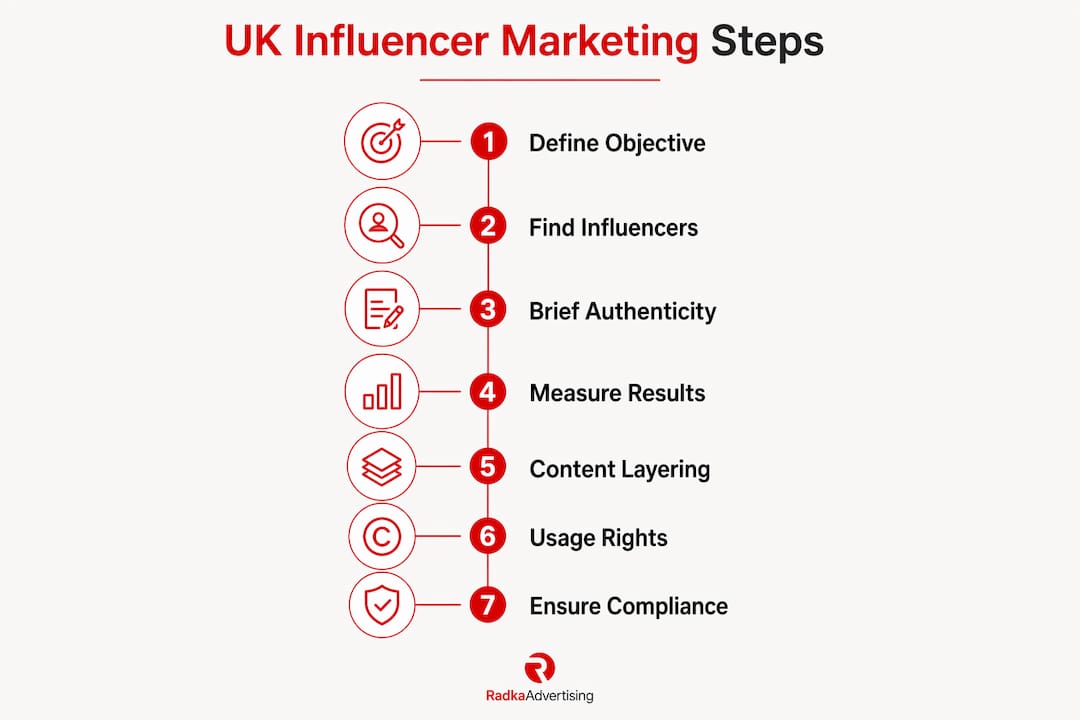
1. Define your objective before you brief anyone
Awareness, consideration, and conversion require different influencer types, different content formats, and different success metrics. A beauty brand launching a new product needs broad reach and visual impact, which points to macro or mega creators on Instagram. A SaaS brand targeting a niche B2B audience needs credibility and specificity, which points to micro creators on LinkedIn or YouTube.
2. Find influencers who genuinely fit your brand
Follower count is the last thing to check, not the first. Start with topic relevance, audience demographics, and content quality. Look at whether the creator actually engages with their community, responds to comments, and posts consistently. Tools like social listening platforms and creator marketplaces can surface candidates, but the final check should always be a manual review of recent content.
3. Brief for authenticity, not compliance
The brief should give the creator the facts they need (product benefits, key messages, mandatory disclosures) while leaving the storytelling entirely to them. Imperial College Business School research is clear that imposed scripts come across as inauthentic and artificial. The creator’s original voice is the asset you are paying for.
4. Build in measurement from day one
Every campaign should include tracked affiliate links or creator-specific discount codes so conversions can be attributed directly. A campaign involving 15–25 creators with tracked metrics can achieve measurable conversions at competitive cost per acquisition compared to paid search. Set up UTM parameters before the campaign goes live, not after.
5. Layer influencer content with other channels
Influencer content does not exist in isolation. Feed top-performing posts into paid social campaigns, embed creator reviews on product pages, and reference campaign themes in email sequences. This full-funnel approach multiplies the value of each piece of content without requiring additional production spend.
6. Negotiate usage rights upfront
Brands that secure content usage rights before the campaign launches can repurpose creator content across paid ads, email marketing, and product pages, effectively doubling ROI without extra production costs. Agree on the scope, duration, and channels for repurposing in the initial contract.
Pro Tip: Always include a disclosure clause in your influencer contract. Under ASA and CMA rules, both the brand and the creator share legal responsibility for ensuring sponsored content is clearly labelled. A contract that specifies exactly how and where disclosures must appear protects both parties.
7. Plan for compliance from the start
The ASA and CMA requirements are not a box to tick at the end. Build disclosure requirements into the brief, the contract, and the content approval process. More on this in the regulatory section below.
For a deeper look at influencer campaign strategies that drive measurable brand growth, the principles of long-term creator partnerships and performance attribution are worth studying before you brief your first campaign.
What are the UK rules on influencer marketing disclosures?
The UK has some of the clearest and most actively enforced influencer marketing regulations in the world. The ASA and CMA both have jurisdiction, and ignorance of the rules is not a defence for either brands or creators.
The core requirement is straightforward: any content where a creator has received payment, free products, a loan, or any other incentive in exchange for promotion must be clearly identified as an advertisement. The ASA and CMA mandate that labels such as #ad appear prominently, upfront, and in a way that consumers cannot miss. Burying a disclosure in a list of hashtags or placing it below a “more” fold does not meet the standard.
Both brands and influencers share legal responsibility for disclosure under UK consumer protection law and the CAP Code. That means a brand cannot simply instruct a creator to handle compliance and walk away. If the post breaches the rules, both parties face consequences.
Practical compliance checklist:
- Label all paid posts, gifted products, and affiliate arrangements as #ad or “Advertisement” at the start of the caption or video.
- Include disclosure obligations explicitly in every influencer contract.
- Review content before it goes live to confirm disclosures are present and visible.
- Apply the same rules to Stories, Reels, YouTube videos, podcasts, and any other format where a commercial relationship exists.
- Do not use vague labels like #collab, #spon, or #gifted as substitutes for #ad. The ASA has been explicit that these do not meet the transparency standard.
- Train your internal team on the rules, not just the influencers you work with.
Compliance is not just a legal obligation. Research from Imperial College Business School found that 96% of sponsored posts are not disclosed, and consumers who feel misled lose trust in both the influencer and the brand. Transparent disclosure, handled well, actually reinforces credibility rather than undermining it. Radkaadvertising’s terms and conditions reflect these disclosure standards as part of every campaign we plan.
How do you measure the ROI of an influencer campaign?
Measuring influencer marketing has moved well beyond counting likes. The channel now sits alongside paid search and programmatic display as a trackable acquisition tool, provided the measurement infrastructure is set up correctly from the start.
The most reliable approach combines three layers of attribution. First, creator-specific tracked links or discount codes tie individual conversions directly to the influencer who drove them. Second, UTM parameters in those links feed data into Google Analytics 4 or whichever analytics platform the brand uses, allowing session-level and conversion-level reporting. Third, post-campaign surveys or brand lift studies capture the awareness and sentiment shifts that click-based attribution misses.
Key metrics to track across a campaign:
- Reach and impressions for awareness-stage objectives.
- Engagement rate (likes, comments, saves, shares) as a proxy for content resonance.
- Click-through rate on tracked links to measure intent.
- Conversion rate and cost per acquisition for performance-focused campaigns.
- Earned media value to quantify the organic amplification the campaign generates beyond paid placements.
The shift to performance-based measurement also changes how budgets are allocated. Brands that treat influencer marketing as a measurable acquisition channel rather than a one-off brand exercise tend to secure stronger internal budget allocations because they can demonstrate returns in the same language as other digital channels. That operational discipline, involving tracked affiliate links, creator-specific codes, and analytic attribution, is what separates campaigns that scale from those that stay experimental.
What trends and challenges define the UK influencer market in 2026?
The UK influencer market is maturing fast, and that maturity brings both opportunity and friction. Several trends are reshaping how brands and creators work together this year.
The authenticity ceiling is real. Imperial College Business School research published in 2026 found that over a third of consumers believe influencers misrepresent themselves and the products they promote, and almost half think most influencers are fake. That scepticism is pushing brands toward longer-term partnerships with fewer creators rather than one-off posts with many. A creator who has worked with a brand for six months is far more credible than one who posts about it once.
Short-form video dominates discovery. TikTok and Instagram Reels have fundamentally changed how consumers find new products. The algorithm-driven discovery model means a micro creator’s video can reach millions of non-followers overnight, which changes the economics of reach entirely. Brands that have not yet built TikTok into their influencer strategy are missing the channel where Gen Z spends the most time.
Regulation is tightening. The ASA has increased enforcement activity, and the CMA has made clear that undisclosed paid promotions constitute a breach of consumer protection law. Brands that built their influencer programmes on informal gifting arrangements are now having to formalise contracts and disclosure processes.
AI-generated content is a growing concern. Synthetic influencers and AI-assisted content creation are entering the market, raising questions about authenticity that regulators have not yet fully addressed. For now, audiences still respond most strongly to real human voices and genuine experience.
Measurement expectations have risen. Marketing directors in the UK increasingly expect influencer campaigns to report against the same KPIs as paid media. Brands that cannot demonstrate cost per acquisition or return on ad spend from their influencer activity are finding it harder to justify the budget internally. The media coverage around performance-driven influencer campaigns reflects this shift across the industry.
Radkaadvertising brings your influencer strategy to life
Running influencer marketing well takes more than finding a creator with a large following. It takes a clear brief, the right creator match, airtight compliance, and a measurement framework that proves the spend. That is exactly where most brands hit a wall, and where Radkaadvertising steps in.
We are a London-based full-service advertising agency that builds and executes influencer campaigns as part of broader, data-driven brand strategies. We handle everything from creator identification and contract negotiation to content approval, ASA-compliant disclosure, and post-campaign attribution reporting. Our case studies include campaigns for clients across beauty, energy, and consumer goods, where influencer content was layered with paid social and SEO to drive full-funnel results. No guesswork, no one-off posts with no follow-through.
If you are ready to build an influencer programme that performs like a proper marketing channel, get in touch with us and let’s talk about what that looks like for your brand.
Key takeaways
Influencer marketing works when authenticity, measurement, and regulatory compliance are built into the strategy from the start, not added as afterthoughts.
| Point | Details |
|---|---|
| Authenticity drives results | Imperial College Business School research confirms that original creator voices outperform scripted brand content every time. |
| UK consumer influence | One in four UK adults are influenced by influencer marketing when making purchasing decisions, with this higher for Gen Z (84%) and Millennials (68%). |
| Disclosure is mandatory | The ASA and CMA require all paid partnerships to be labelled #ad, with both brands and creators sharing legal responsibility. |
| Measure like a performance channel | Tracked links, discount codes, and UTM parameters let you report cost per acquisition alongside paid search. |
| Radkaadvertising | A London-based full-service agency that plans, executes, and measures influencer campaigns with full ASA compliance. |
FAQ
What is influencer marketing in simple terms?
Influencer marketing is when a brand pays or incentivises a social media creator to promote its products or services to their audience. The creator’s existing trust with their followers is what makes the recommendation effective.
How do the ASA and CMA regulate influencer marketing in the UK?
The ASA and CMA require all paid or incentivised social media content to be clearly labelled as an advertisement using #ad or equivalent wording, placed prominently at the start of the post. Both the brand and the influencer share legal responsibility for compliance.
What types of influencers are there?
Influencers are typically grouped by follower count: nano (1,000–10,000), micro (10,000–100,000), macro (100,000–1 million), and mega or celebrity (1 million+). Each tier suits different campaign objectives, budgets, and audience targeting needs.
How do you measure the success of an influencer campaign?
The most reliable method combines creator-specific tracked links or discount codes with UTM parameters feeding into an analytics platform, allowing direct conversion attribution alongside engagement and reach metrics.
Why is authenticity so important in influencer marketing?
Research from Imperial College Business School found that consumers reject scripted or deceptive endorsements and trust influencers who engage genuinely with their communities. Authenticity is a collective outcome shaped by how well brand, creator, and audience priorities align.